Movies
Star turn makes excellent ‘Ripley’ a showcase for Andrew Scott
Reasserting the queerness of an author who boldly pushed boundaries
There’s something about an anti-hero that appeals to us all. Why else would so many of our greatest stories revolve around a character whose behavior goes against everything we’ve been raised to believe is right?
Actually, that question probably answers itself. For many of us, the things we are raised to accept about life in the human world often feel less acceptable once we’ve gone through a few years of adult experience, which tends to put us at odds with the so-called “norms” of conformity. Naturally, this can be frustrating from time to time – and while that might not be enough to make us go “rogue” without regard law or ethics, it’s certainly sufficient to fuel our guilty fantasies.
That, along with the literary skills of Patricia Highsmith, the queer novelist who created him, is why the character of Tom Ripley has been engrossing us in various forms for nearly 75 years. The eponymous anti-hero of “The Talented Mr. Ripley” (originally published in 1955) went on to feature in three additional books by Highsmith, and was subsequently brought to life in multiple small-and-big-screen incarnations, perhaps most prominently by Matt Damon in Anthony Minghella’s 1999 film adaptation. These versions managed to skirt the book’s obvious queer subtext, but queer audiences recognized it anyway. Now, thanks to creator, writer, and director Steve Zaillian, Highsmith’s starry-eyed sociopath has returned in an eight-episode series – which pares the title down to the short-but-evocative “Ripley” – that debuts on Netflix April 4, and portrays his adventures with an eye toward honoring Highsmith’s intent while delivering the kind of up-front queerness that the author could never have dreamed of accomplishing in her heyday.
Not that this “Ripley” is exactly “out and proud,” though the actor who plays him – Andrew Scott (“All of Us Strangers”) – certainly is. The acclaimed Irish thespian brings his own queerness to the table in illuminating a character whose survival depends on never calling attention to himself – and though the series moves the action ahead a few years to1960, it’s still a world where any hint of “deviance” is likely to draw suspicion. That’s the last thing Tom Ripley needs; he’s a con artist, the mid-20th-century equivalent of modern-day “phishing” scammers, grifting gullible marks from his squalid, one-room New York City apartment. He’s good at what he does, an anonymous figure hiding in a sea of strangers – but when a wealthy shipping magnate tracks him down with a request for help and the offer of an all-expenses-paid excursion to Italy, he sees it as an opportunity to change his life for the better.
That opportunity, as it turns out, involves a barely remembered college acquaintance named Dickie (Johnny Flynn), whose post-graduation trip to Europe has become a years-long vacation on the Mediterranean coast from which his father – Ripley’s surprise benefactor – would like him to return. Sent on a mission to convince his old schoolmate to go home, he is instead spellbound by the idyllic seaside setting and opulent lifestyle that surrounds him – and also by Dickie himself. He ingratiates himself into the young man’s life, winning his sympathies despite some initial awkwardness. Not so easily persuaded is Dickie’s girlfriend, Marge (Dakota Fanning), whose lingering distrust must be overcome if Ripley is to enact his new master plan to claim Dickie’s life of expatriate luxury as his own.
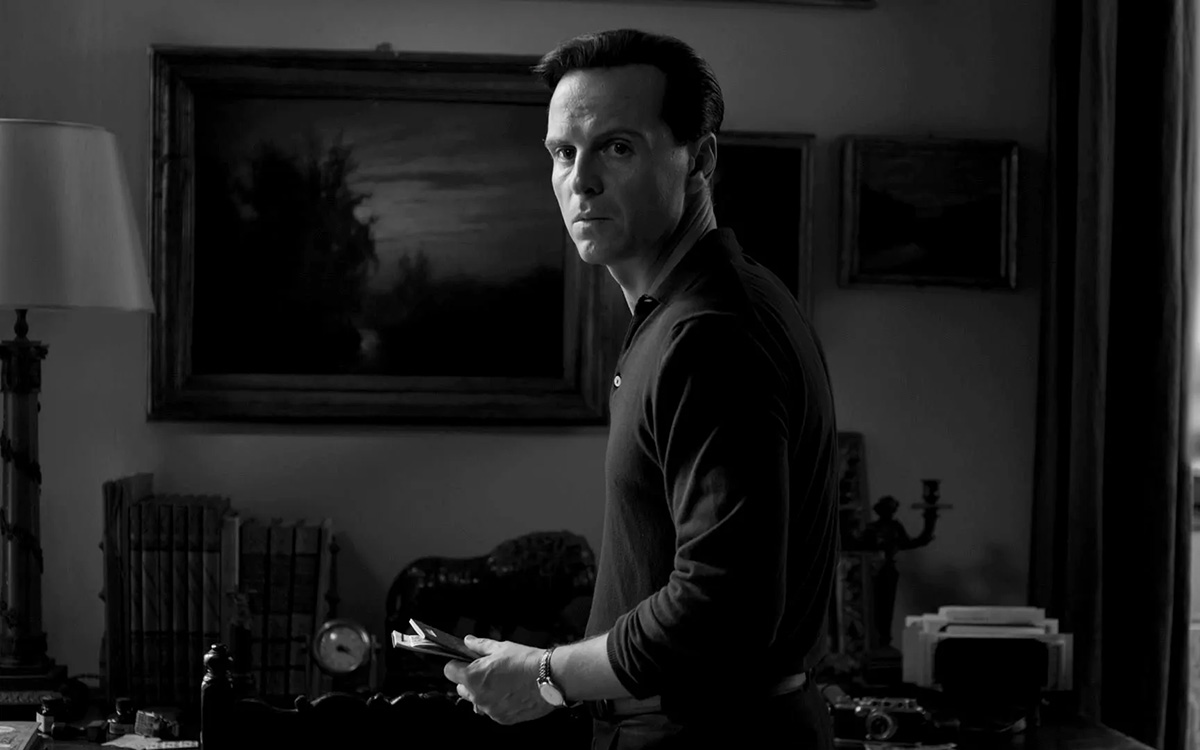
Thanks to its source’s relative familiarity, “Ripley” makes no effort to hide the fact that its anti-hero is a shady guy; we see from the start that he’s a liar and an opportunist. What Zaillian manages to do, unlike others who have adapted the novel, is move past a clinical focus on Ripley’s psychology to give us a less prosaic – and therefore more complex – interpretation of the character. Much of this comes from a script that echoes Highsmith’s hard-boiled style by framing the story (and its protagonist) in a shadowy, amoral universe, enhanced by the stylish black-and-white treatment delivered by Robert Elswit’s cinematography, which leans into both the paradigm-challenging Euro “art cinema” from the period of its setting and the gritty chiaroscuro contrasts of film noir, setting up an instinctual understanding that this narrative, like its visuals, is composed entirely in shades of gray.
In the show’s engrossing first episode, this is a particularly effective hook, style coupling with context to underscore the bleakness of Ripley’s daily routine in New York, which is no less soul-crushing, perhaps, than the more lawful ones into which most of us are locked. Though we see that he’s a predator, it’s hard not to relate to his struggle, and by the time we get to the next chapter and meet Dickie and Marge, we’ve already entered a mindset in which easy ethical judgments become unconvincing and shallow. Our sympathies are effectively split; we’re either on nobody’s side or on everyone’s, and maybe it’s a little bit of both.
Needless to say, perhaps, this tricky transference would not be possible without the presence of a consummate actor in the title role, and Scott fits the bill beyond expectation. Though at first he reads as a bit old for the character, that notion quickly disperses – indeed, his weathered features bespeak the effects of a hard-knock life, the kind that makes a person willing to do anything to break free. More crucially, the unmistakable authenticity of his inner life is communicated with exquisite precision, engaging our empathy even as we recoil from the Machiavellian logic that guides him, and the clear conflict between his not-so-hidden feelings for Dickie and the agenda to which he has committed is made all the more stark by the ring of queer truth that underpins the performance. It’s a tour-de-force turn by an actor whose skills become more breathtaking with each subsequent role.
Fanning, whose equally adept performance provides a powerful counterpoint to Scott’s, is a strong contender for our sympathies, by virtue as much of the intelligence she brings as the peril into which it will eventually put her, and Flynn’s Dickie wears the weight and damage of his upper class status like a chain he can never quite break, making us dread the seemingly inevitable fate that awaits him even as we subliminally sign on to Ripley’s endgame with a sense of guilty (but unapologetic) satisfaction. Also notable is nonbinary actor Eliot Summers (child of former Police frontman Sting), who brings another level of queer identity into the narrative as another old acquaintance of Dickie’s that throws an unwelcome wrench into the works of Ripley’s plan.
Based on its first two episodes, “Ripley” certainly lives up to the anticipation that naturally awaits any adaptation of a high-profile story, and reasserts the queerness of an author who boldly pushed boundaries as far as censors of her time would allow. That’s more than enough to warrant staying with it until the end – and, if audience numbers warrant a renewal, through additional installments that might chronicle the less well-known escapades spun in Highsmith’s sequels. What cinches the deal, though, is the masterful performance that takes centerstage, which represents yet another escalation – and well-deserved triumph – in the rise of the talented Mr. Scott.




Movies
Ethereal ‘Camp’ a moody allegory for queer shame
An unsentimental yet empathetic exploration of guilt

When one watches movies for a living, it’s as easy to fall into routine as it is with any job. Each movie is different, of course, each with its own characters, its own viewpoint, and its own story – (or at least its own variation on one), but in so many other ways, they have a tendency to be very much the same.
This is because there is an entire “language” of filmmaking, established from the earliest days of cinematic storytelling, a process so subtle that most of us are barely aware of it: the image directs our attention, the script provides the shape and structure of the story, and the actors are our stand-ins, allowing us to “experience” the reality of the film through a transference of identity that occurs so reflexively that we don’t even notice it’s happened.
That’s why it can be such a jolt when we come across a movie that doesn’t follow the expected rules, and we can’t think of a better recent example than Avalon Fast’s “Camp,” which drew attention as it made the rounds at last year’s festival circuit and embarked on a series of screenings in select cities beginning on June 26.
Fast, 26, is a queer Canadian filmmaker who specializes in “Girl Horror” (a genre that centers female experience), and who has already become a prominent force in the “new queer indie” movement. Her first feature, “Honeycomb,” got a Slamdance “virtual” screening, and she’s appeared as a performer in films like Alice Maio Mackay’s “The Serpent’s Skin” and leading trans filmmaker Jane Schoenbrun’s yet-to-be-released Cannes hit, “Teenage Sex and Death at Camp Miasma.” With “Camp,” however, she stakes her claim to territory in a burgeoning field of queer/trans/feminist cinema to establish herself as a formidable “brand” of her own.
Rooted in a blend of trope-ish horror conventions and presented in a dreamy, ethereal style that elevates feeling over cognition, it’s the story of Emily (Zola Grimmer), a young woman accidentally responsible for two horrific tragedies, who feels hopelessly trapped by guilt and shame. At the suggestion of her father (Mike Tan), she takes a summer job as a counselor at a camp for “troubled” young people like herself, where she is quickly embraced and assimilated by the core group of female counselors – most of them “hot weirdos” who are more interested in all-night partying and a kind of home-grown witchcraft than they are in the wholesome camp activities they supervise during the day. Her initial response to this new environment is guarded, but as the summer goes on she comes to feel a strong connection to her fellow counselors, beginning to hope that she has – at last – found her place among a “family” that accepts her despite the life-shattering incidents that have come to define her sense of self. Yet at the same time, she becomes ever more aware of a call to confront and quiet the ghosts of her misfortunate past – even if it requires an unthinkable sacrifice.
Dreamy and purposefully opaque when it comes to differentiating between real experience and metaphysical reflection, Fast’s movie draws us in from the start with its edgy mix of visual atmosphere, blending an aesthetic that combines home-movie nostalgia with the ironically whimsical flourishes of the digital age to establish a tone that feels like a half-forgotten memory reconstructed in the form of an Instagram “reel.” It’s a potent effect, creating a milieu of surreal impressionism in which the plot advances more through mood and fragments of subjective experience than through concrete narrative form; at times, it feels untethered, yes, but it always manages to orchestrate its seemingly disjointed perspective into a shape that makes sense — even if we’re not quite sure how or why, or even what is actually happening.
The effect is cumulative, as the story becomes less bound to logic and realism while leaning further into a perspective that favors the arcane and mysterious over the rational and concrete. And while that might prove frustrating for viewers expecting a more traditional kind of “horror,” it provides for an experience that’s more likely to satisfy the kind of fans who appreciate being left to provide their own interpretations. The most obvious comparison would be with the work of David Lynch; there’s clearly an influence there for Fast’s darkly intuitive approach, which goes beyond the obvious parallels of its “Twin Peaks”-ish setting (the forest is most definitely a character here) to emulate the stream-of-consciousness narrative flow that marked much of Lynch’s late-career work.
“Camp” is far from imitative, however. While it may share some traits with the work of Lynch and other masters of contemporary surreal horror, it creates a unique “vibe” by allowing its own creative feminine energy to take the lead. The traumas it depicts spring from a definitively female space, from first-menstruation nightmares to the absurdities of having to defer to the “leadership” of a mediocre male who has more power than you (in this case, Austyn Van de Kamp as the camp’s supervisor, a naive but endearing yokel whose Jesus-centric worldview is undermined by the “coven” under his tentative command), and the overall treatment of its few male characters is largely less than forgiving. Yet on a deeper level, its subtext of carrying “unforgivable sin” that affects every aspect of one’s interactive life feels ultimately as much an expression of queer trauma as it does feminist ideology. The result is just cryptic enough to leave us pondering what we’ve just seen yet clear enough to deliver an emotional catharsis which feels, if not exactly curative, at least healing enough to pave a way forward.
Admittedly, it’s not a film that will likely tick off all the boxes for hardcore horror fans; while it might deal in dark emotions and a certain witchiness that ties it to the legacy of such pagan-flavored classics as “The Wicker Man” or “Midsommar,” its terrors are more existential than visceral, pondering the difficulties of overcoming self-hatred rather than pitting us against a palpable physical threat, supernatural or otherwise. Indeed, it’s more introspective psychodrama than it is traditional horror – which is less a criticism than it is a disclaimer.
Though it’s Fast’s moody aesthetic that emerges as the “star” attraction of “Camp,” much of its effectiveness hinges on the performances of its cast. Grimmer, especially, is central, and she succeeds admirably not only in winning our empathy but in peeling back the morally murky layers of Emily’s path to redemption in a way that feels like empowerment rather than ethical compromise. However, the ensemble of “soul sisters” that surrounds her (Alice Wordsworth, Cherry Moore, Ella Reece, Lea Rose Sebastianis, and Sophie Bawks-Smith) all play their own particular part in creating the “magic” that makes the whole thing work.
All in all, “Camp” is an exhilaratingly fresh – if sometimes opaque – expression of queer filmmaking from a feminine perspective; that’s a regrettably rare occurrence which makes Fast’s fastidiously unsentimental (yet deeply empathetic) exploration of queer guilt all the more powerful, and makes her movie an essential addition to your watchlist.
Movies
‘Leviticus’ demonizes homophobia for gripping queer horror yarn
A genuinely engaging and terrifying supernatural drama
There’s something about horror films that makes them particularly apt as a vehicle for allegory. Vampires, zombies, ghosts, or seemingly death-proof serial killers can all easily be seen as metaphors for some lurking threat from the “dark side” of our own collective psyche, and stories about them are almost always cautionary tales that remind us that it’s the “dark side” of our own nature that we must confront in order for the danger to be eliminated.
This subtext has always been present in the genre, of course; but with the so-called “renaissance” of horror cinema that has taken place across the past decade or so, modern filmmakers in the genre have made increasingly bold choices with regard to how “sub” it is. “Get Out” or “Sinners” need no explanation to get across their allegorical points about racism, nor does “The Substance” require an expert to recognize its satirical observations about the toxic cultural obsession with youth and beauty. These are movies that wear their proverbial hearts on their sleeves, instead of masking them behind layers of cliched and “coded” plot tropes.
The same can definitely be said of “Leviticus,” the debut feature from Australian writer/director Adrian Chiarella, which not only hinges on a conceit that has obvious associations with its not-so-hidden themes but tips off the whole thing by its very choice of title – a reference to the Old Testament book frequently cited by fundamentalist bigots as so-called proof of God’s condemnation of homosexuality, which sets up exactly what we are in for before the opening credits even begin to roll.
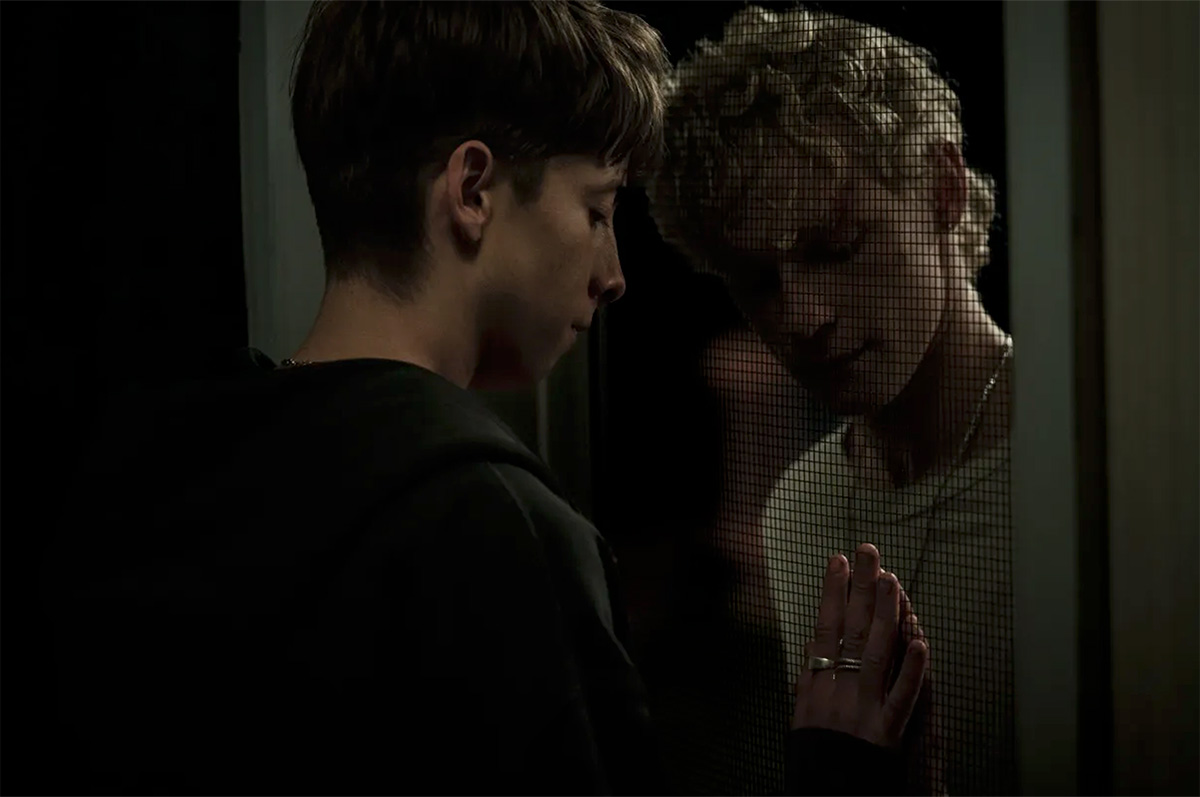
Set in a conservative rural town (in the Australian state of Victoria, though it will feel distinctly familiar to anyone who grew up in similar communities anywhere else in the world), it centers on Naim (Joe Bird), a teen boy newly transplanted by his mother (Mia Wasikowska) – who has ties to a fundamentalist Christian enclave there – after the death of his father. Their new life – like seemingly everything else in the community – is tied directly to the church, which makes it doubly inconvenient when Ryan (Stacy Clausen), son of the town’s presiding preacher, invites him for an after-school “hangout” which leads to a furtive make-out session in the town’s deserted mill.
Though the boys promise each other to keep it secret, they are both soon “outed” to their parents and subjected to a ritual performed by a mysterious “deliverance healer” (Nicholas Hope), intended to “protect” them from their “sinful” impulses. Soon after, a series of mysterious and violent encounters lead them to investigate local rumors around incidents involving other local teens – and the revelation that the ritual has summoned a malevolent entity, which appears to them as the person they are most attracted to (in this case, each other) and unleashes its murderous wrath when they give in to temptation. Their only chance of staying safe is to stay apart – unless they can find a way to defeat the supernatural force that has been turned loose against them.
Yes, it’s all very obvious. There is no attempt to mask what Chiarella’s movie is really about, though the word itself – like the biblical book with which it shares a title – is never spoken aloud in the film. It’s hardly a spoiler, though, to confirm that “Leviticus” is a story about homophobia. From its obvious evocation of real-life “conversion therapy” to its more subtle exploration of the secrecy and social shaming that surrounds same-sex love for so many teens growing up in an environment of fundamentalist religious tradition, every nuance of the film’s ingenious premise announces the clear intent of its messaging: homophobia is the true evil at work here, and its deadly power lies in its ability to make queer people afraid of being who they are.
While some might argue that presenting such an “on the nose” allegory in what is ostensibly “just” a horror film is a heavy-handed choice, we suggest – in this case, at least – that it’s exactly what makes the movie work so effectively.
From the very first scenes (after a prologue that ominously hints at the arcane evil that will soon come into play), we are invested in Naim and Ryan, whose tentative-but-joyous afternoon tryst is bound to trigger our own individual memories of adolescent sexual awakening, and whom we hope will be able to navigate their way through to the other side – even before the introduction of supernatural hate demons being summoned to kill them by using their own feelings for each other as a trap. They’re almost a definitive queer “coming of age” archetype, echoing generations of treasured “first time” memories and “what if“ fantasies about what might have been; we want them to be together, to overcome the otherworldly forces deployed to keep them apart – and when their romance is distorted, inverting their natural attraction into fear and mistrust, it’s their own inability to resist the pull they feel toward each other that continues to put them in danger.
That emotional stake is the anchor of “Leviticus,” which lends an imperative to what might otherwise be a campy B-movie thriller and turns it into a genuinely engaging – and therefore terrifying – supernatural drama that is all the more powerful for playing to our hearts. Much of this effect hinges on the chemistry between its two young stars (which hits just the right pitch between irresistible hormonal urge and inseparable soul connection), but it’s also underscored by the irony of their being immersed within a culture that would rather destroy them than allow them to exist outside its traditional norms.
Nevertheless, while “Leviticus” succeeds by making us identify with its cult-crossed teenage lovers, it pays off by delivering not just a genuinely unsettling, profoundly disturbing, and unflinchingly brutal personification of religious bigotry at its most cruelly hateful, but by providing a tense and terrifying horror scenario that works on a pure “genre” level. Simply put, even setting aside any wider subtext about the deadly consequences of homophobia, it’s a creepy, nerve-wracking ride.
A critical hit as part of the Sundance Festival’s “Midnight” section earlier this year, “Leviticus” went into theatrical release on June 19, the latest in a continuing trend of fresh and inventive films that has elevated the horror movie to new levels of critical appreciation. For us, it’s worth singling out as a boldly original expression of queer experience, elegantly constructed from the reinterpreted formulas of a genre that has always had particular draw for those in our community who knew how to read between the lines.
The difference is, this time we don’t have to – the message is spelled out loud and clear, and that in itself is enough to make it feel a little bit like empowerment, at a time when we could all use as much of it as we can get.
Movies
‘Stop! That! Train!’ is made for fans, but fun for all
RuPaul stars as President Gagwell trying to avert a tragedy

Before I can begin a review of “Stop! That! Train!” (the movie that’s been algorithmically dominating your queer social media feed in the form of ads for weeks now), I feel it’s necessary to provide a disclaimer: I am not a superfan of “RuPaul’s Drag Race.”
That doesn’t mean I’m NOT a fan, mind you. I’m just disclosing that I have never been the loyal viewer for whom each new episode is the highlight of the week, or followed the careers of the contestants I loved the most; I don’t know who won each season, or how many times they’ve been on the show. I barely even know any of the catch phrases. I say all this because you should know that, as someone who didn’t get any of the show references I’ve been told were laced throughout the movie, I’m probably not the person RuPaul and filmmaker Adam Shankman had in mind when they were making it.
I do, however, respect and adore the art of drag, not just as an expression of queer identity tied to a long tradition stretching back centuries, but as a powerful tool for satire. It’s a queer-eyed view that exposes the hypocritical norms and mainstream social “morality” in a form that goes right over the heads of anyone who isn’t in on the joke, and the Queens of “Drag Race” not only honor that tradition but live up to it. Make no mistake, the queer spirit of rebellion is alive and well in “Stop! That Train!” – even if it sometimes feels like it’s just along for the ride.
Mounted as a parody of old-school “disaster movies” – a genre that found its heyday in the same ‘70s and ‘80s period that also saw the success of classic movie spoofs like “Young Frankenstein” and “Airplane!” (which clearly serves as the primary blueprint) – Shankman’s film seems driven by an impulse toward the absurd as a kind of de facto social commentary, but puts the most emphasis on landing its jokes. It imagines a contemporary world where high-speed train travel is an actual thing in America (wouldn’t that be nice?) and a Black drag queen can be elected president (OK, maybe she’s a cisgender woman in context of the plot, but still), but in which everything is pretty much just as “off the rails” as it really is, anyway.
In the middle of it all are Tess and DeeDee (Ginger Minj and Jujubee, both popular “Drag Race” veterans), two “train stewardesses” who fake their way into jobs on the prestigious “Glamazonian Express” railway line and face hostility from the “mean girl” attendants who work there. The popularity contest soon takes a back seat, however, when the train finds itself speeding into a catastrophic “storm-o-ganza,” and they’re faced with the challenge of saving themselves – along with the train’s assortment of passengers – from all-but-certain doom. Fortunately, they’re not alone; under-appreciated train dispatcher Donna Dusk (Rachel Bloom) is doing her best to guide them from afar toward the least catastrophic outcome, and no less than American President Judy Gagwell (RuPaul Charles, of course) takes a personal interest in averting the disaster; after all, it could take a few points off of her popularity rating if she doesn’t. Can this plucky alliance of women-with-something-to-prove shepherd this runaway train (and everyone on board) to safety? Of course they can, and in the most ridiculous way possible.
Like the aforementioned “Airplane!” (the zany 1980 farce that was itself modeled after the popular “Airport” series of all-star disaster epics), “Stop! That! Train!” takes an approach to comedy that’s more like facing a high-speed pitching machine in a batting cage than watching a movie in a theater; it’s one joke after another, thrown rapid fire against the wall on the theory that at least some of them will stick – a time-honored tradition that, admittedly, results in a lot of them that don’t. For every belly laugh, there’s a real groaner, and a fair number of the chuckles are “polite” ones, at best; but that, of course, is part of the appeal. Screenwriters Christina Friel and Connor Wright skew their humor toward the lowbrow – something the popular drag movement fully embraces, anyway – and make most of their characters into clowns as they freely transplant plot points and tropes into their ludicrous scenario; all of it’s on purpose, and most of it works, because this is the kind of movie that is intended to be as “stupid” as possible and we wouldn’t want it any other way.
Of course, some viewers will inevitably be underwhelmed by the movie’s humor; its borrowed tropes may feel less funny for being too familiar, sometimes the “lowbrow” might edge too closely on the “tasteless,” and the overall spirit of “bitchiness” could easily come across as just plain “mean” if one is in the wrong mood. Let’s face it, though: most of those people will probably not be going to see “Stop! That! Train!,” anyway. For the rest of us, even if more of its jokes fall flat than we might hope and some of the zingers don’t have the “zing” that they should, there’s still a cumulative effect that leaves the impression of a whole being greater than its parts. After all, sometimes we just want to have brainless fun at the movies instead of having to think too much about it, and nobody was expecting an Oscar-winner, were they?
As for the disaster movie plot, it’s impossible to take seriously, of course, but it does provide the opportunity to showcase a lot of characters – and caricatures – along the way. Minj and Jujubee are essentially the stars of the show, and their easy chemistry together helps them carry the film; RuPaul, every inch the superstar as ever, strides confidently into his presidential role and rightfully dominates every scene that he’s in, yet is graceful enough not to overwhelm or overshadow the work of his co-stars, especially Matt Rogers, who, as President Gagwell’s possibly psychopathic press secretary and confidante, shares more screen time with him than anyone else.
Veteran comic actor (and “SNL” alumnus) Chris Parnell uses his hilariously deadpan lunacy to great advantage as the train’s conductor, and Brian Jordan Alvarez (“The English Teacher”) brings a smarmy charm as the co-conductor who doesn’t know how to operate a train – despite the questionable choice of using an exaggerated “Bill and Ted” era Keanu Reaves impression for his character’s voice. There’s a whole gallery of familiar faces on hand in bit parts and cameos as passengers on the train, who arguably provide more genuine comedy and interest than the main storyline. And even if she never sets foot on the train herself, Bloom (“Crazy Ex-Girlfriend”) is every bit on board for the ride, serving as a grounding force even as she gives herself over completely to the silliness.
And silly it certainly is. It’s as insubstantial as the AI-generated backgrounds used to create the action scenes of speeding train and the storm. And at the risk of repeating myself, we wouldn’t have it any other way.

As Washington shifts right, Democratic Socialists gain ground

Susan Stewart could make history as Rehoboth’s first openly gay mayor

Silky Nutmeg Ganache talks sex and dating, gender, politics, weight loss journey

Madonna roundup: Reviews, sales, and love for ‘Danceteria’

Three overlooked court rulings limited White House anti-trans policies

‘Transcendent’ a tough but important read

Under-the-radar Delaware beach towns smart buyers are targeting

‘My Favorite Sociopath’ debuts at Shepherdstown’s CATF

In Trump’s divided America, Michael Weinstein’s AHF responds