Maryland
Bethesda church hosts transgender, nonbinary photo exhibit
Photographer Gwen Andersen showcases community members of all ages, backgrounds

Amid the spate of anti-transgender legislation, the bullying of trans students and lack of gender-affirming care for young people across the country, photographer Gwen Andersen’s photo exhibit seeks to portray the trans and nonbinary community in a positive light.
Andersen’s “Becoming Ourselves” exhibit that documents trans and nonbinary people will be on display at the Bethesda United Church of Christ (10010 Fernwood Road) this summer.
Andersen spearheaded the exhibit along with the Rev. Dr. Jill McCrory from Bethesda UCC. The church paid for the project with a donation it received from Stevie Neal, a trans woman who passed away and left part of her estate to McCrory.
McCrory herself has been a pillar in the LGBTQ community for decades, including while pastor at Twinbrook Baptist Church.
The congregation that McCrory closed dispersed more than $1 million to various ministries and LGBTQ organizations, founded the MoCo Pride Center, and married a same-sex couple on the rainbow stage of Capital Pride in 2010. Bethesda UCC has also marked the Transgender Day of Remembrance, and hosted a renaming ceremony for a trans baptized member.
“I happen to have access to a wonderful transgender woman’s (Stevie) donation that she left me to do something for the transgender community,” said McCrory over a Zoom interview. “Andersen came to Rev. McCrory in November of 2023 with the idea. “Gwen knew Stevie. I thought this would be perfect because this is something that would benefit the transgender community.”
“WIthout Stevie, this surely would not have happened. And I say that with great confidence,” Andersen said in a Zoom interview.
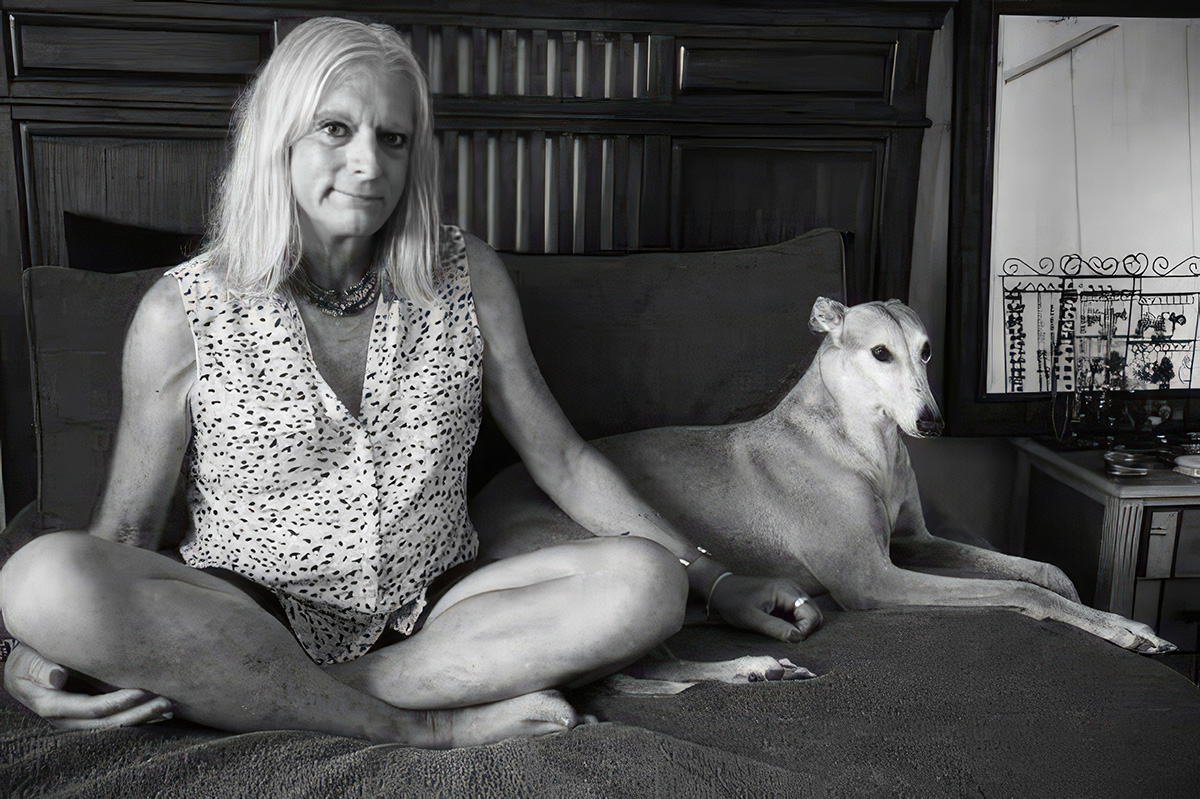
“Becoming Ourselves” debuted at the Unitarian Universalist Congregation of Rockville in March.
The exhibit features photos of trans and nonbinary people from across the country that Andersen and a number of other photographers took.
The photos feature people from all ages — from preteens to elders from all walks of life that include teachers, community leaders, and athletes. Andersen’s exhibit also showcases people who are proudly showing their top surgery scars. It also shows trans and nonbinary people in a variety of ways, from enjoying music, playing sports, and working.
The exhibit most importantly shows them being happy.
Anderson’s exhibit has two main goals: Give a space for trans and nonbinary people to see others in their community in a positive way, and to shift the narrative on how people see trans and nonbinary people.
“It was an emotional issue that won hearts and minds.” said Andersen in reference to the LGBTQ movement to legalize same-sex marriage. “I believe we will reduce the hostility against transgender people by winning hearts and minds.”
“One of the most effective messages is to protect trans kids,” she added. “Right now the hostility has not just gone against adults, it has gone against children, and children are being harassed, beaten up, and killing themselves. In much the same way as gays and lesbians were killing ourselves 30 years ago. I think what will be effective is tugging on hearts and minds and reclaiming the narrative from hate and fear, to love.”
Andersen wants to eventually get a more permanent location for the exhibit rather than bringing it to different venues. But until then, she plans to bring it to other churches that are interested in hosting it.
Anyone interested in supporting Andersen’s exhibit can log onto the “Becoming Ourselves” website, or directly help any of the photographers whose work is showcased. Andersen has directed folks to support photographer Liam Woods, whose online name is Analogue Papi.




Maryland
Md. groups receive state grants to fight hate crimes
Pride Center of Maryland among recipients

Maryland Gov. Wes Moore and the Governor’s Office of Crime Prevention and Policy are awarding a total of $10 million in grants in the 2027 fiscal year to nonprofit organizations that work to prevent hate crimes in the state.
The funds will be used to support those who feel targeted or discriminated against because of their race, religion, sexual orientation, gender identity, or disability status.
The Pride Center of Maryland is among the recipients. Churches, synagogues, mosques, and LGBTQ organizations are all eligible to receive grants
“The safety and security of all Marylanders is my top priority, so we are drawing a hard line because we have no tolerance for hate,” said Moore, according to media reports. “We are committed to protecting and ensuring safe and sacred spaces stay that way by investing in non-profit organizations, houses of worship, and community centers to protect and honor every community that makes our state so diverse and special.”
“Protection Against Hate Crime funding has strengthened the Pride Center of Maryland’s ability to protect, educate, and support the communities we serve … at a time of heightened concern associated with the Trump administration’s anti-LGBTQ/SGL (same-gender-loving) policies and pressures,” Pride Center of Maryland CEO Cleo Manago said. “PAHC funding helps us do more than improve physical security — it strengthens our community’s knowledge, preparedness, connection to resources, and ability to respond to hate with greater awareness and support.”
Maryland’s hate crimes law includes both sexual orientation and gender identity. The state’s nondiscrimination statute is also LGBTQ-inclusive.
Maryland
Anne Arundel schools now need parent permission to call trans students by preferred names
Conservative groups challenged system’s policy
By JESSICA CALEFATI | Anne Arundel County Public Schools staff cannot use transgender students’ preferred names if their parents oppose it, according to an internal document reviewed by the Banner, a change that comes after conservative groups challenged the school system’s approach to gender identity.
Teachers union president Kristina Korona told members in an Aug. 20 email that the new guidance undermines district policy on acceptance and inclusivity and “will begin harming affected students immediately.”
Previously, the district didn’t require parental permission to use a high school student’s chosen name and pronouns corresponding to their gender identity, the internal document says. Now it does. The change comes as parents challenge the suburban school system’s gender identity policy and regulation in court and the Trump-Vance administration threatens the district’s funding.
The rest of this article can be found on the Baltimore Banner’s website.
Maryland
Girlfriends charged with Silver Spring murder to go on trial in 2027
Prosecutors charged both women with killing mother of one of them

Two women identified as a couple who are charged with the May 22, 2026, murder of the mother one of them in her Silver Spring home and who were arrested three weeks later in Ohio are scheduled to go on trial for murder April 19, 2027.
According to online records filed with Montgomery County Circuit Court in Rockville, Vanessa Tjongarero-Henderson, 29, of Clarksburg, Md., and Samantha Raebel, 36, of Phoenix are being held without bond in the Montgomery County Correctional Facility until the time of their trial.
Statements from Montgomery County police show the two women were arrested June 10 in Genoa, Ohio, after fleeing from the scene of the murder in Silver Spring. Police statements and court records show they were extradited back to Maryland in July, where prosecutors with the Montgomery County State’s Attorney’s Office obtained indictments against them for murder.
Earlier statements from Montgomery County police say their investigation into the murder led to their decision to initially charge the two women with first-degree murder for the death of Hilde Henderson, 67, who was Tjongarero-Henderson’s mother.
“Through the course of the investigation, detectives identified Henderson’s daughter, Vanessa Tjongarero-Henderson, and Vanessa’s girlfriend, Raebel, as the suspects,” one of the police statements says. It says police obtained arrest warrants for both women and launched a nationwide search seeking help from the public in in locating them.
One of the police statements says an autopsy determined the cause of Hilde Henderson’s death was blunt-force trauma injuries brought about by a murder. Police and the State’s Attorney’s Office, which is prosecuting the case, have yet to disclose whether they have determined a motive for the murder.
Court records show that prior to the start of the April 19, 2027, trial a “motion” hearing was scheduled for Oct. 30, 2026, a pre-trail conference was scheduled for Feb. 12, 2027, and another motion hearing and a status hearing were scheduled for March 12, 2027.
Court records also show that Tjongarero-Henderson is being represented by attorneys with the Montgomery County court system’s public defender service. The records show that Raebel initially had been represented by a public defender service attorney, but updated records show Aug. 14 is listed as the “removal date” for that attorney.
The docket shows that on Aug. 20, two new attorneys with the prominent D.C. law firm of Covington & Burling made their official appearance as her attorneys in the murder case. One of them, Daniel Solomon, told the Washington Blade in response to an inquiry that the defense has no comment at this time on the case.
He confirmed that Covington & Burling is representing Raebel on a no-cost, pro bono bass.
The office of the Montgomery County public defender service didn’t immediately respond to a phone message from the Blade asking for a comment on the Tjongarero-Henderson case.

House Democrats urge White House to confront Turkish government over anti-LGBTQ crackdown

988 restores crisis services for LGBTQ youth

To school to homeschool to school again

Ryan Murphy’s ‘Monster’ vilifies the lesbian

The right to be an ordinary transgender man

PHOTOS: HRC National Dinner

The LGBTQ real estate map is being redrawn

Factors to consider when hiring an interior designer

Dr. Fauci ‘honored to be part of’ LGBTQ history