Federal Government
LGBTQ federal workers face growing strain, fear of backsliding rights
Government shutdown began on Oct. 1
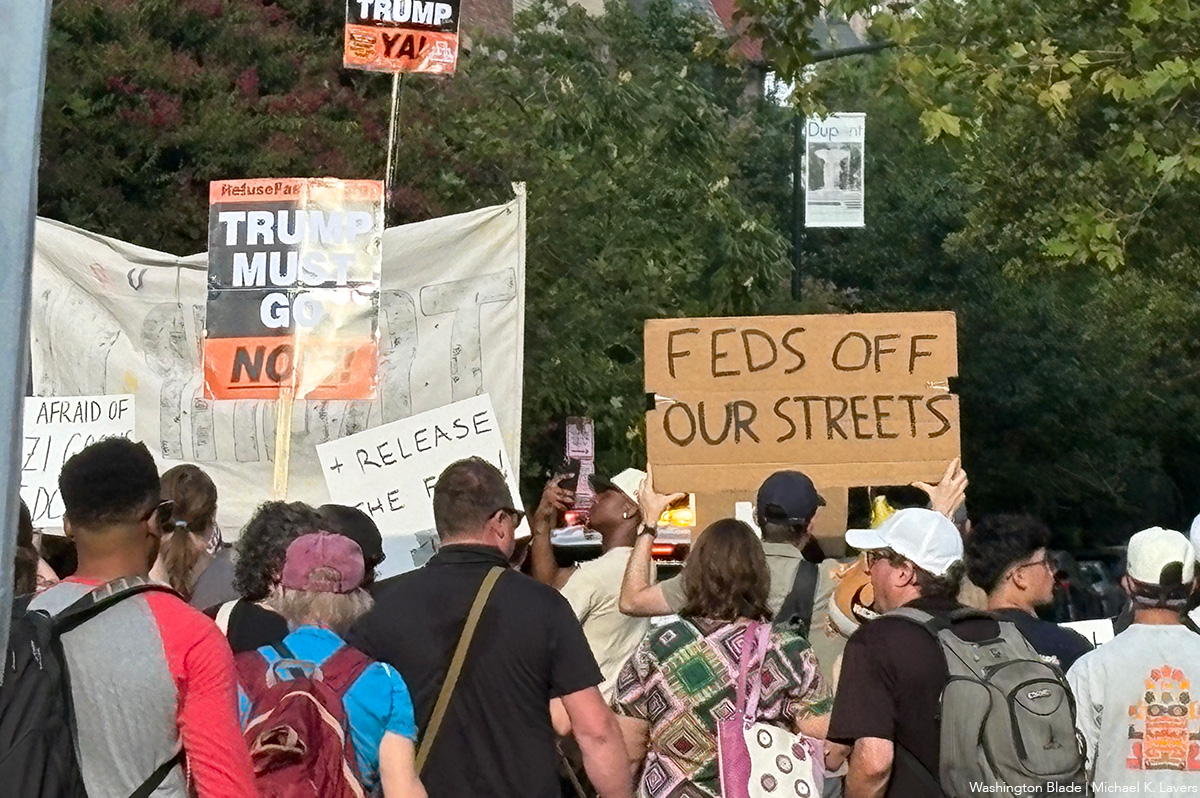
The federal government has been shut down since Oct. 1, marking the second-longest shutdown in American history. This is the third government shutdown under a Trump presidency.
Government shutdowns have become a somewhat normalized part of American governance. Their circumstances often vary, but the solution is always the same: Congress must appropriate the funding for the federal government.
At the heart of the current shutdown is a disagreement over healthcare: Democrats want to extend Medicaid and Affordable Care Act subsidies granted during COVID-19, while Republicans, with the Trump-Vance administration at the helm, argue these subsidies should expire to save money. The standoff has left millions at risk of losing coverage because they otherwise won’t be able to afford it.
As Congress fails to reach a decision on healthcare, roughly 4.5 million paychecks will be withheld from federal civilian employees. Additionally, 1.3 million active-duty personnel and over 750,000 National Guard and Reserve members are required to serve, potentially without pay, according to an Oct. 24 study by the Bipartisan Policy Center.
The Washington Blade spoke with two LGBTQ federal employees from different parts of the government to understand how the shutdown has disrupted their lives and added stress to an already uncertain future.
Both sources spoke on the condition of anonymity, citing fear of retribution amid the current political climate surrounding federal employment and their sexuality. For LGBTQ federal employees, the stakes are often higher, as they must navigate not only financial and professional uncertainty but also a political environment that can threaten hard-won rights and recognition.
The first federal employee with whom the Blade spoke described the difficulty of focusing on work amid the chaos.
“I feel like I expected a certain amount of crazy with the shutdown, but I wasn’t quite ready for, as Steve Bannon said, ‘the muzzle velocity of all this’ — just how quickly they would implement things across the board,” they said. “That’s made it really hard to focus on any one issue, and I think even trans issues almost get buried under all the other things happening.”
They noted that the current shutdown differs from previous ones, in part because of the sheer number of concurrent crises and the quiet targeting of LGBTQ-related programs.
“Even the last shutdown felt huge, it galvanized the news, but this time there are so many other critical things happening at the same time — ICE kidnapping people, the Epstein files, changes in the LGBT space,” they said. “A lot of it happens quietly, under the radar, and it’s troubling.”
The employee also raised concerns about the slow erosion of government services and oversight, particularly in ways that affect LGBTQ representation and history.
“It’s scary how quickly some government agencies can be stripped of their oversight and history. Like the National Park Service scrubbing things off the Stonewall historic marker, or LGBT references from museum exhibits in the Smithsonian, or kicking drag queens and Pride events from the Kennedy Center,” they said. “I feel like there are so many things that would have been huge stories, but just because of how fast everything has happened, it’s allowed a lot of stuff to happen quietly under the radar that’s pretty troubling.”
Despite these challenges, they emphasized the dedication of federal workers, many of whom choose public service over higher-paying private-sector jobs.
“One of the coolest things about D.C. is meeting people who were top of their class, who could have gone into business for themselves, but instead chose to give back and do work that has an impact on the country,” they said. “There are so many people quietly doing fascinating, important work, and they want to keep doing that.”
The employee expressed frustration over the broken budget system, which adds to the instability of federal employment.
“The budgeting system is broken. No other country operates the way we do, and it creates constant uncertainty for federal workers,” they said. “If budgets continued automatically unless changed, we could plan multi-year projects and make government work more effectively.”
Despite the challenges, they stressed that federal workers’ contributions benefit real people, often in ways that go unnoticed.
“Most federal workers do not want to be the story. We want the story to be about real people whose lives are better because of our work. Even during a shutdown, the focus should not be on us, but on the services we provide and the impact we make,” they said.
The Blade also spoke with a second federal employee, who works with the military. They highlighted the personal and financial pressures that accompany a furlough.
“I’ve always worked with the military, and I don’t have a sense of purpose being here without my job … I also need my paycheck, obviously,” they said.
They described the toll the shutdown is taking on mental health — specifically the anxiety over housing costs and the uncertainty of back pay.
“I bought a house, and now I have a mortgage to pay, and I can’t pay it. This is my source of income. I got three months of forbearance on my mortgage, which is a huge relief, because that’s probably my biggest bill,” they said.
Being part of the LGBTQ community has offered some support — particularly from smaller groups and businesses providing free or reduced-cost meals, events, and drinks to federal employees. Many LGBTQ bars and restaurants have begun offering free drink hours in response to the shutdown, including Crush, Shaw’s Tavern, and Shakers. These discounts provide a few moments of relief, the first federal employee explained, but they don’t fully shield workers from the pressures of a shutdown.
“As an out gay federal employee, there’s a broad network of support within the LGBTQ community … I have access to those networks, and I might be better off than my straight counterparts because of that,” they said.
The second federal employee also voiced concern about political bargaining over federal pay and protections.
“It’s troubling to see lawyers in the administration argue that we may not be entitled to back pay, when we are guaranteed this by law,” they said. “I would like to see them not use our pay and our livelihoods as a bargaining chip for their political agenda.”
Reflecting on the broader implications, the employee tied the shutdown to historical challenges for LGBTQ people in federal service.
“I joined the military after ‘Don’t Ask, Don’t Tell,’ and now serve as a civilian in the same military … I’ve seen LGBT rights advance a lot in my lifetime,” they said. “I would hate to see that backslide and feel like I have to be concerned in my position … because of my sexuality.”
Another factor complicating the shutdown is the optics — both the visuals and rhetoric coming from the White House.
The Trump-Vance administration continues to push the narrative that Democrats alone are to blame, rather than acknowledging the broader lack of bipartisan cooperation. Coupled with the White House’s visible efforts to renovate and upgrade the presidential living quarters, it all carries a certain “let them eat cake” undertone.
“It’s heartbreaking to see the East Wing being demolished so quickly without process or public input, while other government workers are furloughed,” the second federal employee with whom the Blade spoke said. “It makes the White House feel like a commodity for sale, and it’s demoralizing for those who maintain it.”
“Seeing bulldozers funded by corporations plow through the White House grounds while National Park Service employees are furloughed is demoralizing,” they added. “It’s a very visual metaphor for what’s happening across the government: those entrusted to maintain it are out of work, while other interests move forward unchecked.”
They continued, explaining that unity — not division — is needed to do the type of work millions of federal employees perform every day.
“I can’t always tell who among my colleagues is conservative or liberal, and honestly, most people just want the government to work efficiently. Even conservatives, when they see potential improvements, want the government to deliver,” they said. “It’s the follow-through that really matters — the thousands of people slogging away doing the actual work.”



Federal Government
Markwayne Mullin confirmed as next DHS secretary
Okla. senator to succeed Kristi Noem
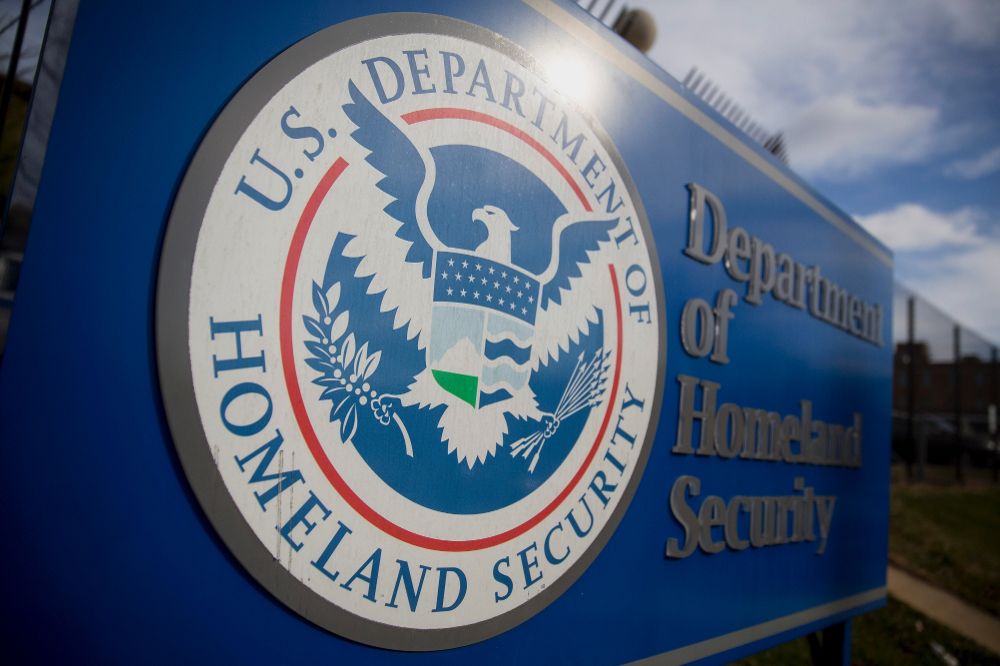
The U.S. Senate confirmed Markwayne Mullin as the next secretary of Homeland Security on Monday, as the agency continues to grapple with what lawmakers have described as a “never-ending” funding standoff, with Democrats attempting to withhold funding from one of the nation’s largest and most costly agencies.
Mullin — a Republican senator from Oklahoma, former mixed martial arts fighter, and plumbing business owner — was confirmed in a 54–45 vote. Two Democrats — U.S. Sens. John Fetterman (D-Pa.) and Martin Heinrich (D-N.M.) — sided with Republicans in supporting his confirmation.
The new agency head is expected to follow the policy direction set by President Donald Trump, emphasizing stricter immigration enforcement. This includes proposals to support immigration agents at polling sites and to cut funding to so-called “sanctuary cities.”
Mullin replaces Kristi Noem, who was fired earlier this month following a widely scrutinized 2-day congressional hearing on Capitol Hill.
During the hearing, Noem faced intense questioning over her response to several crises, including the fatal shooting of two American citizens in Minneapolis by U.S. Immigration and Customs Enforcement agents, a $220 million border security advertising campaign that featured her on horseback near Mount Rushmore amid one of the largest federal workforce reductions in U.S. history, and the federal response to major natural disasters such as the July 2025 Texas floods and Hurricane Helene in 2024.
Noem had previously drawn criticism for a series of policy decisions in South Dakota that broadly focused on restricting the rights of LGBTQ individuals. In 2023, she signed House Bill 1080, banning gender-affirming medical care for transgender minors. She also signed legislation and executive orders restricting trans athletes’ participation in women’s sports, as well as the state’s “Religious Freedom Restoration Act,” which critics argued enabled discrimination against LGBTQ individuals. Additionally, the state canceled contracts related to LGBTQ support services — including suicide prevention and health care navigation programs‚ and later agreed to a $300,000 settlement with trans advocacy group, The Transformation Project.
Despite her removal from DHS, Noem will remain in the Trump-Vance administration as a special envoy for the “Shield of the Americas,” an initiative aimed at promoting U.S. influence in the Western Hemisphere, including efforts to counter cartel networks, reduce Chinese influence, and manage migration.
The new head of DHS has served in Congress since 2013, in both houses of the federal legislature. While in the Senate and a member of the Health, Education, Labor, and Pensions (HELP) Committee, Mullin has been a vocal critic of policies aimed at expanding LGBTQ inclusion. He led a group of lawmakers in urging the Administration for Community Living to reverse a rule requiring states to prioritize Older Americans Act services based on sexual orientation and gender identity, arguing the policy could have unintended consequences.
Mullin also makes history as the first Native American — and a citizen of the Cherokee Nation — to lead the Department of Homeland Security. He was also among the 147 Republicans who voted to overturn the 2020 presidential election results despite no evidence of widespread fraud, and was present in the U.S. House of Representatives chamber on Jan. 6.
Federal Government
Protesters say SAVE Act targets voters, transgender youth
Bill described as ‘Jim Crow 2.0’
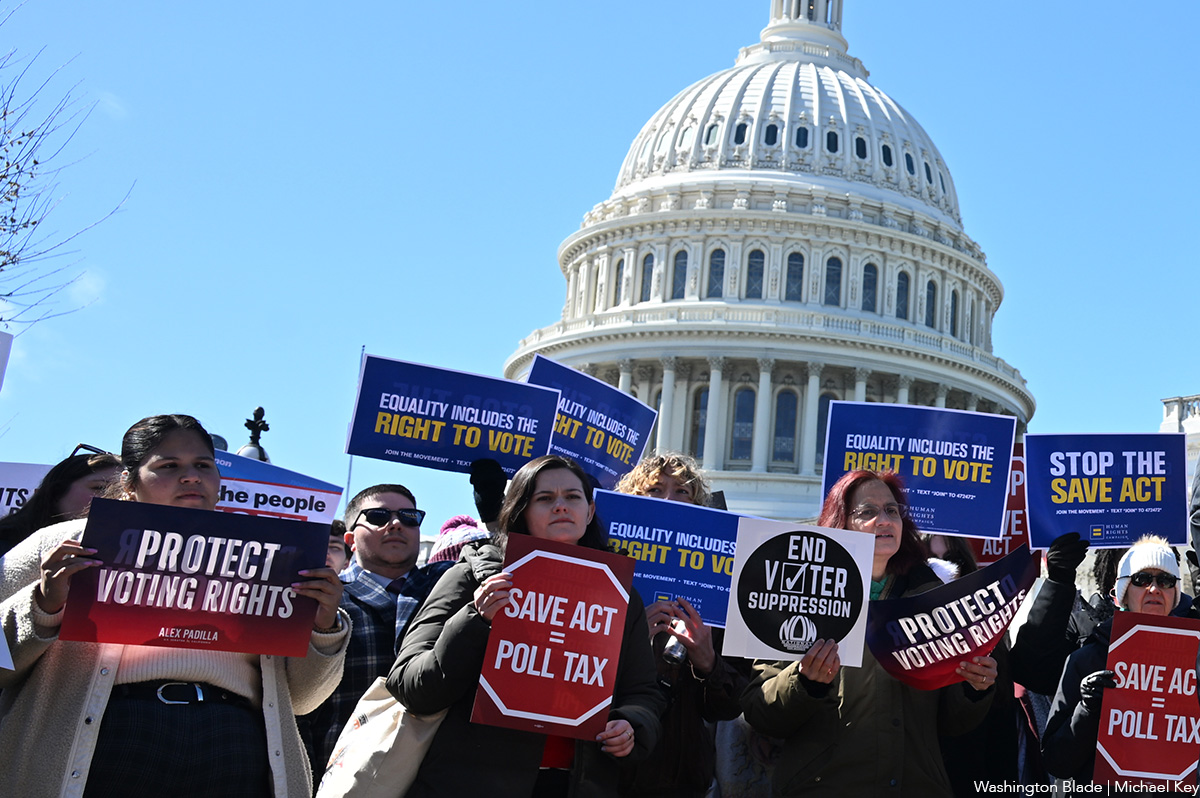
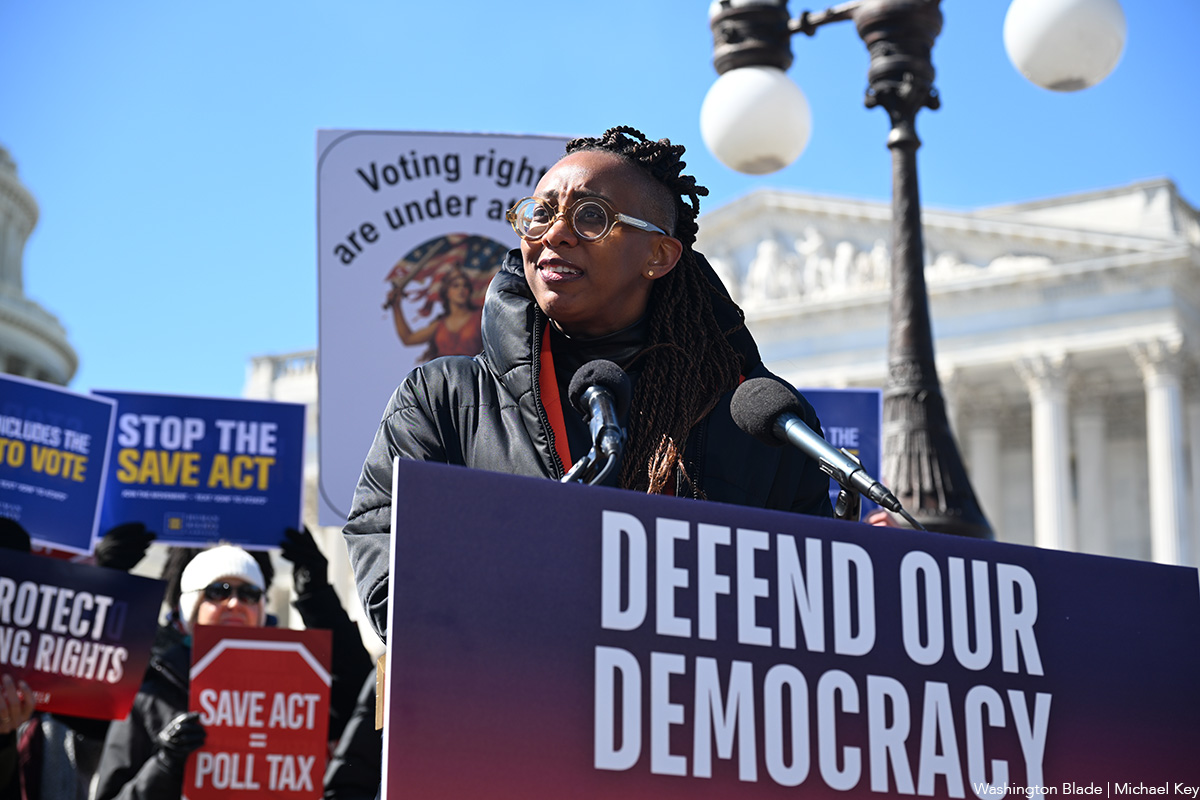
Members of Congress, advocates, and people from across the country gathered outside the U.S. Capitol on Tuesday to protest proposed federal legislation that voting rights activists have deemed “Jim Crow 2.0.”
The Safeguard American Voter Eligibility (SAVE) Act would amend the National Voter Registration Act of 1993 to require in-person proof of citizenship for anyone seeking to vote in U.S. elections.
President Donald Trump has also pushed for the proposed legislation to include a section that would ban gender-affirming medical care for transgender minors, even with parental consent, and prohibit trans people from participating in school or professional sports consistent with their gender identity rather than their sex assigned at birth.
In addition to changing voter registration requirements, the bill would limit acceptable forms of identification to documents such as a birth certificate or passport — records that the Brennan Center for Justice estimates more than 21 million Americans do not have — effectively restricting access to the ballot. It would also ban online voter registration, DMV voter registration efforts, and mail-in voter registration.
A 2021 investigation by the Associated Press found that fewer than 475 people voted illegally or improperly, a tiny fraction of the estimated 160 million Americans who voted in the 2020 election.
Senate Minority Leader Chuck Schumer (D-N.Y.) spoke at the event.
“It will kick millions of American citizens off the rolls. And they don’t even require you to be told,” the highest-ranking Democrat in the Senate told protesters and reporters outside the Capitol. “If this law passes — and it won’t — you’re gonna show up in November … and they’ll say… sorry, you’re no longer on the voting rolls.”
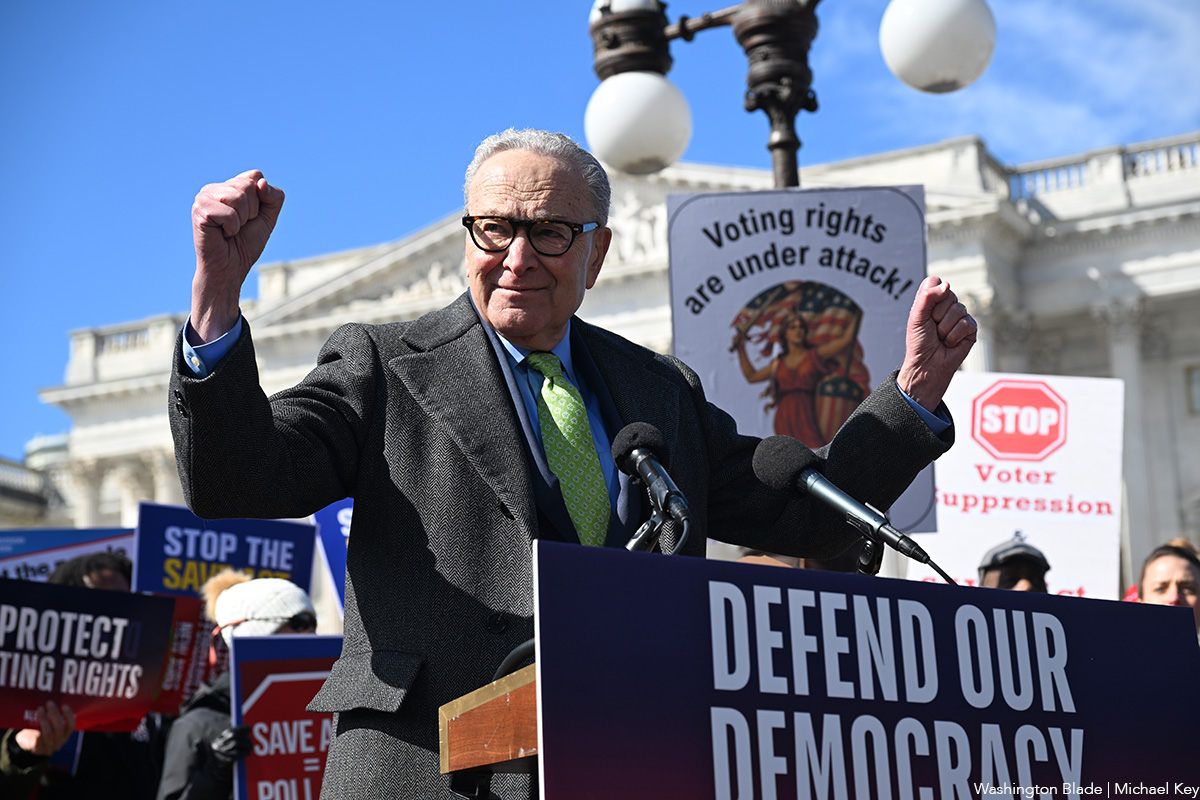
He, like many other speakers, emphasized the bill in the context of American history, pointing to what he described as its racist roots and its impact on Black and brown Americans.
“I have called this act, over and over again, Jim Crow 2.0 … because they know it’s the truth.”
U.S. Sen. Alex Padilla (D-Calif.) was one of the lawmakers leading opposition to the legislation and spoke at the rally.
“It’s not just voting rights that are on the line — our democracy is on the line,” the California lawmaker said. “It’s not a voter I.D. bill. It’s a bait and switch bill.”
He added historical context, noting the significance of voting rights legislation passed more than 60 years ago. In 1965, Alabama civil rights activists marched to protest barriers to voter registration. Alabama state troopers violently attacked peaceful demonstrators at the Edmund Pettus Bridge in Selma, using tear gas, clubs, and whips against more than 500 — mostly Black — protesters.
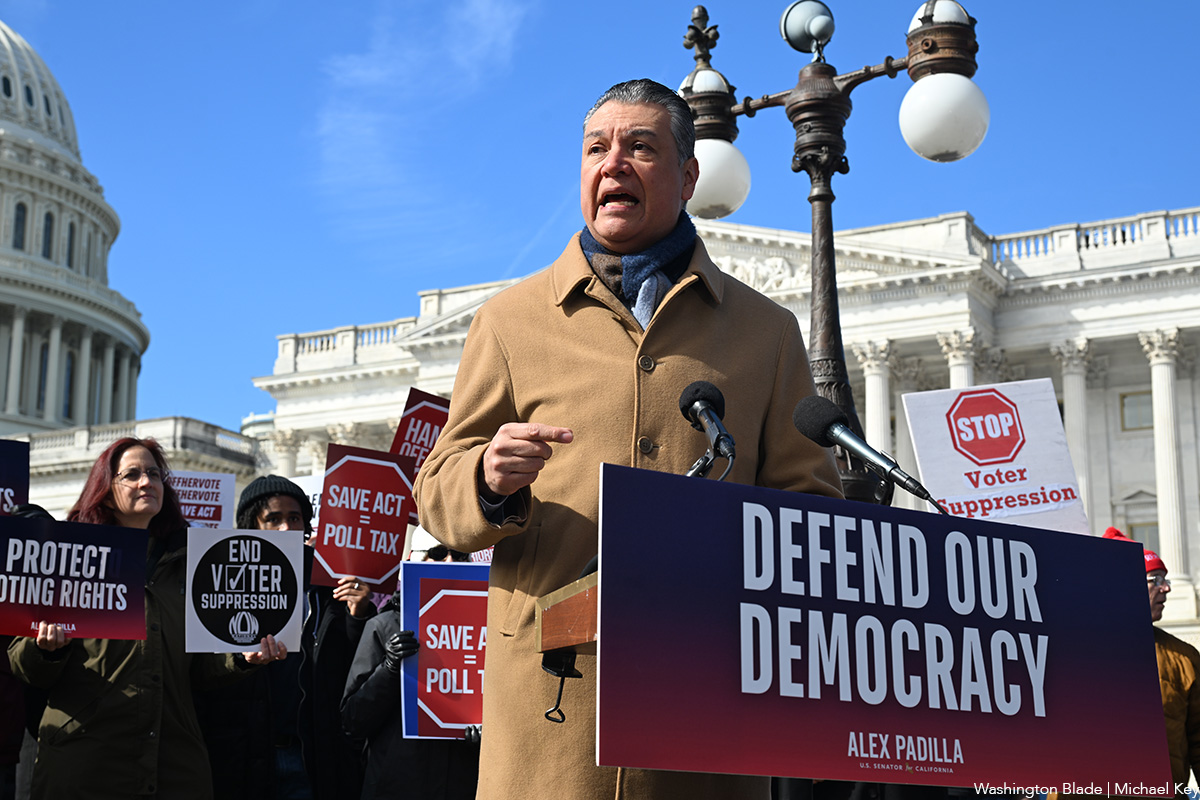
“61 years ago — not to the day — but this week, President Lyndon Johnson came to the Capitol and addressed a joint session of Congress in the wake of Bloody Sunday and pushed Congress to pass the Voting Rights Act,” Padilla said. “61 years later, Donald Trump and this Republican majority wants to take us backwards. We’re not gonna let that happen.”
U.S. Sen. Ben Ray Luján (D-N.M.) also spoke, emphasizing that he views the effort as a Republican-led and Trump-backed attempt to restrict voting access, particularly among Black, brown, and predominantly Democratic communities.
“President Trump told Republicans when they were meeting behind closed doors that ‘The SAVE Act will guarantee Republicans win the midterms and ensure they do not lose an election for 50 years,’” Luján said. “The first time I think Donald Trump’s been honest … This voter suppression bill is only that. Taking away vote by mail? I hope my Republican colleagues from states that voted for Donald Trump or where vote by mail is popular have the courage and the backbone to stand up and say no to this nonsense, because their constituents are going to push back.”
U.S. Sen. Lisa Blunt Rochester (D-Del.) also spoke.
“Our Republican colleagues have already cut Medicaid, Medicare, people don’t know how they’re gonna be able to afford energy,” she said, providing context for the broader political moment. “We’re in the middle of a war that they can’t even get straight while we’re in it and don’t have a way to get out of it. And we are now faced with defending our democracy?”
She then showed the crowd something that she said has been with her throughout her political journey in Washington.
“I brought with me something that I carried on the day that I was sworn into the House of Representatives when I was elected in 2016, and I carried it with me on the day that I was sworn in as United States senator. And I also carried it with me when I was trapped up in the gallery on Jan. 6 and all I could think to do was pray … This document allowed my great great great grandfather, who had been enslaved in Georgia, to have the right to vote. We took this and turned it into a scarf. It is the returns of qualified voters and reconstruction code from 1867. This is my proof of what we’ve been through. This is also our inspiration.”
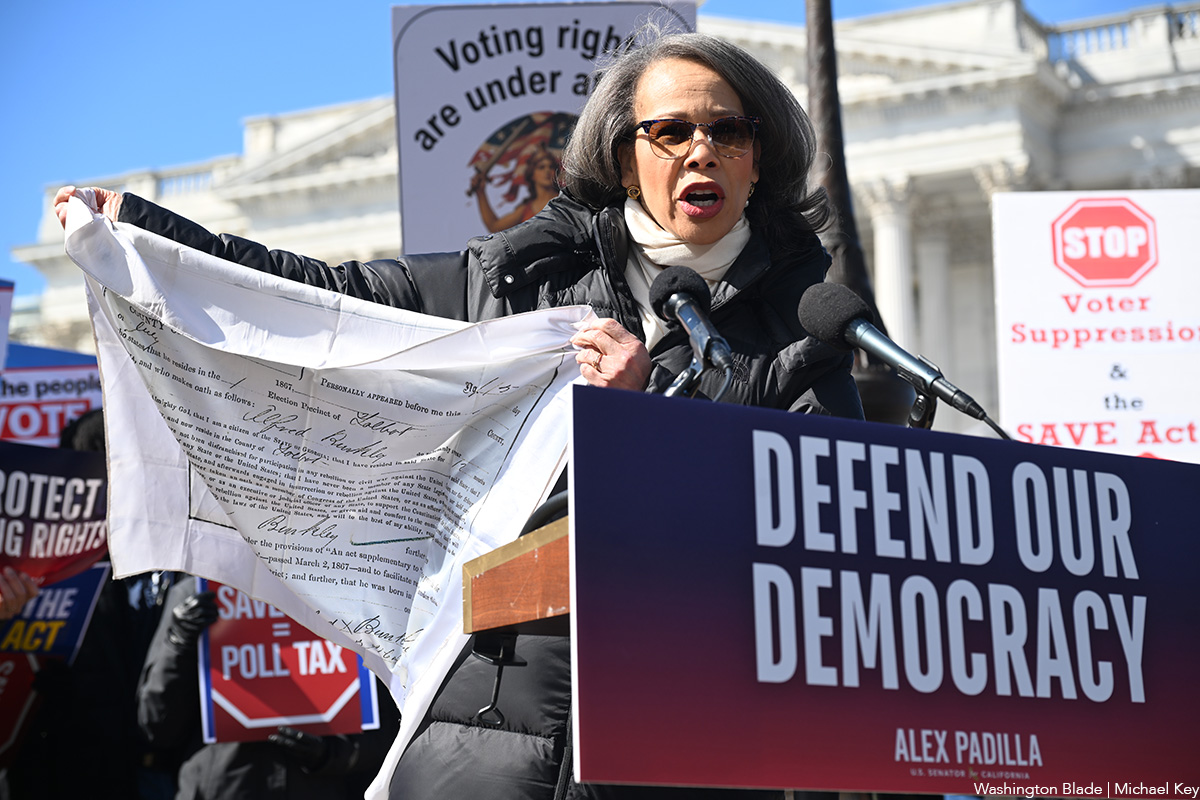
“I got to travel between the Edmund Pettus Bridge two times. And even as I thought about this moment, I recognized that while we wish we weren’t in it, while we don’t know why we’re in it, I do know we were made for it … So I came today to tell you that, um, just like the leader said, that he calls it Jim Crow 2.0. I call it Jim Crow 2.NO.”
Kelley Robinson, president of the Human Rights Campaign, the largest LGBTQ advocacy organization in the U.S., also spoke, highlighting the impact of the bill’s proposed provisions affecting trans people.
“This bill is not about saving America. This bill is about stealing an election. This bill is about suppressing voters,” Robinson said. “This bill not only tries to disenfranchise voters that deserve their right to vote, it also tries to criminalize trans kids and their families … It tries to criminalize doctors providing medically necessary care for our trans youth.”
The SAVE Act passed the U.S. House of Representatives on Feb. 11 but has not yet been considered in the U.S. Senate.
Federal Government
Gay Venezuelan man ‘forcibly disappeared’ to El Salvador files claim against White House
Andry Hernández Romero had asked for asylum in US

A gay Venezuelan asylum seeker who the U.S. “forcibly disappeared” to El Salvador has filed a claim against the federal government.
Immigrant Defenders Law Center, who represents Andry Hernández Romero, on Friday announced their client and five other Venezuelans who the Trump-Vance administration “forcibly removed” to El Salvador under the Alien Enemies Act of 1798, filed “administrative claims” under the Federal Tort Claims Act.
The White House on Feb. 20, 2025, designated Tren de Aragua, a Venezuelan gang, as an “international terrorist organization.”
President Donald Trump less than a month later invoked the Alien Enemies Act of 1798, which the Associated Press notes allows the U.S. to deport “noncitizens without any legal recourse.” The White House then “forcibly removed” Hernández, who had been pursuing his asylum case in the U.S., and more than 250 other Venezuelans to El Salvador.
Immigrant Defenders Law Center disputed claims that Hernández is a Tren de Aragua member.
Hernández was held at El Salvador’s Terrorism Confinement Center, a maximum-security prison known by the Spanish acronym CECOT, until his release on July 18, 2025. Hernández, who is back in Venezuela, claims he suffered physical and sexual abuse while at CECOT.
“As a Venezuelan citizen with no criminal record anywhere in the world, I would like to tell not only the government of the United States but governments everywhere that no human being is illegal,” said Hernández in the Immigrant Defenders Law Center press release. “The practice of judging whole communities for the wrongdoing of a single individual must end. Governments should use their power to help every person in the nation become more aware and informed, to strengthen our cultures and build a stronger generation with principles and values — one that multiplies the positive instead of destroying unfulfilled dreams and opportunities.”
Immigrant Defenders Law Center filed claims on behalf of Hernández and the five other Venezuelans less than three months after American forces seized then-Venezuelan President Nicolás Maduro and his wife, Cilia Flores, at their home in Caracas, the Venezuelan capital.
Maduro and Flores have pleaded not guilty to federal drug charges. Delcy Rodríguez, who was Maduro’s vice president, is Venezuela’s acting president.
‘Due process and accountability cannot be optional’
Immigrant Defenders Law Center on Friday also made the following demands:
- The Trump administration must officially release the names of all people the United States sent to CECOT to ensure that everyone has been or will be released.
- The federal government must clear the names of the 252 men wrongfully labeled as criminal gang members of Tren de Aragua.
- DHS (Department of Homeland Security) must end the practice of outsourcing torture through third‑country removals, restore humanitarian parole, and rebuild a functioning, humane asylum system.
- DHS must reinstate Temporary Protected Status for all individuals who cannot safely return to their home countries, halt mass deportations and unlawful raids and arrests, and guarantee due process for everyone navigating the immigration system.
- Congress must pass the Neighbors Not Enemies Act, which would repeal the Alien Enemies Act.
“In all my years as an immigration attorney, I have never seen a client simply vanish in the middle of their case with no explanation,” said Immigration Defenders Legal Fund Legal Services Director Melissa Shepard. “In court, the government couldn’t even explain where he was — he had been disappeared.”
“When the government detains and transfers people in secrecy, without transparency or access to the courts, it tears at the basic protections a democracy is supposed to guarantee,” added Shepard. “What this experience makes painfully clear is that due process and accountability cannot be optional. They are the only safeguards standing between people and the kind of lawlessness our clients suffered. We must end third country transfers, restore the asylum system, and humanitarian parole, and reinstate temporary protective status so this nightmare never happens again.”

How to navigate shifting tenant expectations

Viktor Orbán ousted in Hungarian elections

Minimal version of ‘Streetcar Named Desire’ heading to Dupont Underground

Comings & Goings

An effort to increase the number of psychiatrists of color
Tenn. lawmakers pass transgender “watch list” bill

LGBTQ groups condemn Trump’s threat to destroy Iranian civilization

Report: Grenell wants Russian ambassadorship

D.C. Council member honored by LGBTQ homeless youth group

Glisten’s 30th annual Day of Silence to take place April 10
-

 Tennessee5 days ago
Tenn. lawmakers pass transgender “watch list” bill
-

 Iran5 days ago
LGBTQ groups condemn Trump’s threat to destroy Iranian civilization
-
The White House4 days ago
Report: Grenell wants Russian ambassadorship
-
District of Columbia5 days ago
D.C. Council member honored by LGBTQ homeless youth group