Connect with us

Arts & Entertainment

Top 10 moments in 2011 pop culture

Coming out stories, dancing with Chaz among year’s top stories

Published

on

It was another big year for LGBT visibility in pop culture. Here are our picks for the top 10 pop culture stories of 2011.

No. 1 Chaz Bono on ‘Dancing with the Stars’

Chaz Bono became the first transgender participant to compete on ABC’s “Dancing with the Stars” this year on the show’s 13th season. He was partnered with professional dancer Lacey Schwimmer for the season, which premiered Sept. 19.

From the start there was controversy over Bono’s inclusion in the show. There was backlash from conservative supporters and threats of boycotts, leading producers to hire extra security for his time on the show.

Bono’s mother, Cher, spoke out on Twitter in support of her son as did many others. He was voted off the show during week six.

No. 2 Celebrities come out

Several celebrities and sports figures came out this year.

Zachary Quinto, star of 2009’s “Star Trek” and currently on FX’s “American Horror Story,” came out in October, explaining on his blog that after the suicide of Jamey Rodemeyer, he realized “living a gay life without publicly acknowledging it, is simply not enough to make any significant contribution to the immense work that lies ahead on the road to complete equality.”

Evan Rachel Wood, who played teen lesbian Jessie on “Once & Again” and starred in HBO’s “True Blood,” came out as bisexual in an interview with “Esquire” in April.

CNN anchor Don Lemon came out in his memoir “Transparent,” released in May.

No. 3 MLB teams make ‘It Gets Better’ videos

Several Major League Baseball teams filmed videos for the “It Gets Better” campaign, starting with the San Francisco Giants. And while the videos were similar, each team added a personal touch.

The Chicago Cubs included a message from lesbian part owner Laura Ricketts and the L.A. Dodgers were the only team to specifically mention gender identity. The Boston Red Sox included their fans and the Tampa Bay Rays featured a personal message from Johnny Damon, who was bullied as a child.

The Seattle Mariners produced their video with Seattle’s other professional sports teams. All the videos are available on YouTube.com.

No. 4 Lady Gaga rallies around LGBT fans

Lady Gaga has done a lot for her LGBT fans in terms of making noise.

The title track off her most recent album, “Born This Way,” deals with self-acceptance and specifically mentions sexual orientation and gender identity.
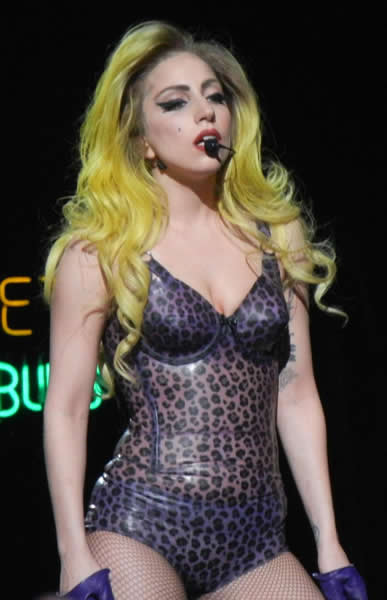
Lady Gaga

She appeared at Europride this summer, giving a speech in which she criticized the state of gay rights in many European countries.

Most recently, during the iHeartRadio Festival held in September in Las Vegas, Gaga dedicated her performance of “Hair” to 14-year-old Jamey Rodemeyer, who committed suicide after being bullied the same week as the concert.

No. 5 Arizona and Callie wed on ‘Grey’s Anatomy’

In the May 5 episode of “Grey’s Anatomy,” orthopedic surgeon Callie Torres, played by Sara Ramirez, and pediatric surgeon Arizona Robbins, played by Jessica Capshaw, tied the knot.

The couple became engaged after getting into a car accident that nearly cost Callie and her unborn child’s lives.

There haven’t been many lesbian weddings on television and even fewer weddings that were actually shown and involved lead characters.

The lesbian wedding between Ross’s ex-wife Carol and her girlfriend Susan on “Friends” in 1996 was one of the first.

No. 6 Tracy Morgan, other celebs make homophobic remarks

“30 Rock” star Tracy Morgan went on a homophobic rant during a stand-up routine at a show in Nashville this summer saying kids should get over being bullied and threatening to kill his son if he were gay. He later apologized for the remarks and agreed to make appearances with GLAAD.

L.A. Lakers star Kobe Bryant was fined for using an anti-gay slur against a referee, as was Chicago Bulls’ Joakim Noah and Atlanta Braves coach Roger McDowell.

No. 7 Gay-helmed talk shows proliferate

What is it with talks shows and gay hosts?

There is of course Ellen DeGeneres, who began her eighth season this year and Rosie O’Donnell has returned to television with her talk show on Oprah Winfrey’s OWN, which premiere in October.

Then there’s Sara Gilbert, famous for her role of Darlene on the sitcom “Roseanne,” who is not only one of five hosts, but is also an executive producer on “The Talk.” Nate Berkus also has his own show as does Rachel Maddow. And Anderson Cooper debuted a talk show this year; it’s rumored that he’s (finally) planning to come out during February’s ratings sweeps period.

No. 8 Gays host award shows

Neil Patrick Harris, star of CBS’s “How I Met Your Mother,” hosted the Tony Awards this year, opening the show with a musical number that included lines like  “Broadway has never been broader, it’s not just for gays anymore,” had a “host-off” with Hugh Jackman and rapped a wrap-up of the evening’s events that was written as the show progressed.

Jane Lynch

Jane Lynch of “Glee” fame hosted the Emmys this year. Lynch spent her hosting gig making fun of the celebrity crowd as well as herself.

Neither Harris nor Lynch are the first gays to host either award show, still the visibility was impressive for such high-profile events.

No. 9 Another coming out on ‘Glee’

There have already been three main characters to openly acknowledge being somewhere on the LGBT spectrum on Fox’s hit show “Glee” and yet another main character has joined them. Santana Lopez, played by Naya Rivera, was outed in a third season episode in a political ad targeting Sue Sylvester.

The following episode, titled “I Kissed a Girl” featured the club rallying around Santana as she came to grips with being out and singing P!nk’s “F****** Perfect,” Melissa Etheridge’s “I’m the Only One,” a slowed down version of Cyndi Lauper’s “Girls Just Wanna Have Fun,” Katy Perry’s “I Kissed a Girl” and k.d. Lang’s “Constant Craving.”

No. 10 ‘A-List: Dallas’ stars attacked

Logo expanded its “A-List” franchise this year with “The A-List: Dallas” starring Levi Crocker, James Doyle, Chase Hutchinson, Ashley Kelly, Philip Willis and Taylor Garrett.

There was controversy surrounding the show when Garrett, a Republican fundraiser, tweeted that his house was vandalized and included a picture of a broken window. Bloggers found this suspect when a producer tweeted back to Garrett about making headlines and it was discovered that Garrett didn’t make a police report. Both tweets have since been removed.

Later, Logo provided the Huffington Post Gay Voices with copies of two police reports, one reported by Garrett’s building manager and another made by Garrett himself.

In an unrelated incident, Crocker said he was attacked at a gay bar in Oklahoma City, Okla., in November.

Advertisement
FUND LGBTQ JOURNALISM
SIGN UP FOR E-BLAST

Movies

‘The Stranger’ queers an existentialist classic

‘Gay male gaze’ anchors film’s visual aesthetic

Published

on

Benjamin Voisin and Rebecca Marder in ‘The Stranger.’ (Photo courtesy Gaumont Music Box Films)

When Albert Camus published “L’etranger” (“The Stranger”) in 1942, he was living in Nazi-occupied France, so it’s no surprise that it became one of the most celebrated “existential” novels of all time. A fascist regime is great for inspiring thoughts of an indifferent and meaningless universe.

It wasn’t his first experience with authoritarianism. Born to a working-class white European family in then-French Algeria, he grew up observing the harsh treatment of the native North Africans by the colonists who governed them. It was this personal history, amplified by the spread of European fascism, that found its voice in “The Stranger.” Short, terse, and shrouded in a cloak of ennui, it was his first novel – novella, really – but its impact was seismic.

Naturally, its influence has run through the world of cinema, and, it has been translated to the screen three times — most recently by French filmmaker François Ozon, whose screen version won acclaim at last year’s Venice Film Festival, and is now available for on-demand streaming in the U.S.

Ozon’s vision is captured in gleaming black-and-white, blending the luster of modern-day faux-vintage fashion photography with the nostalgic flavor of classic era “arthouse” and European cinema, and it maintains a largely faithful connection to Camus’s novel, at least in terms of plot. It’s the story of Meursault (Benjamin Voisin), a French settler living in the capital city of Algiers, who receives word that his mother has died. He takes time off from work, traveling to the nursing home – where he had sent her three years before – in order to attend her funeral, but remains seemingly emotionless throughout, prompting members of the staff and other residents to mark his apparent lack of customary grief.

When he returns to Algiers, he encounters Marie (Rebecca Marder), a former co-worker, and after spending the day together, the two become romantically involved. Their relationship continues over the next few weeks, while they also associate with Meursault’s neighbor Raymond (Pierre Lottin) – a suspected pimp who, after beating his Arab mistress, is being followed and harassed by her brother (Abderrahmane Dehkani) and his friends. After a skirmish with the Arabs, Meursault encounters the brother alone during a walk on the beach, and shoots the young man dead with a pistol given to him for protection by Raymond. On trial for murder, he offers no defense and expresses no remorse. He is convicted and sentenced to death, facing it all with emotional detachment, and seeming to find liberation in the recognition that none of it matters, anyway.

Though it’s a tale that includes romance, murder, and courtroom drama, it feels like a story in which nothing really happens – which is, of course, the perfect effect to emphasize the point of Camus’s philosophical viewpoint; but while that might satisfy the kind of viewers drawn to a film of a Camus novel, Ozon’s movie probably won’t hold much appeal for audiences seeking action, suspense, feel-good sentiment, or easy answers to the moral dilemmas that come hand-in-hand with being alive. Camus was interested in the opposite effect, a confrontation with existence which leaves no room for comfortable denials, and Ozon’s inflection on the original’s themes makes no effort to soften the blow. 

What it does, however, is introduce – without having to adjust the narrative provided by Camus – an element of queerness that lends the whole story a new layer of subtext through what can only be described as the “gay male gaze” that anchors the film’s visual aesthetic.

It’s in the way the camera – aimed by Ozon and cinematographer Manu Dacosse – remains fixated on its star, the exquisitely beautiful Voisin, lingering on his face, his frame, or his body in swim trunks. There’s a sensuality in the way the director shows us female beauty, too, but it’s never framed as the “object” of desire; and in the narrative’s key scene – the killing by the sea – there’s an inescapable element of repressed homoeroticism, born perhaps by associations with the mid-20th-century queer aesthetic of writers like Jean Genet or artists like George Quaintance, or pretentiously artsy commercials for high-end men’s cologne, or just from real-life memories of cruising on the beach. On the surface, Meursault gives no sign of queerness; but the emphasis that Ozon brings to the story – almost purely through visual suggestion – lends the character, already an outsider to the world of “normal” human experience in the first place, an even deeper sense of “otherness.”

As to that, Voisin’s performance is effective for reasons beyond his model-esque physical perfection; there’s a vast inner life happening under that pretty face, and the actor conveys it with a “less-is-more” approach that aligns perfectly with the character’s dissociation from conventional humanity. He’s compelling enough to engage us, and intelligent enough in his expression of Camus’ ideas to help us grasp them even as he makes us feel them – and frankly, that’s saying a lot.

The rest of the cast is effective, as well, though most of them serve primarily as a foil to reflect Voisin and his character. Marder brings a relatably savvy-yet-romantic presence as Marie, and Lottin gives Raymond a kind of louche charisma that evokes a brand of appealing-but-toxic masculinity. Swann Arlaud also stands out as the prison priest who attempts to convert Meursault on the eve of his execution, bearing the full brunt of Camus’ existentialist arguments in a scene that somehow taps into transgressive homoerotic fantasies even as its characters discuss impending death.

Camus, for his part, did not see himself as an existentialist; instead, he embraced and promoted a viewpoint in which human life is defined by its relationship with what he called “The Absurd” – the gap between reality and our assumed expectations about it, where our circumstances and behavior become obviously ridiculous – and believed that, in a meaningless universe, we are free to find our own meaning. An essay he published around the same time (“The Myth of Sisyphus”) posited that finding happiness in the struggle was perhaps the most logical response to facing an unfeeling world, and the Absurdist movement he helped to define used humor – albeit often the dark and sardonic variety – as a means to expose the madness of trying to impose sense on a nonsensical world. In the end, his writings reveal him as a deeply humanistic thinker, whose acceptance of objective reality served only to deepen his dedication to the ideal of a better mankind.

Whether or not any of that comes across in Ozon’s artful film, which emphasizes the immediacy of experience – the beach, the sea, the sun, the visceral responses we get from sex or violence – over the intellectual arguments that Camus would elucidate throughout his life, probably depends on one’s own grasp of Existentialist thinking and its offshoots. In any case, while Ozon’s “The Stranger” might fall short in the challenge to convey its philosophical arguments, it more than succeeds as a stylish piece of international art cinema, and it just might – hopefully – inspire audiences to go on a deeper dive into the mind of Albert Camus.

And even if it doesn’t, it’s still pretty to look at.

Continue Reading

Theater

Cedric Neal on his juicy narrator role in ‘Pippin’

A rash of terrific reviews for a part he’s longed to play

Published

on

Cedric Neal in ‘Pippin.’ (Photo by Christopher Mueller)

‘Pippin’
Through July 26
Signature Theatre
4200 Campbell Ave.
Arlington, Va.
$47-$153
Sigtheatre.org

As Leading Player in Signature Theatre’s revival of “Pippin,” Cedric Neal portrays the manipulative narrator who guides the title character, a young medieval prince, on a quest for meaning. Neal is also receiving a rash of terrific reviews for a part he’s longed to play for some time.

Recently, after the first “Pippin” preview performance, Neal shared his thoughts. “Last night was exciting, mystic and exotic. It was magical. Words are overused, but it was all those things.”

With a powerful, rich tenor voice, Neal is best known as a charismatic West End and Broadway star (“Back to the Future,” “Hadestown,” “Guys & Dolls”) as well as for his memorable semifinalist win on the “The Voice UK” in 2019.

And now Stephen Shwartz’s “Pippin” marks Neal’s second show at Signature Theatre, a place he dearly loves. His first was as Jimmy Early in “Dreamgirls” in 2012, a raucous role that won him a Helen Hayes Award. During that production, Neal forged deep friendships with actor Nova Y. Payton and director Matthew Gardiner. What’s more, while rehearsing the show, he met his husband.

“He likes to say we met on Match.com but I remember it differently,” says Neal. “It was something called Adam4Adam. It might have been a hookup, but instead we met for coffee in Shirlington Village where we talked and talked for hours. Two years later we married.”

BLADE: Your triumphant return to town sounds pretty great. 

NEAL: I’m having the time of my life. Takes me a half hour to come down after the show ends. It’s explosive. 

BLADE: Is Leading Player a part you’ve wanted to do?

NEAL: Very much, and just this way. Rather than leaning on its circus troupe aspect, our director Matthew [Gardiner] explores the darkness of the story and the risk of falling prey to cultish ideology. 

BLADE: Just how nefarious is Leading Player?

NEAL: I’m not judging my character. I believe at some point that Leading Player has good intentions. Somewhere along the line, ego becomes involved. The promise becomes warped.

BLADE: When doing “Pippin,” is it possible to separate the iconic Bob Fosse choreography and Ben Vereens’s sexy portrayal of Leading Player from the original production? 

NEAL: Not entirely, but in our production Matthew [Gardiner] and Rachel Leigh Dolan have meticulously honored the choreography and storytelling of Fosse’s work without it being a carbon copy. I think it’s amazing. 

BLADE: Was your participation in the “The Voice UK” a strategic career move?

NEAL: It was. At the time, I had just gotten a BIG NO on a West End show where the casting director told me the part should have been mine but using a then-unknown American would have created an uproar. 

Then when “Voice UK” scouted me, my agent said this would be the perfect opportunity to boost my profile. Ultimately, I was given a global scale opportunity to go onstage and sing as Cedric. 

BLADE: Your thrilling, original rendition of Stevie Wonder’s “Higher Ground” made the audience and judges like Jennifer Holliday and Sir Tom Jones just go crazy (in a good way). In musical theater, do you make beloved, well-known songs like “Join Us” and “Glory” in “Pippin,” your own in that same way?

NEAL: I couldn’t always, but I can now. When I talk to younger performers, I tell them about the song in “Gypsy” where the experienced strippers talk about getting a gimmick if you want to be a star.

I come from a gospel, R&B, and serious classical background and have always retained my gospel, soulful flair on things. When I entered the world of musical theater, I’d put my twist on a song and the musical director would ask that I tone it down. 

Ten years into my career, I became known for putting my flair on musicals, and that became my gimmick. To “Cedricfy” a song is a legitimate term in musical theater. And you’ll see me bring that to “Pippin.” 

BLADE: Reading about you, it seems you’ve made bold choices and surround yourself with supportive friends and family, blood and chosen. 

NEAL: Yes, and it’s not an accident. I come from a bloodline of revolutionaries and pioneers whose shoulders I stand on. My ancestors are all fighters and refuse to let their fight be in vain. Also, I will always step up to the plate and represent all the marginalized communities that I’m a part of: Black, gay, biracial relationships, liberals. 

BLADE: Are you and your husband still living in the windmill? 

NEAL: We left the windmill but we’re still in the U.K.  Try to imagine our story: A Black boy from the hood in Dallas, Texas, meets a fifth-generation cattle rancher from Alberta, Canada, and they move to the UK, adopt a labradoodle, and live in an actual windmill. Isn’t that the gayest shit you’ve ever heard?

BLADE: It’s like a fairytale. 

NEAL: It was. It still is.

Continue Reading

Out & About

‘How to Survive a Plague’ screens June 5

Commemorating 45th anniversary of first report of AIDS

Published

on

(Image via IMDB)

June 5 marks the 45th anniversary of the first report of AIDS. To commemorate the occasion, Whitman-Walker Health is sponsoring a screening of the film “How to Survive a Plague” on June 5 at 5:30 p.m. at GWU Lisner Auditorium (730 21st St., N.W.). 

The screening is free and you can register on Eventbrite. Other partners involved in the screening are the Center for Black Equity, Food & Friends, HIPS, and Us Helping Us.

After the film, attendees will head to Dupont Circle for a candlelight vigil at sunset.

The film reflects on lessons from the community-led response to the plague while honoring those lost to HIV and AIDS. It tells the story of activism and innovation about AIDS survival. Culled from a trove of archival footage, the film is epic and intimate, tracking a small group of people, most of them HIV-positive, in their nine-year-long battle to save their own lives, according to a statement from Whitman-Walker.

Continue Reading

Popular