News
Migrantes LGBTI+ llegaron a la frontera de EEUU
Grupo de casi 80 personas están en Tijuana
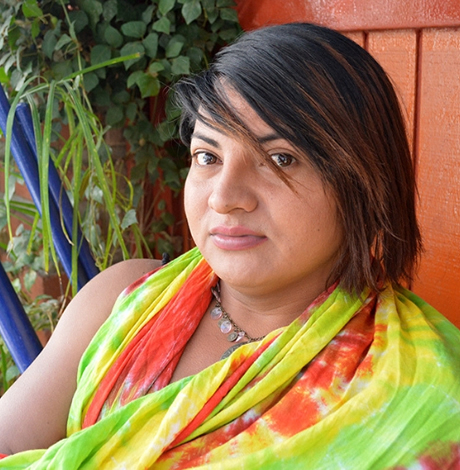
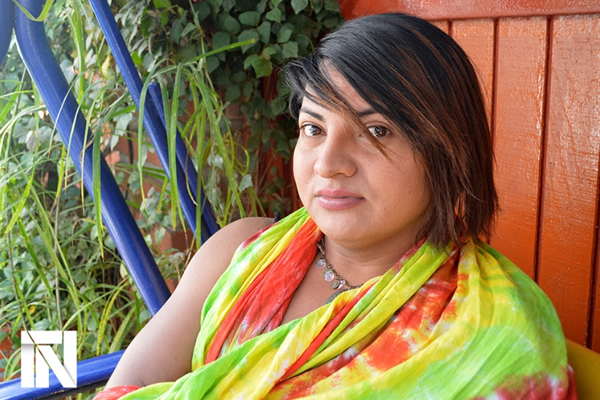
Dentro de poco se cumplirá un mes desde que Loly Méndez salió de El Salvador. (Foto por Yariel Valdés González/Tremenda Nota)
Nota del editor: Yariel Valdés es reportero de Tremenda Nota, una revista electrónica independiente en Cuba que reporta sobre la comunidad LGBT y otros grupos minoritarios en el país. Tremenda Nota es la pareja de contenido del Washington Blade en Cuba.
Yariel Valdés está actualmente en Tijuana, México. Su nota salió originalmente en el sitio web de Tremenda Nota el martes.
TIJUANA, México — Un grupo de migrantes LGBTI+ espera en Tijuana, México, para alcanzar la frontera estadounidense. Decenas de personas dejaron la caravana de al menos 5.000 centroamericanos para evitar el acoso de sus propios compañeros de viaje.
Hace más de 22 días, Loly Méndez emprendió el viaje más largo de su vida. Cerca de 4.400 kilómetros separan por tierra a El Salvador de Estados Unidos. Aun así, Loly decidió unirse a uno de los grupos de migrantes centroamericanos que huyen de la violencia en sus países natales, y avanzan hacia la frontera de Estados Unidos.
Loly, mujer transgénero, cosmetóloga, no vio solo la meta del “sueño americano,” sino la oportunidad de huir de la violencia y la transfobia. Una pandilla la había asaltado y robado en su propio país.
“Doy gracias a Dios porque no me quitaron la vida, ni me violaron,” dice.
En su adolescencia, Loly ya sabía que era una mujer. Sin embargo, el clima de intolerancia que vive en su país de origen le impidió completar el cambio de imagen que deseaba.
“Nunca sabes si vas a amanecer (viva) — dice —. Yo no dejo de pensar en mi amiga, cómo la asesinaron, la estrangularon y la tiraron de un puente. Teníamos planes de salir de allá juntas (de El Salvador), pero la gente le puso odio porque ella ya lucía como una mujer.”
Cruz Torres, director de Diversidad Sexual de la Secretaría de Inclusión Social de El Salvador, estima que 600 personas LGBTI+ han sido asesinadas en los últimos 24 años en ese país centroamericano. Al menos 145 de los crímenes ocurrieron en solo tres años, desde 2015 a 2017.
La frontera, a un paso
“Todas las personas homosexuales que viajamos en esta caravana venimos con el propósito de ser libres, de trabajar, de no ser delincuentes,” explica Loly a Tremenda Nota. “Yo jamás me he prostituido y no voy a otro país a eso.”
La salvadoreña llegó a la localidad Playas de Tijuana el pasado domingo como parte de una avanzada de casi 80 personas de la comunidad LGBTI+, integrantes de la primera caravana de más de 5.000 migrantes centroamericanos.
El grupo llegó escoltado por oficiales del Instituto Nacional de Migración de México y por observadores de varias comisiones de derechos humanos del país azteca. Arribaron a la ciudad fronteriza después de pasar por San Luis Río Colorado (Sonora) y Mexicali, la capital del estado de Baja California.
César Mejías, uno de los migrantes y portavoz no oficial del grupo, declaró que esta primera caravana alcanzó el norte de México antes de lo previsto porque recibieron apoyo de “una organización de Estados Unidos, que también pertenece a la comunidad LGBTI+.” Mejías prefirió no mencionar el nombre de sus patrocinadores.
En Tijuana aumentó la incertidumbre de los migrantes. “Duele saber que ahora nos vayan a deportar para nuestros países,” comenta Kecha Cataleya, una transgénero hondureña de 24 años.
“En 2015 me aventaron gas y me prendieron fuego, aún se me miran las marcas,” cuenta. La joven también asegura que las maras (pandillas) obligan a las personas trans a vender drogas y prostituirse.
Según la organización no gubernamental Transgender Europe, Latinoamérica tiene las tasas mundiales más altas de violencia contra la comunidad LGBTI+.
El Salvador, por ejemplo, ha registrado “aterradores crímenes de odio hacia las personas LGBTI” en los últimos años, según un reporte del grupo COMCAVIS Trans (Comunicacndo y Capacitando a Mujeres Trans). Se trata de “actos que se producen con mayor crueldad de lo usual: mutilaciones, excesos de violencia llegando al extremo de múltiples disparos, cuerpos atados, desmembramiento de partes genitales y acciones de tortura sistemática.”
Cuando Kecha Cataleya y sus compañeros llegaron a la calle Olas Altas, en la sección Coronado, varios vecinos protestaron. “Gracias a Dios — cuenta César Mejías — ellos ya comprendieron quiénes somos, qué es lo que vamos a hacer y cuánto tiempo vamos a estar aquí.”
Mejías y el resto del grupo, en el cual viajan varios menores de edad, esperan por sus “apoderados legales” para iniciar el proceso de asilo político en los Estados Unidos. “Queremos hacer las cosas bien,” añadió.
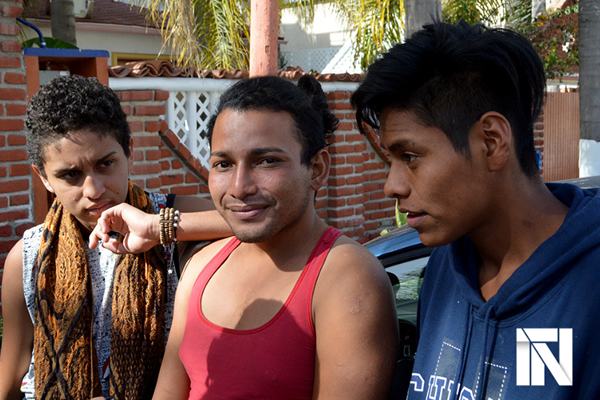
La caravana LGBTI+ arribó el pasado domingo 11 de noviembre a Tijuana, México. (Foto de Yariel Valdés González/Tremenda Nota)
Sin embargo, el presidente norteamericano Donald Trump ha intentado cerrar todas las puertas de Estados Unidos a los migrantes centroamericanos. El pasado 9 de noviembre el mandatario firmó una orden ejecutiva que prohíbe la entrada al país de forma ilegal por la frontera con México. Si los migrantes centroamericanos accedieran a la nación del norte a través puntos de entrada no autorizados, serían arrestados y perderían el derecho de permanecer en el país o solicitar asilo.
A finales de octubre el gobierno norteamericano anunció el despliegue de 5.200 militares en la frontera con México. Aunque Trump no mostró ninguna prueba aseguró en la red social Twitter que las caravanas “también están formadas por algunos matones y pandilleros muy malos.” En otro de sus tweets amenazó a los migrantes: “¡Esta es una invasión de nuestro país y nuestro ejército te está esperando!”
Unos son más iguales que otros
Durante el trayecto, los integrantes LGBTI+ de la caravana caminaron a la par de sus compatriotas hondureños, salvadoreños y guatemaltecos. Cruzaron a nado los mismos ríos, atravesaron las mismas cercas fronterizas, durmieron bajo la intemperie común, padecieron el mismo frío y la misma hambre. Sin embargo, su condición de personas LGBTI+ provocó que fueran discriminados por sus propios compañeros.
“No me esperaba eso de ellos porque todos somos migrantes y veníamos juntos. Pensé que teníamos que apoyarnos,” denunció la salvadoreña Noe Alvarenga.
“Como somos la comunidad más vulnerable — acota Loly — hemos sufrido la violencia, el machismo que viene dentro de esa caravana. Hemos sido mal vistos, nos gritan cosas.”
La antropóloga social Marta García Ortega, investigadora del Colegio de la Frontera Sur de México, coincide en que dentro del conjunto de migrantes, la comunidad LGBTI+ es particularmente vulnerable, “porque no solo están solicitando un derecho al asilo, también están en mayor riesgo, y requieren atención especial, como las mujeres.”
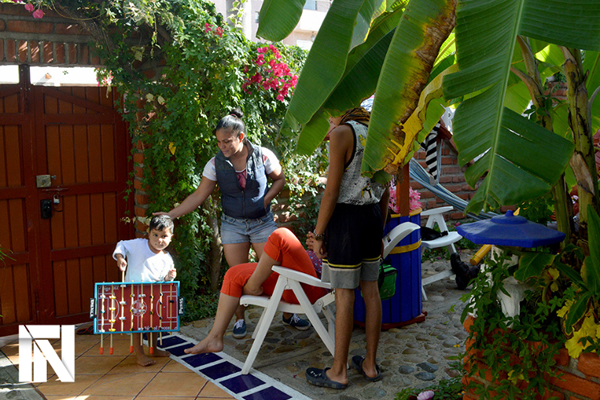
Varios niños se cuentan en la caravana que alcanzó la localidad Playas de Tijuana, a orillas de la frontera norteamericana. (Foto de Yariel Valdés González/Tremenda Nota)
En efecto, la discriminación, la homofobia, la violencia y los crímenes de odio lanzaron a Loly Méndez, Kecha Cataleya, Noe Alvarenga y César Mejías a un camino de miles de kilómetros, desde sus países natales hasta la frontera norteamericana.
“Vivir como yo deseo vivir, siendo lo que soy, sin que nadie me discrimine, sin necesidad de ocultarme, sin que vengan unos maleantes a la vuelta de la esquina y me golpeen…Eso es lo que quiero,” confiesa Mejías.
El recorrido, sin embargo, no termina en la frontera estadounidense. Ahí deberán emprender otra “caminata” por el sistema legal norteamericano.
Las caravanas que en pocos días tocarán las puertas de Estados Unidos han inaugurado un proceso sin precedentes en la historia reciente de las migraciones forzadas, cree la investigadora Marta García Ortega. “Esto ya no es solo un movimiento de éxodo, es un movimiento por los derechos sociales, por los derechos civiles, por el derecho a migrar.”



Turkey
Dozens detained after Turkish authorities raid LGBTQ groups, businesses
Raids targeted gay bars, activists’ homes
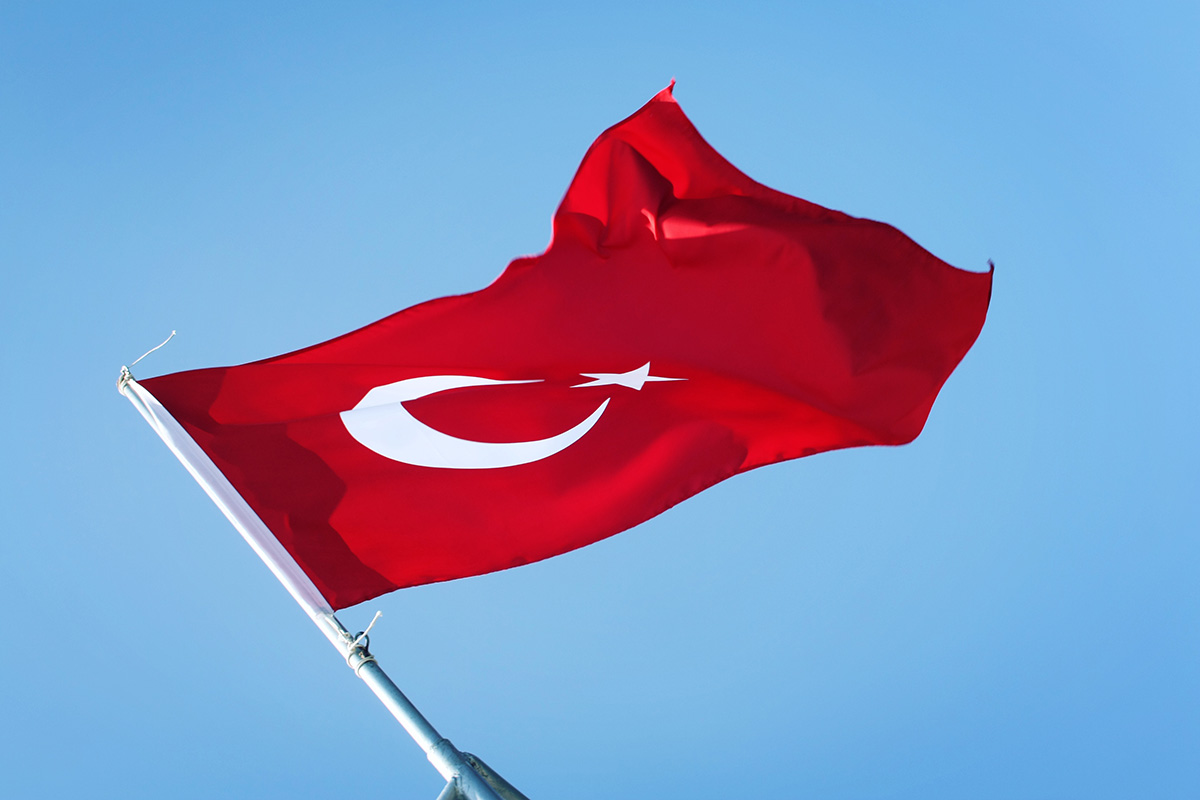
Authorities in Turkey over the weekend detained dozens of people during raids they carried out against gay bars and LGBTQ activists’ homes across the country.
The BBC reported the raids were part of the government’s “My Family is Safe” campaign.
A statement from a group of Turkish advocacy groups the Washington Blade received on Sunday noted Justice Minister Akın Gürlek said the operation included “162 individuals, nine associations, and 13 businesses across 15 provinces.” Prosecutors in Istanbul, Ankara, Izmir, Aydın, and Mersin are coordinating the campaign.
Kaos GL, one of the country’s largest advocacy groups, was among the targets.
“The authorities have referred to allegations including ‘obscenity,’ ‘facilitating prostitution or providing premises for prostitution,’ exposure of children to allegedly obscene content, drug-related offenses, and other morality-related offenses,” reads the press release the Blade received. “Information from the field indicates that additional allegations, including forming a criminal organization, may appear in some investigation files.”
“The reported inclusion of the offense of “establishing an organization for the purpose of committing crimes” under Article 220 of the Turkish Criminal Code is particularly alarming and, if confirmed, would mark a significant escalation in the criminalization of LGBTI+ human rights activism,” it added. “While LGBTI+ activists and organizations have recently faced and continue to face investigations and prosecutions on grounds such as ‘obscenity’ and alleged violations of the Law on Associations, the use of an organized-crime allegation represents a qualitatively more serious threshold, both in terms of the gravity of the accusation and the potential penalties involved.”
Turkish authorities under President Recep Tayyip Erdoğan’s government over the last decade have cracked down on LGBTQ and intersex activists in the country.
Police in 2015 used tear gas and water cannons against people who were about to participate in an Istanbul Pride march. Authorities in 2017 arrested nearly two dozen people who defied a ban on Pride events in the city.
Police in Ankara, the Turkish capital, in 2019, arrested 18 students and an academic who participated in a Pride march at the Middle East Technical University. They faced up to three years in prison, but a court in 2021 acquitted them. Police in 2022 violently broke up a Pride parade at the same Ankara university.
Turkish authorities in July refused to allow a gay cruise ship — the Scarlet Lady, a Virgin Voyage vessel that Atlantis Events chartered — to dock in Kusadasi, a resort town on the Aegean Sea.
Kusadasi is in Aydın Province, one of the provinces in which authorities conducted the raids. Turkish officials also refused to allow the Scarlet Lady to dock in Istanbul.
A Turkish source on Sunday told the Blade the “My Family is Safe” operation began on the 46th anniversary of a military coup that toppled the country’s government in 1980.
“The fact that this operation began on the night of Sept. 12 — the 46th anniversary of the 1980 coup — is highly significant in terms of the foundations of the prohibitive and repressive mindset directed at the LGBTI+ community,” they said. “Moreover, many LGBTI+ organizations had been subject to official inspections last week.”
“Conducting this operation on a Saturday night shortly thereafter also serves the purpose of heightening fear and anxiety within the community,” added the source.
The source asked the Blade not to reveal their identity.
ILGA-Europe in a statement described the raids as “the systematic dismantling of LGBTI civil society.” Paris Mayor Emmanuel Grégoire is among the European officials who have publicly condemned them.
The Blade will update this story with additional details as they become available.

The Comings & Goings column is about sharing the professional successes of our community. We want to recognize those landing new jobs, new clients for their business, joining boards of organizations and other achievements. Please share your successes with us at [email protected].
The Comings & Goings column also invites LGBTQ+ college students to share their successes with us. If you have been elected to a student government position, landed an exciting internship, or are graduating and beginning your career with a new job, let us know so we can share your success.
Congratulations to Jaime Christopher Pierce on their appointment to serve as a member of the Virginia Governor’s LGBTQ+ Advisory Board. Pierce was sworn in on Sept. 3 by Greg Parks, clerk of the Alexandria Circuit Court.
Pierce currently serves as vice chair of the Alexandria City LGBTQIA+ Task Force and as a member of the Alexandria Pride planning committee. They previously served on the board of directors of Equality Virginia.
Upon being sworn in, Pierce said, “Public service has been a central part of my life for more than 30 years, and this appointment gives me an opportunity to serve the Commonwealth in a different and very personal way. My career has allowed me to work with people and communities throughout Virginia, and I hope to bring that experience, along with my own lived experience and my involvement in the LGBTQ+ community, to the work of the Board.” They added, “Having Greg administer the oath makes the occasion even more meaningful because of his own historic role as Virginia’s first openly gay elected circuit court clerk.”
Pierce also serves as Circuit Court Services Manager for the Department of Judicial Services, at the Office of the Executive Secretary of the Supreme Court of Virginia. They began their career in Virginia’s judiciary in 1994 as a deputy clerk with the Virginia Beach Circuit Court and have since held several professional and leadership positions within the court system. Pierce is a member of the National Association for Court Management (NACM) and the Mid-Atlantic Association for Court Management. At the national level, Pierce participated in the workgroup that developed the National Association for Court Management’s Diversity, Equity, and Inclusion Guide, a resource designed to help court professionals advance inclusive practices and strengthen access, fairness and belonging within the justice system.
Pierce earned a degree in Criminal Justice from Liberty University, and a certificate in Paralegal Studies from Norfolk State University.
National
Multi-billion-dollar 9/11 Victim Compensation Fund to continue until 2090
Eligibility for same-sex partner survivors remains unclear

As part of its commemoration of the 25th anniversary of the 9/11 terrorist attacks, the September 11th Victim Compensation Fund, a federally operated program, released information during the past week showing it has awarded more than $18 billion to over 77,000 9/11 victims and their families since 2011.
Officials with what’s now referred to as the VCF point out that it was created to provide compensation to individuals or to a court-approved personal representative of a deceased individual who were present at one of the three sites where the hijacked jetliners crashed.
Among those supported under the program are thousands of rescue workers, clean-up crews, and residents living near the World Trade Center Twin Towers destruction site who became ill, many of whom later died, by being exposed to the toxic fumes created by the fire and falling debris.
“Twenty-five years since that day, the September 11th Victim Compensation Fund has served tens of thousands of victims and their families, and we continue to receive over 750 new claims each month — a clear indication of the ongoing importance of our mission,” said Allison Turkel, VCF’s leader, who holds the title of Special Master.
In a Sept. 2 briefing for the news media in advance of the 9/11 anniversary commemoration, Turkel pointed out that the VCF operation was upgraded and expanded by separate laws passed by Congress in 2011 and 2019, with the 2019 law signed by President Trump providing full funding to “pay all eligible claims and extended the filing deadline to Oct. 1, 2090.”
LGBTQ advocacy organizations in New York and nationwide have reported that during the time shortly after the 9/11 attacks same-sex surviving partners of 9/11 victims learned they were ineligible for compensation benefits because their same-sex relationships were not legally recognized.
Nicole Nava, a VCF spokesperson, told the Washington Blade she would inquire into whether same-sex couple surviving partners were being supported under the VCF program in more recent years.
She said under long established VCF procedures, all applicants for benefit claims regarding a deceased person, whether same-sex or opposite sex, must be appointed as a Personal Representative of the deceased person by a state court. For D.C. residents, the probate division of the D.C. Superior Court appoints a Personal Representative.
“Claims for deceased victims (regardless of the cause of death) may be submitted only by the Personal Representative,” a statement on the VCF website says. “Each state has laws that define the process for appointment of the Personal Representative and the specific authority granted to that Personal Representative,” it says.
The Washington Blade couldn’t immediately determine the criteria for being approved as a Personal Representative by the D.C. Superior Court and various state courts, including whether a same-sex survivor partner would be eligible for such an appointment.
A spokesperson for the District of Columbia LGBTQ+ Bar Association, which includes many local attorneys who specialize in a wide range of specialized legal issues, couldn’t immediately be reached to find out if one or more of their members might be able to determine the same-sex partner eligibility for Personal Representative status.
In her news media briefing, VCF Special Master Turkel said detailed information about how best to file a claim for 9/11 victim compensation is available on the VCF website.
“Twenty-five years since the events of September 11th , 2001, we know it has become increasingly challenging for claimants to find documents needed to prove their presence at an eligible location, which is one of the key requirements to be eligible for compensation,” she said.
She was referring to the requirement that 9/11 surviving victims seeking a claim for support for injuries or illnesses related to the 9/11 attacks must prove they were present at the World Trade Center site, the Pentagon site, or the Shanksville, Pa. site where the hijacked jetliners crashed. Those requirements are separate from the less clearly defined criteria for same-sex couple victim survivor eligibility.
“Our team is committed to ensuring no claimant feels lost or overwhelmed when submitting a claim,” Turkel said at the briefing. “We have a great helpline with real live people who can answer or refer any questions that come in,” she added. “They engage in over 4,000 calls a month on average. We encourage folks to call 1-855-1555 with any questions.”
The VCF website, which has additional detailed information, can be accessed at www.vcf.gov.

Dozens detained after Turkish authorities raid LGBTQ groups, businesses

PHOTOS: SMYAL Fall Brunch

Dolly Parton biography puts her hardships into context

‘Thelma and Louise’ remains landmark of unspoken queer rebellion

Comings & Goings

Nominate your favorites for the Blade’s 25th annual Best Of LGBTQ DC Awards

PHOTOS: SUNFESTIVAL

Gloria Steinem’s life of substance and consequence

How Dolly became a folk saint for Appalachian queers