News
IOC president meets with Russian LGBT athletes, activist
Concerns over Russia’s gay rights record discussed
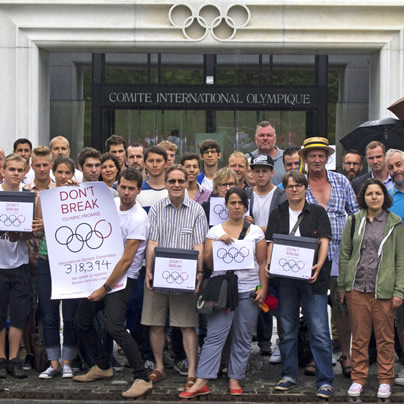
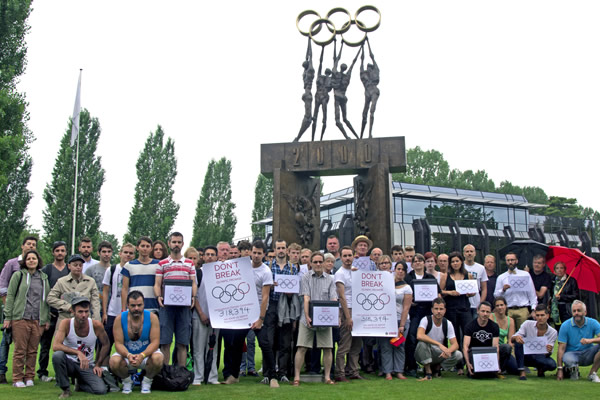
Members of All Out and Athlete Ally on August 7 presented a petition with more than 300,000 signatures to the International Olympic Committee that urges it to pressure Russia to end its gay crackdown. (Photo courtesy of All Out)
Elvina Yuvakaeva and Konstantin Yablotskiy of the Russian LGBT Sports Federation and Anastasia Smirnova of the Russian LGBT Network met with Bach in Paris where he was attending the 100th anniversary of the International Fencing Federation. Emy Ritt and Marc Naimark of the Federation of Gay Games; IOC Director of Communications Mark Adams and Bach’s incoming chief-of-staff, Jochen Faerber, also attended the meeting that lasted more than an hour.
Yuvakaeva, Yablotskiy and Smirnova discussed their desire to have a so-called Pride House for LGBT athletes and their supporters during the games that are scheduled to begin in Sochi, Russia, on Feb. 7. They also raised concerns over the implementation of a vaguely worded law that bans gay propaganda to minors during the Olympics.
The IOC flew the three to Paris for the meeting.
“We expressed our desire for a safe space for LGBT people at the Sochi Games,” Yablotskiy said in a press release the Federation of Gay Games sent to the Washington Blade after the meeting. “At the Vancouver and London Olympics, Pride Houses were organized by the LGBT sports community, but in Sochi, our government has banned such initiatives. We still hope that the IOC will be able to intervene to demonstrate its commitment to sport for all and to the values of the Olympic Charter.”
Smirnova specifically criticized Russia’s gay propaganda law in a letter written on behalf of Russian LGBT rights activists that she gave to Bach.
“We believe that this legislation and the environment infringe and debase the Olympic values,” she wrote. “The IOC is in the unique position of both power and responsibility to ensure that the Winter Olympics 2014 do not embrace discrimination and violence against LGBT persons.”
The letter called upon the IOC to “publicly express support for those in the Olympic movement who speak up for basic human rights of LGBT persons.” It also urged the Olympic body to not only condemn Russia’s anti-LGBT laws, but to create a Pride House in Sochi.
“We are aware of and are gravely concerned with the fact that the IOC does not acknowledge the urgency and necessity of this action, reiterating and endorsing vague assurances by the Russian government of non-discrimination at the Sochi games,” the letter reads. “While we appreciate your assurance that the IOC is committed to non-discrimination, we believe that everyone in the Olympic Movement should have a clear and well-informed understanding of the legal implications that exist in Russia in relation to the basic rights of LGBT individuals.”
Bach in September stressed before the lighting of the Olympic flame in Greece that Olympic values include “respect without any form of discrimination.”
He took part in an Oct. 28 press conference in Sochi during which Russian President Vladimir Putin said gays and lesbians will not suffer discrimination during the games. Other Kremlin officials had previously said authorities plan to enforce the propaganda law during the Olympics.
Smirnova said Bach declined to meet with Russian LGBT rights advocates while in Sochi.
“It’s good to hear that equality advocates are continuing the fight for non-discrimination at the Olympics,” U.S. Rep. Ileana Ros-Lehtinen (R-Fla.) told the Blade after Bach met with Yuvakaeva, Yablotskiy and Smirnova. “I hope that, by this continuing and relentless lobbying efforts by so many, the [IOC] will realize that this issue cannot and will not be swept under the rug. We can all continue to do more to alert officials that the concerns of the LGBT community must be addressed.”
Naimark told the Blade on Monday during an interview from Paris that the IOC has not responded to a campaign the Federation of Gay Games launched in 2010 in support of amending the Olympic charter to ban anti-gay discrimination.
“To go from that to a face-to-face meeting with the president of the IOC is a huge step,” said Naimark as he discussed the Nov. 30 meeting. “Thomas Bach is to be praised.”



2026 Midterm Elections
Markey’s primary win deemed success for LGBTQ activists
Mass. lawmaker champions transgender rights
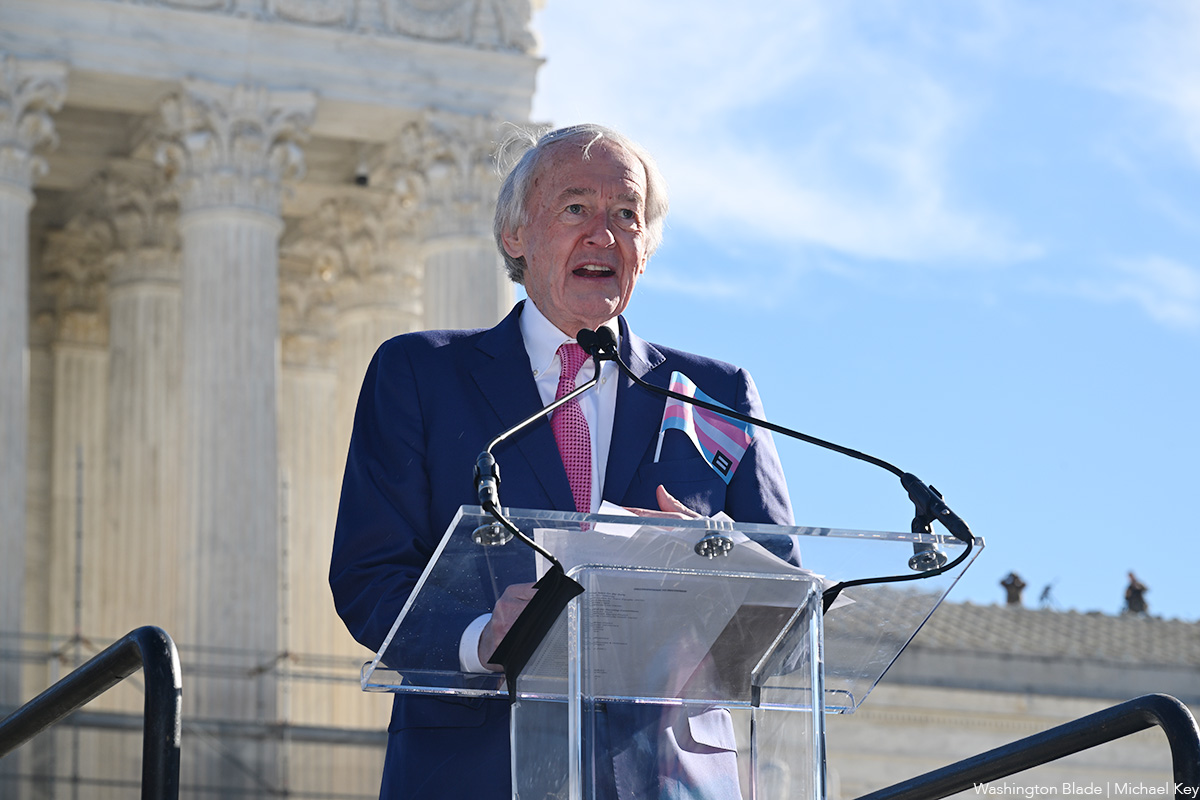
U.S. Sen. Ed Markey (D-Mass.) clinched the Democratic seat for his reelection campaign in Massachusetts’s primary election on Tuesday.
Markey won the deep-blue state with 64.8 percent of the vote, according to NBC News, triumphing over Marine Corps combat veteran and Congressman Seth Moulton, who received 35.2 percent of the vote.
Massachusetts’s primary election, which determined which Democratic candidate will head to the polls to face off against the Republican challenger in November, is being considered a victory for LGBTQ-inclusive policy, as well as for a divisive pro-transgender rights candidate — both things Markey has become an outspoken champion of.
Markey has experience at multiple levels of government, from the state level, where he served three terms in the state House of Representatives, to his federal tenure, including 20 terms in the U.S. House of Representatives and is now serving his second term as a senator. He has become a fixture of a changing Democratic Party in one of the most consistently blue places in the U.S.
This primary — and much of the national discussion surrounding the Senate seat — focused a lot of campaigning power on fighting the growing sentiment, led mostly by Republicans, that the frustration many Americans feel lends itself to an anti-establishment and anti-incumbent attitude.
Markey ran his campaign using his past as a reflection of his commitment to constantly putting his best foot forward for Bay Staters — particularly with apprehension for issues younger and more progressive democrats have been righting for — including Green New Deal and “Medicare for All” while Moulton — who was also elected to federal office prior to this run — campaigned on being younger than Markey, arguing that he was not the same type of established politician.
Moulton also faced backlash for negative comments about trans athletes, sparking criticism for those who did want younger candidate but want for trans rights to be protected.
Markey’s track record of supporting the LGBTQ community is one of the most clear in federal politics, one that has garnered a “100 percent lifetime voting record” on the Human Rights Campaign’s PAC politician review scorecard.
That list of Markey’s actions includes being a cosponsor of the Equality Act, driving landmark legislation to ensure federal protections for LGBTQ Americans, and being one of the most vocal proponents for trans rights in the federal government — specifically in multiple appropriations bills and in the National Defense Authorization Act. He was also the lead sponsor of the Transgender Health Care Access Act and the Transgender Bill of Rights resolution.
Markey first introduced the Transgender Bill of Rights in the Senate in 2023, where it ultimately failed to be brought to law. He reintroduced the legislation this year once again. This was a direct response to the attitude pushed by many conservatives after 2021, when the push to minimize trans rights started to become a key part of their cause and has been constantly propped up by the Trump-Vance administration.
“Massachusetts needs a senator who stands up and fights back, a senator who never forgets who they are fighting for,” Markey said during his victory speech. “That has been the mission of my life, and it always will be.”
Following the calling of the primary, a slew of LGBTQ organizations rallied behind Markey, many pushing his past as an asset that puts his money where his mouth is through advocating for legislation specifically protecting the LGBTQ community.
Tyler Hack, the executive director of the Christopher Street Project, an organization dedicated to pushing for legal protections for trans americans, released a statement following Markey’s win. Hack argued that putting forward such a staunchly pro-trans candidate is a win for the community, especially after endorsing him earlier this year.
“Tonight, anti-trans politics lost. Massachusetts rejected the idea that attacking transgender people is a shortcut to political power. Voters chose a different path: one where equality is not negotiable, cruelty is not courage, and transgender people do not have to disappear for Democrats to succeed.”
The Human Rights Campaign also endorsed him as a candidate earlier this year and issued a statement via its president, Kelley Robinson.
“Ed Markey has spent decades fighting for LGBTQ+ equality, for working people, and for a more livable world,” Robinson said. “He knows why equality matters. He’s stood with us no matter what. We were proud to endorse him this year, and when a pro-equality majority takes back the Senate this fall, we will continue to count on him as a champion for our community.”
Markey is running for reelection against Republican John Deaton in November, where he is expected to win.
Bulgaria
Top Bulgarian court rules government must legally recognize trans people
Decision caps off decade-long legal fight

Bulgaria’s top court has ruled the country’s government must allow transgender people to legally change their name and gender on ID documents.
A trans woman from Bulgaria who moved to Italy, had tried to change her gender and name on her Bulgarian ID documents, but courts in the country denied her requests for nearly a decade.
The Bulgarian Supreme Court of Cassation in a 2023 ruling essentially banned trans people from legally changing their name and gender on ID documents.
The EU Court of Justice in Luxembourg, which is the European Union’s highest court, in March ruled in the “Shipova” case that member states must allow trans people to legally change their name and gender on ID documents. The lead plaintiff in the “Shipova” case is among the four litigants in the Bulgarian Supreme Court of Cassation case.
Two Bulgarian advocacy groups — Bilitis and Deystvie — along with TGEU – Trans Europe and Central Asia and ILGA-Europe in a joint statement they issued on Tuesday noted the Bulgarian Supreme Court of Cassation’s July 22 decision “aligns Bulgarian practice with the Court of Justice of the EU, enabling changes to gender markers, names, and personal identification numbers.”
“The judges also concluded that EU law requires Bulgaria to establish a legal procedure for legal gender recognition, which is necessary so that Bulgarian trans citizens can travel and reside freely inside the EU,” they added.
Bulgaria has been a member of the EU since 2007.
The country borders Romania, Serbia, North Macedonia, Greece, and Turkey.
“We are very glad to see that the judges of the Supreme Court clearly stated that it is actually a matter of rule of law for Bulgaria to respect the universal equality and the dignity of all human beings, including trans people for whom human rights-based legal gender recognition procedures are an indispensable element,” said Denitsa Lyubenova, co-chair of Deystvie who represented the four plaintiffs in the Bulgarian courts and the lead litigant in the “Shipova” case at the EU Court of Justice. “The government needs to act swiftly now to put in place an LGR procedure that is fully in line with European human rights case law, which means without any conditions requiring proof of medical, surgical or hormonal treatment.”
The groups also urged the Bulgarian government to codify the ruling into law.
“While lower courts are expected to follow this ruling directly, a court decision is not a substitute for law,” they said. “Bulgaria still needs a fast, transparent, and accessible legal gender recognition procedure written into legislation, not left to case-by-case court precedent. TGEU – Trans Europe and Central Asia, Bilitis, Deystvie, and ILGA-Europe call on the Bulgarian government to start that legislative process now, with meaningful involvement from civil society.”
National
Lou Chibbaro Jr. documentary wins award from NLGJA
‘Lou’s Legacy’ produced by D.C.’s Mattachine Society

“Lou’s Legacy: a Reporter’s Life at the Washington Blade,” a documentary produced by The Mattachine Society of Washington, D.C., will receive an Excellence in Journalism Award from NLGJA, the Association of LGBTQ+ Journalists.
The film premiered on WETA PBS in D.C. and Maryland Public Television (MPT) in June of 2025. The documentary’s Emmy-nominated director and producer Patrick Sammon will accept the award for Excellence in Local Television on Sept. 11 at NLGJA’s National Convention in San Francisco.
“Lou’s Legacy” was produced in association with the Mattachine Society of Washington, D.C., a non-profit LGBTQ history society dedicated to conducting original archival research. Aside from Sammon, the NLGJA is recognizing other members of the film’s production team including Producer Julianne Donofrio, Editor Amir Jaffer, Executive Producer Charles Francis, and Executive Producer Pate Felts.
“Lou’s Legacy” tells the story of two D.C. icons — legendary Washington Blade reporter Lou Chibbaro Jr. and beloved drag performer Donnell Robinson, known to generations of Washington audiences as “Ella Fitzgerald.” Through Lou’s nearly five-decade career at the Blade and Ella’s return to the stage after a three-year hiatus following COVID, the 29-minute documentary explores the history of Washington’s LGBTQ community and today’s rising backlash against LGBTQ rights, including laws targeting drag performers.
“All students of journalism can learn a lot from the story of Lou Chibbaro, Jr. Lou has chronicled nearly five decades of LGBTQ+ life and the community’s struggle for equality in Washington, D.C. Lou’s work and the role of the queer press has been essential in covering stories the mainstream media would often ignore or erase,” said Ryan Levi, president of the D.C. chapter of the NLGJA.
“We are thrilled to receive this award from the NLGJA,” said the film’s director Patrick Sammon. “Lou Chibbaro’s nearly five decade career at the Washington Blade demonstrates the essential role LGBTQ journalism plays in telling our community’s stories and documenting its history. This recognition from journalists who follow in Lou’s footsteps is particularly meaningful to me and the rest of our production team.”

Markey’s primary win deemed success for LGBTQ activists

Top Bulgarian court rules government must legally recognize trans people

Lou Chibbaro Jr. documentary wins award from NLGJA

Beloved D.C. ‘Old Catholic’ Bishop Charles Braun dies at 86

Blade welcomes fall intern

E-INFOSOL leaders encourage youth to pursue tech careers

New book examines Trump cuts to LGBTQ healthcare

Immersive ‘Nation-State’ imagines a society free of authoritarianism

Poland begins to legally recognize same-sex marriages from other countries

HRC president campaigns for Chris Pappas in NH
-

 Technology5 days ago
E-INFOSOL leaders encourage youth to pursue tech careers
-
Books5 days ago
New book examines Trump cuts to LGBTQ healthcare
-
Theater4 days ago
Immersive ‘Nation-State’ imagines a society free of authoritarianism
-
Poland3 days ago
Poland begins to legally recognize same-sex marriages from other countries