National
Levin wants imminent vote on ‘Don’t Ask’ legislation
HRC fears acting too soon could doom vote
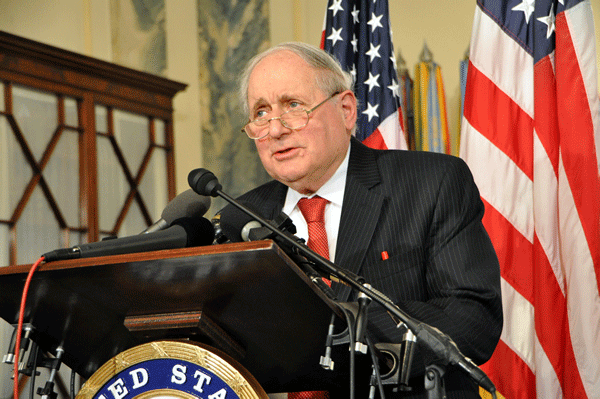
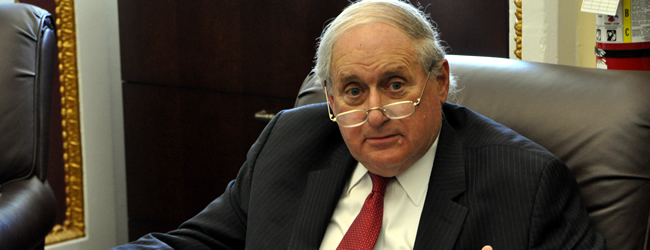
Sen. Carl Levin wants a vote this week on 'Don't Ask' legislation (Blade photo by Michael Key).
Senate Armed Services Committee Chair Carl Levin (D-Mich.) is calling for an immiment vote on “Don’t Ask, Don’t Tell” legislation as LGBT advocates fear moving forward with bill before negotiations are settled could doom the measure to failure.
On the Senate floor Thursday, Levin urged Senate leadership to bring to the floor before the week is out the fiscal year 2011 defense authorization bill, which contains “Don’t Ask, Don’t Tell” repeal language.
“If we don’t proceed on this bill this week, then invoking cloture sometime next week, even if we can do it, it would be a symbolic victory,” Levin said. “And I don’t believe that there would be enough time to hammer out a final bill before the end of this session.”
Levin noted that after passage in the Senate, the legislation would still need to go to conference committee before heading to the president’s desk. The Michigan senator said over the past 10 years, conferencing the legislation has taken an average of 75 days.
“Even if we get 60 votes today to invoke cloture on the motion to proceed to this bill, and even if we’re able to consider amendments and pass this bill in a few days, it will be a possibly insurmountable challenge to work out all of the differences with the House,” Levin said.
The Michigan senator concluded that the Senate would need to bring up the the defense authorization bill this week if the legislation is to be passed with the “Don’t Ask, Don’t Tell” provision intact.
“But the only way that this will be real and that the repeal of ‘Don’t Ask, don’t Tell,’ assuming we continue to keep it in the bill, will be real is if we proceed to the bill this week.” Levin said. “We cannot and should not delay this vote any longer.”
Levin’s remarks concerned “Don’t Ask, Don’t Tell” repeal advocates who feel going to the vote too soon could bring an unfortunate result.
Fred Sainz, the Human Rights Campaign’s vice president of communications, warned the Senate against taking up the defense authorization bill before negotiations over the legislation complete.
“If senators move forward with a vote on NDAA before a deal has been solidified, the vote will fail and all key players will share the responsibility,” Sainz said.
Senate Majority Leader Harry Reid (D-Nev.), earlier in the day said he’s “likely” to move forward with the defense authorization bill sometime on Thursday.
Reid has been in talks with Sen. Joseph Lieberman (I-Conn.), the sponsor of repeal language in the Senate, and Sen. Susan Collins (R-Maine), who’s seen as the most likely Republican to vote for the motion to proceed, to find sufficient GOP support in moving forward.
Assuming that all 58 members of the Democratic caucus vote in favor of the motion to proceed, repeal advocates would need to pick up at least two votes from Republican senators to meet the 60-vote threshold necessary to overcome a filibuster and move forward with the legislation.
Collins has said she would vote in favor of the motion to proceed only after she’s assured a fair amendment process for the defense authorization bill and only after the Senate first takes up the extension of the Bush-era tax cuts.



South Carolina
Who might replace Lindsey Graham? The contenders and their LGBTQ records
Long-time SC senator died suddenly on Saturday.
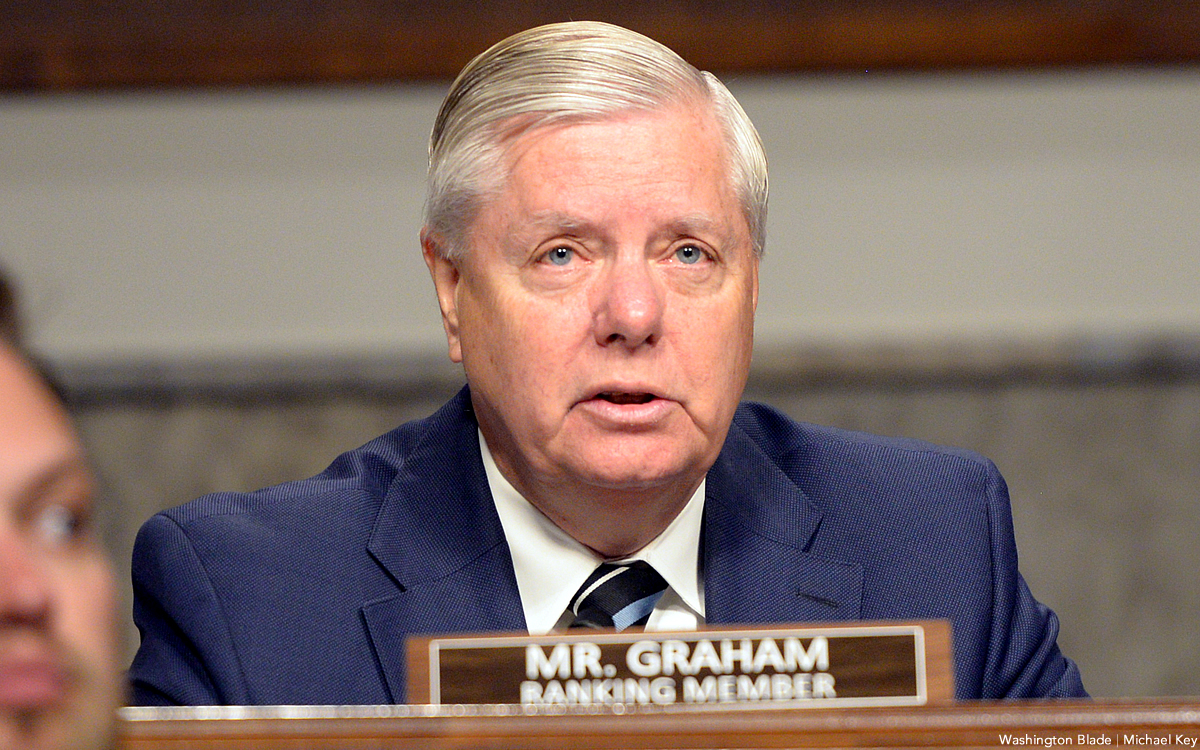
Republican U.S. Sen. Lindsey Graham (R-S.C.) has died, and what he has left behind is a power vacuum for his U.S. Senate seat — and within the Republican Party.
The South Carolina senator had been a major part of Republican politics up until his Saturday death at his home in Washington, reportedly of an aortic dissection related to arteriosclerotic cardiovascular disease.
Graham has been a fixture in government at both the state and federal level. He began his political career in the South Carolina House of Representatives in 1992, representing the Palmetto State’s 2nd District before eventually moving to the federal government.
He moved up to Capitol Hill after his 1994 run for the U.S. House of Representatives. In 2003 he stepped across the rotunda to the Senate in 2003 following the retirement of longtime U.S. Sen. Strom Thurmond.
He consistently opposed LGBTQ rights while alive.
He voted against the 2022 Respect for Marriage Act, saying the decision should be left up to state governments, and the 2013 Employment Non-Discrimination Act, and opposed the repeal of Don’t Ask, Don’t Tell.
With Graham’s sudden passing, the Republican Party is scrambling to find a replacement who can advance both its goals and those of the president as Republicans’ supermajority in the federal government begins to shrink.
Among those reportedly in the running is Treasury Secretary Scott Bessent, the highest-ranking openly LGBTQ federal official in American history and fifth in the presidential line of succession.
Bessent, a South Carolina native, was formerly a supporter of the Democratic Party and donated to several Democratic presidential candidates before switching parties in 2017 following Trump’s election in 2016. He later donated $1 million to Trump’s 2017 presidential inaugural committee.
On Sunday, Bessent was also fielding calls from people asking him to run, according to a person familiar with the communications. A person close to Bessent told Politico that he is not interested in the seat, saying he is happy in his role as Treasury secretary, a position he has long wanted.
The Washington Blade reached out to the Treasury Department for comment, but did not receive a response by publication time.
One of the most anticipated and widely discussed names for the vacant Senate seat is Lt. Gov. Pamela Evette.
Evette is a staunch supporter of President Donald Trump and has gone as far as criticizing Republicans for not supporting the conspiracy theory that the 2020 presidential election was stolen. Trump also endorsed her gubernatorial campaign, though she ultimately lost to her now-boss, Gov. Henry McMaster.
McMaster has a long history of opposing LGBTQ rights.
During an October 2022 gubernatorial debate, McMaster said that if the U.S. Supreme Court overturned Obergefell v. Hodges, he would enforce South Carolina’s preexisting law banning same-sex marriage. In 2022, he also signed legislation requiring student athletes from elementary school through college to compete on teams corresponding to the sex listed on their birth certificates.
Other names reportedly being considered include U.S. Rep. Nancy Mace (R-S.C.), who has had a contentious relationship with LGBTQ issues during her time in Congress. She began as a supporter of LGBTQ rights, becoming one of the few Republicans to publicly support the Respect for Marriage Act, before making a complete about-face as transgender issues became a central part of the Republican Party’s political strategy.
As part of that strategy, Mace introduced a resolution to ban trans women from using female restrooms in the U.S. Capitol, a move she acknowledged was in direct response to the election of U.S. Rep. Sarah McBride (D-Del.), the first out trans person elected to Congress.
In a November 2024 post on X, Mace wrote: “We support gay marriage, and voted for the Respect for Marriage Act twice. However, if you think protecting women is discrimination, you are the problem. We don’t care if you’re trans, if you have balls we don’t want you in the women’s bathroom.”
Two other names being floated are U.S. Rep. Russell Fry, who represents South Carolina’s 7th Congressional District, and U.S. Rep. Ralph Norman, who represents the state’s 5th Congressional District.
Trump recommended Graham’s sister, Darline Graham, should serve as the state’s temporary senator in a post on Truth Social on Monday.
“This would be a fabulous tribute to Lindsey, who loved her dearly!” Trump wrote on his social network.
The scramble comes as Republicans hold increasingly narrow majorities over Democrats in both the Senate and House, potentially complicating efforts to advance Trump’s agenda. That agenda includes continuing the war in Iran, securing Todd Blanche’s confirmation as attorney general, and adding $350 billion in defense spending to the SAVE America Act — a controversial proposal deemed a “Jim Crow 2.0” among voting rights advocates.
McMaster is expected to announce Graham’s interim replacement on Monday at 4 p.m.
Florida
Gay Fla. Democrat Elijah Manley sees opportunity in Trump’s second term
State’s 20th Congressional District’s includes Broward, Palm Beach Counties

Just over two and a half miles from President Donald Trump’s primary residence lies one of Florida’s most reliably Democratic congressional districts. There, a 27-year-old progressive is mounting a campaign centered on resisting what he calls the Trump-Vance administration’s attacks on civil rights, immigrants, and LGBTQ Americans.
Elijah Manley, an openly gay Democrat, sat down with the Washington Blade to discuss why he is running for Florida’s 20th Congressional District, why he believes this moment calls for a new generation of leadership, and what he hopes to accomplish if elected to Congress.
Born and raised in Fort Lauderdale’s historic Sistrunk neighborhood — the city’s oldest African American community — Manley was raised by a single mother who struggled to make ends meet. His family experienced housing insecurity and, at one point, homelessness, experiences he says continue to shape both his politics and his policy priorities.
For Manley, those experiences are precisely what he believes Congress is missing.
“I think now the country is in need of somebody like me, with my story, my lived experience, the struggles I’ve been through in my life. We’re going through a really dark time in the country with the Trump administration coming for our civil rights and an economy that is not working for everybody. In a time where we have MAGA fascism, we need progressive leadership, and we need people who are really going to do the work of fighting back and resisting and obstructing Donald Trump and MAGA Republicans’ agenda in Congress.”
Manley said his campaign is also about ensuring people from marginalized communities — those without wealth, political connections, or institutional backing — have a voice in Congress.
“I think my story sets me aside from everyone else. I’m the only one in this race who has a story to tell voters that lines up with their lived experiences and their struggles. Growing up in poverty and experiencing homelessness was instrumental in developing my worldview and how I fight for people, and I think that’s something that’s absent on Capitol Hill.”
He argues that lived experience offers a perspective often missing on Capitol Hill.
“There are too many lawyers and people coming from professional and political backgrounds. Then you have somebody like me who is rooted in the story of this district. That’s what sets me apart from everyone else in this race.”
According to his campaign website, Manley’s interest in public service dates back to childhood. He cites the election of President Barack Obama as a defining moment that inspired him to pursue politics.
“He was inspired by Barack Obama’s historic election, igniting his passion for public service. He began writing to elected officials, speaking at school board and city council meetings, and advocating for issues affecting his community,” the website states. It goes on to describe his involvement in criminal justice and law magnet programs, Navy JROTC, and hundreds of hours of volunteer service while in high school.
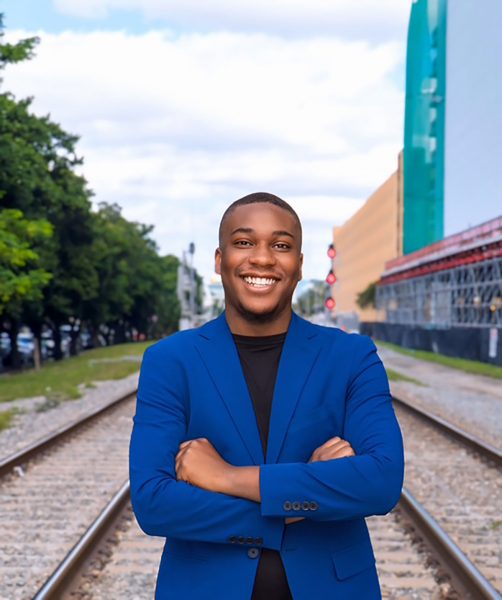
As an openly gay candidate running during Trump’s second administration, Manley said Congress must take a far more aggressive approach to protecting LGBTQ Americans, particularly as Republican-led states continue passing restrictions targeting transgender people.
“I think we need to bring the hammer down on some of these states. I’m not one of these states’ rights people — Congress has the power to preempt laws that states pass through the Supremacy Clause. There’s never been a more important time in our history when we’re seeing fascism, we’re seeing an administration out of control, and we need Congress to act.”
His campaign has also drawn criticism from both Republicans and establishment Democrats for his positions on Gaza, immigration, and his call to abolish U.S. Immigration and Customs Enforcement.
Manley said abolishing ICE does not mean eliminating immigration enforcement altogether.
“I’m not saying there should be no immigration laws. We want laws around immigration, but we want dignity. We don’t need a hypermilitarized, paramilitary group chasing people through the streets, terrorizing communities, churches, schools, and families.”
His personal experiences also inform his healthcare agenda.
“When we talk about healthcare, my experience growing up on Medicaid is seeing the failure of the government to expand Medicaid here in Florida, and now we’re seeing cuts from the Trump administration. I’m not just looking at statistics or numbers on paper — this is based on lived experience. I know how the people in this district are going to be hurt by these policies because I’ve lived it.”
California Democratic Congressman Ro Khanna, who has generated early buzz as a potential 2028 presidential contender for his “progressive capitalist” approach to governing, has endorsed Manley’s campaign, giving the first-time congressional candidate one of his highest-profile endorsements.
Manley faces six other Democrats in the primary, including U.S. Rep. Debbie Wasserman Schultz and former U.S. Rep. Sheila Cherfilus-McCormick, along with four Republican candidates in the general election field. Cherfilus-McCormick resigned from Congress ahead of a potential expulsion and is running again while facing federal criminal charges.
Despite running as the youngest candidate in the field, Manley said he hopes voters leave the race remembering one thing above all else.
“I want people to remember bold and authentic leadership. I want them to know I’m running because I’ve been through what people are going through right now — and it’s not that I’ve been through it, I’m actually still going through it. We need bold people who are going to fight for everybody and stand up for what’s right, and that’s what I hope voters see when they go to the polls.”
Florida
Former Fla. gubernatorial candidate Andrew Gillum arrested on drug charges
Democrat narrowly lost to DeSantis in 2018, later came out as bisexual
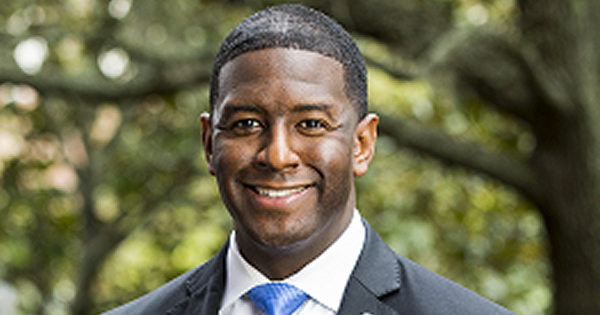
Andrew Gillum, the former Democratic nominee for governor of Florida and former mayor of Tallahassee, was arrested on drug possession charges in Alabama last week.
Police in Daphne, Ala., said they pulled Gillum over for erratic driving and found marijuana and methamphetamine in his vehicle. He was charged with possession of marijuana and unlawful possession of a controlled substance, according to the Daphne Police Department. Jail records show he was arrested on July 2 and released on July 3, the Associated Press reports.
Gillum, the first Black nominee of a major political party for governor in Florida, lost the 2018 election to current Republican Gov. Ron DeSantis in a highly contentious race.
Once considered a rising star in national politics, Gillum served in Tallahassee’s local government, first as a city commissioner and then as mayor of Florida’s capital from 2014- 2018.
The Daphne Police Department said officers stopped Gillum’s vehicle around 10:45 p.m. and initiated a probable cause search after one officer noticed a glass pipe on the center console.
During the search, officers found several rolled marijuana cigarettes and three packages containing a substance that tested positive for methamphetamine, police said.
The day after his arrest he was charged with possession of dangerous drugs, use or possession of drug paraphernalia, and possession of marijuana.
In 2020, Gillum was involved in a similar incident when he was found in a Miami Beach, Fla., hotel room with a man identified as an escort who had apparently overdosed on drugs. Police also found three bags of suspected crystal methamphetamine in the room. The man survived, and no one was ever charged with a crime.
Later that year, Gillum came out as bisexual during an appearance on “The Tamron Hall Show,” where he discussed his struggles with drug and alcohol addiction and his decision to seek treatment following the 2020 incident.
In the same interview he shed light onto this, saying his substance use was a byproduct of the emotional struggles he experienced after losing the 2018 gubernatorial race to DeSantis.
This is not the first time Gillum has faced legal scrutiny.
During his 2014 mayoral campaign, he faced allegations of misconduct after hiring private equity investor Adam Corey as his campaign treasurer, raising questions about a potential conflict of interest. However, the FBI ultimately concluded there was no conflict of interest.

New book reveals what we can learn from animal sex

Who might replace Lindsey Graham? The contenders and their LGBTQ records

PHOTOS: Westminster Pride

Un terremoto también se vive desde el exilio

PHOTOS: Emerald City Pride

Mr. Henry’s celebrates 60 years of proud inclusivity

It’s good to see some justices standing up to Trump

Egyptian authorities refuse to allow gay cruise to dock in country

Queer media dominates 2026 Emmy nominations