News
Will Obama speak out again on marriage lawsuits?
Many advocates would welcome continued participation
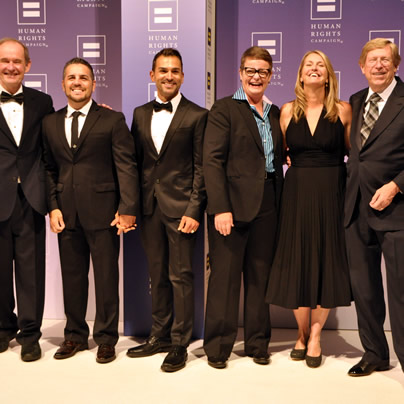
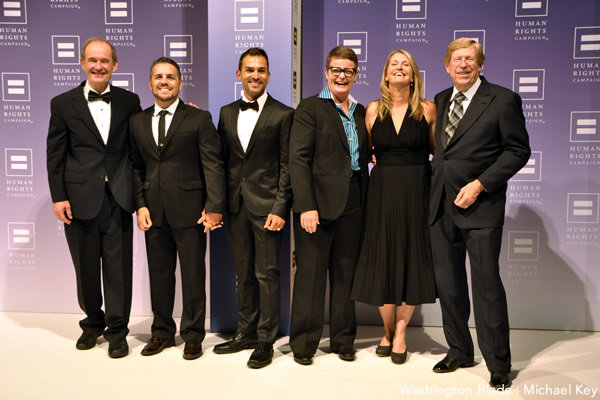
From left, lawyer David Boies , plaintiffs Jeff Zarillo, Paul Katami, Kris Perry, Sandy Stier and lawyer Ted Olson at the HRC National Dinner. Olson and Boies say they’d welcome President Obama’s participation in their lawsuit (Washington Blade photo by Michael Key).
Amid a frenzy of new marriage equality lawsuits making their way to the Supreme Court, some LGBT advocates say continued participation from the Obama administration in litigation would boost their chances for success.
One advocate eager for the administration to continue its participation in litigation seeking marriage equality is Evan Wolfson, president of Freedom to Marry.
“There are 20-some freedom to marry cases underway around the country now, including the two in Virginia, and President Obama’s and the Justice Department’s support for the freedom to marry and constitutional guarantees should absolutely be part of all of them,” Wolfson said.
Because the Obama administration isn’t a party to any of the lawsuits pending, under ordinary circumstances the administration would participate by filing a friend-of-the-court brief before the courts.
But at this stage, some legal experts who spoke to the Washington Blade are taking a more passive stance on whether the Obama administration should take part, saying they’d “welcome” help from the administration’s lawyers without issuing an overt call for action.
Ted Olson and David Boies, the legal duo that brought marriage equality to California by challenging Proposition 8, articulated this view during a conference call with reporters last week when asked by the Washington Blade if they want the administration’s support in Bostic v. Rainey, the lawsuit in Virginia they joined last week.
Boies, the Democratic half of the legal team representing the American Foundation for Equal Rights, said the administration’s participation would be welcome because “the views of the administration are important.”
“Exactly when they will get involved and how they will get involved and what stage they will get involved is something that is obviously up to the administration,” Boies said. “Whether they will decide to wait until we get to the Supreme Court or express views earlier is up to them. But whenever they come in, their support would be welcome.”
Boies’ comments during the conference call follow an endorsement of participation from the Obama administration in his lawsuit during a National Press Club event earlier in the day.
Echoing that sense was Olson, the Republican half of the legal duo that presented the case against Prop 8 during oral arguments before the Supreme Court.
“To have the president’s imprimatur on this issue is so very, very important to the court,” Olson said. “There are institutional reasons for why the Justice Department with the president gets in cases at particular times and we’ll wait till what they decide the right time is, but we very much welcome their support in this case.”
The administration has taken part in previous marriage lawsuits. When the case against Prop 8 came before the Supreme Court, the Justice Department filed a friend-of-the-court brief in favor of plaintiffs and sent U.S. Solicitor General Donald Verrilli to take part in oral arguments before the Supreme Court.
Although the administration didn’t argue the U.S. Constitution guarantees marriage rights for gay couples nationwide, it did contend Prop 8 was unconstitutional and suggested states that offer domestic partnerships should have to afford full marriage rights to gay couples.
The administration’s participation in cases against the Defense of Marriage Act has been more extensive. After announcing it would no longer defend the law in court, the administration filed briefs against the anti-gay law and sent Justice Department lawyers to argue against it in district courts, appellate courts and the Supreme Court.
The Bostic case is but one pending marriage equality lawsuit. According to a tally provided by Lambda Legal, there are 35 marriage lawsuits before 19 states. Just last week, Lambda filed an additional federal lawsuit seeking marriage equality in West Virginia.
Suzanne Goldberg, a lesbian and co-director of Columbia University’s Center for Gender & Sexuality Law, said the involvement from the administration in the marriage lawsuits would reinforce that “the lives of all Americans are deeply affected when states discriminate actively against some of their constituents.”
“The Justice Department’s participation puts additional moral force behind the claims for equality and fairness that gay and lesbian couples make in these cases,” Goldberg continued. “In that sense, the federal government’s participation in state law challenges can be important and helpful, but even if it does not participate, it is also important and helpful that the administration is on record decrying the injustice of unequal marriage rules.”
But the sense that the Obama administration should file additional friend-of-the-court briefs in the marriage lawsuits isn’t universal.
Roberta Kaplan, a lesbian attorney at Paul & Weiss who argued against DOMA before the Supreme Court, said she’s unsure additional friend-of-the-court briefs are necessary.
Courts already know the Justice Department’s position in the aftermath of the Perry case, Kaplan said, and filing additional briefs in every marriage lawsuit out there would be “frankly, a logistical pain in the butt for them.”
“What they said in Perry pretty much answers the question,” Kaplan said. “Frankly, a court knows what their position is because they’ve said it. It’s the same issue…There should be no mystery to anyone what their position is.”
Kaplan said if the administration would participate, chances are it would happen at the appellate or Supreme Court level.
“I’m sure at the Supreme Court, when and if one of these cases gets up there, they will be asked to participate and they will,” Kaplan said. “At the appellate courts, I think it pretty much depends on which case and whether they’re going to have a policy of putting in the same brief in 20 different cases that all say the same thing when they’ve already done it once.”
The Justice Department hasn’t responded to repeated requests for comment. The answering machine at the public affairs line says it will respond to calls in the aftermath of the government shutdown.
The administration may not be able to participate in a marriage equality case as long as the government remains closed. According to the shutdown plan on the Justice Department website, civil litigation, the category of litigation for marriage lawsuits, will be “curtailed or postponed.”
“Litigators will need to approach the courts and request that active cases, except for those in which postponement would compromise to a significant degree the safety of human life or the protection of property, be postponed until funding is available,” the website states. “If a court denies such a request and orders a case to continue, the government will comply with the court’s order, which would constitute express legal authorization for the activity to continue.”
But if the Obama administration were to file a brief in a marriage case before an appellate court, the one for which the opportunity is coming soon is in the case challenging the same-sex marriage ban in Nevada known as Sevcik v. Sandoval. The case, filed by Lambda, is pending before the U.S. Ninth Circuit of Appeals and is one of the cases that has thus far advanced the furthest. Friend-of-the-court briefs are due Oct. 25.
Lisa Hardaway, a Lambda spokesperson, said the attorney working on the case would welcome support from the administration.
“Tara Borelli, our lead attorney on the Sevcik matter, says that we would welcome a brief from the Obama administration,” Hardaway said.
Considering Lambda in the Sevcik case is arguing the ban on same-sex marriage in Nevada is unconstitutional because the state is relegating gay couples to second-class domestic partnerships, the case seems like a natural fit for an administration that has previously said all civil union states should offer marriage to gay couples.
But Kaplan said the more interesting question is whether the administration will articulate a response in the marriage lawsuits that are contending a state must recognize a same-sex marriage from another jurisdiction. Among these cases is Whitewood v. Corbett, the marriage lawsuit pending in Pennsylvania.
“I think the more interesting issues are, frankly, like when the issues come up about recognition…of marriages in states that don’t permit,” Kaplan said. “That at least presents a different question than something they’ve already put out.”
Chad Griffin, president of the Human Rights Campaign, said “it goes without saying” that he shares Olson and Boies’ views and predicted the Obama administration would come on board based on its previous actions and stated commitment to LGBT rights.
“The administration not only stopped defending the Defense of Marriage Act, as you know, but weighed in as we all hoped they would, and encouraged them to, in the Prop 8 case, going the distance there in that case before the Supreme Court,” Griffin said. “And again, we’re just announcing this case today and it still has a distance to go, but I’m optimistic that at the right time, the administration will be there in support of this.”


U.S. Supreme Court
Supreme Court rules against Colo. law banning conversion therapy for minors
8-1 decision could have sweeping impact
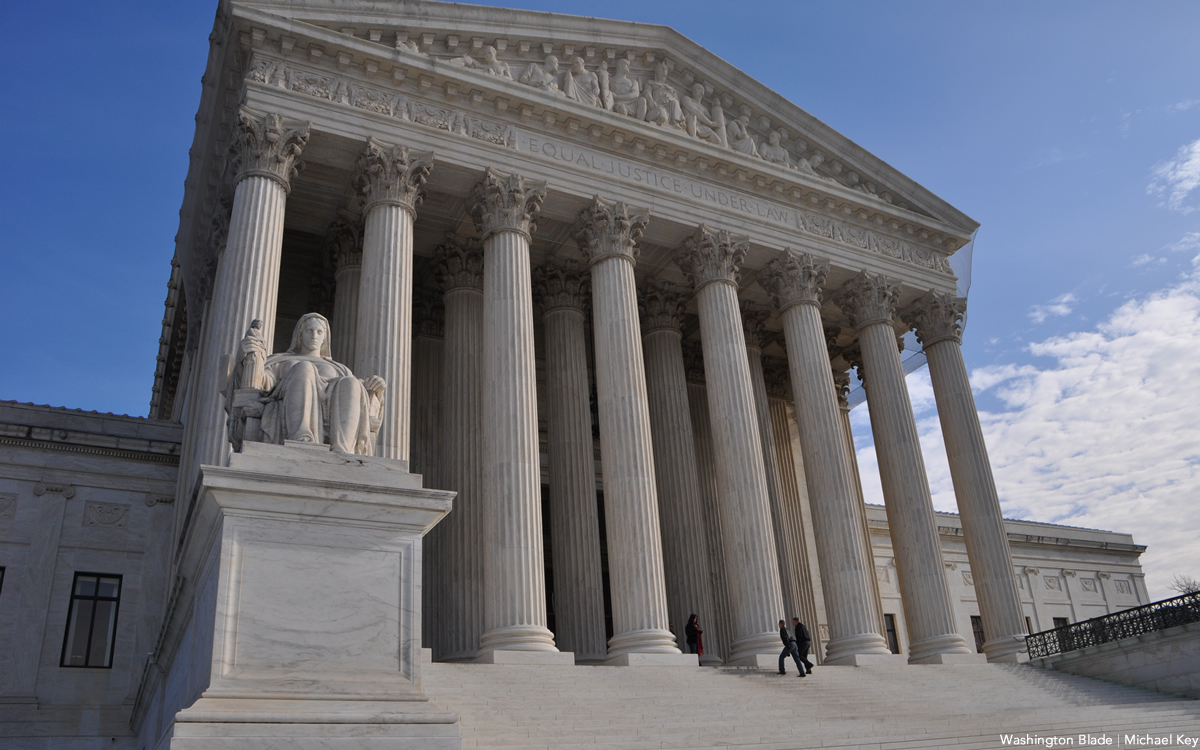
The U.S. Supreme Court on Tuesday ruled against a Colorado law that bans so-called conversion therapy for minors.
The justices last October heard oral arguments in Chiles v. Salazar. They ruled 8-1 in favor of Kaley Chiles, a therapist who challenged the 2019 law.
More than 20 states and D.C. ban the widely discredited practice for minors.
The Washington Blade will update this article.
The White House
Thousands attend ‘No Kings’ protests in D.C.
Protesters demand accountability, defend democracy, and oppose Trump administration
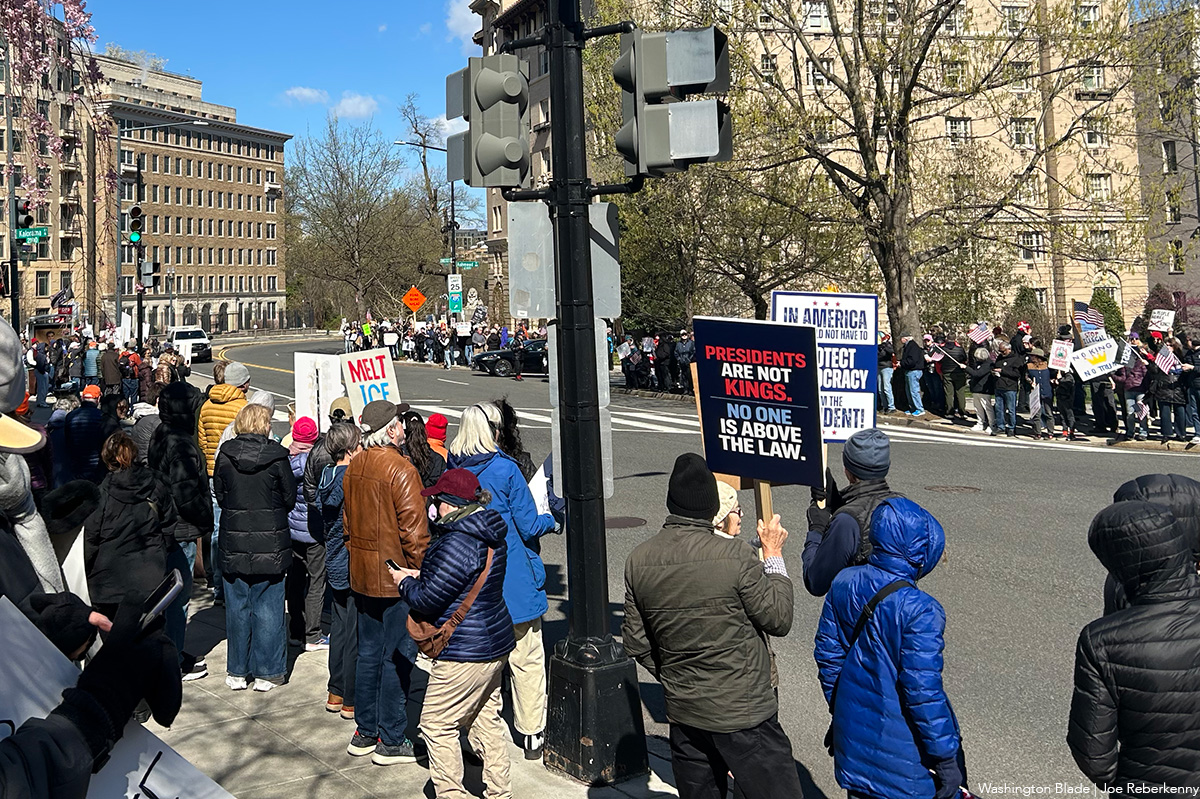
Across all 50 states — and D.C. — more than 8 million people came out nationwide from towns big and small, red and blue, to make their voices heard. That united voice echoed what nearly 20,000 protesters declared in the nation’s capital back in October 2025: the citizens of the U.S. would not sit idly by as President Donald Trump and his administration erode democracy, attempt to restrict human rights, loosens First Amendment protections, and begin wars without congressional approval.
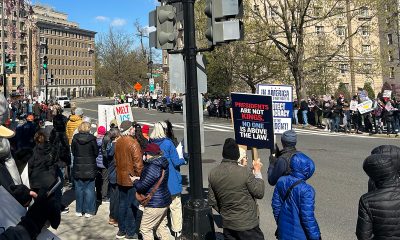
While there were countless differences among the thousands who joined the “No Kings” protests this weekend in the DMV — from creeds and socioeconomic statuses to races, sexualities, and gender identities — there was one thing that united them all during the chilly March 28 weather: a commitment to making their voices heard.
By 10 a.m., the Washington Blade estimated around 200 people had braved bitter winds and temperatures hovering around 40 degrees, with bright sun, to stand along the cherry blossom-adorned streets of Kalorama and Connecticut Avenue. Protesters carried signs large and small from criticizing Trump’s disregard for the “everyman” to handmade signs emphasizing love, calling for the melting of ICE, and addressing issue-specific concerns like ending the wars in Gaza and Iran — both policies propagated by Trump.
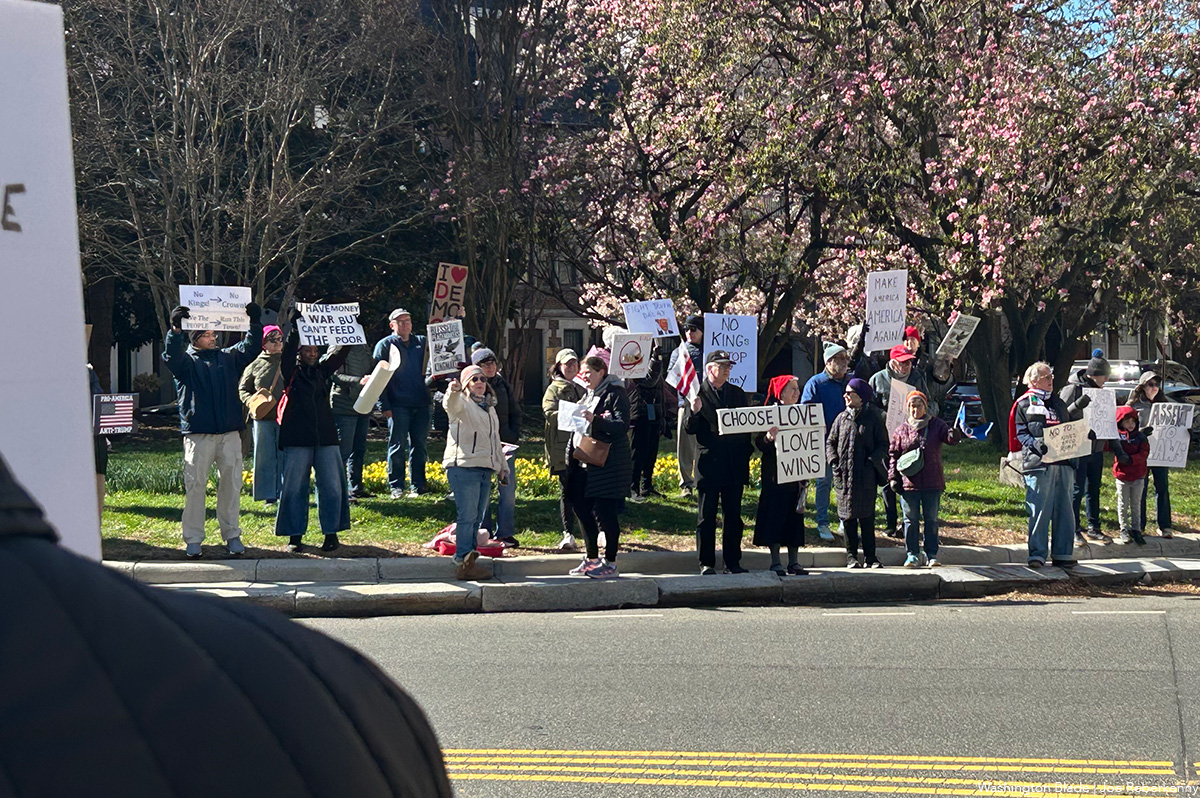
While a solid group of D.C. residents came out with babies in strollers and dogs on leashes, the Kalorama protest skewed older with a majority-white crowd.
On the other side of town, the more heavily attended protest in Anacostia started at 1:30 p.m., crossing the Frederick Douglass Bridge.
MS Now estimates that over 20,000 people marched across the bridge, sending a clear message to the president, his administration, and the Republican-controlled federal government: federal overreach is not what the majority of Americans want to see, hear, or witness as protesters in the thousands came out for, as organizers say “the single largest non-violent day of action” in American history.
The two marches on Saturday differed in both theme and location — the Kalorama protest felt like a small-town demonstration in a big city, covering a wide variety of topics, whereas the Anacostia protest was more focused, directly calling out and pushing back against the actions of Stephen Miller (the White House chief of staff)and other Trump allies.
Many participants shared their reasons for marching with glee — shouting as cars honked in support passing by and discussing the broader issues within the current political climate with those standing next to them: some neighbors, some friends, others complete strangers. Regardless, an important discussion was happening across the city.
A surprise to many participants — and the Blade reporter covering the event — was seeing U.S. Rep. Sara Jacobs (D-Calif.) stand outside in near-freezing temperatures with her staff and some signs.
Jacobs used the exclusive — and more intimate — ability to speak on her experience watching everything unfold from inside the halls of Congress.
“We had votes until midnight last night, so I couldn’t make it back to San Diego for the march, but it’s important to show up and cheer on people standing up and making their voices heard,” Jacobs said. “This is just the start. We need to make our voices heard every day through the end of the year.”
Jacobs also used the opportunity to criticize congressional inaction from those on the other side of the aisle, reminding the Blade that a legislator’s job is to protect and secure the people they represent — not the interests of a wannabe king or corporations that back many congressional campaigns through PACs.
“It makes me angry at my Republican colleagues who won’t stand up to Trump. Actions like this inject courage into my colleagues — they need to see that the American people have their back,” she added, eventually emphasizing the public responsibility lawmakers have to protect the Constitution and everyone in the country (which the Supreme Court had pointed out as far back as 1886 with Yick Wo v. Hopkins). “Congress is not going to save people. This is about everyone showing up and making our voices heard and building the democracy we want.”

Ashley Gould, a tourist visiting from Missouri, told the Blade that despite Washington being seen as one of the most politically active towns in the country, over the past few years, she and many other politically active Missourians have been preparing for this moment and were zealous to have their voices heard together as one.
“I’m actually visiting my sister from Missouri, and we’ve been doing this since the first No Kings protest [there]. I wanted to see how you guys did it here,” she said. “As someone in a red state, we’re not represented in Congress right now, so I don’t personally have a say in any of this. If I can do one small thing, I want kids in our town to see me trying to make a difference, get petitions signed. This is all we have.”
Gould continued, “I don’t know if it’s going to cause an impact for elected officials, but I hope that little kid who sees us with the posters sees that we do have a voice—and maybe one day they can, if they can’t right now.”
Gary Bowman, another early protest-goer, held a sign that pointed out the obscurity — and unconstitutional nature — of the current administration’s actions.
“I hate the direction the country is going in, and Donald Trump is not fit to be in office,” Bowman said, adding that his choice of sign exemplified that. “It’s obvious based on his policies — his attacks on the trans and LGBTQ communities — that he’s trying to suppress people. And the Republican Congress isn’t helping.”
When asked how the phrase “No Kings” resonates with him, especially since this is the third one held in two years, Bowman said it may be catchy for headlines or help inspire creative signs (like Trump on a golden throne or toilet), but the march and protest are about something much more important.
“‘No Kings’ is a catchphrase for me; I’m more concerned about losing our democracy. We, the people, have a voice we should use,” he said, elaborating on how this administration’s course of action disregards rules designed to prevent an authoritarian — or wannabe-authoritarian — from taking power. “I don’t think Trump is overstepping … I think he’s shattering democratic norms. He wants to do what’s right for Donald Trump, not for anyone else.”
He concluded bluntly that unless everyone — including Republicans in power — stand up to the president for these ludicrous choices, change won’t happen, regardless of how loud he or any other Trump critics scream at protests.
“Until we have a Congress that would actually look at protests and take action, it won’t matter. He’ll just get pissed off and act against them,” Bowman said.
When asked what he could say to those in charge, he finished strongly: “If I could say one thing to him? Fuck off, Donald Trump.”
Jameson Woosley and Elena Lacayo were standing on the corner of Kalorama Road, holding their baby tight as pink cherry blossom trees swayed behind them, as if to cheer on the protesters.
“It’s the degradation of democracy. Every day there’s an overreach by the executive branch, and Congress just sits on their hands,” Woosley said, standing side by side with Lacayo.
“It’s terrifying for my baby. This administration has turned people who’ve done nothing wrong into criminals — it’s Orwellian. Up is down, war is peace,” Lacayo noted. “I was raised in another country with authoritarians… I’m a citizen here, and I’m going to use every right I have to advocate for those who can’t.”
Lacayo then spoke about how, for many, direct protests against government action (and inaction) are the only choice — especially under a supermajority federal government with the White House, Supreme Court, and both chambers of Congress.
“We have no choice but to believe change can come. This is what we can do. We must continue fighting; that’s what the human spirit is about,” she said.
Woosley emphasized the growing impact of the protests, saying, “Every protest gets bigger, and opinion polls keep swinging in the right direction … We need to speak up and get all the right people out to bring positive change.”
“These people are nothing without us,” Lacayo added.
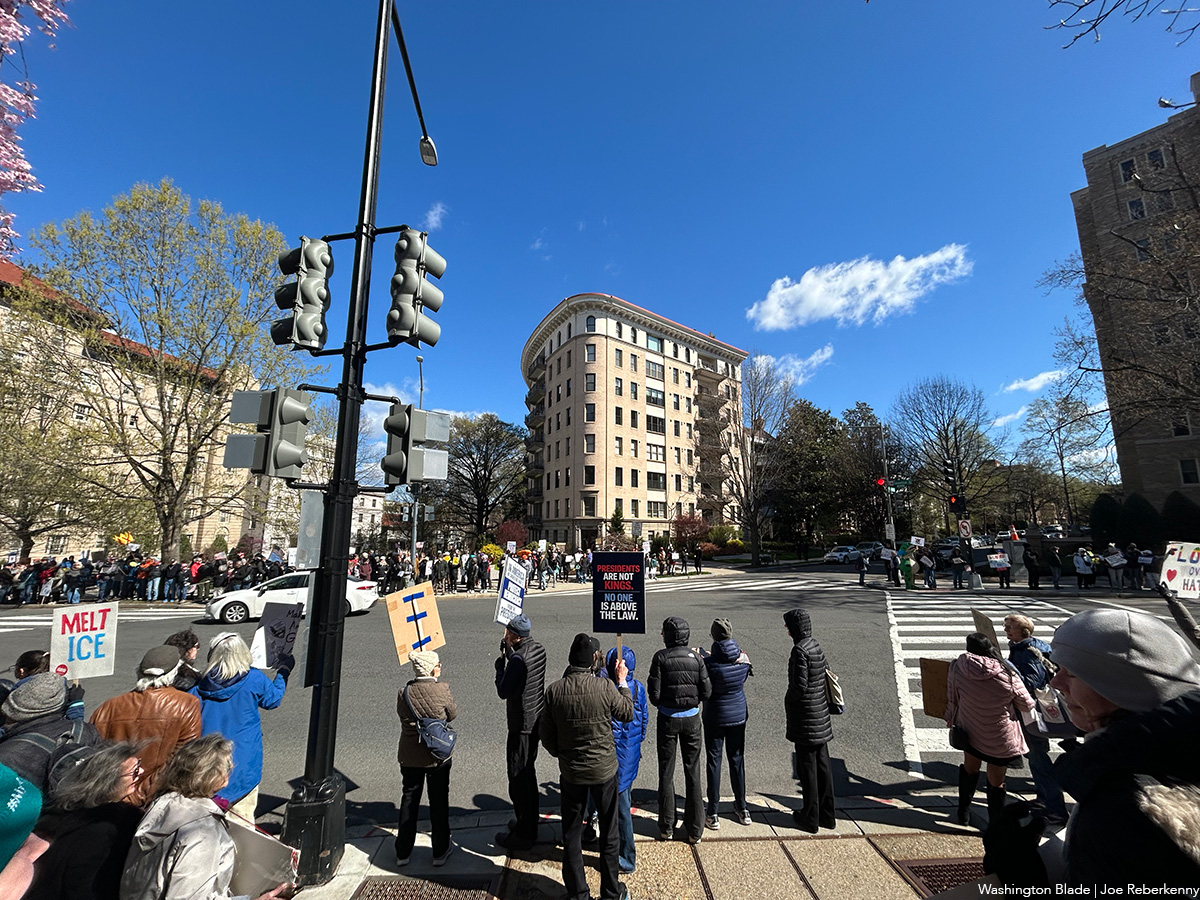
Beth Davis, a former resident of Kalorama, shared with the Blade that this place holds special meaning for her — and her children — which is in part why she chose this one over the larger protest in Anacostia.
“I used to live in the neighborhood, so this is special for me. It’s easy to bring the kids and let them be part of the movement,” Davis said, as her elementary-aged children ran around the manicured grass while bundled up, enjoying the lively atmosphere.
“What’s happening to immigrant communities is horrific, and I want to show solidarity. Also, the Iran war — it’s terrifying what’s happening,” she added before explaining what the “No Kings” name actually means to her. “’No Kings’ makes me think of the extreme grab for power — it’s unprecedented.”
Davis then noted the importance of protesting when it seems like the main goal is often to iisolate : “Coming to protests makes people feel like they’re not alone, and that momentum carries into elections,” she explained, noting why she not only brought her two children to this protest—and many others in the past as well– but uses these as real world teaching moments. “We bring kids to teach them their civic responsibilities. My oldest has been to about ten protests.”
Another remarkable aspect of D.C. protests is the diversity of participants. Teachers, retail workers, students, and even some congresspeople turned out. In Kalorama on Saturday, the No Kings protest brought out Anne Plant, a biochemist and fellow at the National Institute of Standards and Technology, where she was previously chief of the Biosystems and Biomaterials Division.
Plant focused on many issues when speaking to the Blade, but started with what many consider the most important: Trump-era policies making civic engagement more difficult, particularly regarding civil rights.
“A lot of things are going wrong, and the only way to change them is for people to act. D.C. has no statehood, no vote — it’s a civil rights issue,” Plant said. “To deny the vote to any group of U.S. citizens doesn’t make sense. These people work for us; we should be able to hold them accountable.”
She held a small, hand-painted sign with two cohesive messages: “Reject Fascism. Defend democracy.”
“Some of what’s going on now is not healthy for society. No one will benefit; it’s just ruination,” Plant concluded. “Seeing more people out here shows that others feel the same, and momentum is what it takes to move things.”
Religious activists also joined the marches. Sister Diane and Sister Claire, two Catholic nuns, were out protesting Trump and his agenda.
“We’re sisters, Catholics in support of LGBTQ rights. I work with immigrants, and we wanted to stand in solidarity,” Sister Diane said.
Sister Claire reflected on the era the U.S. is in now: “It’s so disturbing. I’m almost glad my folks aren’t alive anymore for all they cared about. It’s heartbreaking, but we need something for the future.”
John Jones, another attendee teeming with energy and anger against the regime, captured the urgency of the moment succinctly.
“We’ve got to do something. I needed to be part of the community and let them know we’re tired of all the madness,” Jones told the Blade before detailing specific atrocities by the Trump-Vance administration.
“Rounding up legal people who follow the rules — throwing them away just because he’s racist, or his friends tell him to be racist. Helping pay for a war, bombing Gaza, killing people for no reason, manipulating the stock market for personal gain. It’s crazy,” he said, still holding out hope that small acts — like the protest gathering — show everyday Americans they have power, advocating for even more people to come out for the next No Kings protest.
“I hope protests can spark change. I won’t hold my breath, but the more people out here, the more they [in power] seem to be listening.”
Patty Bowring, who had moved with her family from the United Kingdom to join her husband in D.C. for his career, is set to return soon due to immigration restrictions. She, her children, and her mother came out to protest because she believes it is just as important for non-citizens to have the right to both protest and exist in a country founded and enriched by immigrant and enslaved labor.
“Even though we’re British, we’re leaving America in two months because of the administration. But this affects everybody — it’s hugely dangerous and worrying,” Bowring said.
Despite the somber mood, she kept a smile and joked: “I hope it’s the death of dinosaurs and that nothing more radical comes next. I want them to be happy,” also pointing out that the mixed messages at the protest could dilute impact. “Protests need a clearer message. ‘Anti-fascist’ should be the focus; too many other messages muddy things.”
Finally, John Norrin highlighted the continuity of civic engagement, informing the Blade that this protest — albeit a smaller version — happens every week on the corner.
“I’m here with friends, looking for more,” Norrin said. “There’s a regular protest every Thursday morning, and I’m going to start joining … The kings today are mostly figureheads, but we also have dictators not called kings who act like one. We have an elected representative trying to be a king.”
He, much like others around him — even with Jacobs standing mere feet away — criticized Congress’ inaction.
“Congress is understepping. They should assert their rights under Article One — declare war, impose tariffs — but they’re too afraid to follow their oath,” Norrin said, eventually shifting to a note of hope. “If at least 3.5 percent of the populace regularly protests, there’s a good possibility for change. I hope that happens here. Some friends will go to Connecticut to join larger groups. I had to figure out which protest in D.C. to join—it took a while.”
District of Columbia
Blade contributor, husband exchange vows in D.C.
Yariel Valdés and Kevin Vega held ceremony at Jefferson Memorial on March 23

Washington Blade contributor Yariel Valdés and his husband, Kevin Vega, exchanged vows at the Jefferson Memorial on March 23.
The couple married in Fort Lauderdale, Fla., on Nov. 24, 2025. The Jefferson Memorial ceremony — which Blade International News Editor Michael K. Lavers and Samy Nemir Olivares officiated — coincided with the third anniversary of Yariel and Kevin’s first date.
Yariel in 2019 asked for asylum in the U.S. because of the persecution he suffered as a journalist in his native Cuba. He spent nearly a year in U.S. Immigration and Customs Enforcement custody before his release on March 4, 2020.
Yariel wrote a series of articles about his time in ICE custody that the Blade published. The series was nominated for a GLAAD Media Award in 2022.
Yariel and Kevin live in South Florida.

Supreme Court rules against Colo. law banning conversion therapy for minors

Thousands attend ‘No Kings’ protests in D.C.

Blade contributor, husband exchange vows in D.C.

Ghanaian president welcomed to Philadelphia amid backlash over anti-LGBTQ bill

PHOTOS: ‘No Kings’ rally and march

Introducing the Torchbearers Awards honoring queer, trans women and nonbinary people

New IOC policy bans trans women from Olympics

‘No Kings’ protests set for D.C.

Border to border: modern slavery and human trafficking in refugee movements across East Africa

Celebrate cherry blossoms the drag way
-

 a&e features5 days ago
Introducing the Torchbearers Awards honoring queer, trans women and nonbinary people
-
Sports5 days ago
New IOC policy bans trans women from Olympics
-
District of Columbia5 days ago
‘No Kings’ protests set for D.C.
-
Opinions5 days ago
Border to border: modern slavery and human trafficking in refugee movements across East Africa