Movies
Tab today
Hunky ’50s actor on Divine, Tallulah and more
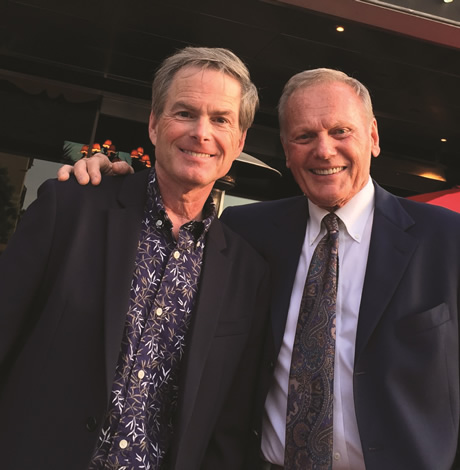
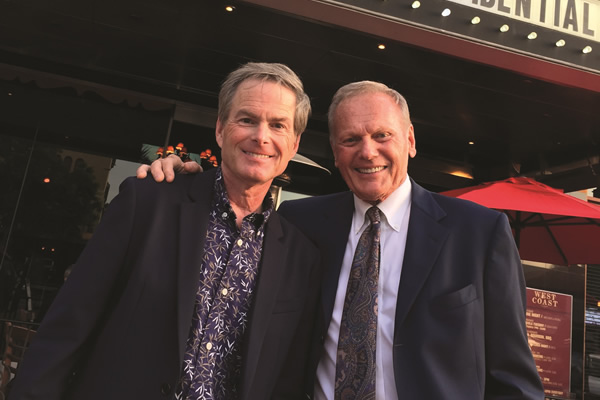
Tab Hunter, on right, credits his partner Allan Glaser, on left, with bringing his life story to the screen. (Photo courtesy the Film Collaborative)
‘Tab Hunter Confidential’
Oct. 23-29
Friday, Oct. 23 at 4 p.m.
Saturday, Oct. 24 at 5:30 p.m.
At age 84, openly gay actor Tab Hunter still has the boyish good looks, easy charm and buoyant optimism that made him one of Hollywood’s leading heartthrobs in the 1950s. He’s happy to be back in the spotlight with the release of the new documentary “Tab Hunter Confidential,” based on his 2006 memoir.
Hunter credits his long-time partner, Hollywood producer Allan Glaser, with getting him to write the memoir. Hunter remembers, “Allan said, ‘I think you should write a book,’ and I said, ‘Who would read a book about me?’ Allan said, ‘You’d be surprised.’ So I thought about it long and hard. I finally figured they may as well get it from the horse’s mouth and not from some horse’s ass after I’m dead and gone.”
In the book, Hunter confirmed decades-old rumors about his sexuality, including his relationship with Anthony Perkins. Looking back at their relationship, Hunter remembers that Perkins was different than his screen persona.
“Tony Perkins had a reputation for being very broody,” Hunter recalls. “Broody was very big in Hollywood at that time. And he was very moody, but he was also very intelligent with a quick sense of humor.” They were involved with each other for three years, but drifted apart after Hunter suspected that Perkins stole a plum role from him.
Hunter’s memoir was a big hit and Allan started work on a film documentary version. Hunter is proud of his partner’s work on the film. “Allan worked really hard putting it together,” he says. “The producer is the person who causes it all to happen. He raised all the money, hired the director, got all the interviews and stills. It took him six years to do it.”
“Tab Hunter Confidential” will be bringing Hunter to the D.C. area this week. The film opens tonight (Friday, Oct. 23) at the Angelika Pop-Up at Union Market and Hunter will be there in person on Sunday, Oct. 25. The film will also be part of the Middleburg (Virgina) Film Festival this weekend and Hunter is looking forward to being back in Virginia. “I am so looking forward to that. I used to have a farm out there. That’s heaven on earth, one of my favorite places in the world,” he says. “Sheila’s done a great job with that festival.”
The teen idol and gay role model was born Arthur Andrew Kelm in New York City in 1931. After brief stints in the Coast Guard (he was discharged for lying about his age) and at a riding academy (he’s had a life-long love of horses), the fledgling actor got an introduction to famous Hollywood agent Henry Willson. Willson renamed him, saying that he wanted to “tab” him with a catchy new name. “Hunter” came from his skills as a horseman who rode hunters and jumpers.
Hunter wryly remembers that Willson originally wanted him to change his name to “Troy Donahue.” He scoffs, “Can you believe that Henry Willson wanted to stick that name on me?” Ironically, the name later want to another New York native named Merle Johnson who succeeded Hunter as Hollywood’s leading heartthrob.
The newly minted Hunter was quickly snatched up by the legendary Jack Warner at Warner Brothers. Despite rumors about his sexuality, Hunter quickly became a star. From 1955 through 1959 he was the top grossing star for Warner Brothers and his chart-topping singles also helped to launch the Warner Brothers Records label.
As the new documentary details, Hunter grew frustrated by his restrictive deal with Warner Brothers and he bought out his contract with the studio. Unfortunately, without the protection of the studio’s press office, and with the rise of new heartthrob Troy Donahue, Hunter slid into infamy and then obscurity. He starred on Broadway with his friend Tallulah Bankhead in Tennessee Williams’ “The Milk Train Doesn’t Stop Here Anymore,” but the show only lasted five performances. Hunter also worked in dinner theaters across the country as well as appearing as a guest star in numerous television shows and acting in a number of B-movies. Things changed in 1981 when he got a call from trashy film director John Waters.
“John called me when I was doing a play in Indianapolis,” Hunter says. “He asked if I knew who he was and I said I was a big fan. I loved ‘Mondo Trasho’ and ‘Pink Flamingos.’ And then he said, ‘Before we go any further, how would you feel about kissing a 350-pound transvestite?’ I said, ‘Well, I’ve kissed a hell of a lot worse.’”
With that, Hunter was cast in the cult hit “Polyester” and sprang back into the public spotlight. He was only on the set for a week (that’s all Waters could afford), but Hunter still has fond memories of that shoot and his plus-size co-star, Divine. “John is such a great character,” Hunter says. “He’s like a friendly undertaker. He’s one of the sweetest people in the world with his little Adolphe Menjou mustache. He’s so creative. He is just wonderful. So was Divine. That was a lot of fun.”
Hunter’s appearance in “Polyester” also led to his meeting with his partner of 30-plus years. “I originally met Allan at the studios at Twentieth Century Fox,” Hunter says. “I brought him a project I’d been working on called ‘The Reverend and Rosie.’ He liked the idea. It was his idea to change the title to ‘Lust in the Dust’ and to bring in Divine and Lainie Kazan. The only sad thing is that we didn’t get John Waters to direct, but we sure tried.”
Nowadays, Hunter spends most of his time on his beloved Santa Barbara ranch with Allan and his horses, but he’s enjoying promoting the documentary and meeting fans old and new.
“I was an old man just out at the barn every day with my horses shoveling out the real stuff,” he says. “But they’re really keeping me busy with the documentary. I’m just overwhelmed by the response.”





Movies
Controversial ‘Blue Film’ pushes past taboos for gripping drama
Two-character psychosexual drama explores Dom-sub encounter
When movies are labeled as “controversial,” the effect is often akin to Oscar Wilde’s quip that “there’s only one thing in life worse than being talked about, and that is not being talked about.”
Indeed, a whiff of controversy can be the best publicity of all, turning a movie that might otherwise have been no more than a blip on the cultural radar into the buzziest “hidden gem” of the season – and “Blue Film,” a two-character psychosexual drama about an encounter between a male sex worker and a much-older client, is a perfect example. The debut feature of filmmaker Elliot Tuttle, it was rejected for inclusion at last year’s Sundance and SXSW festivals before finally premiering at the Edinborough International film fest; and even then, some audience members were walking out of the theater in disgust.
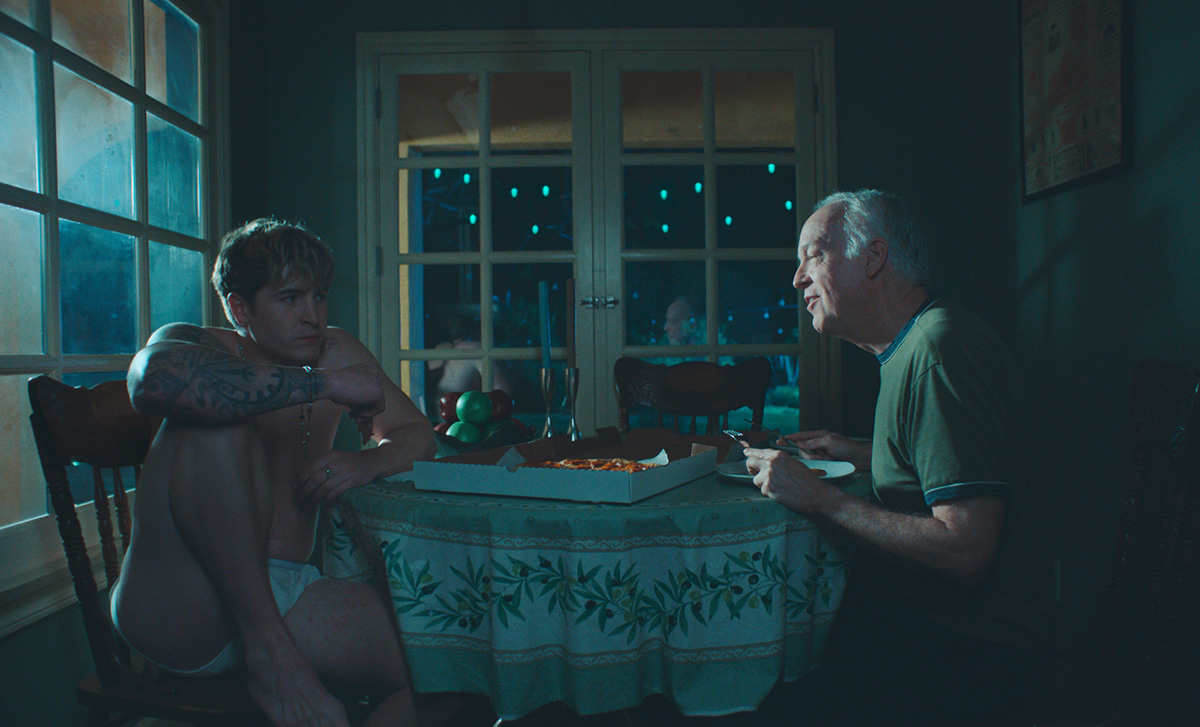
It’s easy to see why, really. The taboos it breaks run far deeper than just frank depiction of queer sexuality to rattle some among the ones most hard-coded into our cultural DNA, and the directness with which it pushes past our comfort zones is merciless. It begins with Aaron Eagle (Kieron Moore), a Los Angeles “fetish cam-boy” who specializes in financial humiliation and domination, proudly performing for his online fans by fondling his stacked physique on camera while deriding them with homophobic slurs and other forms of verbal abuse. He also taunts them by bragging that one of them is paying $50,000 to be abused in person overnight.
When he shows up for the gig, he’s greeted by an older man in a ski mask (Reed Birney), who wants to begin their session by asking him questions on camera about his personal life. Aaron agrees, but makes up the answers, only to have the client call out his lies; the mask soon comes off, revealing that the man behind it is Hank Johnson, a teacher who had been fired from Aaron’s home town middle school after attempting to molest a student in the boys’ restroom, and who confesses that he has spent his life savings to set up this meeting because he was once “in love” with Aaron from afar. Claiming he doesn’t want a sexual experience, but simply the chance to “get to know” each other and achieve a kind of closure in his old age, he convinces a wary-but-intrigued Aaron to stay, setting the scene for a night of charged conversation, true confessions, and secretive soul-baring, which leads them to discover unexpected common ground.
It’s clear from even the barest description that Tuttle’s movie is not designed for all audiences. Even within the “niche” of queer cinema, these are “problematic” characters: sex workers, despite years of growing acceptance and decriminalization, are still largely stigmatized by the culture at large; and as for convicted pedophiles, you’re more likely to find tolerance for them in the halls of government than on a big screen. Yet in “Blue Film,” these are the characters we get, and as a result, it’s a movie in which almost everything that is said or done has a layer – and often, several layers – that’s likely to be objectionable to someone in the audience.
That’s not by mistake. In his director’s statement, Tuttle calls his film an “essay on perversion,” born from “the accumulation of a lifetime of private thoughts regarding sex, fetish, and relationships,” and fueled by his frustration with what he calls the “conceptualization” of sex on the screen. His purpose in presenting a two-person “echo chamber” is an exploration of how these sexually stigmatized individuals find a “reckoning with the ways in which they can and cannot connect with those around them,” in which his explicit intention is to make sex on the screen “feel uncomfortable, scary, and laced with significance.” It’s safe to say that he succeeded.
Of course, it would be easy enough to stave off the discomfort “Blue Film” creates for us to sit in by dismissing the whole thing as deliberately sensational, if not for the fact that it’s so well done. Tuttle directs it like a thriller – a fitting approach, considering the uneasy dynamic between its characters, each of whom might easily be operating with malicious intent, and the generally “sketchy” circumstances of their arranged meeting – and he uses the resulting tension as a subliminal undercurrent that keeps us feeling unsettled. When things do begin to get sexy (because of course they do, Hank’s protestations of wholesome intent notwithstanding), he plays into the anticipated uneasiness of sexually squeamish viewers by layering in some particularly ominous strains from Isaac Eiger’s moody electronic score; it feels like we’re about to see something horrible, when in fact we don’t even get any full-frontal nudity.
In fact, it’s in these sexual moments – which, though explicit enough to get the point across, never feel pornographic – that “Blue Film” may deliver its most directly transgressive imagery. Though both men are adults, participating in consensual acts, what we are watching is probably the ultimate sexual taboo of all, not because of what we see but because we know the fantasy being played out in their minds. It’s unsettling, perhaps even for the most open-minded fetishists out there, yet in the unvarnished honesty with which the movie strives to deliver its uncomfortable truths, it somehow plays as something almost sweet.
As always in a film that presents characters who push the limits of our ethical and moral boundaries, the actors carry the weight of responsibility for transcending (or at least tempering) our judgment of them; in this case, the two star players face a monumental task, and they rise to it with unflinching commitment. Birney, a Tony-winning actor who also served as an executive producer on the film, has the more challenging burden, but he defies the odds by bestowing Hank with both the grace of a man who has learned how to endure shame and the cageyness that comes from a life of keeping it hidden. Moore, an up-and-coming British actor (recently seen in the gays-in-the-military series, “Boots”), leans into the aggressive toxicity of his fetish “Dom” persona with a ferocity that makes the “sub” vulnerability he slowly makes visible feel even more delicate; indeed, they both navigate the spectrum of that dynamic in a way that emphasizes its subtle fluidity, and “Blue Film” could not work without their contributions.
But work it does, for those who are able to get past their many layers of discomfort over its subject matter; it will speak most directly to those who have already come to embrace their own alternative sexualities, who understand that sex work can be empowering, who recognize that forbidden desires are not a choice and can find empathy for those who must live with them. Still, a movie that acknowledges (among other things) the validity of rape fantasies, the ancient cultural traditions of pederasty, and the transcendence of self-loathing through fetish is a movie that has appeal for only a particular kind of viewer; and with “Blue Film” coming to VOD platforms June 12, you’re the only one who can decide if you’re one of them.
Movies
‘The Stranger’ queers an existentialist classic
‘Gay male gaze’ anchors film’s visual aesthetic

When Albert Camus published “L’etranger” (“The Stranger”) in 1942, he was living in Nazi-occupied France, so it’s no surprise that it became one of the most celebrated “existential” novels of all time. A fascist regime is great for inspiring thoughts of an indifferent and meaningless universe.
It wasn’t his first experience with authoritarianism. Born to a working-class white European family in then-French Algeria, he grew up observing the harsh treatment of the native North Africans by the colonists who governed them. It was this personal history, amplified by the spread of European fascism, that found its voice in “The Stranger.” Short, terse, and shrouded in a cloak of ennui, it was his first novel – novella, really – but its impact was seismic.
Naturally, its influence has run through the world of cinema, and, it has been translated to the screen three times — most recently by French filmmaker François Ozon, whose screen version won acclaim at last year’s Venice Film Festival, and is now available for on-demand streaming in the U.S.
Ozon’s vision is captured in gleaming black-and-white, blending the luster of modern-day faux-vintage fashion photography with the nostalgic flavor of classic era “arthouse” and European cinema, and it maintains a largely faithful connection to Camus’s novel, at least in terms of plot. It’s the story of Meursault (Benjamin Voisin), a French settler living in the capital city of Algiers, who receives word that his mother has died. He takes time off from work, traveling to the nursing home – where he had sent her three years before – in order to attend her funeral, but remains seemingly emotionless throughout, prompting members of the staff and other residents to mark his apparent lack of customary grief.
When he returns to Algiers, he encounters Marie (Rebecca Marder), a former co-worker, and after spending the day together, the two become romantically involved. Their relationship continues over the next few weeks, while they also associate with Meursault’s neighbor Raymond (Pierre Lottin) – a suspected pimp who, after beating his Arab mistress, is being followed and harassed by her brother (Abderrahmane Dehkani) and his friends. After a skirmish with the Arabs, Meursault encounters the brother alone during a walk on the beach, and shoots the young man dead with a pistol given to him for protection by Raymond. On trial for murder, he offers no defense and expresses no remorse. He is convicted and sentenced to death, facing it all with emotional detachment, and seeming to find liberation in the recognition that none of it matters, anyway.
Though it’s a tale that includes romance, murder, and courtroom drama, it feels like a story in which nothing really happens – which is, of course, the perfect effect to emphasize the point of Camus’s philosophical viewpoint; but while that might satisfy the kind of viewers drawn to a film of a Camus novel, Ozon’s movie probably won’t hold much appeal for audiences seeking action, suspense, feel-good sentiment, or easy answers to the moral dilemmas that come hand-in-hand with being alive. Camus was interested in the opposite effect, a confrontation with existence which leaves no room for comfortable denials, and Ozon’s inflection on the original’s themes makes no effort to soften the blow.
What it does, however, is introduce – without having to adjust the narrative provided by Camus – an element of queerness that lends the whole story a new layer of subtext through what can only be described as the “gay male gaze” that anchors the film’s visual aesthetic.
It’s in the way the camera – aimed by Ozon and cinematographer Manu Dacosse – remains fixated on its star, the exquisitely beautiful Voisin, lingering on his face, his frame, or his body in swim trunks. There’s a sensuality in the way the director shows us female beauty, too, but it’s never framed as the “object” of desire; and in the narrative’s key scene – the killing by the sea – there’s an inescapable element of repressed homoeroticism, born perhaps by associations with the mid-20th-century queer aesthetic of writers like Jean Genet or artists like George Quaintance, or pretentiously artsy commercials for high-end men’s cologne, or just from real-life memories of cruising on the beach. On the surface, Meursault gives no sign of queerness; but the emphasis that Ozon brings to the story – almost purely through visual suggestion – lends the character, already an outsider to the world of “normal” human experience in the first place, an even deeper sense of “otherness.”
As to that, Voisin’s performance is effective for reasons beyond his model-esque physical perfection; there’s a vast inner life happening under that pretty face, and the actor conveys it with a “less-is-more” approach that aligns perfectly with the character’s dissociation from conventional humanity. He’s compelling enough to engage us, and intelligent enough in his expression of Camus’ ideas to help us grasp them even as he makes us feel them – and frankly, that’s saying a lot.
The rest of the cast is effective, as well, though most of them serve primarily as a foil to reflect Voisin and his character. Marder brings a relatably savvy-yet-romantic presence as Marie, and Lottin gives Raymond a kind of louche charisma that evokes a brand of appealing-but-toxic masculinity. Swann Arlaud also stands out as the prison priest who attempts to convert Meursault on the eve of his execution, bearing the full brunt of Camus’ existentialist arguments in a scene that somehow taps into transgressive homoerotic fantasies even as its characters discuss impending death.
Camus, for his part, did not see himself as an existentialist; instead, he embraced and promoted a viewpoint in which human life is defined by its relationship with what he called “The Absurd” – the gap between reality and our assumed expectations about it, where our circumstances and behavior become obviously ridiculous – and believed that, in a meaningless universe, we are free to find our own meaning. An essay he published around the same time (“The Myth of Sisyphus”) posited that finding happiness in the struggle was perhaps the most logical response to facing an unfeeling world, and the Absurdist movement he helped to define used humor – albeit often the dark and sardonic variety – as a means to expose the madness of trying to impose sense on a nonsensical world. In the end, his writings reveal him as a deeply humanistic thinker, whose acceptance of objective reality served only to deepen his dedication to the ideal of a better mankind.
Whether or not any of that comes across in Ozon’s artful film, which emphasizes the immediacy of experience – the beach, the sea, the sun, the visceral responses we get from sex or violence – over the intellectual arguments that Camus would elucidate throughout his life, probably depends on one’s own grasp of Existentialist thinking and its offshoots. In any case, while Ozon’s “The Stranger” might fall short in the challenge to convey its philosophical arguments, it more than succeeds as a stylish piece of international art cinema, and it just might – hopefully – inspire audiences to go on a deeper dive into the mind of Albert Camus.
And even if it doesn’t, it’s still pretty to look at.
Movies
Quest for fame becomes an obsession in entertaining ‘Lurker’
Psychological thriller explores the dynamics of power and control

It was nearly 60 years ago when über-queer icon Andy Warhol pronounced to the world his prediction that “in the future, everyone will be famous for 15 minutes.” While it may have been an overstatement, we’re now experiencing the future he was talking about; and though it remains statistically impossible for “everybody” to achieve fame, that doesn’t mean that we can’t all “feel” like we’re famous. If social media has delivered any gift to the human race, that might just be it.
In the real-life dystopia that is 2026, Warhol’s 1967 quip has become a kind of cultural mantra: influencers are more famous than movie stars, podcasters can shape political policy, and anybody with a “hot take” can change the way we perceive even the most fundamentally held opinions. Whether or not this is progress is probably a moot point; it’s the reality we live in, and we have a government full of “cosplaying” charlatans to prove it.
That’s why Alex Russell’s “Lurker” – a 2025 Sundance favorite that’s now streaming on HBO Max after a limited theatrical run last summer – cuts so close to the quick. A psychological thriller exploring the dynamics of power and control within the entourage of a rock star, it strikes some uncomfortably familiar chords for an era when “bootlicking” seems to have become a national pastime.
It centers on Matthew (Théodore Pellerin), a young Angeleno who lives in his grandmother’s apartment and works in a trendy designer boutique on Melrose Avenue. When rising pop musician Oliver (Archie Madekwe) brings his entourage to the store one afternoon, Matthew sees a chance to make an impression; plugging his phone into the shop’s sound system, he plays a song that he knows the pop star admires – and minutes later, he’s been given a backstage pass to Oliver’s next concert and invited to hang out with the star himself.
Their relationship continues to develop quickly at the show. Though he’s met at first with some discomfortable hazing from members of the entourage, by the end of the evening he’s on his way to becoming part of the inner circle. Chosen by Oliver to become his “official documentarian,” he’s soon a fixture in the entourage himself, sparking jealousy from members higher in the “pecking order” than he is; but Matthew is better at the game than they suspect, and despite their attempts to keep him in his place, he uses his proximity to Oliver – and a few surgically precise acts of sabotage – to rise quickly to the top.
Staying there, however, is not so easy. Within the volatile social politics of the entourage, he must always be on guard, and his efforts to thwart others from displacing him become increasingly ruthless. Eventually, he crosses a line, resulting in a fall from Oliver’s grace and his ejection from the group; but being close to fame leads to its own kind of fame, and Matthew has worked too hard to give it up so easily – even if it means using his Machiavellian powers to go after Oliver himself.
Slick, stylish, and as hypervisual as any viral pop music video you can imagine, Russell’s sardonically amoral exploration of fame – or rather, the desire for it – is as much a satire as it is a psychological drama, but it plays like a horror movie. Matthew is a protagonist cut from the same cloth as the title character of “The Talented Mr. Ripley,” a schemer whose endearingly awkward appearance masks a devious purpose and a diabolical mind. Oliver, whose creativity seems more about his “vibe” than his actual music, is charismatic but aloof, beneficent but mercurial, and seemingly blind to the massive ego that hides beneath his “chill” persona. There’s a kind of tension between these two characters that feels distinctly romantic, even homoerotic, and though it’s expressed only through subtext, it provides a palpable edge that makes their relationship feel dangerous – as if this were a love story in which anyone who tries to come between them is likely to get hurt.
As to what they actually feel about each other, “Lurker” keeps quiet about it. Matthew “reads” like a queer character, but his inner life is never revealed to us save through the conclusions we can draw from his behavior, and Oliver seems so much in love with himself that nobody else can compare; even so, there’s something between them that plays as much more intimate than the enthusiastic “bro”-ish affection that they exhibit together.
In the end, however, the “love story” here is not about romance, nor even sex; it’s about fame. Matthew, even if his own creative talents may be more solid than Oliver’s, is enamored primarily with fame; perhaps he longs for importance, for a life of more excitement and opportunity than his thankless existence as a low-level retail employee, and as the movie proceeds it becomes clear that he is willing to go as far as he has to go in order to achieve it. For Oliver, maybe it’s about the longing of the famous for something more than sycophantic lip-service, for finding the adulation of his fans personified in an authentic, tangible, and individual form. Whatever it is, there’s very little love involved.
Of course, there’s an unavoidable comparison to be made between the mentality on display in “Lurker” with the prevailing trend in our American consciousness, in which performative loyalty and opportunistic friendship feel like the order of the day; from the fickleness of “fan culture” to the escalation of outrage-baiting on social media to the barely-concealed cutthroat narcissism on daily display in our very government, the message that comes through loud and clear is a chilling throwback to the Reagan-era “greed is good” philosophy: loyalty, feelings, and friendship are for suckers, and the most vicious player is the winner who takes it all.
As usual in a character-driven piece like this one, it’s ultimately the actors who make it work; Pellerin (a Canadian actor who won his country’s equivalent of an Oscar for “Family First” in 2018) is the lynch pin, and he delivers such an endlessly fascinating portrait of obsessively determined duplicity that we find ourselves rooting for him even as we recoil from the coldness of his tactics; Madekwe (“Saltburn”) captures the vapid pretension of a pop artist who has faked his way to success, but infuses Oliver with enough well-meaning sincerity that we can still feel a little bit sorry for him. In a smaller role, Hannah Rose Liu (“Bottoms”) makes an impression as the manager who keeps Oliver’s life running, offering an anchor of relative sanity in a sea of madness.
Russell’s taut and tantalizingly opaque screenplay manages to capture all these things and more into a compact narrative that keeps us engaged while weaving its observations seamlessly into the plot, and his direction – which somehow yields an expansive scope through an intimate and sometimes frenetic focus – reinforces the unpredictable instability of fame, status, power, and the social hierarchy that governs them all. There are occasionally twists that feel a bit too convenient to be believable, but all in all, it’s a solid piece of cinematic workmanship.

PHOTOS: Fairfax City Pride

EXCLUSIVE: Pelosi reflects on four decades of LGBTQ advocacy

D.C. prepares to party as Pride celebrations kick off Saturday

David Archuleta, Monroe Alise named D.C. Pride parade marshals