World
Fire destroys lesbian-run migrant shelter in Mexican border city
Blaze displaced 152 Refugio del Migrante residents in Mexicali

A fire destroyed a lesbian-run migrant shelter in the Mexican border city of Mexicali on Friday morning.
Local media reports indicate the blaze began at Refugio del Migrante at around 1:40 a.m.
The majority of the 152 migrants — including 22 minors — who the fire displaced are from Guatemala, El Salvador and Honduras. They all escaped the fire without injury.
Centro Comunitario de Bienestar Social (COBINA), a Mexicali-based group that serves LGBTQ people and other vulnerable groups, ran the shelter. It also runs two other migrant shelters in the city that borders Calexico, Calif., in California’s Imperial Valley.
COBINA President Altagracia Tamayo told La Voz de la Frontera, a local newspaper, it appears as though an electrical short circuit in one of the shelter’s bedrooms sparked the fire.
COBINA and organizers of Mexicali’s annual Pride events are raising funds to help the displaced migrants. They are also accepting donations of clothes, shoes, toilet paper, personal hygiene products, bottled water and canned food.
The International Community Foundation is among the groups that are raising funds to help the displaced migrants. They can also register with the U.N. Refugee Agency and the International Organization for Migration for additional assistance.
Aquí se puede ayudar pic.twitter.com/PC8Cs8Mexm
— Maky Pollorena (She/Her/Ella) (@Its_Maky_Bitch) July 10,
The Washington Blade in January 2019 visited Posada del Migrante, another COBINA-run migrant shelter that is a few blocks away from the one that burned down. Posada del Migrante and the third COBINA migrant shelter continue to operate.





World
This year’s IDAHOBiT to highlight democracy
Criminalization laws, US funding cuts among global movement’s challenges
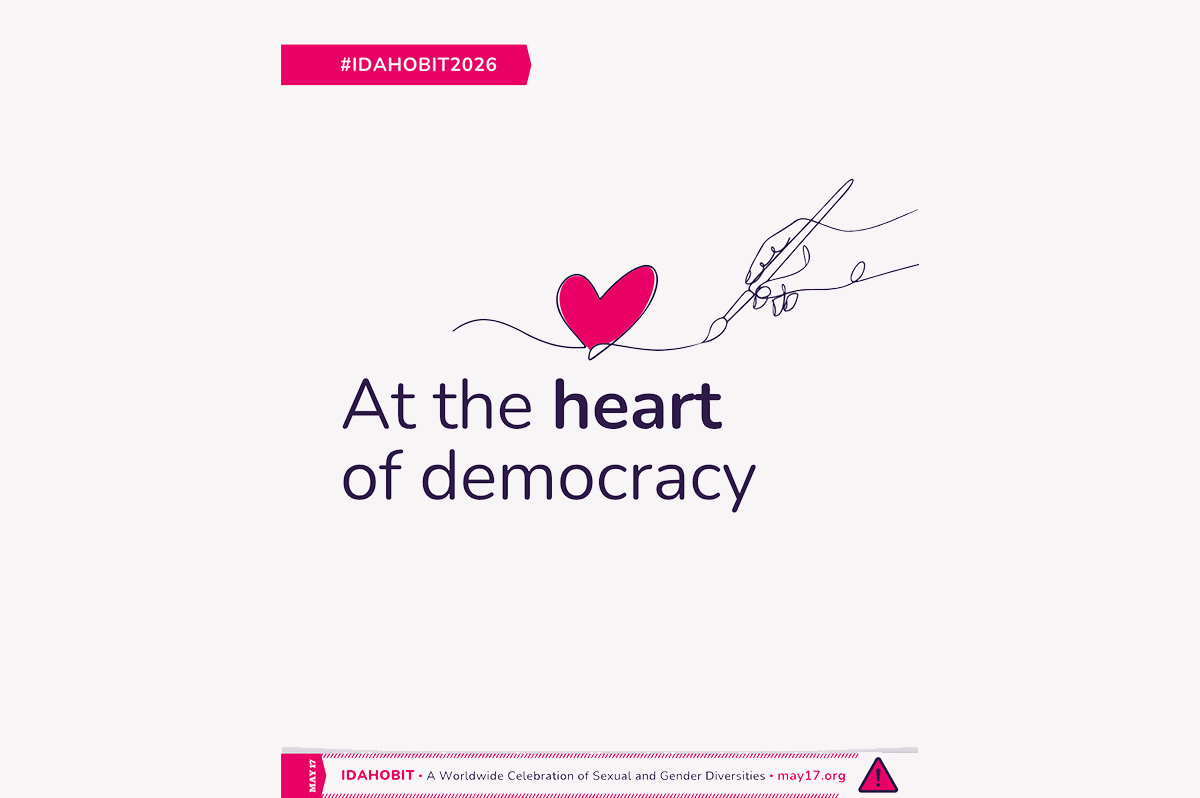
Activists around the world on Sunday will mark the International Day Against Homophobia, Transphobia, and Biphobia.
The IDAHOBiT Advisory Group — which includes 18 LGBTQ and intersex rights organizations around the world — in a press release notes IDAHOBiT events are expected to take place in more than 60 countries. Advocacy groups are also using IDAHOBiT to highlight discrimination and violence based on sexual orientation and gender identity and other LGBTQ-specific issues.
Caribe Afirmativo, a Colombian advocacy group, on May 8 released a report that notes one LGBTQ person was reported murdered in the country every 32 hours in 2025. Caribe Afirmativo also said the Colombian government has not done enough to address anti-LGBTQ violence.
“The evidence is clear: violence against LGBTIQ+ persons in Colombia does not begin with homicide, but with tolerated prejudice and ignored threats,” reads Caribe Afirmativo’s report. “In 2025, the State not only failed to protect — it also failed to count, investigate, and sanction. The crisis is not invisible. It is structural. And it requires an urgent, comprehensive, and sustained response.”
The Initiative for Equality and Discrimination, a Kenyan group known by the acronym INEND, issued a report that details how the country’s law enforcement treats LGBTQ and intersex people. “A widespread pattern of arbitrary arrests, extortion, and both physical and sexual violence” are among the abuses the INEND report notes.
“These abuses not only inflict severe physical and psychological trauma but also foster a widespread distrust of the law enforcement, further marginalizing the community and hindering its ability to seek justice, access essential services such as healthcare, and fully enjoy fundamental freedoms,” it reads.
IDAHOBiT commemorates the World Health Organization’s declassification of homosexuality as a mental disorder on May 17, 1990. This year’s IDAHOBiT theme is “At the Heart of Democracy.”
This year’s IDAHOBiT will take place against the continued impact that the lack of U.S. funding is having on the global LGBTQ and intersex rights movement.
The IDAHOBiT Advisory Group notes consensual same-sex sexual relations remain criminalized in 65 U.N. member states, and the number of countries with criminalization laws increased in 2025. The IDAHOBiT Advisory Group also indicates more than 60 countries have laws that restrict “freedom of expression related to sexual and gender diversity issues.”
“No matter where we live, who we are, or the faiths that drive us, most people want to nurture neighborhoods and communities where every life can bloom,” said the IDAHOBiT Advisory Group. “But today, reactionary governments worldwide are poisoning our gardens with the invasive weeds of their authoritarian policies and exclusionary legislations.”
‘Progress is still happening’
Activists around the world since last year’s IDAHOBiT have seen several legal and political victories.
New Hungarian Prime Minister Péter Magyar on April 12 defeated his predecessor, Viktor Orbán, whose government faced widespread criticism over its anti-LGBTQ crackdown.
The Eastern Caribbean Supreme Court last July struck down St. Lucia’s colonial-era laws. The Dominican Republic’s Constitutional Court a few months later ruled the country’s National Police and Armed Forces cannot criminalize consensual same-sex sexual relations among its members. Botswana late last month repealed a provision of its colonial-era penal code that criminalized homosexuality.
A Hong Kong judge last September ruled in favor of a lesbian couple who sought parental recognition for their son. The European Union Court of Justice over the last year issued two landmark decisions: one said EU countries must recognize same-sex marriages legally performed in other member states and another directed member states to allow transgender people to legally change their name and gender on ID documents.
“Time and again, LGBTQIA+ people have resisted, rolled up their sleeves together with all the good people caring about their communities, and sowed the seeds of change,” said the IDAHOBiT Advisory Group in its press release.
United Kingdom
UK government makes trans-inclusive conversion therapy ban a legislative priority
King Charles III on Wednesday delivered King’s Speech

King Charles III on Wednesday said a transgender-inclusive ban on so-called conversion therapy in England and Wales is among the British government’s legislative priorities.
“My government will bring forward a bill to speed up remediation for people living in homes with unsafe cladding [Remediation Bill] and a draft bill to ban abusive conversion practices [Draft Conversion Practices Bill],” said Charles in his King’s Speech that he delivered in the British House of Lords.
The government writes the King’s Speech, which outlines its legislative agenda. The British monarch delivers it at Parliament’s ceremonial opening.
“Conversion practices are abuse, and the government will deliver the manifesto commitment to bring forward a trans-inclusive ban on conversion practices,” said the government in an addendum to the speech.
Then-Prime Minister Theresa May’s government in 2018 announced it would “bring forward proposals to end the practice of conversion therapy in the U.K.”
Then-Prime Minister Boris Johnson’s government in 2022 said it would support a ban that did not include gender identity. The decision sparked outrage among British advocacy groups, and prompted them to boycott a government-sponsored LGBTQ conference that was ultimately cancelled.
Prime Minister Keir Starmer’s Labour Party ahead of the 2024 elections included a conversion therapy ban in its manifesto. Charles delivered the King’s Speech against the backdrop of growing calls for Starmer to resign after the Labour Party lost more than 1,000 council seats in local and regional elections that took place on May 7.
Stonewall, a British advocacy group, on April 30 said the government “has failed to meet its own timeline to publish a draft bill to ban conversion practices.”
“We should not have to wait any longer,” said Stonewall CEO Simon Blake in his group’s statement. “Conversion practices are abuse. LGBTQ+ people do not need fixing or changing. They need to hear and feel that government is going to protect their safety and dignity. Not at some random date in the future. No more delays.”
European Union
European Commission says all EU countries should ban conversion therapy
Recommendation ‘an important step forward for LGBTI rights across Europe’

The European Commission on Wednesday said all European Union countries should ban so-called conversion therapy.
The recommendation comes weeks after the European Parliament voted in favor of prohibiting the widely discredited practice across the EU. More than 1.2 million people signed a campaign in support of the ban that ACT (Against Conversion Therapy) LGBT launched in 2024 through the EU’s European Citizens Initiative framework.
“We warmly welcome today’s commitment from the European Commission to a recommendation on ending conversion practices, an important step forward for LGBTI rights across Europe,” said ILGA Europe in a statement.
Seven EU countries — Belgium, Cyprus, France, Malta, Norway, Portugal, and Spain — have banned conversion therapy outright.
Greece in 2022 banned the practice for minors. German lawmakers in 2020 passed a law that prohibits conversion therapy for minors and for adults who have not consented to undergoing the widely discredited practice.
ILGA Europe said the European Commission’s recommendation “highlights how much work remains to be done.”
“Ending conversion practices cannot stop at symbolic commitments or fragmented national approaches,” stressed the advocacy group. “We need coordinated EU action, proper training for professionals, and survivor-centered support systems that recognize the serious harm these practices cause.”
“More than one million people supported the European Citizens’ Initiative calling for change,” added ILGA Europe. “The message is clear: conversion practices are not therapy or belief, they are a form of violence that Europe can and should end.”

‘The Inheritance’ is most-nominated at this year’s Helen Hayes Awards

HIV Vaccine Awareness Day set for May 18

DC Black Pride is around the corner

United Night Out set for Saturday

Calendar: May 15-21

America’s broken pipeline of mental healthcare for trans youth

Blade finalist for D.C. Society of Professional Journalists awards

He is 16 and sitting in a Cuban prison

From the Capitol to the coast: Rep. Sarah McBride shares Rehoboth favorites

Jason Collins dies at 47
-

 National4 days ago
America’s broken pipeline of mental healthcare for trans youth
-
News4 days ago
Blade finalist for D.C. Society of Professional Journalists awards
-
Commentary4 days ago
He is 16 and sitting in a Cuban prison
-
Rehoboth Beach4 days ago
From the Capitol to the coast: Rep. Sarah McBride shares Rehoboth favorites