Politics
Meet Gisele Fetterman, bisexual wife of Pennsylvania’s incoming freshman senator
An exclusive interview with the Blade after her husband’s hard-won Senate bid
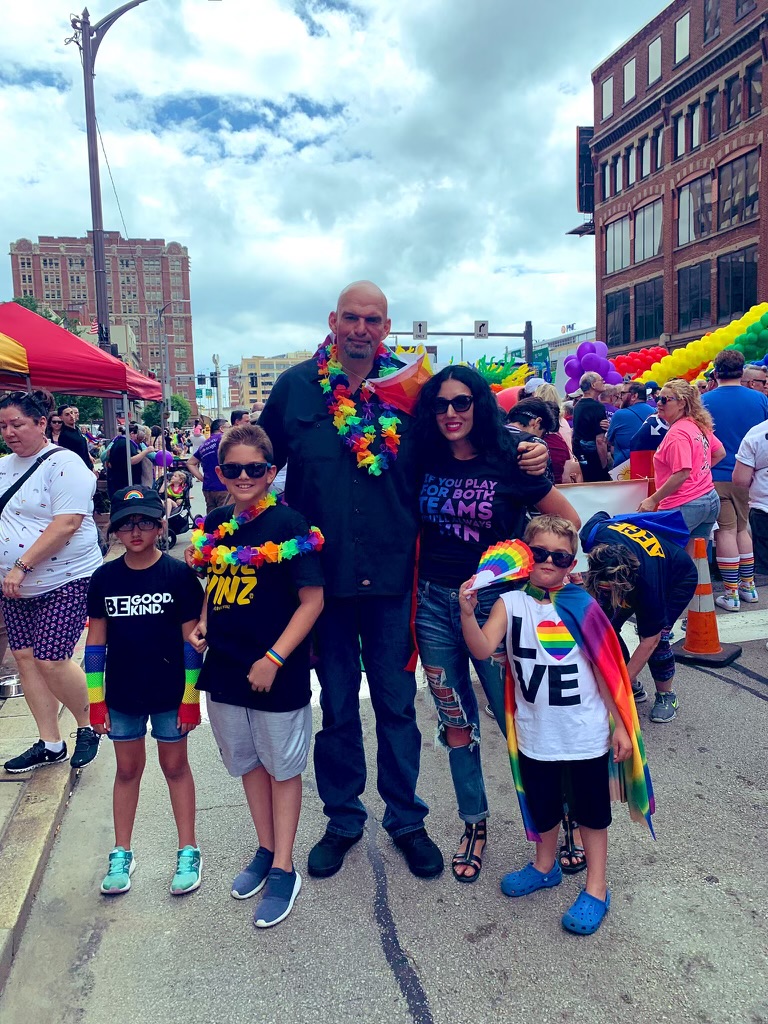
When the Washington Blade caught up with Gisele Barreto Fetterman this month, she was looking forward to some upcoming travel plans.
First up is a trip to Washington in January to witness the swearing-in ceremony for her husband, Pennsylvania Lt. Gov. John Fetterman, who was just elected to represent the Keystone State in the U.S. Senate after one of the year’s most hard-fought midterm races.
Then, in March, she plans to visit family in Brazil for the first time since travel to her native country was restricted in the early days of the pandemic, and just in time to celebrate another electoral victory as Brazilian voters have ousted their far-right President Jair Bolsonaro.
Luiz Inácio Lula da Silva (“Lula”) will assume office on Jan. 1.
Travel of the more rote and routine variety also lies ahead for Fetterman and the senator-elect, who will be dividing their time between Washington and the couple’s home with their three children in Braddock, Pa.
Gisele Fetterman is eager for the opportunity to better acquaint herself with the nation’s capital. Having already met some very nice people in the city, she told the Blade, “I’m so excited to make some more fun memories and get to know D.C. better.”
It is difficult to imagine she will have trouble making friends. Even over the phone, she is disarmingly funny, sensitive, and kind; unflinchingly sincere in her dedication to service on behalf of those in need.
At the same time, because the breathless and exhaustive press coverage of her husband’s race against Republican opponent Dr. Oz sometimes included unwarranted scrutiny and criticism of the Democratic candidate’s wife, some folks who were not previously familiar with her might have been left with an incomplete or distorted picture.
Gisele Fetterman was under the microscope as much for her sartorial choices (almost all thrifted), as for her stalwart presence as one of the Fetterman campaign’s most effective surrogates.
Regarding the right-wing attacks that were focused on her identity as a bisexual woman and immigrant from Latin America, she jokes, “they made me sound like a superhero.”
Still, this type of partisan rancor, mean spiritedness, cynicism, and guilefulness are so anathema to Gisele Fetterman’s character and core values that you are left with the impression that she would probably prefer to keep politics at an arm’s length but for her marriage to an incoming U.S. senator.
Leading by example with love and unconditional acceptance
Children are a comforting reminder that human beings are not predestined to fear or harbor prejudice against each other, she said, recalling a memorable exchange that happened as her family was hosting a wedding for a gay couple.
She had rushed to Costco to pick up a big rainbow cake and was fastidiously preparing their home for the ceremony when one of her boys asked what the fuss was about. “Daddy marries people all the time,” he said. “What’s the big deal?”
“This time it’s two boys who are getting married,” Gisele Fetterman said. For her son, it was still just another wedding. “Oh my God, it was just such a sweet and normal and beautiful reaction,” she said, “but that’s all he knows.”
John Fetterman has married same-sex couples for years, including when such unions were illegal under Pennsylvania law during his tenure as mayor of Braddock. Raising children to be “loving and accepting and non-judgmental is really easy if we live that example for them,” Gisele Fetterman said.
She would know, having grown up around LGBTQ people who were embraced unconditionally. After moving with her family to New York at the age of eight, a gay couple who lived nearby stepped in to help care for Gisele and her brother when their mom had to work long hours, she said. The neighbors “became like uncles.”
“My best friend in middle school was gay, my best friend in high school was gay, and I consider myself a member of the community, too, so it’s always just felt very natural” to enjoy the company of other LGBTQ people, she said. “I always choose them.”
More broadly, she said she has always felt closest to “those who have been underrepresented, or historically ignored,” a personal ethos that has informed her work as an activist, philanthropist, and founder-director of mission-driven nonprofit organizations.
A nutritionist by trade, 10 years ago she launched a program to cut down on food waste while helping people who are experiencing hunger. More than 24 million pounds of good, safe-to-eat food from retailers, wholesalers, and grocers has since been rescued from landfills and rerouted to help feed people who are food-insecure.
Gisele Fetterman also leads initiatives to provide those in need with other essential items, support services, and emergency funds, including through the organizations that she founded or co-founded, Free Store 15104, For Good PGH, and 412 Food Rescue.
Along with her nonprofit work, she said the way in which she has approached her role as a politician’s wife has also been influenced by her memories of and experiences with financial hardship in both Brazil and the United States.
For instance, in 2019 when her husband was elected to become Pennsylvania’s lieutenant governor after 13 years as Mayor Fetterman, the new house that came with his new job, complete with a swimming pool, made her uncomfortable. “I would never want to live in a mansion that taxpayers are paying for,” she said. “It just felt wrong.”
Ultimately, the family opted not to live in the lieutenant governor’s mansion. The pool, however, was a different story.
She knew that generations of Black people in America have been denied access to swimming pools through segregation, redlining, and other racist policies, suffering consequences like higher rates of accidental drowning as a result. So she decided to open the pool for public use.
“I really believe you have to see yourself in places to know that you belong in them,” she said. Welcoming historically excluded people to learn about water safety and enjoy themselves in a space that otherwise would be reserved for the couple and their three children made for some “amazing summers,” she said.
In October, a Fox News columnist characterized as “bizarre” Gisele Fetterman’s rationale for opening the swimming pool for public use, writing that Pennsylvania’s second lady had called the act of swimming itself “racist.”
Was it possible that the author had not understood her words rather than deliberately mischaracterizing them and the context in which they were delivered to make a bad-faith attack with Election Day less than two weeks ahead?
Gisele Fetterman appears to think so, as she did not entertain the notion that perhaps the columnist should be tossed into an outdoor pool in December. Instead, she suggested a history book, adding that America’s record of racism and segregation is “really painful, and it can be ugly, but it’s really important to know.”
Asked how she might advise her husband on the challenge of dealing with difficult colleagues in Congress, particularly the senator from Texas whom former GOP House Speaker John Boehner memorably called “lucifer in the flesh,” she again urged patience and understanding.
“The way I work with difficult or unkind people,” she said, is to make up a narrative, a story about something or someone that may have caused the poor behavior because imagining there is an underlying reason can help lower the temperature.
At the same time, she said, while it’s true that hurt people hurt people, everyone is capable of reflecting, consulting a therapist, and otherwise doing whatever it takes to forge a different path.
There may be a dearth of kindness and empathy in Washington’s political circles, but there is certainly no shortage of self-aggrandizement or inflated egos.
Here, too, she may be able to offer some guidance, given her habit of never taking herself too seriously or missing the opportunity for a self-deprecating joke (often directed at her husband).
For instance, after becoming the second lady of Pennsylvania, she shortened her title to its acronym, preferring instead to call herself and be known by others as “the SLOP.”
She also shares photos on social media with her 6-foot-8 husband’s head partially cropped out so that her shoes are visible in the frame, and insists that their marriage operates with the unspoken understanding that Gisele is always right when there are differences of opinion.
On that latter point, should anyone long for the same dynamic with their spouse or significant other, Gisele Fetterman offers the following advice: “You just have to be really confident in your truth,” she said, adding, “then you just, like, ignore him when he’s speaking.”





Congress
Top Democrats re-introduce trans bill of rights
Lawmakers spoke outside US Capitol on Wednesday
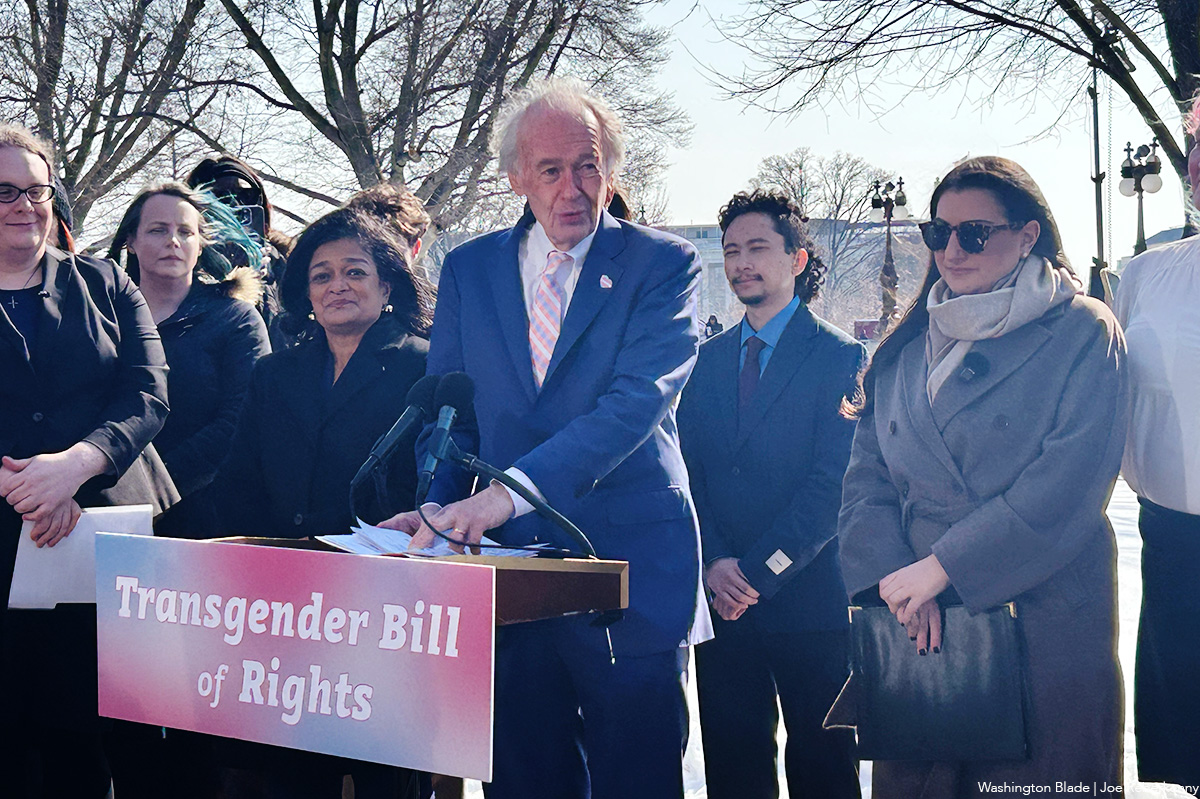
U.S. Sen. Ed Markey (D-Mass.) and U.S. Reps. Pramila Jayapal (D-Wash.), and Sara Jacobs (D-Calif.) announced the reintroduction of a “Trans Bill of Rights” on Wednesday.
Despite chilling winds and snow on the ground, transgender activists, LGBTQ rights advocates, and trans-supporting lawmakers gathered outside the U.S. Capitol to announce the reintroduction of the “Transgender Bill of Rights” resolution to protect trans Americans, as the Trump-Vance administration continues to target LGBTQ Americans.
About 30 people gathered outside to hear from legislators and individuals impacted by recent White House policies.
“Today we say loud and clear that trans rights are human rights, and they must be protected every single day of every single year,” Markey told the crowd. “We stand together in solidarity with the trans community and with those who have too often been left behind by a system that refuses to recognize their humanity. We are here to ensure that every trans and gender-diverse person in America can live freely and safely and authentically. That’s what the Trans Bill of Rights is all about.”
Markey is leading the resolution on the Senate side, while Jayapal is pushing it forward in the House.
“With the Trans Bill of Rights, we are laying out a comprehensive vision to provide protections for transgender and nonbinary people — a vision that ensures every single person has a chance to thrive,” Jayapal said. “A vision that says: you are us, you belong, and you are worthy of the same rights as everyone else. This bill supports amending the Civil Rights Act to ensure that trans people have the same rights and protections as all other Americans. It creates a level playing field where trans people no longer have to fight tooth and nail to get the same treatment as their cisgender friends.”
The resolution for House and the Senate reads:
“Recognizing that it is the duty of the federal government to develop and implement a Transgender Bill of Rights to protect and codify the rights of transgender and nonbinary people under the law and ensure their access to medical care, shelter, safety, and economic security.”
Trans Legislation Tracker, an independent research organization that collects data on anti-trans legislation from the hyper-local level to the floor of the U.S. Senate, found that in 2025, 1,022 measures were proposed across the country to restrict the rights of trans Americans — from health care removals to bathroom bans.
Markey directly called out those lawmakers for what he described as discriminatory actions taken against trans Americans who, as he pointed out, are fighting for rights that everyone else is inherently given.
“Trump and MAGA Republicans have used the power of government to spread fear and hate across our country. They have tried to ban lifesaving and medically necessary health care, strip anti-discrimination protections, and turn trans lives into political talking points for their benefit. Well, we have a message for them: we are louder, we are stronger, and we are not going anywhere. We’re in this fight for the long term,” the Massachusetts senator said.
Jacobs, a co-chair of the Transgender Equality Task Force within the Congressional Equality Caucus, also spoke at the event.
“Trans Americans are being targeted just for being who they are — by laws and court decisions that try to erase them from classrooms, from courts and fields, from health care and public life. These attacks aren’t about safety or fairness,” Jacobs said. “They’re about hatred and instilling fear. And we know how quickly fear can warp into suspicion and violence with deadly consequences.”
In addition to lawmakers, trans Americans and supporters spoke.
Olivia Hunt from Advocates for Trans Equality, LaLa Zannell from the American Civil Liberties Union, as well as three additional people who have been actively harmed by the ongoing wave of anti-trans legislation, shared their stories.
Hunt emphasized the staggeringly high number of anti-trans bills being introduced in statehouses across the country — despite trans adults making up less than 1 percent of the population, according to the Williams Institute’s 2025 data.
“Since 2020, thousands of anti-LGBTQIA+ bills have been introduced in statehouses across the country,” Hunt said. “It’s a veritable tidal wave of political bullying disguised as legislation, and most of these bills specifically target transgender and nonbinary people — especially trans youth and their families. This is a moment that demands action.”
Hunt, who is trans, helps trans people in D.C. obtain legal documents that match their gender identity — something the Trump-Vance administration has stopped.
“Trans youth deserve to be protected by their government. They shouldn’t have to be protected from their government,” she said. “It’s long past time that our federal laws reflect and protect the reality and dignity of all people. Trans people have always existed — we are your neighbors, your family members, your community — and we belong.”
Zannell, who spoke proudly about her trans identity, explained why the bill is necessary and how it would protect trans people in all facets of their lives.
“I stand here as an unapologetic Black trans woman who has led this movement for over a decade to get us to moments like this. The reintroduction of the Trans Bill of Rights will aim to protect access to gender-affirming care, prevent discrimination in housing and public spaces, and preserve legal recognition,” Zannell said. “My hope is that this affirms our government’s duty to protect all trans and nonbinary people.”
The Transgender Bill of Rights is cosponsored in the Senate by U.S. Sens. Jeff Merkley (D-Ore.), Elizabeth Warren (D-Mass.), Mazie Hirono (D-Hawaii), Ron Wyden (D-Ore.), Martin Heinrich (D-N.M.), Alex Padilla (D-Calif.), Bernie Sanders (I-Vt.), and Peter Welch (D-Vt.).
In the U.S. House of Representatives, the resolution is led by Jayapal, co-led by Jacobs and U.S. Rep. Mark Takano (D-Calif.), with nearly 100 other representatives signing on as co-sponsors.
“To all trans people across the United States: you are seen, you are valued, and you are loved,” said Markey. “And I want you to know there are people who will fight for you every single day on the floor of the House and Senate to win those rights for you.”
2026 Midterm Elections
LGBTQ Victory Fund looks beyond Washington for change in 2026
Vice President of Political Programs Daniel Hernández spoke with Blade
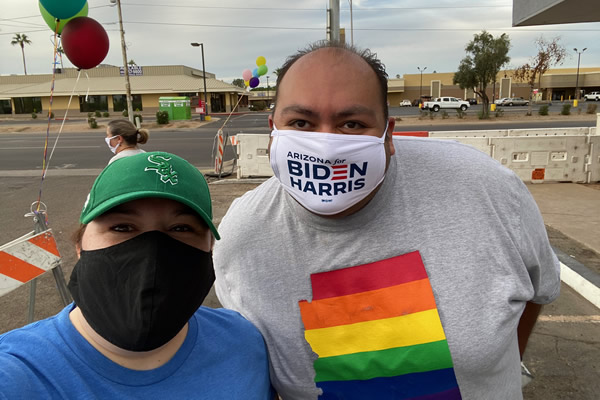
As the Trump-Vance administration enters its second year, LGBTQ people from around the country are running for public office amid fears of the removal of federal civil rights laws that could lead to rollbacks in protections.
The Washington Blade sat down with Daniel Hernández Jr., the newly made vice president of political programs for the LGBTQ Victory Fund, a nonpartisan political action committee dedicated to electing openly LGBTQ individuals to all levels of government, to discuss why now is more important than ever to actualize LGBTQ political power.
Hernández is often credited with saving the life of then-U.S. Rep. Gabrielle Giffords (D-Ariz.) while working as her 20-year-old intern in Tucson, Ariz., in 2011. He served on the Pima County School Board and in the Arizona House of Representatives from 2017-2023, advocating for LGBTQ rights, healthcare access, and education.
Founded in 1991, the Victory Fund was created by a group of prominent LGBTQ political voices, including Dallas gay rights activist William Waybourn and former Human Rights Campaign Fund Executive Director Vic Basile, who were inspired by the success of EMILY’s List, a PAC that works to elect Democratic women to office.
Since its founding, the Victory Fund has worked with LGBTQ advocates and LGBTQ-supportive donors who recognized the need to prepare LGBTQ people to run for office nationwide.
When asked where LGBTQ people and allies need to focus looking ahead, Hernández emphasized that 2026 will be won or lost at the state and local level.
“One of the bigger things that people may not be paying as close attention to as we really should is the impact of state and local races. Federal races are crucial, obviously, but the folks who are actually able to have an impact in a meaningful way right now are not the people in the U.S. House or Senate,” Hernández said. “It can take years before a bill even moves through Congress. Meanwhile, state and local leaders are the ones standing up and fighting for our rights today. Especially during this Trump administration, that’s where the real action is happening.”
He expanded on that point, saying that at this moment in the U.S. political landscape, statewide races matter far more than they are often given credit for — particularly as 2026 is a midterm year under President Donald Trump. People who win elected office in midterm years, Hernández explained, are many times viewed as legislators pushing back against the administration at the top.
“Looking at 2026 in particular, because it’s a midterm year, people sometimes forget just how many critical statewide races are on the ballot. We have people like Chris Mayes in Arizona, who won by less than 300 votes in a battleground state and is now running for reelection,” he said. “These are the races that protect democracy and protect people’s rights in real time. If we ignore them, we’re doing so at our own peril. Statewide offices are where so much power actually lives.”
Hernández also urged LGBTQ voters and donors to think critically about where their time, money, and energy are going — particularly as resources remain limited heading into 2026 and not every race is winnable.
“I think one thing we don’t do enough as a community is pause and ask whether our resources are actually going where they can have an impact. If someone is running against a Republican in a plus-20 Republican state that hasn’t elected a Democrat in decades, do I really need to give my limited resources there? Or does it make more sense to support candidates in competitive states like Arizona or Wisconsin? In 2026, we have to be more strategic, because our resources are not unlimited. Winning matters.”
That calculation, Hernández said, also means moving away from what he described as emotionally driven donations and toward a more deliberate strategy.
“Our community is incredible at rallying when we’re angry, and I call that ‘rage giving.’ Someone awful is in office, a challenger pops up, and we all open our wallets. But what we really need to be doing is asking where that money will actually move the needle. In 2026, it’s not enough to feel good about donating — we have to make sure those donations help candidates who can realistically win. That’s how we protect LGBTQ rights long term.”
Asked how the Victory Fund determines which candidates receive endorsements — especially amid a growing field of openly LGBTQ contenders — Hernández emphasized that viability is central to the organization’s approach in 2026.
“One of the things we’re really focused on in 2026 is viability. We’re not endorsing people who have a zero-percent chance of winning. We’re looking at candidates who are running strong campaigns, who have plans, who are fundraising, and who are doing the work. That’s important because our community deserves guidance it can trust. When you see a Victory endorsement, it means we believe that candidate can actually win.”
Hernández also pushed back on the long-standing notion that being openly LGBTQ is a political liability — an argument that has resurfaced amid right-wing attacks on LGBTQ candidates.
“There’s been this long-standing perception that being LGBTQ is a liability and that it can cost Democrats elections. But when you actually look at the data, that just isn’t true. The reality is that being LGBTQ is not a risk — it’s often a strength. Voters care about roads, health care, affordability, and jobs, not fear-based caricatures. In 2026, we’re seeing more LGBTQ candidates than ever because people understand that now.”
That shift, he added, has helped reframe what LGBTQ candidates are actually campaigning on — despite efforts by conservatives to reduce them to culture-war issues.
“The so-called ‘gay agenda’ is not bathrooms. It’s making sure people have access to health care, that roads are safe, and that families can afford to live. LGBTQ candidates are talking about the same bread-and-butter issues as everyone else. That’s why the idea that LGBTQ candidates cost elections just doesn’t hold up. In fact, we’re seeing them lead on some of the most important issues facing voters right now.”
As misinformation and fear-based narratives continue to dominate right-wing messaging, Hernández said openly LGBTQ elected officials play a crucial role in countering those attacks — both through policy and presence.
“First and foremost, any elected official’s responsibility is to their constituents. That’s what we’re seeing from LGBTQ officials who are focused on affordability, health care access, and consumer protections while Republicans obsess over culture-war nonsense,” Hernández said. “But there’s also a responsibility to be authentic. Being honest about who you are and why you fight matters. That authenticity cuts through fear-based disinformation.”
Looking ahead to 2026, Hernández pointed to transgender elected officials as a particular source of momentum and optimism, even amid intensified political attacks.
“Our trans elected officials are honestly at the forefront of some of the biggest battles we’re facing right now. Despite relentless attacks and vilification, they are still delivering results for their communities. That tells me something incredibly powerful about where the country is headed. Even in this political climate, trans leaders are winning and governing. That gives me a lot of hope for 2026.”
Ultimately, Hernández said the stakes of the upcoming cycle extend far beyond a single election, shaping the future of LGBTQ political leadership nationwide.
“The leaders we elect at the state and local level today are the members of Congress and senators of tomorrow. People don’t just wake up one day and run for Congress — they come from city councils, state legislatures, and school boards. That’s why 2026 is so important. If we invest now, we’re not just defending our rights in the moment, we’re building the next generation of LGBTQ leadership.”
Victory Fund’s endorsed candidates
Incumbents Endorsed: January 2026
- Helen Grant (they/them) – Norman City Council, Ward 4, Okla.
- Louie Minor (he/him) – Bell County Commission, Precinct 4, Texas
- Jonathan West (he/him) – Manchester Selectboard, Vt.
- George Leach (he/him) – Court of Common Pleas, Franklin County Judge, Ohio
- John Fredrickson (he/him) – Nebraska State Senate, District 20
- Ben Bowman (he/him) – Oregon House of Representatives, District 25
- Jeffrey Prang (he/him) – Los Angeles County Assessor, Calif.
- Amie Carter (she/her) – Sonoma County Superintendent of Schools, Calif.
- Elinor Levin (she/her) – Iowa House of Representatives, District 89
- Ken Carlson (he/him) – Contra Costa County Supervisor, District 4, Calif.
- Emma Pinter (she/her) – Adams County Commission, District 3, at-large, Colo.
- Justin Chenette (he/him) – York County Commission, District 3, Maine
- Kris Fair (he/him) – Maryland House of Delegates, District 3
- Jennifer Cornell (she/her) – Ann Arbor City Council, Ward 5, Mich.
- Darlene Martinez (she/her) – Constable, El Centro – Downtown Phoenix, Ariz.
- Brian Garcia (he/him) – Arizona House of Representatives, District 8
- Christian Phelps (he/him) – Wisconsin State Assembly, District 93
- Jack Patrick Lewis (he/him) – Massachusetts House of Representatives, 7th Middlesex
- Will Brownsberger (he/him) – Massachusetts State Senate, Suffolk and Middlesex Counties
- Julian Cyr (he/him) – Massachusetts State Senate, Cape & Islands District
- CM Hall (she/they) – Newport City Council, Ore.
- Jimmy Mack (he/him) – Southampton Town Trustee, N.Y.
- Michael Vargas (he/him) – Elk Grove USD Board of Education, Area 2, Calif.
- Lisa Grafstein (she/her) – North Carolina State Senate
- Hector Bustos (he/him) – Trustee, Santa Ana Unified School District, Calif.
Newly Endorsed Candidates – January 2026
- Kirk McPike (he/him) – Virginia House of Delegates, District 5
- Winn Decker (he/him) – North Carolina House of Representatives, District 37
- Jonathan Lambert-Melton (he/him) – Wake Co. Board of Commissioners, At-Large, N.C.
- Karen Stegman (she/her) – Orange County Board of Commissioners, At-Large, N.C.
- Landon Campbell (he/him) – Hays County Criminal District Attorney, Texas
- Christine Castillo (she/her) – Bexar County District Clerk, Texas
- Nicholas “Nico” Costilla (he/him) – Hays County Clerk, Texas
- Davis Mendoza Darusman (he/him) – Harris Co. Justice of the Peace, Pct. 5, Pl. 2, Texas
- Nicholas Palmer (he/him) – Justice, Fifth Court of Appeals, Texas
- José “Che-Che” Wilson (he/him) – Cook County Board of Commissioners, District 12, Ill.
- Sarah Bury (she/her) – Metropolitan Water Reclamation District Board of Commissioners, Ill.
For more information of the LGBTQ Victory Fund’s endorsments, qualifications, or on how to register to receive an endorsement, visit the organization’s website at victoryfund.org
Congress
New Equality Caucus vice chair endorses Equality Act, federal trans bill of rights
Salinas talks about her personal road to LGBTQ advocacy
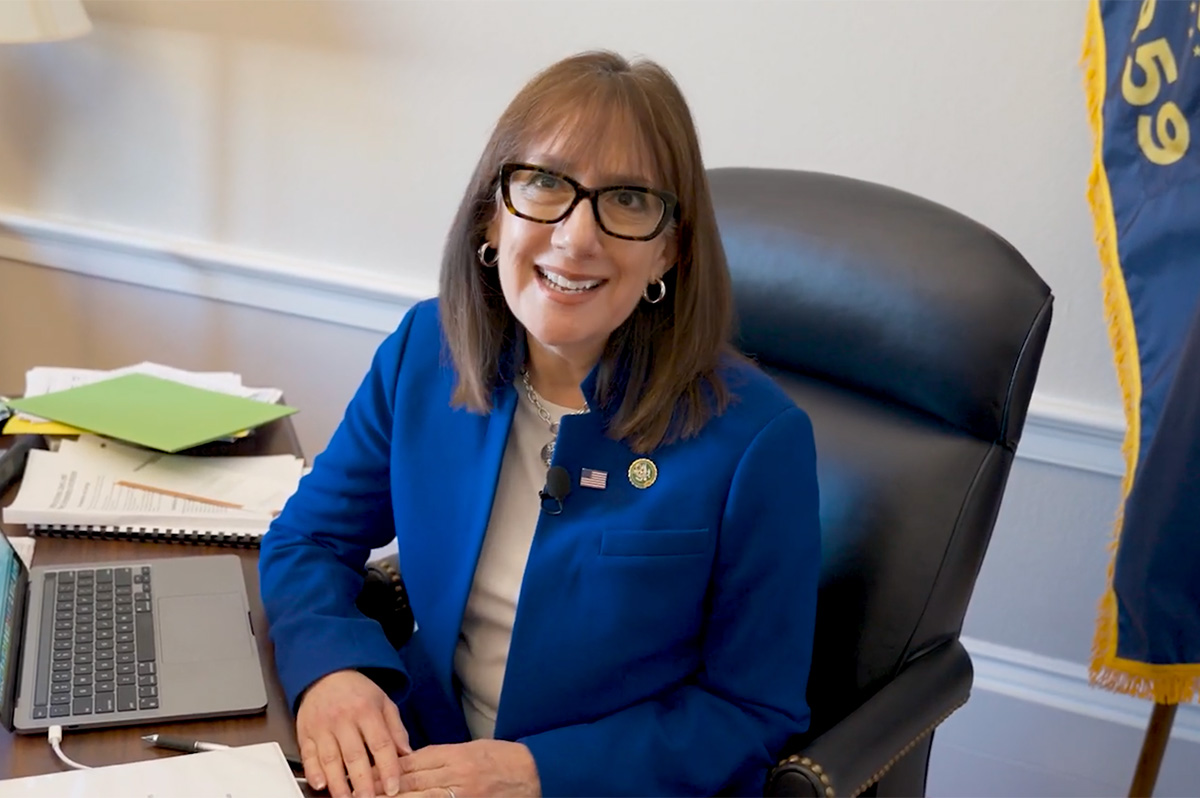
Rep. Andrea Salinas, the new vice chair of the Equality Caucus, sat down with the Blade to discuss the battles ahead as she demands protections for LGBTQ Americans.
Salinas is no stranger to government service. The daughter of a Mexican immigrant, she graduated from the University of California, Berkeley, and soon became a valued member of multiple Democratic offices — including working as a congressional aide to U.S. Sen. Harry Reid (D-Nev.) and U.S. Reps. Pete Stark (D-Calif.) and Darlene Hooley (D-Ore.). From there, she served six years in the Oregon House of Representatives before being elected to Congress, representing areas south of Salem and parts of southern Portland. With her new role in the Equality Caucus, Salinas vows to push protections for LGBTQ Americans in every room she enters.
The Washington Blade spoke with Salinas last week following her leadership announcement to discuss what the role means to her, why she — as a straight woman— feels it is her duty to fight for LGBTQ protections, and how she views the current state of the country.
When asked why she decided to take on a leadership role within the Equality Caucus, Salinas explained that she was already doing the work — but that the timing of the caucus’s outreach, coupled with what she described as a growing threat posed by the Trump-Vance administration, made the moment feel especially urgent.
“I was actually asked to take on this role because of the work I’ve already been doing. I didn’t seek out a title— the Congressional Equality Caucus came to me, and I was honored by that,” the Oregon representative told the Blade. “I’ve been a lifetime advocate, first as a mother and then as a legislator. With Trump back in office and the shackles off, kids are vulnerable right now, and they’re being attacked. We need champions, and with or without a title, I was going to do this work anyway.”
That work includes passing LGBTQ-related education policy during her time in the Oregon House of Representatives, requiring the Oregon Department of Education to train teachers on how to better support LGBTQ students. She also backed legislation aimed at preventing LGBTQ-related bullying and harassment, while using her platform to ensure educators had the skills needed to address trauma in the classroom. Salinas also pushed for Oregon’s 2013 conversion therapy ban and played a role in defending it.
Salinas said her personal motivation for expanding and protecting LGBTQ rights is rooted in the experiences of her daughter, Amelia.
“My daughter is queer, and she has known who she is since she was a child,” Salinas said. “She presents very masculine, and I’ve had to advocate for her her entire life — from whispers on soccer sidelines to fears about using the bathroom when she was just three or four years old. That kind of bullying and harassment stays with you as a parent. It became part of who I am, part of my ‘mama bear’ advocacy. When I entered public office, continuing that fight was the most natural thing in the world.”
That “mama bear” advocacy, she said, now extends far beyond her own family.
“Across this country, kids are vulnerable right now, and Trump is attacking them,” she said. “My daughter was devastated after the 2024 election— she said, ‘They’re coming after us,’ and she was right. That fear is real, especially for transgender youth. Civil rights should be expanding, not being stripped away from certain communities. That’s why this fight feels so urgent.”
Since returning to the White House in 2024, the Trump administration has moved to roll back anti-discrimination protections, particularly those affecting transgender people. These efforts include barring transgender people from serving openly in the military, blocking access to gender-affirming medical care in federal health programs, challenging state laws that protect transgender students on religious grounds, and arguing that the Constitution entitles employers to discriminate against LGBTQ people based on religious beliefs — even in states with nondiscrimination laws.
For Salinas, the Equality Caucus’s most urgent task under the Trump-Vance administration is advancing what she called a long-sought but non-negotiable priority: the Equality Act.
The Equality Act would add explicit protections based on sexual orientation and gender identity to federal law. Despite more than five decades of debate on Capitol Hill, no version of the bill has yet become law.
“We have to keep pushing the Equality Act— there’s no way around that. No one should be discriminated against in housing, employment, credit, or healthcare because of who they are,” Salinas said. “Republicans are making LGBTQ identity a political wedge because they think it’s expedient, and that’s unacceptable. Sexual orientation and gender identity should not matter in determining someone’s access to opportunity. Yet here we are, still having to fight for that basic principle.”
Salinas added that advancing legislation like the Equality Act requires compassion— even when that compassion is not returned— and a commitment to education.
“We have to meet people where they are— Democrats, Republicans, independents, all of them. Until you know a family, or understand someone’s lived experience, it can feel abstract and overwhelming,” she said. “Education, compassion, and empathy are essential to moving the dial. When people understand this is about human rights, not politics, conversations start to change. That’s how we build broader support.”
She also emphasized the need for a federal transgender bill of rights, which would provide explicit protections for transgender Americans amid what she described as an increasingly hostile federal environment.
“A transgender bill of rights would clarify that discrimination against transgender and nonbinary people is illegal — in employment, housing, credit, and healthcare,” Salinas said. “What’s happening right now, with efforts to criminalize doctors for providing evidence-based care, is unheard of and dangerous. We also need to ban conversion therapy nationwide, because states are increasingly trying to undo those protections through the courts. These safeguards are about ensuring people can live safely and with dignity. That should not be controversial.”
Mental health is another central focus of Salinas’s work. She said ensuring children have access to support— particularly LGBTQ youth— is critical to their long-term wellbeing.
After the Trump administration eliminated the LGBTQ-specific option from the 988 Suicide and Crisis Lifeline, Salinas said her reaction was one of outrage.
“When Trump shut down the 988 press-three option for LGBTQ youth, I was apoplectic,” she said. “It is one of the simplest, most upstream ways to save lives, and it felt arbitrary, cruel, and inhumane. We know the suicide risk among transgender youth is far higher than among non-LGBTQ kids. Connecting them with someone who understands their experience can be life-saving. This should be bipartisan, and I’m going to keep pushing to restore it.”
“You cannot be what you cannot see….” she added while reflecting on the handful of LGBTQ leaders who have— and continue to— navigate the halls of Congress to protect their community. “When Sarah McBride was elected, my daughter met with her and walked out glowing… joyful, hopeful, and excited about the future. That kind of representation changes lives. Electing LGBTQ leaders changes the trajectory for people across the country. Grassroots organizing and electoral power go hand in hand, and we need both.”
With Salinas’s experience in both the Oregon House of Representatives and the U.S. House of Representatives, she said that while one arena may reach more people, change often begins locally, especially when combating anti-LGBTQ attacks.
“I’ve seen how misinformation fuels fear at the local level— whether it’s school board fights or bathroom debates rooted in baseless claims. There is no data to support these scare tactics,” she said, echoing her past work with the Oregon Department of Education. “What actually helps is facts, education, and training teachers to better support LGBTQ students. I passed legislation in Oregon to give educators real tools to prevent bullying and harassment. That kind of work matters just as much as what we do in Congress.”
Despite just being named vice chair of the Equality Caucus, the Blade asked Salinas what legacy she hopes to leave, particularly when it comes to LGBTQ advocacy.
“I want people to be able to live authentically, without fear from their government or their neighbors. That means passing real legislation— the Equality Act and a transgender bill of rights— so protections are not dependent on who’s in power. Civil and human rights are meant to expand, not contract.
“I’ve been doing this work since I became a mother, and I’ll keep doing it for as long as it takes. My daughter deserves it, and so does every LGBTQ person in this country.”

Markwayne Mullin confirmed as next DHS secretary

Gay man murdered in Va.

Trans Day of Visibility events planned

Virginia General Assembly’s 2026 legislative session ends

Polish court rules country must recognize same-sex marriages from EU states

Queer American in Israel discusses Iran war’s impact

‘How We Survived’ panel set for March 25

Calendar: March 21-26

Small is beautiful: subcompact SUVs