News
Obama ‘blindsided’ Gates over ‘Don’t Ask’ repeal
Former HRC president says defense chief ‘somewhat disingenuous’ in new book
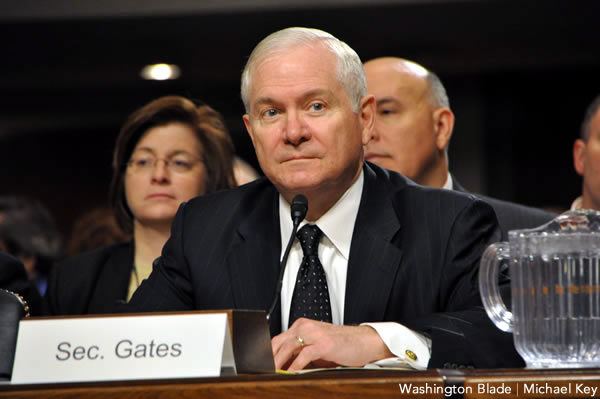
Defense Secretary Robert Gates reportedly said he was blindsided by President Obama’s announcement that he would repeal “Don’t Ask, Don’t Tell.” (Washington Blade file photo by Michael Key)
Robert Gates’ new tell-all book is stirring controversy, including among LGBT rights advocates, who are hitting back at leaked excerpts regarding “Don’t Ask, Don’t Tell” repeal.
According to a preview of “Duty” in media reports, including in the Washington Post, the former defense secretary identifies “Don’t Ask, Don’t Tell” repeal as among the issues he said he endured “continued conflict and a couple of important White House breaches of faith” over the course of 2010.
Although Gates reportedly writes he supported the decision to move toward open service, he says Obama “blindsided” him and then-Chairman of the Joint Chiefs of Staff Adm. Mike Mullen with one day’s notice that he would announce his request to repeal the law.
According to the Los Angeles Times, Gates also takes a jab at Obama by saying “Don’t Ask, Don’t Tell” repeal was among the few military issues about which the president expressed interest.
“The only military matter, apart from leaks, about which I ever sensed deep passion on his part was ‘Don’t Ask, Don’t Tell,'” Gates reportedly writes.
Based on the media outlet’s depiction of the portion of the book, it’s hard to tell what Gates is referring to by Obama’s announcement that he would move to end “Don’t Ask, Don’t Tell.” Gates may be referring to the 2010 State of the Union address in which Obama pledged to “work with Congress and our military to finally repeal the law that denies gay Americans the right to serve the country they love because of who they are.”
Nonetheless, LGBT advocates who contributed to the effort to repeal “Don’t Ask, Don’t Tell” are scratching their heads over the depiction that Gates was “blindsided” by the president’s plans.
Joe Solmonese, former president of the Human Rights Campaign, said his memory of what happened “doesn’t really square” with Gates’ reported recollection of the administration’s efforts to repeal “Don’t Ask, Don’t Tell.”
“If anything, I think they were particularly sensitive to making sure that Secretary Gates and Adm. Mullen were completely engaged in the process,” Solmonese said. “At each step along the way, my recollection, my memory, what I witnessed being part of the process was that was something they were incredibly sensitive to.”
Recalling that the Obama administration set up a 10-month study over the course of 2010 to examine the potential impact of open service, Solmonese said the administration approached repeal “with a deference toward” Gates and Mullen. They both endorsed the study when they announced it before the Senate Armed Services Committee in February 2010.
Nathaniel Frank, a political commentator who formerly worked for the University of California’s Palm Center on “Don’t Ask, Don’t Tell,” said Obama was “clear from the start” he wanted open service and it’s “hard to see” how Gates could have felt blindsided.
“The two men were doing a delicate dance over how much to prioritize repeal among many important issues, and both were under a lot of pressure to deliver,” Frank said. “I don’t know what their private conversations involved, but eventually the president came to understand that the political window for repeal was closing, and he had to move forward.”
Solmonese added he thinks Gates included in his book disparaging remarks about “Don’t Ask, Don’t Tell” repeal as part of a broader theme of disappointment with the administration. Although Solmonese said he wouldn’t speculate on Gates’ motivation, he said the former defense secretary’s claim he was “blindsided” is “somewhat disingenuous to me.”
“This was a United States senator and a candidate for president, and the president all through the first part of his term who ongoingly talked about his intention to end ‘Don’t Ask, Don’t Tell,'” Solmonese said. “Quite frankly, it was a rather long time from that particular moment, if that’s what he’s talking about, until we actually ended ‘Don’t Ask, Don’t Tell.'”
But not all LGBT advocates who worked on the transition to open service share the same view.
Jarrod Chlapowski, who worked on “Don’t Ask, Don’t Tell” as part of HRC and the now-defunct Servicemembers United, said “it’s possible” Gates didn’t expect repeal would happen because there was a question over whether open service or the Employment Non-Discrimination Act would be a priority for the LGBT movement.
“There are a number of events prior to that which indicated that DADT was sexier than ENDA: Patrick Murphy’s push in the House (coordinated with Voices of Honor), the rise of Dan Choi, the standing ovation during the HRC dinner in 2009,” Chlapowski said. “I remember talking to David Smith the next day who was absolutely shocked that DADT resonated so strongly among HRC’s major donors, and you can bet that shock was shared by the administration.”
Chlapowski said the “sudden announcement” that Gates recalled would be consistent with the sudden change in priorities for the LGBT groups.
“So the narrative that the administration worked closely with Gates on a long-term strategy only to pull out the rug from under Gates jibes with the sudden recalibration of the entire gay rights movement at roughly the same time,” Chlapowski said.
The White House didn’t immediately respond to a request for comment on Gates’ remarks regarding “Don’t Ask, Don’t Tell.”
Even after Congress voted to repeal “Don’t Ask, Don’t Tell” and the president signed the repeal measure in December 2010, Obama, Gates and Mullen waited nine months to formally lift the ban in September 2011. Over the course of that time, military officials engaged with troops to prepare for the change in law, saying their duties wouldn’t change with open service.
Winnie Stachelberg, vice president of external affairs at the Center for American Progress, said she won’t comment on Gates’ recollection because she wasn’t part of his discussions. However, she said whatever the challenges in getting there, the end result to open service was seamless.
“Regardless of one’s memory, I think it’s important to note that the president and the administration were firmly committed, and that the process took some challenging turns, but the end result speaks for itself,” Stachelberg said. “Repeal of ‘Don’t Ask, Don’t Tell’ was a success and the concerns about undermining readiness and unit cohesion and retention never materialized.”



District of Columbia
Over 2,000 turn out for Hands Around the Kennedy Center protest
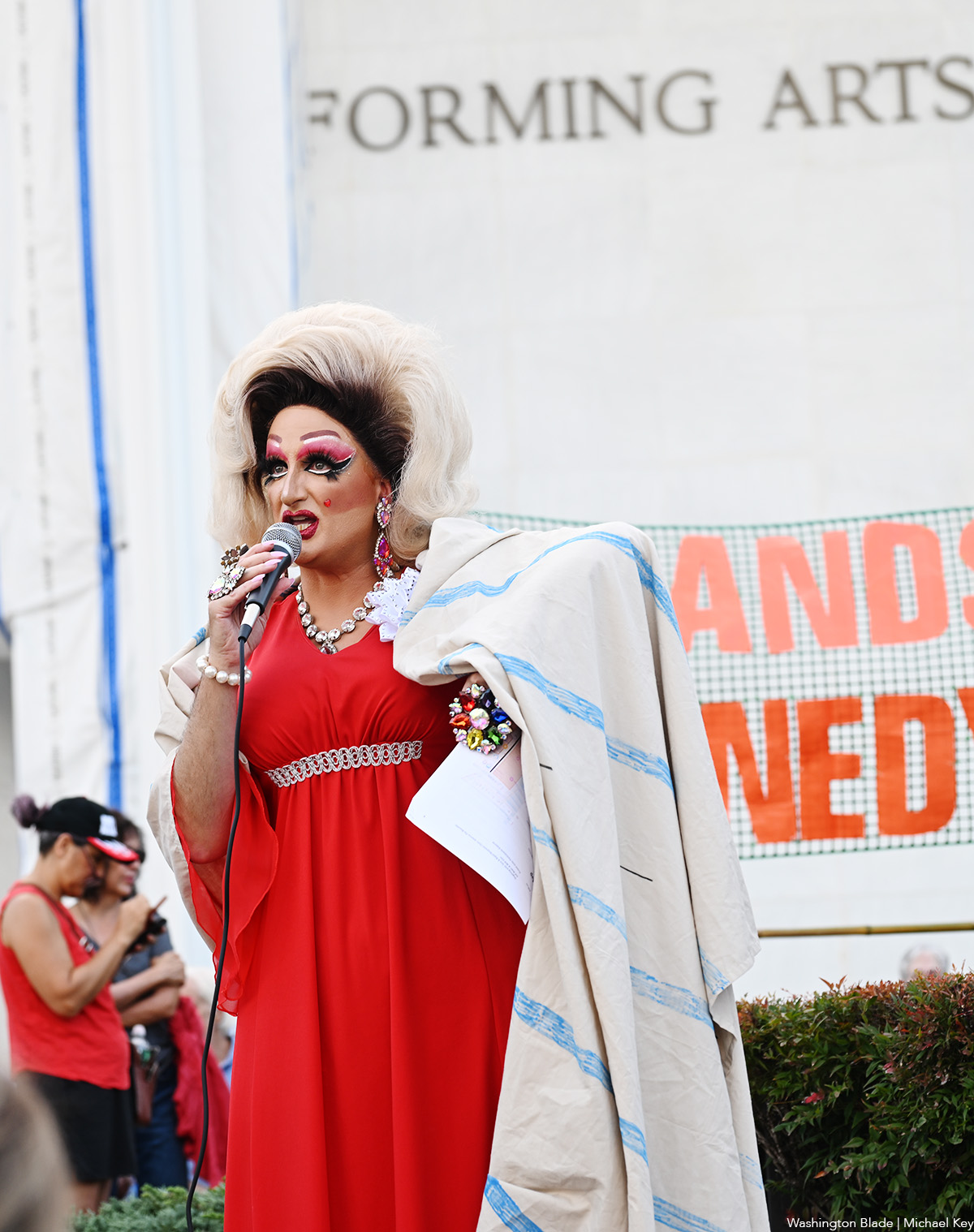
Drag performer Tara Hoot serves as MC, Gay Men’s Chorus of DC performs, attendees shout for Trump to keep ‘hands off’ Kennedy Center
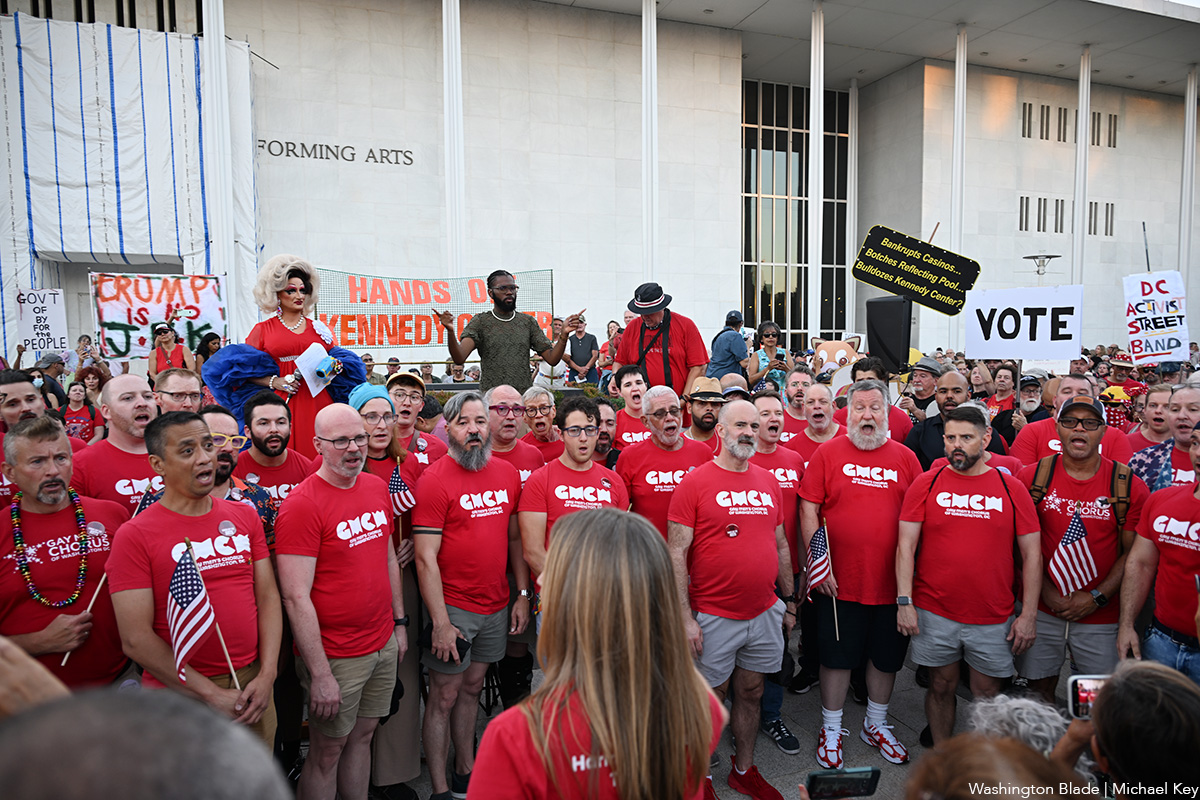
More than 2,000 supporters of the John F. Kennedy Center for the Performing Arts turned out on Sept. 18, for a rally in support of the performing arts center and a vocal protest against President Donald Trump’s threats to permanently close the center and possibly demolish it.
The event was organized by a group called Hands Off the Arts, which initially called for participants to form a “human chain” around the Kennedy Center’s main building following a rally on the plaza in front of the building.
However, due to a decision by the Trump-controlled Kennedy Center’s board of trustees to close the center earlier in the week and install fencing around part of the building, participants could only form the chain around part of the building, according to organizers.
Drag performer Tara Hoot, who co-organized the event and served as master of ceremonies for the rally preceding the “human chain,” said the large turnout could have fully surrounded the building at least twice had the fencing not prevented a full encirclement.
Among the musicians and singing groups that performed at the rally was the Gay Men’s Chorus of Washington, which, like other rally performers, had performed at the Kennedy Center in past years. They drew loud applause after singing one of their favorite songs from the Broadway musical show Ragtime, which includes the lyrics, “Will justice be demanded by 10 million men? Make them hear you. When they hear you, I’ll be near you again.”
View on Threads
Prior to their performance, Gay Men’s Chorus of Washington’s artistic director, Thea Kano, spoke at the rally, reminding participants that shortly after the Trump takeover of the center last year, Kennedy Center officials cancelled a concert the chorus was scheduled to perform there for World Pride 2025.
A Kennedy Center spokesperson said the cancellation was due to a scheduling conflict, but chorus members and LGBTQ activists believe it resulted from policies put in place by Trump and his leadership team at the Kennedy Center following Trump’s statements that he would end controversial “woke” performances that he claimed the majority of Americans disapprove of.
“Now this building sits empty in silence,” Kano told the crowd at the rally. “Let us raise our voices together and bring back the Kennedy Center as it was intended, a place where American culture could be celebrated and elevated, embracing the vibrancy with the spectrum of identify without censure and without politics,” she said.
Among the others who spoke at the rally were U.S. Rep. Don Beyer (D-Va.), U.S. Rep. Jonathan Jackson (D-Ill.), and D.C. Councilmember Robert White (D-At-Large).
Most speakers, along with LGBTQ participants in the hands-around-the-building event expressed strong opposition to Trump’s demand that the Kennedy Center name be changed from the John F. Kennedy Center for the Performing Arts to the Donald J. Trump and the John F. Kennedy Center for the Performing Arts.
At Trump’s request, his appointed board initially made that name change and placed Trump’s name on the front wall of the building along with the Kennedy name. But following legal action taken by opponents who pointed out that Congress must approve such a name change, a judge ordered the removal of Trump’s name from the building. Trump has said he will take steps to reverse that order and has said he will stop plans to renovate the Kennedy Center building and possibly demolish it if his name is not restored in the Kennedy’s Center’s official name.
Throughout the Sept. 18 rally, LGBTQ participants repeatedly responded to the Trump threats by shouting, “Hands Off!”
Chris Raleigh, one of the founders of Hands Off the Arts and a lead organizer of the Sept. 18 event at the Kennedy Center who spoke at the event told the Washington Blade that more similar events are being planned and he welcomes the support the event has received from the LGBTQ community.
“The LGBTQ community was here first, and we’re following them,” he said. “They’ve been the spearhead; they’ve been the vanguard. And I’m so thankful for heroes like Tara Hoot,” he said, adding, “It’s because they know what it means and how this is a safe place – the theater – for many LGBTQ people.”
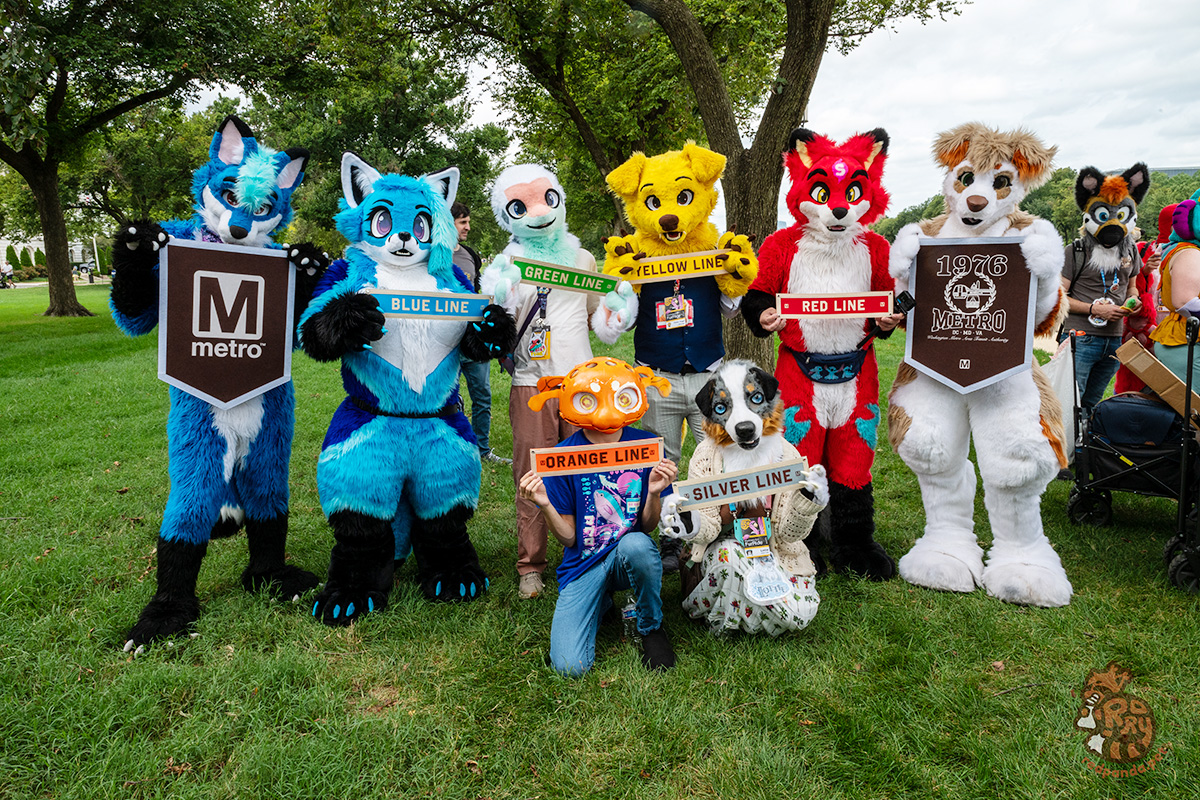
The DMV’s own furry group was on full display on the Metro on Sept. 12.
Shutterpaws is a volunteer-led 501(c)(3) non-profit organization located in Maryland.
The furry group has been doing the FurRide event since 2024 and has blown up in popularity for furries around DMV. They showcased themselves on the Silver and Blue Lines near the Smithsonian on Sept. 12.
“A lot of careful planning goes into running these events, with the goal being a seamless and enjoyable experience for everyone who attends,” says Zayre, a Shutterpaws staff member. “There’s a lot that you learn just by trial and error, and as Shutterpaws hosts more and more events, our team of event organizers continues to learn and refine our approach to keep things running smoothly and finding new ways to engage with our community.”
With a larger growth of participation in the community comes many challenges with the group, especially when it comes to the Metro rides and organizing.
“The biggest challenge that we face as organizers is keeping things fresh and finding new and engaging venues to host events,” says Zayre. “Recently we saw a lot of success hosting a meet at On Target Battlezone, an indoor NERF gun battle arena where our crew was welcome to show up and play both with and without a fur suit.”
Nevertheless, Shutterpaws receive overwhelming support from the community and partners.
“Across the DMV there are so many amazing places to host a Shutterpaws event so we can pursue our mission of helping connect fur suiters and photographers, and we’re blown away with the amount of support we’ve received from our community partners,” says Zayre.
Shutterpaws plans to do more events for anyone in the DMV who is interested.
Their next event in collaboration with DC Fur Meet will take place at Pitchers (2317 18th St., N.W.) on Saturday. Visit Shutterpaws’ website for more information.
Turkey
Activists protest outside Turkish Embassy in D.C.
Dozens detained during anti-LGBTQ ‘My Family Is Safe’ campaign raids
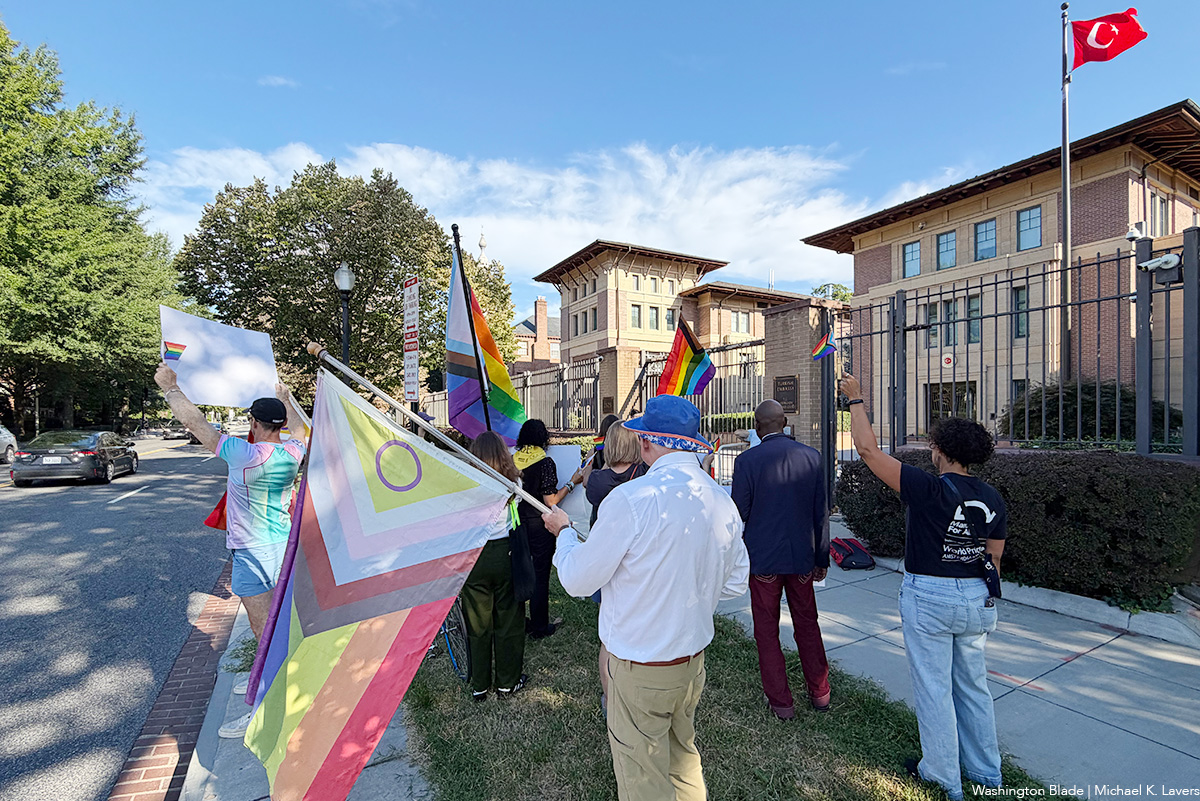
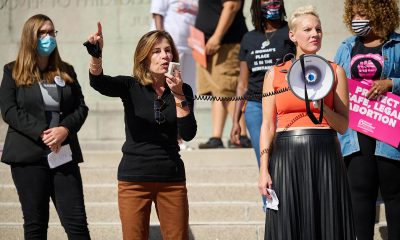
A group of activists on Friday gathered in front of the Turkish Embassy in D.C. to protest the country’s anti-LGBTQ crackdown.
The protest — which the Council for Global Equality, Amnesty International USA, Outright International, and Health GAP organized — took place less than a week after Turkish authorities detained dozens of people during raids that targeted the country’s LGBTQ community and advocacy groups and HIV/AIDS service organizations.
Authorities in Istanbul on Sept. 15 detained more than 150 people who gathered outside a courthouse to protest the raids that are part of the government’s “My Family Is Safe” campaign. Journalists are among those who were taken into custody.
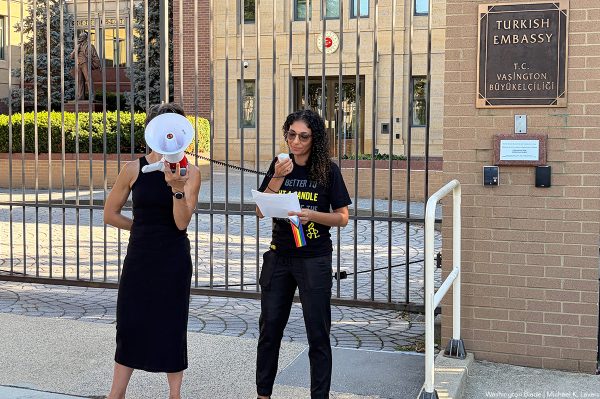
“This crackdown is not making families safer,” said Amnesty International USA Executive Director Nadia Daar, speaking in front of the Turkish Embassy.
Council for Global Equality Managing Director Keifer Buckingham stressed that “homosexuality is not a crime in Turkey.” Health GAP Executive Director Asia Russell and Outright International Senior Director of Law, Policy, and Research Neela Ghoshal also spoke.
View on Threads
Activists in Madrid and in other cities around the world held similar protests on Friday.

PHOTOS: Walk and 5K to End HIV

PHOTOS: Wanda Alston Foundation Fall Reception

Moving presents a chance to ‘clean house’

EV ecstacy: BMW iX3, Rivian R2

Curl up with a good book this fall

Trump’s Cabinet: Dumb, dumber, dumbest, and evil

More than 150 people detained outside Istanbul courthouse

Virginia Anti-Violence Project struggles to fill federal funding gaps

Gay man sues Delaware AG for not prosecuting partner in domestic violence case

D.C.’s fall theater season is already well underway
-

 Opinions4 days ago
Trump’s Cabinet: Dumb, dumber, dumbest, and evil
-
Turkey4 days ago
More than 150 people detained outside Istanbul courthouse
-
Virginia5 days ago
Virginia Anti-Violence Project struggles to fill federal funding gaps
-
Delaware5 days ago
Gay man sues Delaware AG for not prosecuting partner in domestic violence case