News
Anti-trans referendum won’t make 2014 California ballot
Opponents of law found to be 17,276 short of valid names
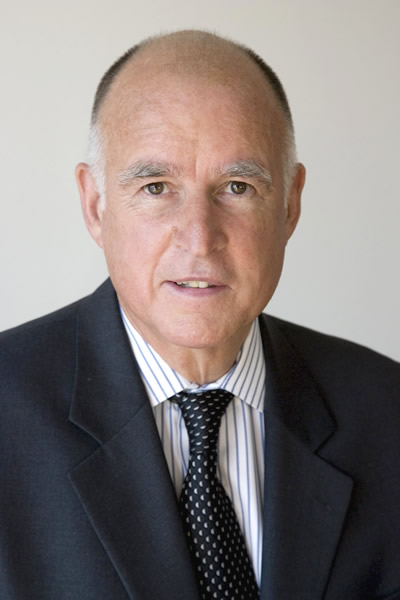
Gov. Jerry Brown signed a law that says schools must allow trans students to use the bathrooms and locker rooms and play on sports teams that match their gender identification. (Photo public Domain)
Despite the efforts of anti-transgender groups, a referendum on a law allowing California students to participate in student activities in accordance with their gender identity won’t appear before state voters in 2014.
On Monday, California Secretary of State Debra Bowen announced via Twitter that the signature check on the referendum for the law, known as the School Success & Opportunity Act, didn’t yield enough valid signatures to place the measure on the state ballot. A spokesperson for the office confirmed for the Blade the measure failed to qualify.
After a signature-check process that lasted months, state officials found opponents of the law submitted 487,484 valid names — which is 17,276 short of the necessary 504,760 names to qualify. They submitted 619,387 names, but 131,903 were deemed invalid.
The law, signed by California Gov. Jerry Brown on Aug. 13, requires California public schools to respect students’ gender identity and ensures transgender students have access to school activities, facilities and sports teams in accordance with their gender identity. But critics say it violates the rights of students who may feel uncomfortable sharing facilities with someone of a different biological sex.
LGBT advocates responded to the news by saying the law, which went into effect Jan. 1, ensures all students, including those who are transgender, can do well in school.
Masen Davis, executive director of the San Francisco-based Transgender Law Center, said the law fosters a positive environment for students in California schools.
“This law gives schools the guidelines and flexibility to create an environment where all kids have the opportunity to learn,” Davis said. “We need to focus on creating an environment where every student is able to do well and graduate. This law is about doing what’s best for all students — that’s why it’s supported by school boards, teachers, and the PTA.”
The Transgender Law Center is part of a coalition known as the Support All Students campaign, which consists of nearly 100 state and national organizations including Equality California, National Center for Lesbian Rights, ACLU of California, Gay-Straight Alliance Network, the L.A. Gay & Lesbian Center and Gender Spectrum.
Chad Griffin, president of the Human Rights Campaign, said the failure of the referendum to qualify for the ballot reflects the growing support for transgender rights.
“The forces of discrimination tried to go after California’s LGBT young people, and it’s a sign of our progress that they fell short of their goal,” Griffin said. “Yet unfortunately there are groups out there that are actively working to make the lives of LGBT youth harder. This law does nothing more than safeguard transgender students from being excluded and ensures all students are provided the same opportunities – regardless of gender identity.”
The lack of insufficient valid signatures to place the measure on the ballot isn’t surprising. John O’Connor, executive director of Equality California, predicted in November that it was “unlikely, [but] it’s not impossible” for the measure to qualify given the signature validation rate at that point.
Enough signatures deemed valid last month after a randomized spot-check was conducted to trigger a full count of all of the signatures acquired in the 58 counties. But, as revealed on Monday, the full count revealed the anti-trans campaign had failed to gather enough names to put the issue up for referendum.
Brad Dacus, president of the Pacific Justice Institute, nonetheless vowed in a statement to continue the fight against the trans student law through other means.
“Make no mistake, Pacific Justice Institute is committed to protecting the privacy of children,” Dacus said. “We are ready to review and challenge every signature that was not counted towards the referendum of this impudent and in-your-face bill. Our children’s privacy is worth doing all that we can.”
The statement says the Privacy for All Students, the coalition behind the referendum effort, has a right to review and appeal to the courts each of the around 131,000 signatures that were rejected. Additionally, the organization “to defend any child who has their privacy rights violated” because of the trans law.
It’s also still possible for opponents of the law to repeal it through a separate ballot initiative process different from the referendum process. But the deadline has passed for such a measure to qualify for the 2014 ballot, so the soonest that would be is 2016. A statutory ballot initiative would require 504,760 signatures to qualify for the ballot; a constitutional amendment would require 807,615 names.
Erik Olvera, spokesperson for the National Center for Lesbian Rights, said the odds aren’t favorable for path anti-trans groups have to strip the student law from the books.
“They would have to do an initiative or go to the legislature — both very hard,” Olvera said.




Bulgaria
Top Bulgarian court rules government must legally recognize trans people
Decision caps off decade-long legal fight

Bulgaria’s top court has ruled the country’s government must allow transgender people to legally change their name and gender on ID documents.
A trans woman from Bulgaria who moved to Italy, had tried to change her gender and name on her Bulgarian ID documents, but courts in the country denied her requests for nearly a decade.
The Bulgarian Supreme Court of Cassation in a 2023 ruling essentially banned trans people from legally changing their name and gender on ID documents.
The EU Court of Justice in Luxembourg, which is the European Union’s highest court, in March ruled in the “Shipova” case that member states must allow trans people to legally change their name and gender on ID documents. The lead plaintiff in the “Shipova” case is among the four litigants in the Bulgarian Supreme Court of Cassation case.
Two Bulgarian advocacy groups — Bilitis and Deystvie — along with TGEU – Trans Europe and Central Asia and ILGA-Europe in a joint statement they issued on Tuesday noted the Bulgarian Supreme Court of Cassation’s July 22 decision “aligns Bulgarian practice with the Court of Justice of the EU, enabling changes to gender markers, names, and personal identification numbers.”
“The judges also concluded that EU law requires Bulgaria to establish a legal procedure for legal gender recognition, which is necessary so that Bulgarian trans citizens can travel and reside freely inside the EU,” they added.
Bulgaria has been a member of the EU since 2007.
The country borders Romania, Serbia, North Macedonia, Greece, and Turkey.
“We are very glad to see that the judges of the Supreme Court clearly stated that it is actually a matter of rule of law for Bulgaria to respect the universal equality and the dignity of all human beings, including trans people for whom human rights-based legal gender recognition procedures are an indispensable element,” said Denitsa Lyubenova, co-chair of Deystvie who represented the four plaintiffs in the Bulgarian courts and the lead litigant in the “Shipova” case at the EU Court of Justice. “The government needs to act swiftly now to put in place an LGR procedure that is fully in line with European human rights case law, which means without any conditions requiring proof of medical, surgical or hormonal treatment.”
The groups also urged the Bulgarian government to codify the ruling into law.
“While lower courts are expected to follow this ruling directly, a court decision is not a substitute for law,” they said. “Bulgaria still needs a fast, transparent, and accessible legal gender recognition procedure written into legislation, not left to case-by-case court precedent. TGEU – Trans Europe and Central Asia, Bilitis, Deystvie, and ILGA-Europe call on the Bulgarian government to start that legislative process now, with meaningful involvement from civil society.”
National
Lou Chibbaro Jr. documentary wins award from NLGJA
‘Lou’s Legacy’ produced by D.C.’s Mattachine Society

“Lou’s Legacy: a Reporter’s Life at the Washington Blade,” a documentary produced by The Mattachine Society of Washington, D.C., will receive an Excellence in Journalism Award from NLGJA, the Association of LGBTQ+ Journalists.
The film premiered on WETA PBS in D.C. and Maryland Public Television (MPT) in June of 2025. The documentary’s Emmy-nominated director and producer Patrick Sammon will accept the award for Excellence in Local Television on Sept. 11 at NLGJA’s National Convention in San Francisco.
“Lou’s Legacy” was produced in association with the Mattachine Society of Washington, D.C., a non-profit LGBTQ history society dedicated to conducting original archival research. Aside from Sammon, the NLGJA is recognizing other members of the film’s production team including Producer Julianne Donofrio, Editor Amir Jaffer, Executive Producer Charles Francis, and Executive Producer Pate Felts.
“Lou’s Legacy” tells the story of two D.C. icons — legendary Washington Blade reporter Lou Chibbaro Jr. and beloved drag performer Donnell Robinson, known to generations of Washington audiences as “Ella Fitzgerald.” Through Lou’s nearly five-decade career at the Blade and Ella’s return to the stage after a three-year hiatus following COVID, the 29-minute documentary explores the history of Washington’s LGBTQ community and today’s rising backlash against LGBTQ rights, including laws targeting drag performers.
“All students of journalism can learn a lot from the story of Lou Chibbaro, Jr. Lou has chronicled nearly five decades of LGBTQ+ life and the community’s struggle for equality in Washington, D.C. Lou’s work and the role of the queer press has been essential in covering stories the mainstream media would often ignore or erase,” said Ryan Levi, president of the D.C. chapter of the NLGJA.
“We are thrilled to receive this award from the NLGJA,” said the film’s director Patrick Sammon. “Lou Chibbaro’s nearly five decade career at the Washington Blade demonstrates the essential role LGBTQ journalism plays in telling our community’s stories and documenting its history. This recognition from journalists who follow in Lou’s footsteps is particularly meaningful to me and the rest of our production team.”
Obituary
Beloved D.C. ‘Old Catholic’ Bishop Charles Braun dies at 86
Gay church leader offered spiritual support to LGBTQ community
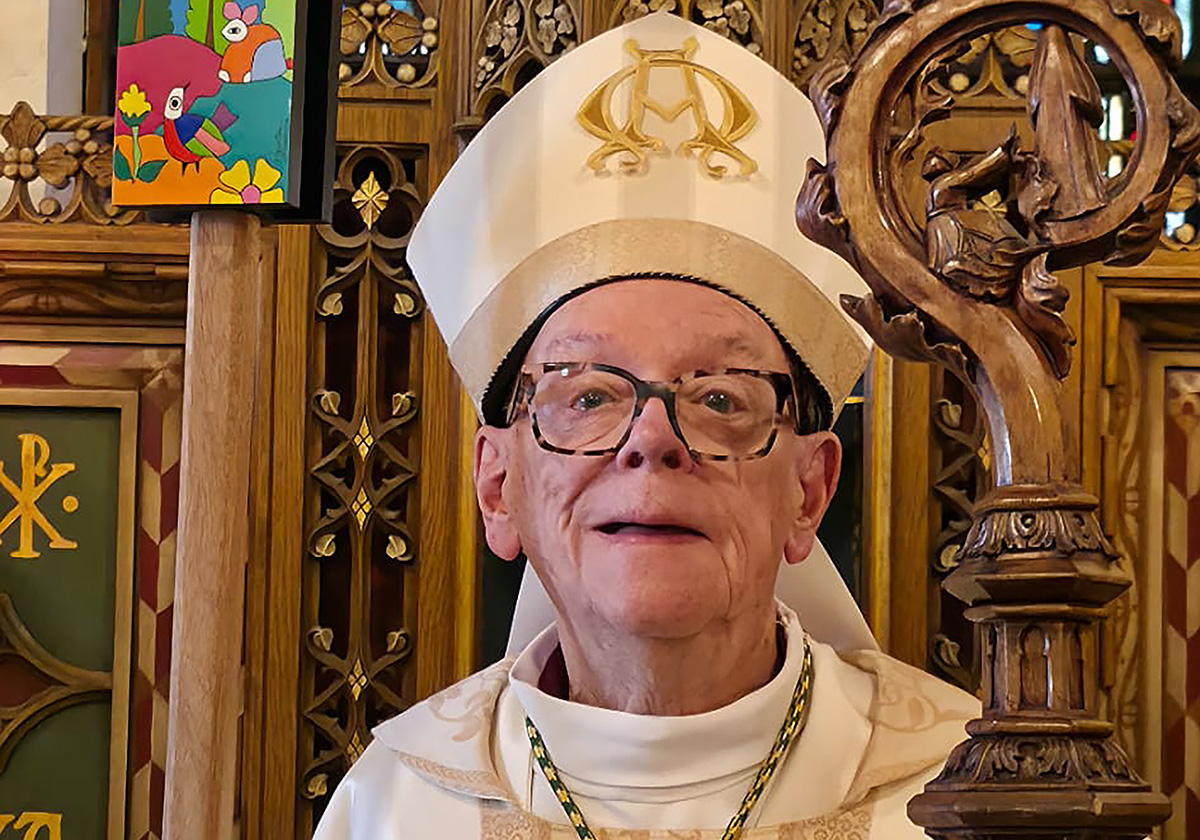
The Rt. Rev. Charles “Charlie” Braun, who served since 2001 as Bishop of the D.C.-based Inclusive Catholic Diocese of the Chesapeake Bay and as founding minister at the affiliated LGBTQ supportive St. John’s Inclusive Catholic Community of D.C., passed away Aug. 3 at the age of 86.
Write-ups about Braun’s life and legacy as a progressive religious leader report that the Inclusive Catholic Diocese of the Chesapeake Bay and St. John’s Inclusive Catholic Community are part of the “Old Catholic” movement, which is a partial break-away church from the Roman Catholic Church.
“St. John’s parish was founded with and continues with the special calling to reach those who had been hurt by other church denominations,” a statement on the St. John’s website says.
“St. John’s welcomes all without exception, with particular care for members of the LGBTQIA+ community who have suffered abuse and rejection elsewhere, offering them contemporary scriptural and theological guidance grounded in an ancient faith tradition made to work in the 21st century,” the website statement says.
It notes that until the time of his passing, Braun, among other things, performed the St. John’s Inclusive Catholic Community’s weekly Sunday mass at its headquarters location at 3417 14th St., N.W. in the city’s Columbia Heights neighborhood. The location is in a converted townhouse owned and operated by the LGBTQ supportive Dandelion Collective, which provides support for the local LGBTQ community.
Rev. Stephen F. Scott, the current pastor at the D.C. St. John’s Catholic Community, said Braun is a native of Bucks County, Pa., and studied to become a priest at D.C.’s Catholic University’s Marist House seminary, where he was ordained as a Roman Catholic priest in the 1960s.
Scott told the Washington Blade that Braun was then assigned as a parish priest at St. Michael’s Catholic Church in Wheeling, W.Va. The St. John’s Catholic Community website write-up says Braun directed that church’s choir “and formed friendships that lasted lifetimes.”
The website write-up continues, “Bishop Charlie left the Roman Catholic priesthood but never left ministry. He found a new spiritual home in the Old Catholic movement, where he was consecrated a bishop and became a beloved unapologetic voice for its theology and tradition.”
It says he began his service as Bishop of the D.C.-based Inclusive Catholic Diocese of the Chesapeake Bay in October 2001 and later founded the St. John’s Inclusive Catholic Community, both of which he led until the time of his passing.
“In Washington, D.C. Bishop Charlie became especially well known and cherished within the LGBTQ+ community, offering compassionate pastoral presence, ordaining and mentoring candidates for ministry, and reminding all who knew him that ministry does not end when circumstances change – it simply takes new forms,” the website statement says.
Rev. Scott confirmed reports by people in the LGBTQ community who knew Braun and who told the Blade the man they knew as Bishop Charlie visited LGBTQ supportive bars and restaurants in D.C., including the Dupont Circle area, to perform religious services and offer spiritual support for LGBTQ people.
“Charlie spoke so much about the importance of loving and welcoming, especially gays, lesbians, transgender Catholics and Christians and meeting them where they were,” Scott said. “So not expecting people to come to a full-on church building, he would go in his evenings and enjoy a drink or have a meal, whether it was Dupont Italian Kitchen, Floriana, or any of the neighborhood gathering places in the queer community,” Scott told the Blade.
“If there was a couple that would come to talk to him and wanted to get married, he would arrange with the couple to have the ceremony at their venue of choice,” according to Scott. “He would have weddings, confirmations, baptisms at those locations because that’s where the community felt comfortable.”
A Mass of Christian Burial was held for Bishop Charles ‘Charlie’ Braun on Saturday, Aug. 22, at the LGBTQ supportive Lutheran Church of the Reformation located in the Capitol Hill neighborhood. Scott said the church was selected because it offered a larger space for the service than the St. John’s Inclusive Catholic Community location in Columbia Heights.

Top Bulgarian court rules government must legally recognize trans people

Lou Chibbaro Jr. documentary wins award from NLGJA

Beloved D.C. ‘Old Catholic’ Bishop Charles Braun dies at 86

Blade welcomes fall intern

PHOTOS: Miss Gay Old Bay

San Francisco, long a queer safe haven, remains competitive for homebuyers

E-INFOSOL leaders encourage youth to pursue tech careers

Milo Yiannopoulos deported to UK

For LGBTQ youth starting with nothing, Pride House in Florida offers help

New book examines Trump cuts to LGBTQ healthcare
-

 California5 days ago
San Francisco, long a queer safe haven, remains competitive for homebuyers
-
Technology4 days ago
E-INFOSOL leaders encourage youth to pursue tech careers
-
National5 days ago
Milo Yiannopoulos deported to UK
-
Florida5 days ago
For LGBTQ youth starting with nothing, Pride House in Florida offers help