National
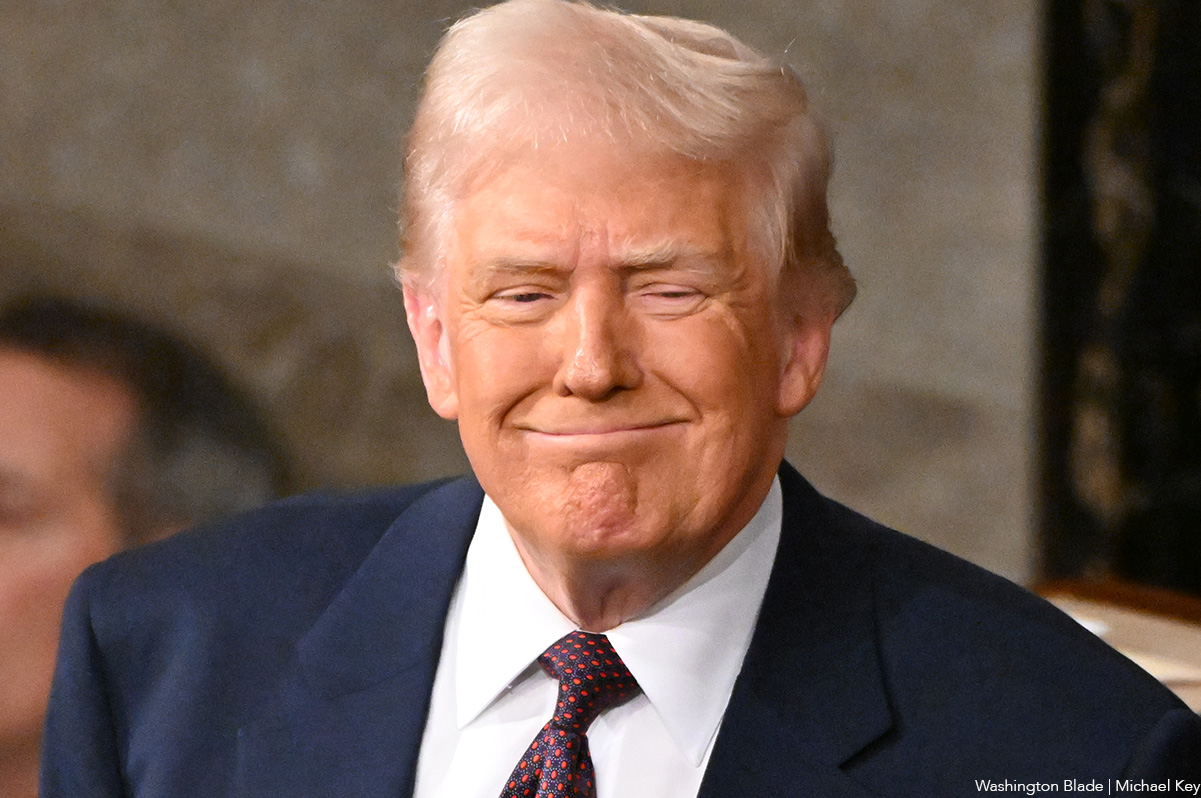
Trump falsely links trans people to terrorism
Intelligence agencies threatening to investigate community members as domestic terrorists
Uncloseted Media published this article on Feb. 14.
By HOPE PISONI | In December, Kathy Brennan was in San Francisco on a video call with her wife and son when she started to feel a burning pain in her chest. While she ignored it at first, it quickly spread to more of her body until it was too much to bear. She called 911 and was brought to the hospital on a stretcher.
“My entire chest was just crushed in pain, I couldn’t even move it was so bad,” Brennan told Uncloseted Media. “I said ‘God, I am not ready to die here. Please don’t let me die.’ I was thinking about Alaina, and we have so much more life together.”
Brennan spent the next few days recovering in the hospital from what doctors determined to be a stress-induced heart attack.
Brennan had spent the past year in a near-constant state of what she called “safety monitoring” her wife, Alaina Kupec.
She obsessively followed the news about the Trump administration’s attacks against the trans community, especially as officials began openly labeling trans people as terrorists. Everywhere she went, she mentally patrolled for how to keep her wife safe.
“Is our home safe? Is my wife safe? Are we safe? What do we have to do? … Can we protect ourselves if people come to our door? What do we have to worry about when we go to the grocery store? Are we gonna get doxxed?” Brennan remembers thinking.
Kupec, a trans naval intelligence veteran, is an outspoken advocate for trans rights and is the founder president of Gender Research Advisory Council + Education (GRACE).
“I think the big worry is that she will be taken away from me and we won’t be able to find her. … Then, just for the sheer sake of cruelty, my beautiful, feminine woman of a wife, they would put her in a men’s prison.”
Brennan’s fear reflects that of many trans Americans and their loved ones. In the aftermath of the assassination of anti-trans conservative activist Charlie Kirk, the Trump administration and its allies began taking actions to target socially progressive people and organizations as terrorists, with a focus on trans people. In September, Trump signed an executive order designating Antifa, a decentralized movement focused on militant opposition to fascism, as the first ever “domestic terrorist organization.” At the same time, the closely allied Heritage Foundation — who penned Project 2025 — began pushing for the creation of a new national security designation called “Transgender Ideology-Inspired Violent Extremism.”
Shortly after, Trump released National Security Presidential Memorandum (NSPM)-7, which directs intelligence agencies to investigate left-wing political organizations for involvement in domestic terrorism, singling out “extremism on migration, race, and gender” and “hostility towards those who hold traditional American views on family, religion, and morality.”
The unfounded trans terrorism panic has swept right-wing spaces, and experts say that it’s putting trans people in danger.
“If people are told, day after day, especially from … people with that veneer of legitimacy, that this entire group of people … is implicitly a dangerous terrorist, that sends that message that these people are able to be targeted for violence,” Jon Lewis, a research fellow at the Program on Extremism at George Washington University, told Uncloseted Media.
The what and the why
While Trump relied on anti-trans messaging since he began campaigning in the 2024 presidential election, his portrayal of trans people as a national security threat emerged in response to an August 2025 mass shooting in Minneapolis, where a trans person killed two children. While the overwhelming majority of mass shooters are cisgender men, right-wing figureheads blamed the shooting on the perpetrator’s transness.
While Kirk’s assassin is cisgender, early reports falsely claimed that he had engraved pro-trans messages onto his bullets, which conservative figures like Megyn Kelly and Laura Loomer used to blame trans people for the killing. “It’s time to designate the transgender movement as a terrorist movement,” Loomer said the following weekend on X. And Vice President JD Vance suggested that he considers trans people to be part of a “terrorist movement.”
The Trump administration picked up on this rhetoric to justify its actions: the Antifa executive order and NSPM-7 both reference Kirk’s assassination as well as either trans people or “extremism on gender.”
As these policies began rolling out, independent journalist Ken Klippenstein reported that the FBI was preparing to designate trans people as “nihilistic violent extremists.” A leaked intelligence brief showed that U.S. Customs and Border Protection had centered the focus of one extremist group on their trans membership, referring to them as a “radical leftist trans militant cult.”
How these actions will be enforced remains to be seen. At least two trans women are currently jailed and awaiting trial over an anti-ICE protest where a local police officer was shot by a cis man, which the Department of Justice claims was connected to an “Antifa Cell.” It is not known whether the government will attempt to use the defendants’ transness to implicate them in terrorism charges.
And leaked documents indicate that the FBI is compiling a list of groups and individuals involved in extremism based on a number of beliefs including “radical gender ideology.” Their ability to compile such lists may be enhanced by a policy change from the Department of Homeland Security last February that allows the government to surveil people based on their sexual orientation or gender identity.
While some have questioned to what extent the administration intends to actually enforce all of these policies, experts say that the fact they’re being discussed poses a serious risk.
“From 9/11 onward, the United States has been leading a ‘global war on terror,’ so to label somebody as a terrorist is a rallying cry for violence and discrimination,” says Arie Kruglanski, a professor of psychology at the University of Maryland. “This term of terrorism calls people to action. … Once you label somebody as a terrorist, then clearly they present a mortal danger to society, and they need to be fought against.”
‘Tremendously damaging’
Lewis says that being exposed to these attacks can be “tremendously damaging.”
“It’s not even that there are [always] explicitly these immediate legal repercussions that some person will face, but it’s that othering, it’s that sense of fear every day,” he says.
That fear has caused Jewels Jones to withdraw from public life. Jones, a trans man from the South, says that the anti-trans vitriol online after Kirk’s death became too much to handle, and he had to leave social media almost entirely.
“I’m 23, I should be on social media, but I can’t because if I even go onto my timeline, something can trigger me,” Jones told Uncloseted Media. “[I miss] the feeling of freedom.”
With community often hard to find, Jones says he and several other trans people he knows have been struggling with substance use.
“Everyone here has their own reasons for turning to things such as drinking and smoking and partying and just finding [a way] to feel numb or ignore what’s going on,” Jones says. “Just being trans and having to see how everybody views you, how you’re perceived, how you’re feeling, all these different emotions that you feel is more than enough of a reason [to] turn to those things.”
PJ, a trans man from a small town in Arizona, who asked to remain anonymous because he is not out, says that after Trump’s inauguration, he’s started to hide his transness. And he’s not alone: Since the 2024 election, 55 percent of trans people have taken steps to be less visible in their communities.
“It is torture,” PJ says. “I do not like having to lower my voice when I speak to prevent sounding androgynous. I do not like having to hide away my wardrobe for ‘being too gay.’ There is no comfort in overcompensation.”
Individuals aren’t the only ones stepping into the shadows. Kupec has been withdrawing herself and her nonprofit from the internet as much as possible. She says GRACE used to host monthly calls, where as many as 100 people would join to hear from experts on issues facing the trans community. But now, they no longer have public meetings, and internal communications have moved to Signal, an encrypted messaging app.
“We have backed off of doing those things because of the fear of how this could be leveraged against us,” Kupec told Uncloseted Media. “It’s had a chilling effect on our ability to exercise our freedom of speech as individuals and as a nonprofit organization.”
Trying to leave
Because of this fear, many trans Americans are trying to leave. A survey by the Movement Advancement Project found that 43 percent of trans Americans had considered moving to a different state since the 2024 election, with 9 percent having already moved. And the Williams Institute found that 45 percent of trans people wanted to move out of the country.
Kupec has watched noteworthy friends disperse across the globe: Rachel See, the former chair for National Center for Transgender Equality, moved to Portugal; and author and advocate Brynn Tannehill moved to Canada.
“That’s part of what [the administration’s] desired outcome is, to get people to self-deport,” Kupec says.
For many, relocating isn’t easy: For 64 percent of trans people who want to move out of state, cost of living was cited as a barrier. PJ has been trying to move for years. But within the U.S., relatively LGBTQ-friendly states like California and Massachusetts have much higher costs of living, making moving there financially challenging.
Moving internationally is no small feat either — every country has its own laws to navigate around immigration.
PJ says he kept running into barriers while trying to leave. The Netherlands initially seemed promising, but he discovered that the path to residency required him to start a business, which he couldn’t afford to do. Other countries fell through because he didn’t have the money to cover application fees. The closest he got to making it out was when a friend on the east coast of Canada offered to let him stay with them for a while. But it fell through when the friend’s septic tank collapsed, ruining the house and forcing PJ back to the U.S.
“It seems like every plan that you make to try to get out of here, it just gets squashed,” he says.
Those barriers have gotten scarier for PJ as the clock may be ticking for him to be able to leave. In November, the Supreme Court allowed the Trump administration to enforce a ban on passports with gender markers that do not align with an individual’s birth certificate, with the State Department’s website suggesting that passports which have already been updated may be invalidated.
Given all of these threats, PJ believes that trans Americans should be able to seek asylum in other countries. Applications for asylum by trans Americans have been rejected in countries including the Netherlands and Canada, and most European countries don’t view the U.S. as dangerous enough to grant refugee status despite many having issued travel advisories for trans residents visiting the country.
“We can’t really claim asylum right now so there’s not really many other options but sink or swim,” PJ says.
There have been some efforts to push for asylum status for trans Americans. Politicians, advocates and lawyers in Canada and Norway have called for their respective governments to accept trans Americans as refugees. And in July, a Canadian judge blocked the deportation of a nonbinary American who overstayed their visa, with one of the factors considered in the decision being “current conditions for LGBTQ, nonbinary, and transgender persons” in the U.S.
Finding hope and respite
In the face of all this, finding a support network can be crucial to survival. While community has been especially hard to find in the South, Jones says that he’s been able to connect with other transmasc people via reddit communities like r/TMPOC (Trans Masculine People of Color) or r/testosteronekickoff.
Kupec and Brennan find solace through their 12-year relationship. Brennan says, “I love her more now … than I did when I first fell mad smack in love with her.”
“Having love where there’s respect and kindness and joy and excitement and it goes both ways, that is really unique, not a lot of people have that,” she says. “But when you do have it, it’s like, ‘I wanna preserve this and protect this with every ounce of my energy and soul because it’s the center of my life,’ and I know that she feels that way too.”
As Brennan recovers from her heart attack, she’s been watching less news and joined a book club to connect with other people. Kupec, a Catholic, has been putting her faith in God to get through.
“I know who I am, I know my maker knows who I am, and I have strong faith that by doing the right thing, at the end of the day, that’s what’s going to win out.”
Additional reporting by Sam Donndelinger.


Netherlands
Dutch prime minister visits Stonewall Inn
Rob Jetten is the Netherlands’ first openly gay prime minister
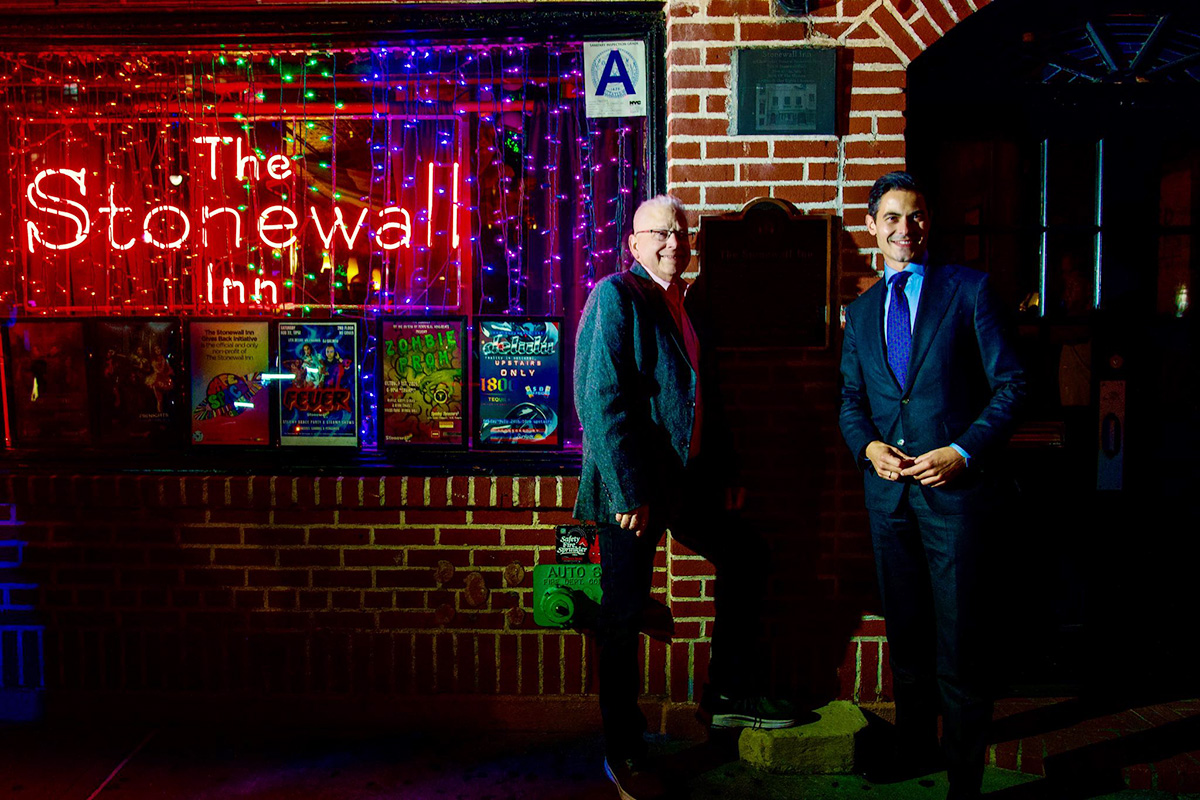
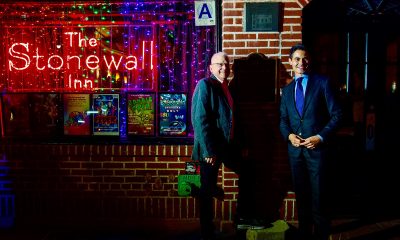
Dutch Prime Minister Rob Jetten on Monday visited the Stonewall Inn in New York.
“The Stonewall Inn is not just a gay bar in New York, but the place where in 1969 riots took place as a reaction to years of discrimination and police violence,” wrote Jetten on X. “This is seen as the starting point of the global LGBTIQ+ emancipation and activism. Nowadays, the bar is a national monument, dedicated to the LGBTIQ+ rights movement.”
“For me, it is impressive and moving to be here tonight. And also fitting, because the defense of human rights is an important part of our foreign policy,” he added. “The Netherlands stands alongside the Stonewall Inn community when it comes to everyone’s right to live openly, safely, and with pride, no matter who you are or who you love.”
De Stonewall Inn is niet zomaar een gay bar in New York, maar de plaats waar in 1969 rellen plaatsvonden als reactie op jarenlange discriminatie en geweld van de politie. Dit wordt gezien als startpunt van de wereldwijde lhbtiq+-emancipatie en activisme. Tegenwoordig is de bar… pic.twitter.com/hJmFYjF91Z
— Rob Jetten (@MinPres) September 23, 2026
Jetten in February became the Netherlands’s first openly gay prime minister.
He opened last month’s World Pride Human Rights Conference in Amsterdam. Jetten also participated in a panel with former Irish Prime Minister Leo Varadkar, former San Marino Captain Regent Paolo Rondelli, and other current and former heads of government who are gay or lesbian.
Jetten is scheduled to speak to the U.N. General Assembly on Thursday.
National
For lesbian victims of domestic violence, competent care is scare
Heteronormative assumptions, funding cuts contribute to lack of resources for survivors
Uncloseted Media published this story on Sept. 22.
By EMMA PAIDRA | Claire, a 25-year-old Los Angeles resident, distinctly remembers the night she and her ex-girlfriend broke up.
“She was strangling me in a CVS parking lot,” Claire recalls, adding how she was gasping for air as bystanders looked on. “I made eye contact with one man who just kept walking, and we were right behind a car that was trying to reverse out of a parking spot. No one got out of the car. They didn’t honk; they didn’t do anything.”
Claire, who asked to use a pseudonym due to safety concerns regarding her ex, says she managed to fight her way out of her then-girlfriend’s grasp. It was at this moment in 2024 she realized things had reached a breaking point.
While research on intimate-partner violence has traditionally focused on opposite-sex couples, two recent reports found that queer women, like Claire, are not immune to this type of abuse. An international research review published last year in the Journal of Media Critiques found “IPV rates in same-sex relationships are comparable to or exceed those in heterosexual relationships,” with up to 46 percent of lesbians encountering such abuse, compared to 36 percent of straight women. A separate review published earlier this year found that nearly 27 percent of lesbians surveyed had experienced IPV.
Despite the prevalence of IPV in lesbian relationships, heteronormative and outdated assumptions have left many queer women feeling like they have nowhere to turn for competent services and support, according to experts, advocates and victims interviewed by Uncloseted Media.
“Queer folks are joining the conversation to say, ‘This is happening in our communities, too, and we need the same resources and support services that straight women are offered,’” Tori Stranges, a professor of women’s studies at the University of British Columbia, told Uncloseted Media.
A frequently overlooked problem
Stranges says the false notion that only men are domestic abusers can result in violent same-sex relationships not being taken seriously.
“People assume that violence is perpetrated by men against women,” she says, adding that this “has left queer people out of the conversation.”
“If it was a man that was doing all these things, and people heard and saw it, I’m sure I would have been taken seriously,” says Claire. “People saw a 5-foot-7 woman who didn’t look that strong — and above all, she was a woman. Men, especially, don’t really see that as a threat. So they’re like, ‘If I’m not threatened, then I’m sure it’s not a big deal.’”
Outdated assumptions about IPV can even result in victims themselves overlooking their abuse.
“When it comes to abuse in heterosexual relationships, there are national campaigns, there are resources that you can access,” Stranges says. “There are people coming into the school systems to talk about relationship violence. We don’t have similar recognition and the same conversations about queer people.”
Claire says the violence she was subjected to was paired with moments of intense affection, which made it harder for her to recognize the abuse.
“We would get into a fight, and she would physically abuse me, and then apologize. She was actually also very gentle with me sometimes,” Claire recalls. “That kind of cycle can be really addicting. I would always wait for the good parts.”
The role of mental illness
K.P., a 47-year-old lesbian living in Maine, was with her abusive ex-girlfriend for five years before ending the relationship in 2023. During their time together, K.P. says her ex, who struggled with panic disorders, ADHD and depression, experienced a decline in her mental health, which contributed to more frequent outbursts of rage. When it comes to the link between rage and violence, one 2022 meta-analysis found that “anger was a significantly stronger correlate of IPV perpetration for women than men.”
K.P., who was working from home at the time and felt like she had no escape, says her ex’s verbal abuse spiraled into physical violence.
“I was on the couch with my laptop, trying to work, and she was just being belligerent,” recalls K.P., who asked to be identified by only her initials because of safety concerns. “I tuned her out, but when she realized I wasn’t giving her the attention that she expected, she went to the kitchen, grabbed two knives and started coming at me.”
K.P. ran outside, trying to get away. Her ex ran after her and then chased her back inside to avoid being seen by neighbors.
Once inside, her partner hid her phone. K.P. used this brief window to message a co-worker on her laptop, asking him to call the police.
“I was confused and afraid,” K.P. told Uncloseted Media. “I’d never been chased with a knife before, let alone by someone who I cared about.”
Research shows LGBTQ people have higher rates of mental health conditions than their non-LGBTQ peers. A study published last year in JAMA Network Open found sexual and gender minorities had “significantly higher odds of at least four of 10 commonly diagnosed mental health conditions,” including post-traumatic stress disorder and bipolar disorder.
IPV may also contribute to negative mental health effects, with research finding that victims experience an increase in depression, anxiety and PTSD and a reduction in life satisfaction.
“After we broke up, I was messed up,” K.P. says. “It took me a good six or eight months to feel like I could breathe again.”
Trapped in a ‘double closet’
In addition to mental health, the stigma of being queer may affect a victim’s response to being in an abusive relationship. When Claire first came out to her family, she says they kicked her out of their home until she returned to the proverbial closet. They eventually accepted her sexuality, but Claire says the residual shame she carried afterwards led her to avoid the added stigma she feared she’d experience if she admitted to being in an abusive relationship.
“All of that combined made me feel so trapped. I just thought, ‘Oh my god, I’m being judged from every single angle,’” she says. “There was just nowhere to go.”
Letícia Yuki de Araujo Furukawa, a clinical psychologist specializing in supporting survivors of IPV, says this kind of thinking is not uncommon among queer women in abusive relationships.
“Sometimes lesbian women who are experiencing IPV relationships start to isolate themselves, to prevent themselves from the shame and judgment they think they are going to suffer,” she says.
Furukawa says this impulse is rooted in the layers of stigma queer women face.
“It comes down to two things that make it like a double closet: We have the closet of being a lesbian, and you have the other one that comes from being in a violent relationship.”
According to Furukawa, having a supportive family can decrease the risk of entering an abusive relationship. Unfortunately, strained familial relationships are common among queer people: A 2022 study in the Journal of Marriage and Family found that 32 percent of gay and lesbian adult children — compared to 22 percent of their heterosexual counterparts — were estranged from their fathers.
Because of the shame Claire faced from her family when she came out, she was reluctant to admit there was a problem in her relationship when her mother and sister expressed concern. She worried that if her family knew her lesbian relationship was abusive, they would stop accepting her queer identity.
“My mom and sister would say to me during the relationship that they thought my ex looked evil, and that I changed so much. I used to be such a bubbly girl, and my personality made a complete 180,” she remembers. “In my head, I was like, ‘I can’t admit that it’s true.’”
‘Gaps in, policy, care, and services’
When queer women have the courage to report IPV, some don’t receive the response they’re hoping for. When police arrived at K.P.’s home following the knife-wielding incident, she says they opened a case file and wrote an incident report but said there was nothing else they could do because her ex had fled the scene.
“It was a little frustrating that since my ex-girlfriend drove away, the police couldn’t do anything,” K.P. explains.
Laura Elizabeth, an assistant professor of criminal justice at Virginia Union University who researches IPV, says there may have been additional steps police could have taken to support K.P., including connecting her with resources for domestic-violence survivors.
“It is vital that [police] make the proper referrals, and that it not just be limited to handing the victim a brochure,” she says. “There needs to be an active discussion with victims about what their options are in terms of who they can reach out to, who can offer what services.”
Kimberley Jackson, an associate professor at the Arthur Labatt Family School of Nursing at Western University, says lack of research on same-sex domestic violence also impacts the support services available to lesbian victims.
“The intersection of IPV and the LGBTQ community is really not well understood,” Jackson told Uncloseted Media. “What we can tell you based on really limited evidence, is that there are huge gaps in policy, care and services. And with respect to shelters, we haven’t really moved the needle very far.”
One area in which shelters may be failing lesbian victims has to do with both the perpetrator and the victim being able to access the same shelter.
“This issue is further compounded in rural areas, where there’s likely only one shelter,” Jackson says. “There’s a chance they won’t be able to turn someone away, even if they’re the perpetrator.”
Jackson says queer victims of domestic violence who aren’t open about their sexuality may face additional obstacles.
“With respect to anonymity, in a lot of rural places, you’re going to know people in the community,” she says. “There are issues with accessing help if you’re worried about outing yourself.”
Calls for change
Experts and victims say LGBTQ training for shelter workers and law enforcement, as well as funding for research, could help prevent same-sex IPV and address the damage done by such abuse.
But under the Trump-Vance administration, these funding resources are slipping away. In March of last year, the administration canceled at least 68 grants, totaling nearly $40 million, that were focused on LGBTQ health. A second round of cuts followed two months later, during which $800 million worth of grants dedicated to researching LGBTQ health were terminated.
Rebecca Hobbs, co-executive director of Through These Doors, a domestic violence resource and advocacy center in Portland, Maine, says LGBTQ training materials are essential to ensuring shelters can support lesbian victims.
“LGBTQ people will not come to us unless they see themselves reflected in our materials,” Hobbs says. “We want our advocates to be well versed in understanding the additional barriers and challenges that LGBTQ people might experience.”
Advocates say police departments could also benefit from LGBTQ-awareness training.
The state of California and a number of large cities — including Atlanta, Chicago, Los Angeles, Houston, New Orleans, New York, Philadelphia and D.C. — have implemented some form of LGBTQ-sensitivity training.
But Greg Miraglia, founder and CEO of Out to Protect, a national organization supporting LGBTQ police officers and equipping all officers to serve queer people, says these programs are the exception, not the rule.
“Most other states do not require any type of LGBT awareness training,” Miraglia, a retired police officer who is based in California., told Uncloseted Media “There are over 18,000 law enforcement agencies out there, and I don’t think we’ve scratched the surface.”
“The problem comes about when law enforcement goes into a domestic violence incident with a same-sex couple without any training, carrying a lot of stereotypes that are common,” Miraglia adds. “They’re not picking up the fact that this is a couple that’s involved in an intimate relationship, and therefore domestic violence laws in that state apply.”
Claire says she wishes someone had intervened when her ex abused in the CVS parking lot and on her college campus. “The police had the biggest missed opportunity to intervene, as well as campus security,” she says. “A lot of our fights were in public, and she would get very loud. I made a promise to myself that if I ever saw anything like that in public, I would say something, because that’s all I needed at the time.”
National
Long-time DignityUSA executive director announces retirement
Marianne Duddy-Burke has been with LGBTQ Catholic group for decades
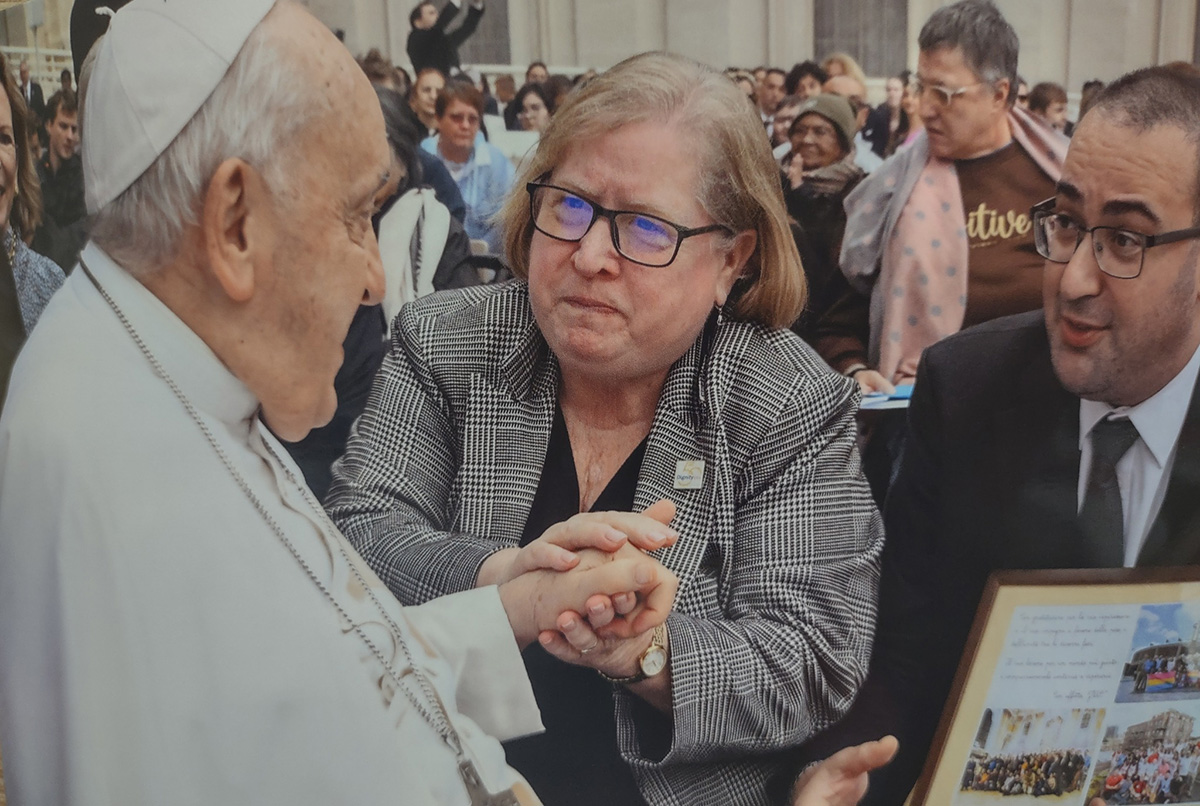
The executive director of the world’s oldest LGBTQ Catholic organization has announced she will retire once her successor has been chosen.
Marianne Duddy-Burke has been with DignityUSA for more than four decades. She has been the group’s executive director since 2007.
DignityUSA announced Duddy-Burke’s retirement on Sept. 17.
Duddy-Burke during her tenure has urged the Vatican to do more to welcome LGBTQ Catholics. She has also, among other things, championed marriage equality and advised the State Department on LGBTQ-specific issues. (The Trump-Vance administration’s decision to freeze nearly all U.S. foreign aid shortly after it took office in January 2025 has had a devastating impact on the global LGBTQ and intersex rights movement and efforts to fight HIV/AIDS around the world. A report that Outright International released earlier this month notes 90 percent of LGBTQ and intersex rights groups around the world have lost funding since 2025.)
Duddy-Burke met with Pope Francis in 2023.
She traveled to Rome in 2025 for the papal conclave to choose the Argentine-born pope’s successor. Pope Leo XIV, who was born in Chicago, succeeded Francis.
DignityUSA in the press release that announced Duddy-Burke’s retirement notes she expressed “particular appreciation to people who spoke honestly about the reality of being a queer Catholic or family member.”
“I have been inspired every day by your stories and have done my best to lift them up,” said Duddy-Burke. “It is your lives, your faith, your struggles, your hopes that I have strived to reflect in my work, and doing this has been a great honor.”
DignityUSA President Meli Barber praised Duddy-Burke.
“It is almost impossible to sum up the scope and depth of Marianne’s achievements and contributions to DignityUSA over her more than four decades of service,” said Barber. “Under her wisdom and leadership, DignityUSA has only grown in stature as an advocate for LGBTQIA+ Catholics and as a visionary thought leader for LGBTQIA+ ministry and spirituality.
“Marianne has been more than an extremely able executive director,” added Barber. “Her care for and ministry to chapters, her deep personal relationships with countless Dignity members, her connections to LGBTQIA+ Catholics around the world, the relationships she has built with other progressive Catholic organizations, her skill as a public representative, the respect with which she is universally regarded, and her tireless devotion to service all leave an indelible mark. It is not an exaggeration to say that she has shaped not only Dignity but a generation of LGBTQIA+ Catholics.”
Barber said DignityUSA will “soon begin a search for a new executive director.” Barber added Duddy-Burke “will assist with the transition.”

Colombia withdraws from Equal Rights Coalition

Caso Karlina: Una sentencia histórica contra las terapias de «conversión»

Washington Blade responds to concerns over White House pool duties

Young people should know history of the fight for human rights

Dutch prime minister visits Stonewall Inn

Over 2,000 turn out for Hands Around the Kennedy Center protest

PHOTOS: Wanda Alston Foundation Fall Reception

PHOTOS: Walk and 5K to End HIV

What LGBTQ veterans are building after ‘Don’t Ask, Don’t Tell’