Arts & Entertainment
Sonic cocktails
Pink Martini’s Lauderdale on life, music and his V Day show at the Kennedy Center
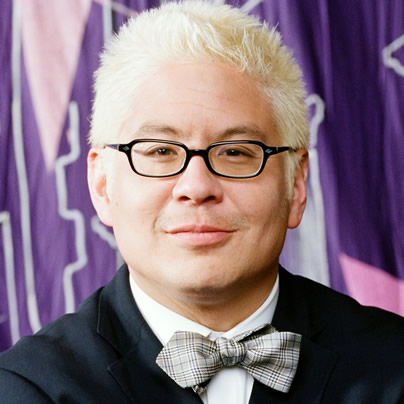
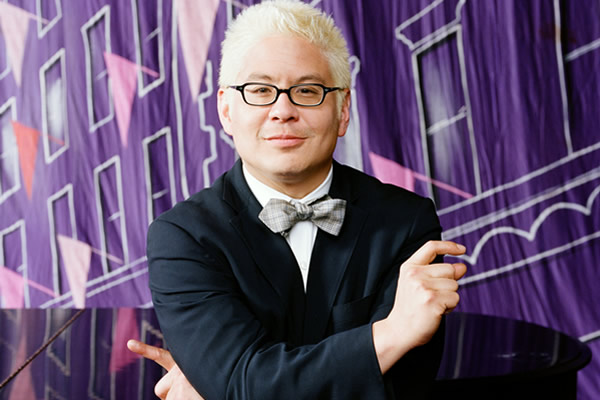
Thomas Lauderdale, founder and frontman for Pink Martini. (Photo by Autumn de Wilde)
Pink Martini
Thursday
8 p.m.
Kennedy Center Concert Hall
$30-$90
wpas.org
202-785-9727
Thomas Lauderdale, the gay founder and band director of Pink Martini, called just a few minutes after waking up one day last week from his home in Portland, where he lives in a house he says is haunted with his partner of eight years, Philip Iosca. Pink Martini returns to Washington next week for a Washington Performing Arts Society concert on Valentine’s Day at the Kennedy Center. Comments edited for length — Lauderdale is a big talker.
BLADE: Is it a good morning in Portland?
LAUDERDALE: Yes, I love it here. It’s sort of like the Pittsburgh of the west. And the guys are really cute here, more so than the girls. It seems like most cities either have cuter guys or cuter girls. Here it’s the guys.
BLADE: Pink Martini has performed with so many orchestras all over the world, yet your music is not straight-up classical at all. Are the players ever snobby about it or do they mostly just have fun with it?
LAUDERDALE: They’re really game for it. I think classical musicians who were snobby are becoming less so all the time. They have to be. Nobody’s going to hear them. Their audiences are dwindling all across America. … Most young people are watching “American Idol.” It’s just not a viable option to just play the traditional repertoire. … Orchestras all over the country are in the quandary of how to generate new audiences.
BLADE: So are the lines blurring between pop/rock and classical?
LAUDERDALE: Yes, they have to. … That was one of the reasons behind creating the band — I wanted to appeal to people outside their traditional dividing lines so it would connect with people who are really conservative, really liberal and everybody in between. This international styl with kind of an old fashioned pop feel, I felt it would be inspiriting and fun and a place where people could find commonality. And that’s kind of come true.
BLADE: Whatever happened to the Del Rubio Triplets (the group Pink Martini was formed to open for in 1994)? Surely they must be dead by now?
LAUDERDALE: Yes, sadly they are all dead. I think Millie, the oldest one by a few minutes, died about two summers ago. They were complicated — very Catholic, very anti-immigrant, yet so pro-gay and really Southern California. It was dizzying.
BLADE: Your stuff has this pre-classic rock era feel. Do you watch “Mad Men”?
LAUDERDALE: No. I don’t have a TV.
BLADE: You must feel some sense of identity with the pre-Vietnam era. Your music isn’t just that, but there’s kind of a Steve and Eydie vibe to some of it, right?
LAUDERDALE: Yeah, that sort of era between World War II and up to about 1964. It seems one of the goals of that era was building things that were beautiful and were built to last. You find refrigerators built in the ‘50s that are still working just fine. Later we saw, I think, a darker side to capitalism but I think it would have been nice if some of those trappings of that era had survived into the political liberation post-’64.
BLADE: On paper, it sounds so unlikely that a band like Pink Martini would make it. Do you feel you stumbled on something missing in the zeitgeist that there was a hunger for or does the cream always manage to rise with the truly talented in the end?
LAUDERDALE: Well, I don’t know. I think working on that first album, we were just trying to figure out a way to make it fun and accessible and not negative. It definitely helped that we were all from Oregon. This band would not have made it if we’d all lived in New York or San Francisco where everything is just so expensive and you have to be in five bands or something crazy just to make the rent. Here you can get by on very little, so you actually have time to think and just be.
BLADE: How many are in the band currently?
LAUDERDALE? Anywhere from eight to 14 depending. We’ll probably have about 10 in D.C. And we’ll maybe hire a string section.
BLADE: Can you tell us anything about the show?
LAUDERDALE: I haven’t thought that far ahead. It’s for Valentine’s Day so we might do something kind of romantic-ish.
BLADE: How gay is the band besides you?
LAUDERDALE: Well Ari Shapiro has been doing stuff with us and we’re both totally gay. And Timothy (Nishimoto). There are a few others who might be gay for pay. I think they could be tricked into it.
BLADE: You grew up in church. Were you aware at all of a mid-century trend where even the Lawrence Welk-era stuff was starting to be reflected in the gospel music of the time? There’d be stuff in the hymnals that even had waltz accompaniments.
LAUDERDALE: Well we had the red hymnal and the blue songbook where you had the newer stuff. That’s where you found the artsier, ‘70s stuff. You know, my Dad was the first openly gay minister in the Brethren church. He tends to like these cheesy inclusive modern hymns which I think are just cheesy and awful. When I go back to visit, I’m always pulling out these gloom and doom hymns — you know, we’re all going to burn — from, like, the 1880s. The melodies are just better, more beautiful. And I always win because I’m at the piano.
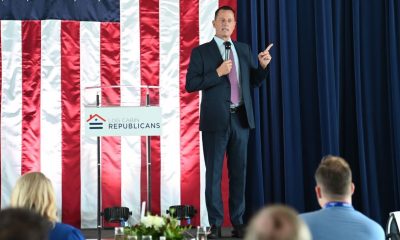



The Capital Pride Alliance presented the 2026 Capital Pride Honors at “The Audacity Brunch: In Full Fuchsia” at the Four Seasons Hotel Washington, D.C. on Sunday, June 7.
(Washington Blade photos by Landon Shackelford)


Out & About
Congressional Cemetery hosts Gays & Graves
Daylong Pride celebration blends history, remembrance, art and community

Historic Congressional Cemetery will host the second annual “Gays & Graves: A Big Gay Festival” on Sunday, June 14 at 11 a.m.
The event will feature pioneering activist Randy Wicker, the Gay Men’s Chorus of Washington, and new public art installations and programs celebrating LGBTQ+ history. Gays & Graves is an official partner event of Capital Pride 2026.
This event is a daylong Pride celebration blending history, remembrance, art and community. Visitors can shop from LGBTQ+ and allied artists and makers, experience performances and interactive installations, and engage with programs exploring LGBTQ+ history and lived experience.
For more details, visit the cemetery’s website.
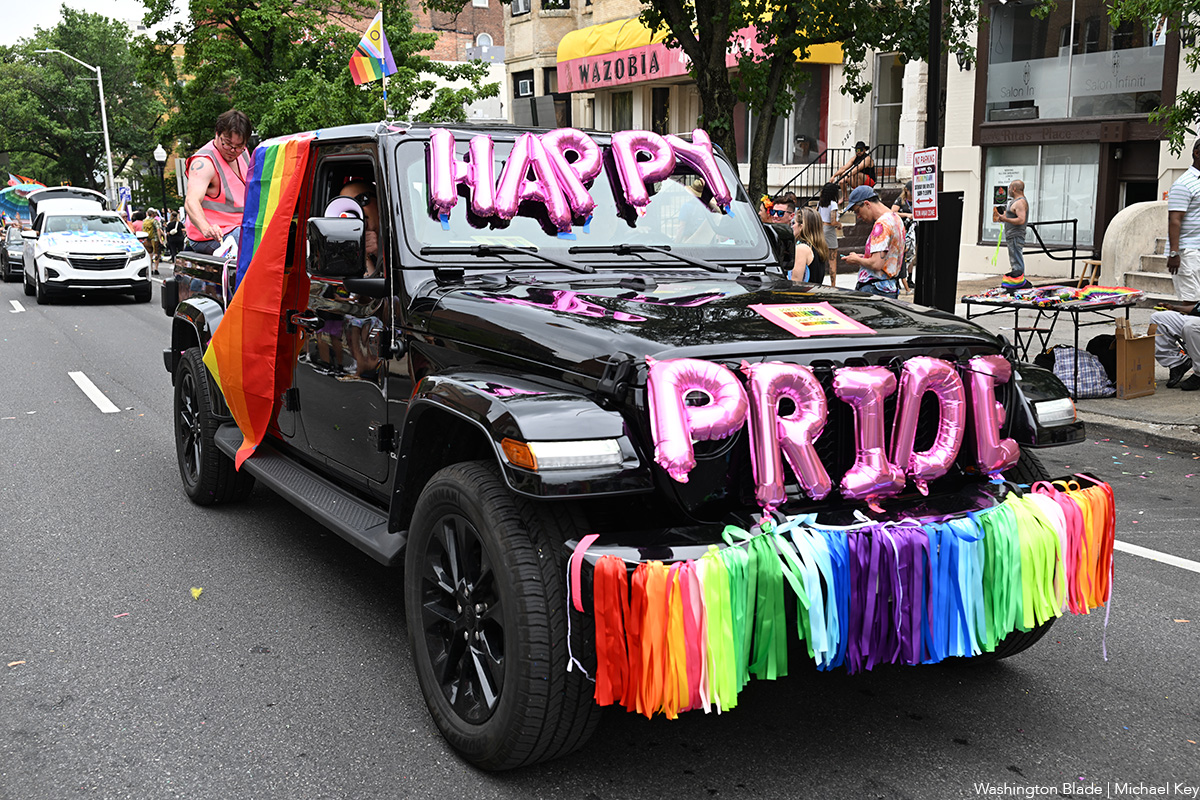
Baltimore Pride is underway, taking place from June 8-14.
The Pride Parade will be on Saturday, June 13 at 12 p.m. at Charles Street & North Avenue, followed by the Pride Block Party at 1 p.m. at Druid Hill Park. And then the Pride Festival will be held on Sunday, June 14 at 12 p.m. at Druid Hill Park.
There will be an array of additional events including: a fashion show, a “Suits and Sneakers” reception and a 5k race, among many other events.
For more details, visit Baltimore Pride’s website.

PHOTOS: The Audacity Brunch

D.C. Council approves expanded grant funding for Mayor’s Office of LGBTQ Affairs

Congressional Cemetery hosts Gays & Graves

Baltimore Pride is here

Calendar: June 12-18

‘Mighty Real’ explores history of LGBTQ music

D.C.’s housing reality: Cautious optimism meets landlord strain

Hundreds of thousands expected to attend D.C. Pride events

PHOTOS: Pride Run