National
Utah’s 1,300 gay weddings spark change in attitudes
Marriage equality in conservative state impacts public opinion, LDS Church
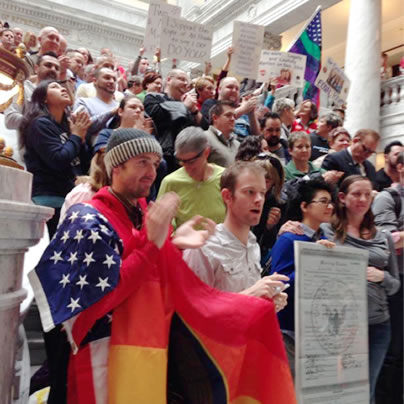
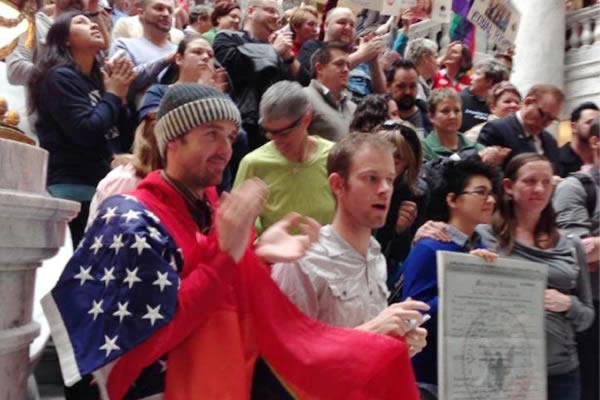
Utahns rally in support of marriage equality. (Photo courtesy J Seth Anderson)
Although the 18-day period during which Utah allowed same-sex marriages has ended, observers say the visibility of gay couples marrying there made an indelible impression on one of the nation’s most conservative states.
Utah’s flirtation with marriage equality began on Dec. 20 when a district court ruled in favor of marriage, allowing more than 1,300 same-sex couples to marry in the state before the U.S. Supreme Court issued a stay on the weddings pending appeal of the litigation.
Gov. Gary Herbert has said the state won’t recognize the same-sex marriages, but the federal government had pledged to view them as legitimate, and the events have shaken the state government, the view of state residents and even the Mormon Church.
Michael Ferguson, who wed his partner in Salt Lake City on Dec. 20 and became one-half of the first same-sex couple to marry in Utah, saw a sharp transition in support for marriage equality on social media in just two days of having marriage equality in Utah.
“I saw people who were posting some pretty horrible things about bestiality and pedophilia, and the slippery slope of world corruption, that’s going to ensue with same-sex marriages being solemnized in Utah,” Ferguson said. “Within two days of social dialogue, those same people were apologizing, and saying, ‘I can see that I was wrong and speaking from a place of ignorance, and I’m going to keep a more open-minded position in this conversation.'”
Mark Lawrence, director of the Utah-based Restore Our Humanity and the individual behind the marriage equality lawsuit, also noticed a distinct change in public opinion as the weddings took place.
“So many more people are, ‘OK, this is going to happen,” Lawrence said. “They’re coming around. They still may not agree with it, they still may not be happy with it, but I don’t think they see it anymore as the sky is falling and this is going to be the destruction of society.”
Evidence that attitudes have shifted on marriage equality in Utah is more than just anecdotal. Two new polls reveal significant growth in support for same-sex marriage in the state.
A new consumer poll made public on Sunday reveals that for the first time ever, a bare majority of Utah residents — 51.3 percent — support marriage rights for gay couples. In comparison, 43.7 percent oppose legal relationship recognition.
David Baker, a Mormon and gay D.C. activist, ran the poll over the course of last week using Google’s digital platform system, which is deemed an accurate method of polling by statisticians.
Baker said he “absolutely” believes the events in Utah in the past few weeks — especially Herbert’s decision not to recognize the marriages performed in the state — has had an impact on the perception of marriage equality in the state.
“I feel that Gov. Herbert’s decision to continue to put the rights of LGBT couples, who are legally married in the state of Utah, in a legal limbo has caused Utahns to face this issue that they may not have thought of before in the same context of legal rights for LGBT couples,” Baker said.
The results of Baker’s latest poll are along the lines of a poll published Tuesday by the Salt Lake Tribune that found Utah residents are now evenly split on whether same-sex couples in Utah should be allowed to marry — 48 percent were for it and 48 percent against it — and nearly three-fourths said same-sex couples should be allowed to have civil unions.
It’s hard to say that new support for marriage equality in Utah is the result of people seeing firsthand same-sex marriages happening in the state because no other data exists immediately before the weddings took place. However, the findings assert strong support for gay nuptials never before seen in the state.
Perhaps the most visible demonstration of this support for same-sex marriage came on Friday — coincidentally the day U.S. Attorney General Eric Holder announced the Obama administration would recognize the same-sex marriages — when an estimated 1,500 people rallied in Salt Lake City to urge Herbert to drop his appeal before the U.S. Tenth Circuit Court of Appeals.
Among the speakers was a 12-year-old boy, Riley Hackford-Peer, who said seeing his lesbian moms being able to marry in Utah was the second-happiest day of his life — right after the birth of his younger brother — and “felt like fireworks bursting in my heart.”
“Some people do not believe that I’m from a loving family because my moms are gay; they are wrong,” Riley said to applause. “I love my moms, and my moms love me and my brother, unconditionally.”
Troy Williams, a Salt Lake City gay activist and one of the organizers of the rally, said the event was intended to build off online petitions at Moveon.org calling on Herbert to let the court ruling stand in favor of marriage equality in Utah. At the time of the rally, the petitions had a total of 58,000 signatures.
“There’s so much excitement and energy right now,” Williams said. “Utah’s LGBT community is on fire and we are united like I have never seen before. There is such a sense of momentum and it was just happy coincidence that Friday morning Eric Holder announced the federal government would be acknowledging our marriages.”
Another institution showing signs of change — albeit subtle — is the Church of Jesus Christ of Latter-day Saints, which is headquartered in Utah and nearly six years ago led the fight against same-sex marriage when California’s Proposition 8 came on the ballot.
In a statement the church issued on Friday, it reaffirmed its opposition to same-sex marriage, warning church officers not to employ “their ecclesiastical authority to perform marriages between two people of the same sex” and forbidding the use of church property for same-sex marriages.
Still, a portion of the statement advises members of the church to treat everyone with respect.
“While these matters will continue to evolve, we affirm that those who avail themselves of laws or court rulings authorizing same-sex marriage should not be treated disrespectfully,” the statement says. “The gospel of Jesus Christ teaches us to love and treat all people with kindness and civility — even when we disagree.”
The words came the day after news broke that the Mormon Church wouldn’t file a friend-of-the-court brief in the Utah case seeking marriage equality now before the U.S. Tenth Circuit Court of Appeals — a change in trajectory for the church after it joined the religious right in making filings before the U.S. Supreme Court when it considered Prop 8 and the Defense of Marriage Act.
Spencer Clark, executive director of Mormons for Equality, said the statement is notable because it could have come out when same-sex marriages started advancing throughout the country, but instead is happening now.
“But given the rapid spread of civil marriage equality over the past couple years it’s evident that the church has recognized that this is something that is not going away and with which they will have to co-exist,” Clark said. “The fact that this letter came out now, and not in 2001 or even 2004, is a tacit admission that the climate has incontrovertibly changed and that we as Mormons must confront reality.”
And there’s optimism going forward about the lawsuit. It’s pending before the U.S. Tenth Circuit Court of Appeals, which has pledged to consider the case on an expedited basis and is expected to render a decision this spring.
J. Seth Anderson, the other-half of the first gay couple married in Utah, said the short-lived nature of marriage equality in Utah demonstrates that the issue needs to be at the federal level and not left to the states.
“The states cannot be trusted to treat fairly, equally and lawfully their gay and lesbian citizens,” Anderson said. “There’s no statute in Utah law that allows the governor to select a group of marriage licenses and just declare them not recognized. It places Utah at the center of a very important national debate, and shows, I think, Utah digging its heels into keeping its position as a far right-wing rogue theocracy.”
The lawsuit may be the first to reach the U.S. Supreme Court among others seeking the court to find a constitutional right to same-sex marriage.
But Lawrence said he’s hoping the case ends with the Tenth Circuit ruling — with no appeal by the state of Utah to the Supreme Court — so that gay couples in Utah can continue marrying yet again as soon as possible.
“There are many people who want to this to go to SCOTUS, and if it does, we feel very strongly if we go to the Supreme Court this is going to be the end-all for the whole country,” Lawrence said. “That would be great, but I don’t want to keep our people in limbo for that long.”



U.S. Federal Courts
Renee Good’s family files two federal lawsuits
ICE officer killed lesbian mother of three in Minneapolis in January
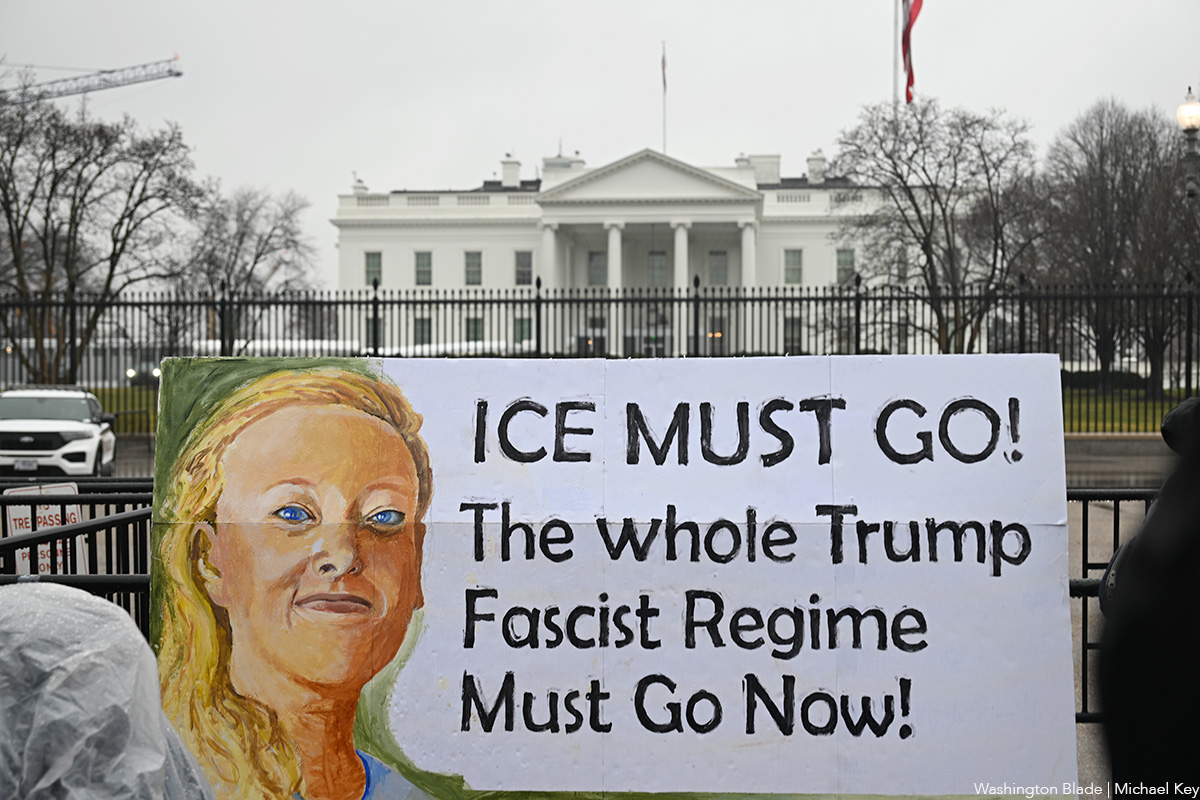
The family of lesbian woman who a U.S. Immigration and Customs Enforcement killed in Minneapolis in January have filed two federal lawsuits.
The Associated Press notes Renee Good’s partner, Becca Good, and her brother, Brent Ganger, in the lawsuits accuse the Trump-Vance administration and ICE officer Jonathan Ross of “unjustified and excessive use of force.”
Renee Good was a 37-year-old mother of three.
Ross on Jan. 7 shot and killed her in Minneapolis.
The shooting took place during the Trump-Vance administration’s so-called Operation Metro Surge that targeted Somalis and other immigrant groups in Minneapolis. U.S. Customs and Border Protection agents on Jan. 24 shot and killed Alex Pretti, a 37-year-old nurse who worked for the U.S. Department of Veterans Affairs, in Minneapolis.
Both shooting sparked outrage across the U.S. and around the world.
“Every morning, she is my first thought. I think about how the kids are growing up without their mama, and how I will grow old without the love of my life. I think about how we should have had 40 more years together. But I also think about what she would have wanted after all of this,” said Becca Good in a statement the Human Rights Campaign released after she and her partner’s family announced the lawsuits.
“As we have tried to navigate our own massive loss, I am also devastated by how many other lives have been destroyed in this darkest of times. So many other families are dealing with the loss of their loved ones; to everyone who has had to witness it — the pain of this moment extends far beyond our family,” added Becca Good. “What happened to us should never happen to any family. No child should grow up without a parent because of it. No one should lose their sister or their daughter. No one should have to live without their soulmate. Accountability — real accountability — is the only way to make sure that no other family has to go through what we have.”
HRC President Kelley Robinson in her own statement said the Good family “is one of our own — and today, the Human Rights Campaign joins them in demanding justice.”
“It has been eight months and 24 days since Renee was shot and killed by an ICE agent, and the United States government has failed to take responsibility for its actions,” said Robinson. “Her partner, Becca, and brother Brent, have made the brave and bold decision to hold the government accountable, and we stand with them. Like every person murdered by ICE, Renee should be alive today. The Goods were robbed of what every American family deserves: to be together.”
Federal Government
988 restores crisis services for LGBTQ youth

The lifesaving 988 call-in number to help people experiencing mental health crises or suicidal thoughts has once again restored its specialized services for LGBTQ youth.
The lifeline, which used to have the option to “press 3” to be directly sent to specialized services for LGBTQ youth facing mental health crises or suicidal thoughts, was returned on Wednesday following an over-year-long battle with the Trump-Vance administration, which removed the service in May 2025.
The Press 3 option rolled out as a pilot program in 2022 through a government contract with the Trevor Project, a suicide prevention and crisis intervention organization for LGBTQ people.
Then, in June 2025, the federal government announced that the lifeline would be eliminated within a month. By July 2025, 988 Lifeline’s “Press 3” services were terminated.
Openly gay U.S. Sen. Tammy Baldwin (D-Wis.) helped lead Congress in reversing the removal of the lifesaving resource from American phones. As a member of the Senatw Labor-HHS Appropriations Subcommittee, she started the process of securing $535 million for 988 — a $15 million increase — as well as dedicated funding for LGBTQ youth specialized services.
Then, in September 2025, Baldwin, along with U.S. Sen. Lisa Murkowski (R-Alaska), introduced bipartisan legislation in the Senate, the 988 LGBTQ+ Youth Access Act, to codify the 988 Lifeline’s specialized services for LGBTQ young people.
At the same time, U.S. Rep Raja Krishnamoorthi (D-Ill.) introduced the legislation in the House of Representatives alongside U.S. Reps. Michael Lawler (R-N.Y.) Sharice Davids (D-Kan.) Brian Fitzpatrick (R-Pa.) and Seth Moulton (D-Mass.)
The Senate passed Baldwin’s bipartisan funding bill in January 2026, funding the Department of Health and Human Services with explicit language mandating the return of 988’s LGBTQ youth specialized services.
In February 2026, Congress passed legislation mandating that the previously eliminated “Press 3” specialized services be restored and funded with $33,100,000 — but it was unclear if the Press 3 option would still be allowed under current executive orders, namely Executive Order 14168, or “Defending Women From Gender Ideology Extremism and Restoring Biological Truth to the Federal Government.”
Despite the securing of federal funding for the Press 3 resource, the battle to get the 988 LGBTQ+ Youth Access Act through Congress is ongoing — and would provide codafied protection from this removal ever happening again.
According to data on the Trevor Project’s website, LGBTQ young people are more than four times as likely to attempt suicide than their peers.
Baldwin’s office touts the immense help the lifeline provides to LGBTQ people in their moments of greatest need. The press release on the reinstatement of Press 3 highlighted the continued demand for the service:
“The volume of calls, texts, and chats 15 percent higher than a year earlier and nearly 50 percent higher than two years ago. Since the lifeline launched, it has received over 27 million contacts, including over 18 million calls, 4 million texts, and 3 million chats.”
Advocates for LGBTQ rights and mental health awareness have agreed with the increasing numbers and hailed the return as a win for everyone.
“Suicide and mental health struggles touch every community across our state, and that’s why creating the 988 crisis lifeline to make sure help is there for everyone is one of my proudest accomplishments,” said Baldwin said in a statement. “But, last year, the Trump administration decided to make these real struggles a political football and ripped away the specialized line that helped LGBTQ children. This was a deliberate choice. The Trump administration chose to put children’s lives on the line to score some political points.
“I’ve fought tooth and nail to restore this lifesaving resource. When I realized the Trump administration was not going to do it on their own, I wrote it into federal law to require them to restore the Press 3 option,” the Wisconsin senator said. “This lifesaving resource never should have gone away in the first place, but I am glad the lifesaving support Press 3 provides is once again there for people who need it.”
“I’m proud that we secured the funding to restore this lifesaving LGBTQ+ crisis line and successfully pressured the Trump administration to bring the program back,” Krishnamoorthi said. “When an LGBTQ+ young person reaches out for help in a moment of crisis, they deserve to reach a counselor trained to understand and support them. This program should never have been taken away, and now we need to make sure it stays available for every young person who needs it. I’m grateful to the Trevor Project, NAMI Chicago, Equality Illinois, the American Foundation for Suicide Prevention, and all the advocates and young people who worked alongside us to bring these services back.”
Jaymes Black, CEO of The Trevor Project who works with the SAMHSA, in their press three operations celebrated the return of the resource.
“We are grateful to see that the 988 Suicide & Crisis Lifeline’s ‘Press 3’ specialized services for LGBTQ+ youth have been restored. Resuming this national resource will be critical in addressing the public health crisis of suicide among LGBTQ+ young people, and supporting the estimated more than 1.8 million LGBTQ+ youth who seriously consider attempting suicide in the U.S. each year,” Black said via a statement. “We are thankful for the large coalition of bipartisan lawmakers, mental health advocates, allies, and supporters who fought tirelessly for this restoration. We will monitor the launch and usage of these important services to ensure all LGBTQ+ youth are supported with clinically best standards.”
If you or someone you know needs mental health resources and support, please call, text, or chat with the 988 Suicide & Crisis Lifeline or visit 988lifeline.org for 24/7 access to free and confidential services. Trans Lifeline, designed for transgender or gender-nonconforming people, can be reached at (877) 565-8860. The lifeline also provides resources to help with other crises, such as domestic violence situations. The Trevor Project Lifeline, for LGBTQ+ youth (ages 24 and younger), can be reached at (866) 488-7386. Users can also access chat services at TheTrevorProject.org/Help or text START to 678678.
California
Calif. governor signs 6 pro-LGBTQ bills, vetoes 1
Gavin Newsom rejected measure he claimed is legislative overreach

Last week, California Gov. Gavin Newsom signed and vetoed a slew of bills into state law. Among them were seven pertaining to California’s LGBTQ community. Newsom signed six while vetoing one. His actions drew applause and scorn from advocacy groups in the state.
The six signed bills:
Assembly Bill 1775 allows transgender veterans, who were banned from service last year by the Trump-Vance administration, to access housing assistance, use California’s discharge upgrade assistance program, and get support for gaining employment.
Assembly Bill 1930 strengthens privacy protections for healthcare patients and providers by creating clear guidelines for California agencies, individuals, and corporations to respond to out-of-state subpoena requests relating to abortion or gender-affirming care. This includes a requirement to contact the California Attorney General at least seven days prior to responding to the subpoena or providing legal documents. This should add additional protection to those residing in California from investigations in states where abortion or gender-affirming care has more restrictions.
Senate Bill 934 targets conversion therapy in California and increases the amount of time a patient has to bring a medical malpractice lawsuit against a provider for attempting to change the patient’s sexual orientation or gender identity. The bill takes aim at the widely debunked practice that treats queerness as a mental disorder that could be cured through psychotherapeutic methods. Conversion therapy has been illegal in California since 2012; however, a recent Supreme Court decision threw the ban into question, prompting lawmakers to write this new bill that legally defines it as medical malpractice.
Senate Bill 1023 expands access to PrEP, a medication that protects people from contracting HIV. The bill requires insurers to cover the drug through the medical benefit and the pharmacy benefit pathways, allowing for more providers to give patients PrEP.
Senate Bill 1114 strengthens privacy protections for voluntary self-identification data about sexual orientation and gender identity. The bill limits when California government agencies can share this data and bars it from being disclosed outside of the state government, with few exceptions.
Senate Bill 1328 expands support for LGBTQ students and staff in California colleges. The bill requires any institution of higher education to designate an employee at any campus, satellite campus, branch campus, or outreach center to support the needs of LGBTQ individuals.
Equality California, the largest statewide LGBTQ civil rights group in the country, commended the governor for his support of legislation that protects and supports the queer community amid escalating threats, attacks, and rollbacks from the federal government.
Executive Director Tony Hoang said in a written statement, “California is once again demonstrating that when LGBTQ+ people are targeted, our state will respond with action,” adding, “We are grateful to Gov. Newsom for signing these measures.”
The vetoed bill:
Assembly Bill 2164 would have banned California from extraditing anyone residing in California for providing abortions or gender-affirming care in another state. Newsom vetoed this bill despite agreeing with its principles, claiming in a written statement that “extradition is an exclusively executive function” and that he did not want to limit the “executive authority of an incoming governor.”
This bill was created in response to Louisiana’s attempt to extradite a California physician for allegedly sending abortion pills in the mail to a Louisiana woman. Newsom responded forcefully to the extradition request, publicly denying it and stating, “We will not allow extremist politicians from other states to reach into California and try to punish doctors based on allegations that they provided reproductive health care services.”
In a written statement responding to the veto, Lizzy Hinkley, the legal director of the bill’s lead sponsor, Abortion Coalition for Telemedicine, criticized Newsom, stating, “[the] outgoing governor’s principled stance is cold comfort to Californians living and working in the real world post-Dobbs. A high-brow, academic justification for refusing to codify legal protections only reveals an ignorance for the lived reality of patients and providers — and does nothing to help them.”

Lula, Flávio Bolsonaro to face off in second round of Brazilian presidential election

The financial realities facing LGBTQ+ first-time buyers

‘Merrily’ is for Sondheim super fans, the uninitiated, and anyone in between

Engrossing ‘Tip Toe’ delivers tension and an ominous warning

Eliot Glazer’s new book an engaging collection of essays

Meet the LGBTQ candidates running for U.S. House, Senate

Ana Brnabić becomes world’s first openly lesbian head of state

Vote now! Best Of LGBTQ DC readers’ choice awards

Gay Va. couple hopeful voters will enshrine marriage equality in state constitution

Victory Fund board investigates former staffers’ allegations against CEO Evan Low
-

 2026 Midterm Elections5 days ago
Meet the LGBTQ candidates running for U.S. House, Senate
-
Serbia5 days ago
Ana Brnabić becomes world’s first openly lesbian head of state
-
Arts & Entertainment5 days ago
Vote now! Best Of LGBTQ DC readers’ choice awards
-
Virginia4 days ago
Gay Va. couple hopeful voters will enshrine marriage equality in state constitution