News
Senate blocks vote on Gillibrand amendment to protect trans troops
Republican leadership blocks measure opposed by Trump administration
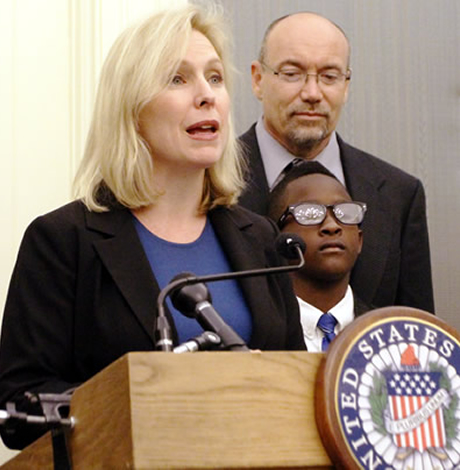
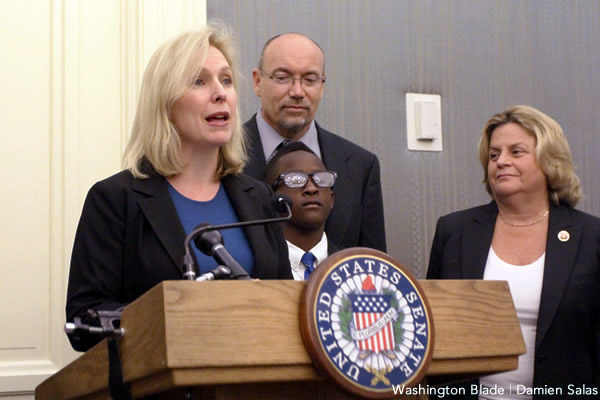
The amendment Sen. Kirsten Gillibrand (D-N.Y.) filed against Trump’s transgender military ban won’t get a vote.
(Washington Blade file photo by Damien Salas)
A Senate Democratic leadership aide said the Senate didn’t have unanimous consent and Senate Majority Leader Mitch McConnell (R-Ky.) was unwilling to file cloture to force a vote. Gillibrand proposed the amendment, which was co-sponsored by Sen. Susan Collins (R-Maine), as part of the fiscal year 2018 defense authorization bill.
The amendment, which sought to protect transgender troops in the aftermath of Trump’s directive barring them from the U.S. armed forces, had three parts.
It would have expressed the sense of Congress that qualified individuals should be able to serve in the armed forces; prohibited the military from discharging service members solely for being transgender; and codified the review Mattis established in June to determine whether openly transgender people can enlist in the armed forces. The amendment called for a report to Congress on that study by Feb. 21.
The amendment was carefully crafted to obtain support from Republicans and wouldn’t have eliminated every aspect of Trump’s transgender military ban, such as his ban on U.S. military payment for gender reassignment survey. Nonetheless, the Trump administration opposed the amendment, insisting the process Mattis set up at the Pentagon is sufficient to address the issue.
Chad Griffin, president of the Human Rights Campaign, took to Twitter to condemn the Senate for blocking a vote on the amendment, placing the blame squarely on Republican leadership.
Thank you @SenGillibrand & @SenatorCollins for standing up for all transgender patriots who serve our country in uniform.
— Chad Griffin (@ChadHGriffin) September 14, 2017
Also condemning Senate Republicans for blocking a vote on the amendment was Democratic National Committee spokesperson Joel Kasnetz.
“Last night, Republicans picked bigotry over security, and cowardice over taking a stand,” Kasnetz said. “By squashing even this incremental attempt to defend transgender members of the military against Trump’s offensive executive order, Mitch McConnell and Senate Republican leadership are destroying lives and disrespecting the people who keep them safe.”
Even though the amendment was thwarted, litigation continues seeking to undo Trump’s transgender military ban. At least four federal lawsuits were filed against the policy.
The American Civil Liberties Union, which filed a lawsuit in federal court in Maryland, and Lambda Legal and OutServe-SLDN, which filed a lawsuit in Washington State, called Thursday for injunction from those courts blocking enforcement of the ban as litigation moves forward. Another request from an injunction in the lawsuit filed in federal court in D.C. by the National Center for Lesbian Rights and GLBTQ Advocates & Defenders remains outstanding.



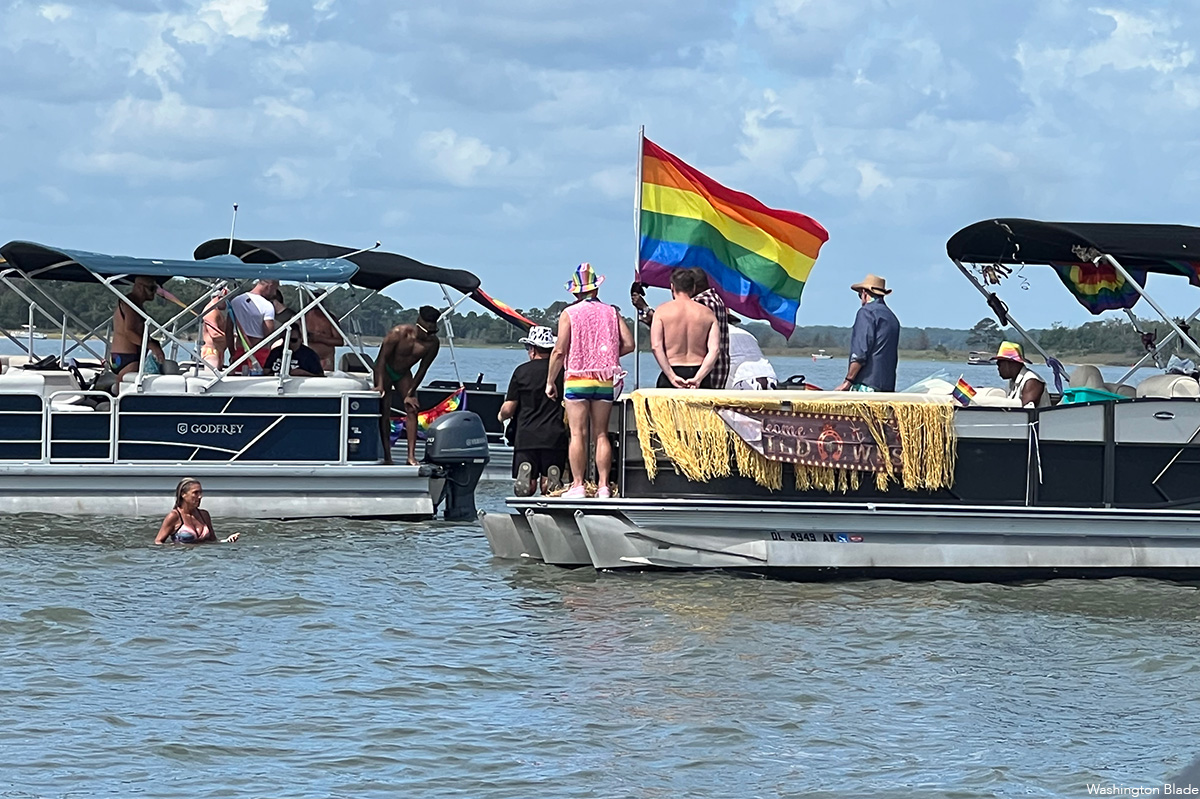
Pride month festivities continue through the end of the month and there’s a new event for Rehoboth/Dewey Beach residents and visitors, Pride on the Bay, set for June 27.
Boaters will tie up at the sandbar near Massey’s Landing from 12-4 p.m. Visit Pride on the Bay’s Facebook page for a map of the exact location. You can rent pontoons for the day at Dewey Beach Watersports (deweybeachwatersports.com).
Aqua Bar & Grill is sponsoring the inaugural event and will provide a floating DJ for the afternoon. Aqua will then host an after-party back on land (57 Baltimore Ave., Rehoboth Beach).
Local part-time resident Brian Sparrow is organizing the gathering, citing the need for more Pride-oriented events at the beach.
“I decided to create an event in June for Pride month,” Sparrow told the Blade. “There aren’t many Pride events in Rehoboth and Dewey where we can take advantage of the Rehoboth Bay.”
He noted that there is another event called “Bay Pride” but that it is held in late summer on a Sunday. “Having the event on Saturday will allow for more boat renting options for visitors and friends to join,” Sparrow said, adding that he plans to make this an annual event.
News
Blade editor inducted into D.C. Society of Professional Journalists Hall of Fame
Joe Reberkenny, Michael Key won SPJ awards
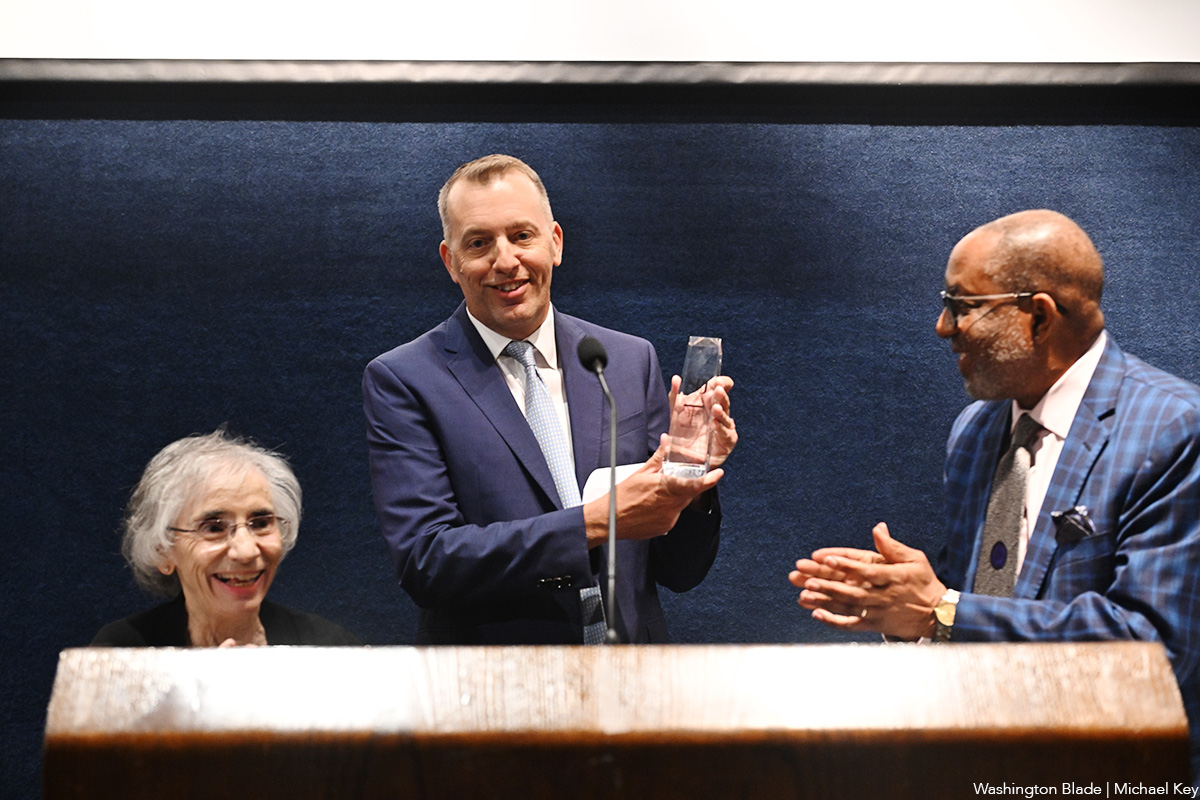
The Society of Professional Journalists’ Washington, D.C., Pro Chapter on Tuesday inducted Kevin Naff, the Washington Blade’s editor and co-owner, into its Hall of Fame.
The induction took place at the group’s annual dinner that took place at the National Press Club.
White House Correspondent Joe Reberkenny won an SPJ award in the weekly newspaper features category for his article “Queer defiance, footlong in hand: the rise of ‘Sandwich Guy.’” Photo Editor Michael Key won two SPJ awards: one in the weekly newspaper feature photography category for a photo of a protest that he took outside the D.C. Attorney General’s office, and another in the weekly newspaper photography story category for his article “‘Trump Must Go Now’ march to the White House.”
International News Editor Michael K. Lavers was a finalist for SPJ awards in the weekly editorial/opinion writing category, the weekly newspaper non-breaking news category. Senior Reporter Lou Chibbaro was also a finalist for an SPJ award in the weekly newspaper non-breaking news category.

District of Columbia
McDuffie on LGBTQ support and standing up to Trump
‘I’m committed to governing with the queer community at the table’
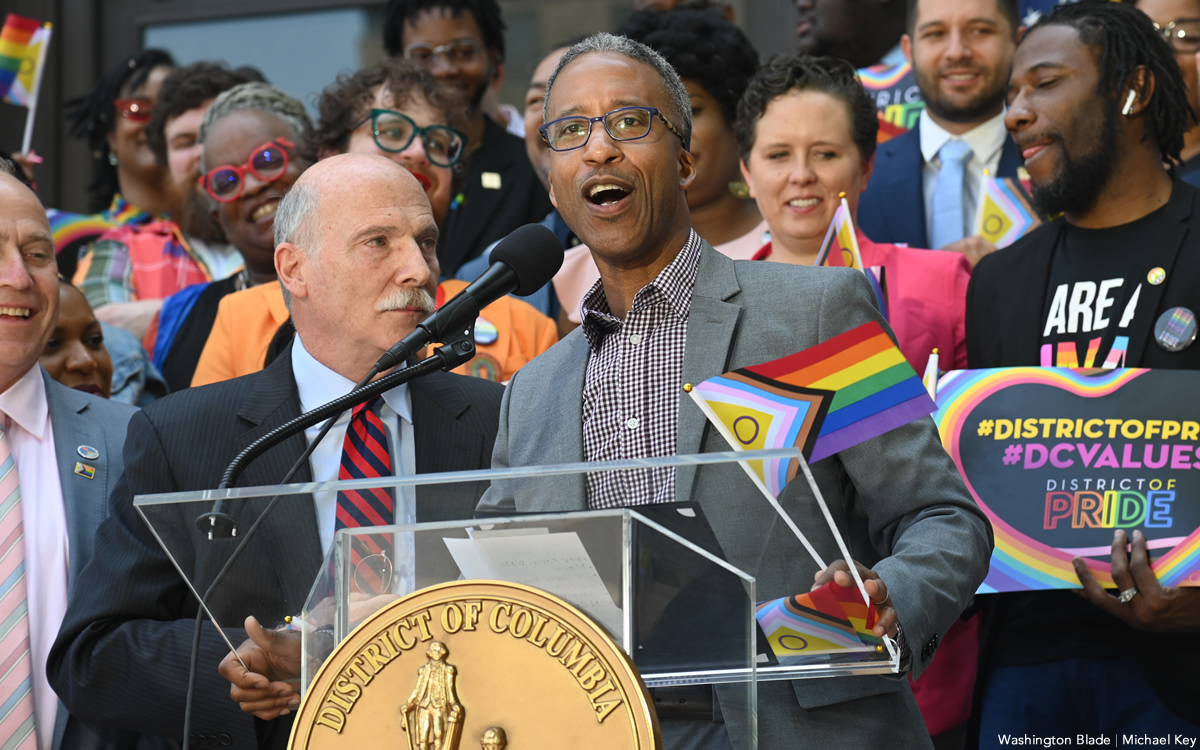
Former D.C. Council member Kenyan McDuffie is running for mayor as Muriel Bowser’s third term expires in January. He’s running in a crowded Democratic primary field; recent polls show him in second place behind Council member Janeese Lewis George. D.C.’s primary is Tuesday, June 16.
The Blade sat down with McDuffie on June 8 for a wide-ranging conversation about his pro-LGBTQ record and challenges now facing the community.
The Blade reached out to fellow mayoral candidates Lewis George and Rini Sampath, who identifies as queer, for interviews. Neither responded to repeated requests over several weeks.
Blade: Members of the D.C. LGBTQ community are receiving information that most if not all the seven Democratic candidates for mayor, including you and Council member Janeese Lewis George, are strong supporters of the LGBTQ community. What message would you have for LGBTQ voters on why they should support you rather than one of the other candidates?
McDuffie: Thank you for the question, Lou. And thank you for your work over the years with the Washington Blade. I’m really looking forward to having this conversation. You know, Washington, D.C. is the capital of the United States, and our city is one of the most beautifully diverse and inclusive cities in America because generations of LGBTQ+ residents, advocates, and organizations have fought to make it that way.
And throughout my time on the Council, I’ve been proud to support that work by advancing equity and opportunity and standing up for the rights and dignity of every resident across the District regardless of where they live, who they know, how much money they have. And as mayor, I’m going to build on that progress by ensuring D.C. remains a place where LGBTQ+ residents can live safely, where they can access quality healthcare and housing, they can build families and businesses and thrive in the neighborhoods of our city.
And now more than ever, making sure we protect residents from a hostile federal administration, including President Donald Trump, who seeks to roll back civil rights and civil liberties.
Blade: Some people, including members of the LGBTQ community, have criticized Mayor Bowser for what they say has been her position of not standing up forcefully enough against the Trump administration on various issues, including the deployment of National Guard soldiers in the city. What are your thoughts on that? How would you deal with the Trump administration if you were mayor?
McDuffie: Well, I’m going to deal with the Trump administration by prioritizing D.C. residents first. I’m going to stand up and fight back against federal infringement from Donald Trump and from Republicans in Congress or any other individual or organization that seeks to threaten Washington, D.C. residents.
And that means on day one rescind the executive order that permits cooperation between the Metropolitan Police Department and ICE and DHS [U.S. Department of Homeland Security]. And I know because of my work 13-and-a-half years on the Council doing research, authoring transformational legislation that protects people’s civil rights, that makes the Metropolitan Police Department more transparent, doing things like authoring the landmark NEAR Act [a 2016 D.C. law aimed at reducing violent crime].
I know from that work, and I know from my former work as a civil rights attorney in President Obama’s Department of Justice that you have to fight to ensure that we have a fair and more just society. I did that as a civil rights attorney traveling the country fighting to protect people’s civil rights. I did that as a prosecutor who fought crime and delivered justice for victims.
And I’m going to do that as mayor to ensure that we use every legal and political tool available as mayor to resist any federal effort to roll back LGBTQ+ protections in Washington, D.C. And I’m committed to governing with the queer community at the table and lifting up their contributions to this city at the center of every decision that I make as mayor. You know that I’ve been a champion making Washington, D.|C. more equitable, more just, and economically inclusive. And I plan to continue to build on that work that I have done and the work that so many important people have done in the LGBTQ+ community in Washington, D.C. to make sure that our residents can live safely and thrive in Washington, D.C.
And so, we’re going to fight back against Trump and any hostile federal administration to make sure we’re protecting the residents first. And we will work with the federal government where there is an opportunity to do transformational economic development projects like RFK, transformational infrastructure projects like expanding Union Station. Both of those will create thousands of jobs and thousands of opportunities for D.C.-based small businesses.
But I will draw a very bright line when it comes to protecting the civil rights of individuals across the District of Columbia, including the LGBTQ+ community and our vulnerable neighbors like our immigrant neighbors and families who in many cases today are living in the shadows, afraid to leave their homes, afraid to go to work, afraid to walk their kids to school because they’re being snatched off the streets in safe places around schools and places of worship. And it is utterly despicable what Donald Trump has done and how he’s weaponized our federal law enforcement.
Blade: As a follow-up to that, reports surfaced last year that the mayor had to cut the budget for the Office of LGBTQ Affairs for this year by $600,000 because of a large cut in the city’s budget by Republicans in the U.S. House of Representatives. Would you do something to try to restore the funds that were cut from that office?
McDuffie: Absolutely. I will as mayor fully fund the Mayor’s Office of LGBTQ+ Affairs and direct it to proactively identify gaps in city services while also ensuring that the Office of Human Rights has additional resources to vigorously enforce efforts against discrimination across government agencies and within the private sector where it arises. I am a civil rights attorney by training. And I will bring the full force of the District of Columbia government to bear when it comes to protecting the rights of our residents, including especially our vulnerable communities like LGBTQ+ community.
And we’re going to fully fund the Office of LGBTQ+ Affairs and make sure it is doing the work proactively to identify any gaps in services any gaps in resources that are needed to shore up the supports and services to the community. And that’s been my record on the Council, too. As you know, I’ve supported on the Council marriage equality. That I’ve supported helping to repeal D.C.’s anti-surrogacy laws, expanding opportunities for LGBTQ couples.
You know that I’ve supported polices that recognize diverse family structures and co-introduced and passed the birth certificate equality amendment act. I supported efforts to reduce bureaucratic barriers faced by transgender residents. So, that’s the kind of work that I’ve done as a Council member. And as mayor I’m going to really fight and deliver for our LGBTQ+ neighbors to ensure that they’re supported, seen, heard, continue to be woven into the fabric of our city.
Blade: Do you or your campaign have any plans for participating in any LGBTQ Pride events during Pride month?
McDuffie: Oh, we are going to be not only front and center in marching in the Pride parade but being there as a resources to work directly with the organizers to make sure that they have every single thing that they need to build on the strong legacy of Washington, D.C.’s Pride community and all the festivities that are associated with it. I was so proud to stand on the steps of the Wilson Building last year for WorldPride and announce what Washington, D.C. does and how we do it and why we’re so special as a city. And when it comes to supporting Pride this year, I’m going to be right there marching with everybody else and ensuring that the longstanding relationships with the LGBTQ community across the District of Columbia are shown and displayed as our nation’s capital sets the example of what it looks like to really protect the beautiful diversity that we have in our city.
Blade: People have been talking about the poll just released by the Washington Post showing you to be 11 points behind Janeese Lewis George in the race for mayor. Do you have any reaction to that?
McDuffie: Well, what the poll shows is that I have the broadest coalition of support across the District of Columbia. Because I continue to show up and meet residents where they are. That demonstrates whether you are a longtime resident or whether you are Black or white or a member of the LGBTQ+ community. My support in the District of Columbia is deep, and it is broad.
Because I will govern as mayor in the way I have led as a Council member, which is by building the broadest coalition possible, walking across differences and really coming out with solutions to address intractable issues. So, I know that Washington, D.C. has been a national leader when it comes to protecting civil rights and ensuring fairness and justice. And I’ve been one of the people who led on those issues, making our city more racially equitable, more socially just, and more economically inclusive.
Blade: As you know, some of your critics have been trying to link you to the Pepco electric rate increase and for being responsible for higher utility costs. Do you have a response to that?
McDuffie: They try to link me to a number of things that are a part of what is a widespread disinformation campaign much like what we’ve seen on a national level from Trump and other Republicans. I don’t accept it. I think the fact that I’ve been elected four times in the District of Columbia, I demonstrate my ability to work with residents across the District of Columbia to get things done.
When it comes to utilities, I’m going to fight to lower utilities costs for residents, ensuring that we expand renewables and alternative energy sources, recognizing that Janeese Lewis George was the only Council member who voted against expanding solar a couple of years ago. But I’m also going to make sure that we have automatic enrollment for individuals in the District of Columbia who are having trouble paying for the utilities. I will make sure we protect seniors who are feeling a squeeze when it comes to being able to pay for utilities …
And we’re going to make sure that everybody understands why their energy bill is going up and push back against disinformation, so that they understand that a lot of what we’re seeing in increased utility bills, which I also face with my wife, is driven by demand on the regional grid at PJM. It is the data centers that are driving up our costs and lowering supplies. I’m going to hold those data centers accountable to pay their fair share for how they are contributing to the increase in utility costs that residents across the District of Columbia and across the region are seeing on their Pepco bills.
Blade: Thank you for your time. Do you have anything else you may wish to say to conclude your remarks?
McDuffie: Just to be clear that the disinformation campaign that Janeese Lewis George and her supporters are waging is one of the lowest political tactics that we’ve seen in D.C. politics. But she is banking on voters who are not doing their research. And what I know is that D.C. voters are smart. They know me from my work on the Council. And they know I am better qualified on day one to stand up and fight back against Trump to protect home rule and to deliver a city that is safer, that is more affordable and deliver a government that is more accountable and works for residents across the District of Columbia.

Rehoboth’s Pride on the Bay set for June 27

Blade editor inducted into D.C. Society of Professional Journalists Hall of Fame

Pride in a new world order

McDuffie on LGBTQ support and standing up to Trump

PHOTOS: Fairfax City Pride

Controversial ‘Blue Film’ pushes past taboos for gripping drama

Timothy Nelson on the premiere of his opera ‘Song of Sakuntala’

PHOTOS: ‘Soul Divas’

‘Mighty Real’ explores history of LGBTQ music