World
Baja California officially legalizes same-sex marriage
Mexican state’s constitution amended in June

Same-sex couples in Mexico’s Baja California state can now legally marry without a court order.
The Baja California Congress in June removed an amendment from the state constitution that banned marriage for same-sex couples. Three of the state’s five municipalities — Tijuana, Mexicali and Tecate — subsequently approved the amendment.
The state’s Official Journal published the amendment on Sunday.
“We are able to finally say that marriage equality in Baja California is the law,” tweeted Maky Pollorena, a Mexicali-based activist who works with Centro Comunitario de Bienestar (Cobina), a local LGBTQ advocacy group, on Monday. “This paper is the result of many years of struggle and tears. (It is) one step of many that we have taken to make sure that our state and country is diverse and inclusive. The historical debt does not end here.”
Y por fin ahora si podemos decir que el #MatrimonioIgualitario en #BajaCalifornia es ley. Tantos años de lucha y lágrimas resumidas en esta hoja. Un paso de muchos que tenemos que dar para que nuestro Estado y país sea diverso e inclusivo. La deuda histórica no termina aquí. pic.twitter.com/zXda3L9F3b
— Maky Pollorena (She/Her/Ella) (@Its_Maky_Bitch) August 9, 2021
Baja California borders California and a small portion of southwestern Arizona.
Same-sex couples have been able to legally marry in Mexico City since 2010.
The Mexican Supreme Court in 2015 ruled laws that ban same-sex marriage are “discriminatory.” Chihuahua, Jalisco, Oaxaca and Quintana Roo are among the Mexican states with marriage equality, but same-sex couples are still unable to legally tie the knot throughout the entire country.

Colombia
Claudia López wins primary in Colombian presidential race
Former Bogotá mayor’s wife lost reelection bid on Sunday
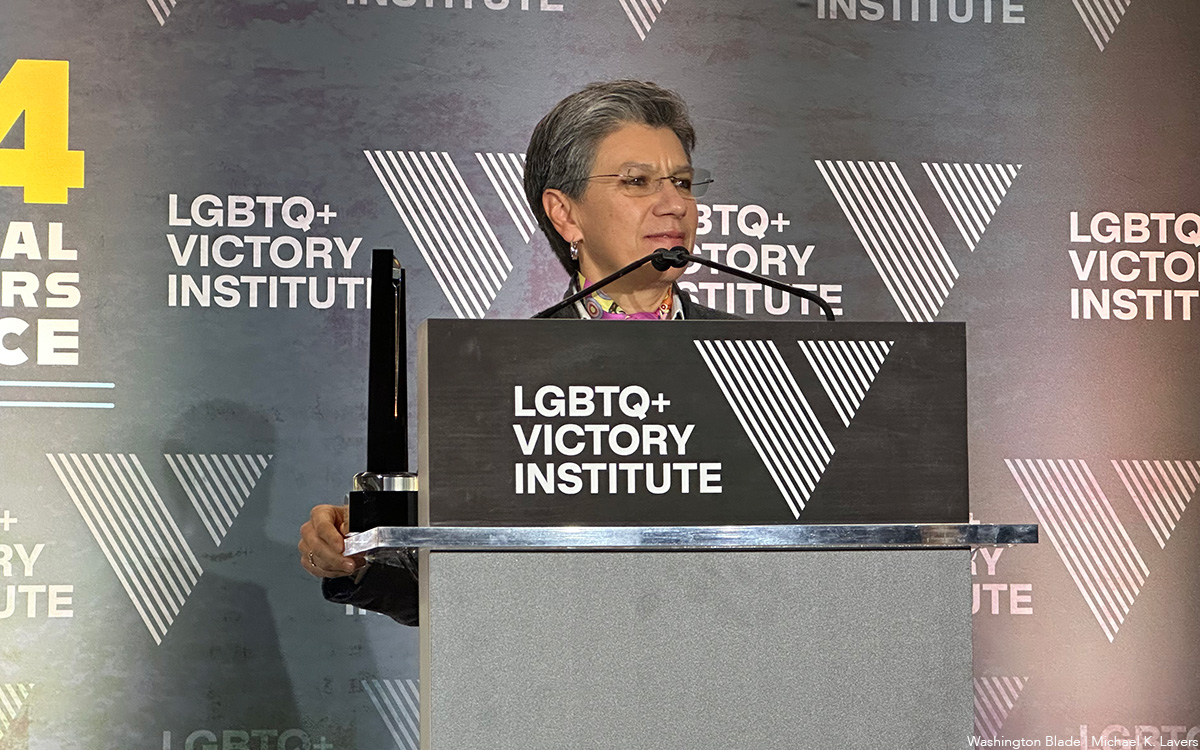
Former Bogotá Mayor Claudia López on Sunday won her primary in the race to succeed Colombian President Gustavo Petro.
López, a centrist who is running as an independent, defeated Leonardo Huerta in the “Consulta de las Soluciones” primary.
López was the Colombian capital’s mayor from 2020-2023. She was a member of the Colombian Senate from 2014-2018.
López is running to succeed Petro, the country’s first leftist president who cannot seek a second consecutive term under Colombia’s constitution. Other presidential candidates who won their respective parties’ primaries on Sunday include Sen. Iván Cepeda, a member of Petro’s Historic Pact party, and Sen. Paloma Valencia of the conservative Democratic Center, the country’s main opposition party that former President Álvaro Uribe leads.
Juan Daniel Oviedo, who finished second in the Democratic Center’s primary, is openly gay.
The first-round of Colombia’s presidential election will take place on May 31.
Polls indicate López is trailing Cepeda and Valencia, who are considered the two frontrunners.
A second round will take place is no candidate receives at least 50 percent of the vote on May 31. López would become Colombia’s first female and first lesbian president if she wins the election.
López’s wife loses Senate seat
Colombia’s congressional elections also took place on Sunday.
Former Congressman Mauricio Toro, a member of the center-left Green Alliance party, in 2018 became the first openly gay man elected to Colombian Congress when he won a seat in the House of Representatives.
He lost his reelection bid in 2022. Voters on Sunday elected Toro for a second term.
Congresswoman María del Mar Pizarro, a bisexual Historic Pact member, won re-election.
Caribe Afirmativo, a Colombian LGBTQ and intersex rights group, notes only two of the 33 openly LGBTQ congressional candidates won their respective races. Among those who lost is Sen. Angélica Lozano, a bisexual woman who in 2018 became the first openly LGBTQ person elected to the Colombian Senate.
Lozano is married to López.
Lozano in a message posted to her Instagram page expressed “heartfelt gratitude to everyone for their support and love.”
“I will end my work in Congress on a high note by ensuring (the) child support and service contractor protection bills will become a reality in June,” she said.
Uganda
Ugandan activist named Charles F. Kettering Foundation fellow
Clare Byarugaba founded PFLAG-Uganda
The Charles F. Kettering Foundation has named a prominent Ugandan LGBTQ activist as one of its 2026 fellows.
Clare Byarugaba, founder of PFLAG-Uganda, is one of the foundation’s five 2026 Global Fellows.
Byarugaba, among other things, has been a vocal critic of Uganda’s Anti-Homosexuality Act. Byarugaba in 2024 met with Pope Francis — who criticized criminalization laws during his papacy — at the Vatican.
The foundation on its website says it “is dedicated to bringing research and people together to make the promise of democracy real for everyone, everywhere.”
“Clare is the kind of hero who rushes toward the emergency to help,” said PFLAG CEO Brian K. Bond in a Feb. 27 statement to the Washington Blade. “She founded PFLAG-Uganda as the country pushed to criminalize homosexuality and those who support LGBTQ+ people. Yet, she never hesitated in her courage, telling us that families wanted to organize to keep their LGBTQ+ loved ones safe, and PFLAG was the way to do it. Clare Byarugaba not only deserves this honor, but she will use her compassion and experience to teach the world about LGBTQ+ advocacy as a Kettering Global Fellow.”
India
Activists push for better counting of transgender Indians in 2026 Census
2011 count noted 488,000 trans people in country
India is preparing to conduct a nationwide Census in April, the first since 2011.
Interim projections based on the previous Census placed India ahead of China as the world’s most populous country. A Technical Group on Population Projections projection in July 2020, chaired by the Registrar General of India, estimated the country’s population in 2023 was 1.388 billion. Transgender Indians are now raising concerns about the data collectors and their sensitization.
Activists have raised concerns about whether data collectors are adequately sensitive to the community ahead of the Census. Government training material emphasizes household engagement, data privacy and sensitivity while asking personal questions, but publicly available flyers do not outline specific guidance or training related to recording trans identity during enumeration.
Concerns around the counting of trans people in India are not new.
The 2011 Census recorded around 488,000 trans people, a figure activists and researchers have described as a likely undercount due to stigma, misclassification, and a reluctance to self-identify. Subsequent surveys and field reports have pointed to inconsistencies in how gender identity is recorded and the absence of uniform sensitivity among Census data collectors. Rights groups and policy researchers have also warned that gaps in official data affect access to welfare schemes, legal recognition, and targeted public policy, making accurate counting central to future Census exercises.
A decade after the 2011 Census formally recorded trans people as a distinct category, multiple studies have continued to document entrenched socio-economic disparities. Research has pointed to lower literacy rates, limited workforce participation and barriers to healthcare access within the community.
A National Human Rights Commission-supported study cited in subsequent reporting found a significant proportion of trans respondents reported employment discrimination, underscoring the gap between formal recognition and lived economic inclusion.
Educational exclusion has remained a persistent concern within the trans community. Studies have documented higher dropout rates, lower literacy levels and barriers to continuing education, often linked to stigma, discrimination and limited institutional support. Policy researchers note that despite formal recognition in official data after 2011, targeted interventions addressing school retention and access for trans people have remained uneven.
Access to housing schemes has reflected similar gaps.
The Washington Blade in December reported only a small number of trans people have benefited from India’s flagship low-income housing program, despite its nationwide rollout and eligibility provisions. The findings underscored continuing barriers to inclusion in welfare delivery systems.
The Social Justice and Empowerment Ministry and the Office of the Registrar General and Census Commissioner did not respond to the Blade’s multiple requests for comment regarding sensitization measures for Census data collectors and the recording of trans identity in the upcoming Census.
Karnataka state in southern India last September conducted its first statewide baseline survey of gender minorities. The Department of Women and Child Development, in collaboration with the Karnataka State Women’s Development Corporation, launched the initiative to document the lives of trans people across 31 administrative districts.
When the results were released, the survey identified 10,365 trans people. The country’s 2011 Census, by comparison, recorded 20,266 trans people in Karnataka, nearly double the 2025 figure. The discrepancy raised questions about how the state’s recorded trans population appeared to decline over 14 years.
The discrepancy in Karnataka’s survey has intensified scrutiny over how gender minorities are counted. Reports questioned the methodology used in the 2025 exercise, which was conducted over 45 days beginning in mid-September. Instead of door-to-door enumeration, trans people were required to report to designated registration sites — primarily district-level public hospitals and sub-district government health facilities. The approach presented barriers for potential participants, particularly those in rural areas, those without reliable transportation, those wary of institutional settings due to prior discrimination, or those who did not know about the count, raising the possibility of exclusion.
Bihar state in eastern India in January 2023 conducted a caste-based survey that included trans respondents.
The final report identified 825 trans people in the state, compared with 40,827 recorded in the 2011 Census. Activists disputed the figure, calling it inaccurate and pointing to community estimates that suggested higher numbers, including in Patna, the state capital, raising concerns about significant undercounting.
The 2011 Census marked the first attempt to enumerate trans people at the national level, but researchers and activists have described the exercise as limited in scope.
It recorded 487,803 people under the “other” category, a classification used for respondents who did not identify as male or female. Analysts have argued that the figure likely underestimated the community’s size.
The Census questionnaire provided three sex categories — “male,” “female,” and “other” — a framework that critics said did not fully capture the diversity of gender identity and may have affected how some respondents chose to identify.
During the 2011 Census, enumeration practices varied across regions.
In states such as Tamil Nadu, local reporting indicated estimates were at times derived from existing administrative records, including state-issued trans identity cards, rather than solely through door-to-door identification. Such approaches risked excluding individuals who did not possess identity documentation or were not registered with welfare boards, raising concerns about gaps in coverage.
Official data from the Social Justice and Empowerment Ministry shows only a few hundred trans people as of early 2025 have been issued identity cards through the national portal, despite nearly 2,000 applications being submitted. Many are still pending or have been rejected.
Critics of the 2011 Census said many Census data collectors were not adequately trained or sensitized to engage with gender identity beyond traditional binary classifications. Similar, detailed guidelines specific to trans sensitization have not been publicly made available for the 2026 Census, according to an examination of training materials and official circulars.
Akkai Padmashali, a trans rights activist, told the Blade that Census data collectors in earlier exercises were often not sensitized and lacked awareness of intersex people and gender-diverse communities. She said trans people and other gender and sexual minorities continue to face social exclusion and require careful handling during door-to-door data collection. Padmashali called for targeted training of data counting officers and said the government should treat the issue as a priority, adding the trans population is likely to be higher than what was recorded in 2011 and efforts to make officials more sensitive to the community are necessary.
“We will definitely join our hands with this move the government of India has taken,” said Padmashali. “I think there should be proper guidance from the main in-charge people who are conducting this enumeration, and if no such proper information is given to these Census data collectors, it is difficult to gather any sort of information concerned.”
“This whole issue of self-identification — I think India, in its current situation, is not in such a way that it openly accepts people’s identities,” she added. “It will be challenging, it will be difficult, it will be a struggle to offer people the opportunity to express their identities as concerned. But to make sure those who are part of the sexual minority community are counted, I think we also take responsibility for educating people to be part of the enumeration.”
Padmashali said many people are not accustomed to using mobile devices and only a limited number are familiar with them. She said technology should not mislead or misguide the collection of information. Padmashali added she and other trans people plan to engage with Census data collectors and officials who organize the Census.
“Government should have local meetings,” said Padmashali. “Government should hold regional consultations on why the national enumeration is important, because we also know that from 2011 to 2026 is almost 15 years, and now we are here.”
“The government should hold local meetings, especially in their constituencies,” she added. “If the government meets with non-government organizations and civil society groups, this could become a more inclusive exercise across the country. India has a population of more than 1.4 billion, and I think this is the appropriate time to bring accurate statistics to help draft policies in the context of the larger community concerned.”