Federal Government
Trans veterans sue the VA for coverage of surgeries
Case filed in the U.S. Court of Appeals for the Federal Circuit
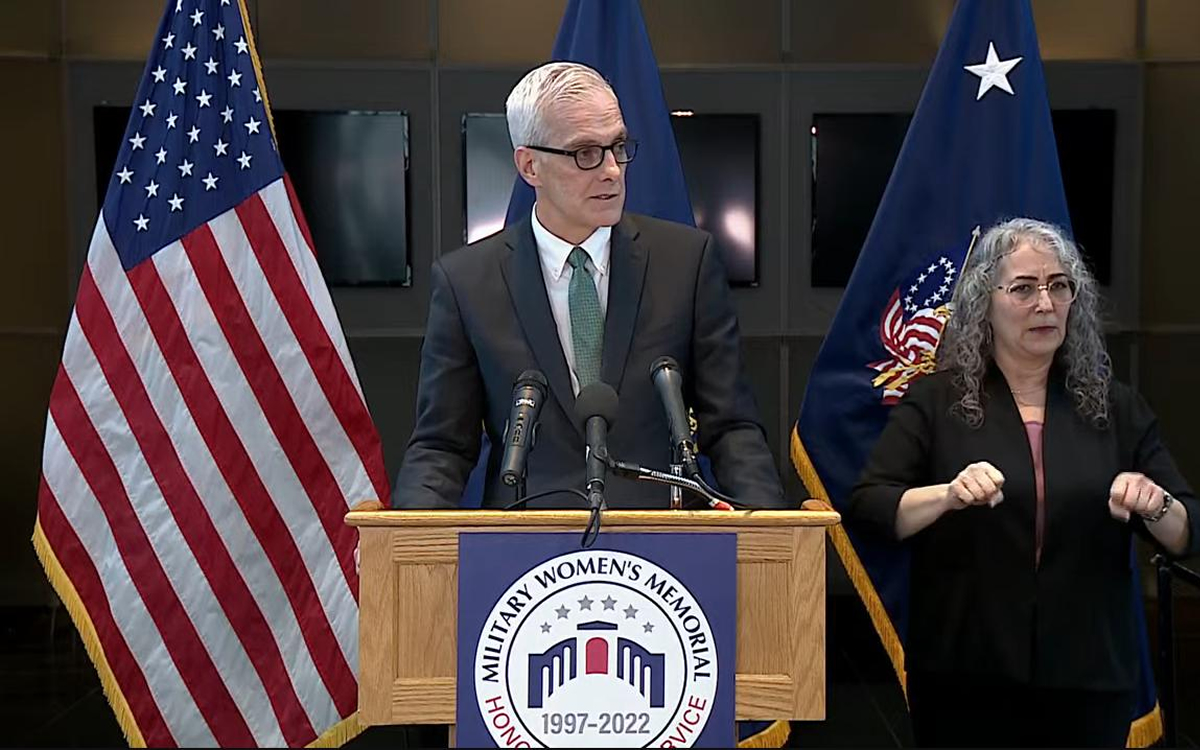
A group of transgender veterans on Thursday sued the U.S. Department of Veterans Affairs to compel the agency to cover gender affirming surgeries, following verbal assurances that it would begin providing these services.
The lawsuit, filed by the Transgender American Veterans Association, aims to reduce the risk of adverse health outcomes that can result from lack of access to medically necessary healthcare interventions for people with gender dysphoria.
This includes suicides, depression and psychological distress.
In its complaint before the U.S. Court of Appeals for the Federal Circuit in Washington, the group argued gender affirming surgeries are often prohibitively expensive when administered by private doctors.
Veterans Affairs Secretary Denis McDonough in 2021 said the agency was engaged in a rule making process to provide these services to trans veterans such that they can “go through the full gender confirmation process with VA by their side.”
The process, he said, would take a few years to “develop capacity to meet the surgical needs.”





Federal Government
Trump holds housing bill hostage to anti-trans SAVE Act
President’s SAVE Act failed in the Senate
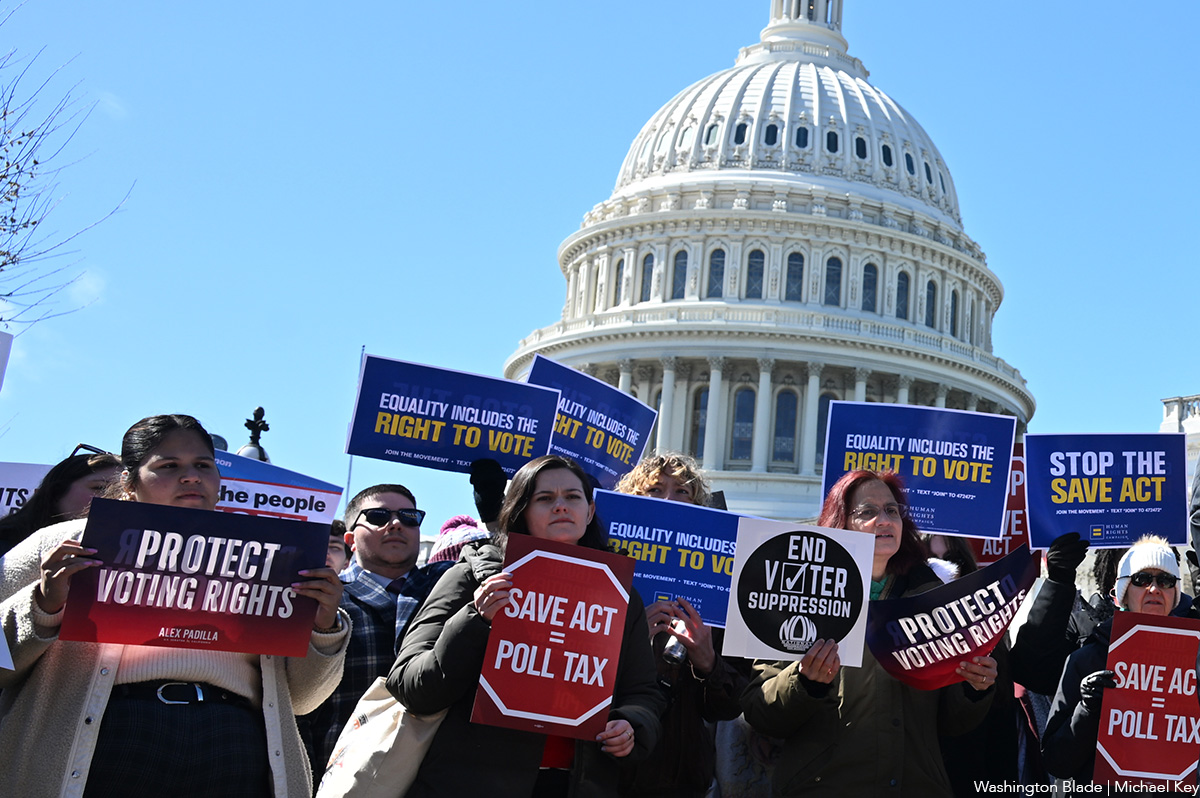
President Donald Trump is refusing to sign a new bipartisan housing bill unless his SAVE Act is approved by the legislative branch.
The bill being prevented from being enacted into law is the “21st Century ROAD to Housing Act.” The legislation is an attempt by Congress to make buying a home in the U.S. Senate more affordable in response to various factors — including housing shortages and regulatory constraints — that have made homeownership increasingly difficult. The total number of homeowners has nearly stopped growing, with high interest rates and surging home prices pushing more Americans toward renting.
The housing bill was considered highly bipartisan, something that is rare in this Congress. The House voted to pass the bill 358-32 on Tuesday after the Senate approved the measure 85-5 a day earlier. The legislation was led by U.S. Sens. Elizabeth Warren (D-Mass.) and Tim Scott (R-S.C.) in the Senate and U.S. Reps. Maxine Waters (D-Calif.) and French Hill (R-Ark.) in the U.S. House of Representatives.
Some of the highlights of the legislation are aimed at increasing the supply of affordable housing while making homeownership more accessible. The bill would streamline environmental reviews and direct the U.S. Department of Housing and Urban Development to provide guidance to communities on reforming zoning and land-use policies that can create barriers to housing development.
The legislation would also expand the definition of “manufactured housing,” making it cheaper and easier to mass-produce homes built in factories before being transported to their sites. To encourage additional development, the bill would provide grants and loans for the construction of new housing, the rehabilitation of aging properties, and the conversion of vacant buildings into residential units. It would also increase certain banks’ Public Welfare Investment cap, allowing them to direct more capital toward low-income and affordable housing projects.
In an effort to help more Americans purchase homes, the legislation would create a program to expand access to small-dollar mortgages, which are often used to finance lower-cost homes, while also seeking to improve housing opportunities for veterans. The bill would further promote homeownership by limiting the number of single-family homes that large institutional investors can own and requiring them to disclose how many such properties they control, a measure intended to prioritize American families over corporate buyers.
The bill the president wants enacted — the SAVE Act — is a restrictive and anti-transgender piece of proposed legislation.
The bill would impose a number of new limitations on voter registration across the country by amending the National Voter Registration Act of 1993 to require in-person proof of citizenship for anyone seeking to vote in U.S. elections. The bill would also limit acceptable forms of identification to documents such as a birth certificate or passport — records that the Brennan Center for Justice estimates more than 21 million Americans do not possess — effectively restricting access to the ballot. It would also ban online voter registration, DMV voter registration efforts, and mail-in voter registration.
Trump pushed for the SAVE Act to include a provision that would ban gender-affirming medical care for trans minors, even with parental consent, and prohibit trans people from participating in school or professional sports consistent with their gender identity rather than their sex assigned at birth.
Trump also pressed Senate Majority Leader John Thune (R-S.D.) to eliminate the filibuster so the Republican-controlled Congress could pass the SAVE Act, saying Republicans will never win another election without it.
It is expected that Congress will override the president’s veto and pass the 21st Century ROAD to Housing Act, as it requires a two-thirds supermajority vote in both the House of Representatives and the Senate — a threshold the legislation currently exceeds.
It is not expected that the SAVE Act will pass the Senate in its current form. It passed the House, but every Democrat and four Republicans voted against it in the Senate.
Federal Government
Advocates push back on proposed FCC warning labels
New rating system public notice seeking comments issued on April 22

The Federal Communications Commission is considering a new rating system that would require a warning label to appear before any television content that includes LGBTQ characters.
On April 22, the FCC issued a public notice asking Americans to submit comments on whether the TV Oversight Management Board should create new TV ratings to alert viewers to “transgender and gender nonbinary programming” and “the discussion or promotion of gender identity themes.”
This proposed warning would appear before content, similar to warnings that explain a program contains sexual content, drug use, or violence — categories that Congress explicitly included in the Telecommunications Act of 1996 on the grounds of obscenity and violence that some parents “believe is harmful to their children.”
The public notice says that “recently, parents have raised concerns that controversial gender identity issues are being included or promoted in children’s programs without providing any disclosure or transparency to parents.”
It goes on to say that not having a warning for trans and nonbinary people is “undermining the ability of parents to make informed choices for their families.”
LGBT Tech is an organization that works to provide LGBTQ representation in mainstream media or entertainment. The group notes 81 percent of trans respondents it surveyed said these representations had a positive impact on them discovering or learning about their identity.
“These numbers reflect a basic truth: for many people, and especially young people, seeing LGBTQ+ lives represented in ordinary media is not harmful. It is formative, affirming, and often lifesaving.”
Since the public notice’s publication, more than 40 organizations have come out against the proposed alert.
GLAAD President Sarah Kate Ellis issued a statement in May on the proposal, highlighting what she described as a concerted effort by the Trump-Vance administration to other trans and nonbinary people.
“The FCC does not set TV ratings, but under this administration the FCC has repeatedly tried to control what Americans can see on their own televisions. This government overreach is dangerous and a threat to our community and our democracy,” Ellis said.
“LGBTQ+ people and their families deserve to see their lives represented in the media they watch. And media companies must have the freedom to create programming that appeals to their viewers and subscribers without interference from a government pursuing its own anti-LGBTQ+ political agenda.”
Human Rights Campaign President Kelley Robinson pointed out that this is an act of politically motivated policy, not one based on any rhyme or reason.
“LGBTQ+ stories matter and deserve to be told, seen, and heard,” Robinson said. “The Trump administration does not get to use the FCC to try and erase us simply because they want to pretend to live in a world where we don’t exist. This is a brazen form of political interference that will hurt the ability of all people to appreciate, understand, and learn about the world and people around them.”
Brian Dittmeier, director of LGBTQI+ equality at the National Women’s Law Center Action Fund, echoed Robinson’s concerns that this is attempted censorship for the sake of political gain.
“The FCC is cloaking itself in purported concern for parents in an attempt to censor content, intimidate industry, and silence depictions of our trans siblings and neighbors,” Dittmeier wrote. “The FCC is overstepping its authority to undermine the existing ratings system, which is well understood by parents and enjoys broad public support. The FCC’s presumption that it knows better does not reflect parents’ priorities and reeks of government overreach.”
PFLAG National Vice President of Policy and Government Affairs Diego Sanchez said this is federal government overreach into censorship — something the First Amendment protects against.
“The FCC has given us yet another example of what ‘small government’ means: small enough to fit in your living room; to interrupt family movie night; small enough to make home feel unsafe,” Sanchez said. “Parents and families with transgender loved ones in particular know too well how big government actions impact their families directly, because they feel those impacts before everyone else.”
This proposed warning follows a slew of other federal actions targeting trans people in America, including Executive Order 14168, “Defending Women from Gender Ideology Extremism and Restoring Biological Truth to the Federal Government,” which mandated that only sex assigned at birth be used on federal government documents regardless of gender identity, as well as broad-based restrictions on gender-affirming care, particularly for trans minors.
Federal Government
Texas Children’s Hospital reaches $10 million settlement with DOJ over gender-affirming care
Clinic specializing in detransition care will be established

The Justice Department announced May 15 that it has reached a settlement with Texas Children’s Hospital, one of the nation’s top pediatric hospitals.
Under the agreement, the hospital will pay more than $10 million in damages and civil penalties related to its provision of gender-affirming care and will establish a clinic specializing in detransition care.
The DOJ partnered with Texas Attorney General Ken Paxton’s office to resolve allegations that the hospital submitted false billings to public and private insurers to secure coverage for pediatric gender-affirming procedures. The department alleges the conduct violated the Federal Food, Drug, and Cosmetic Act, the False Claims Act, and federal fraud and conspiracy laws.
The settlement was reached out of court, meaning neither party formally admitted wrongdoing. Both the DOJ and Texas Children’s Hospital denied liability.
“The Justice Department will use every weapon at its disposal to end the destructive and discredited practice of so-called ‘gender-affirming care’ for children,” Acting Attorney General Todd Blanche said in a DOJ press release. “Today’s resolution protects vulnerable children, holds providers accountable, and ensures those harmed receive the care they need.”
The DOJ’s hardline stance on gender-affirming care sharply contrasts with the positions of major medical organizations, transgender healthcare advocates, and human rights groups, which broadly support gender-affirming care as an evidence-based treatment for gender dysphoria.
Adrian Shanker, former Deputy Assistant Secretary for Health Policy and Senior Advisor on LGBTQI+ Health Equity at the U.S. Department of Health and Human Services under during the Biden-Harris administration, told the Washington Blade the settlement could have sweeping consequences for trans youth and healthcare providers nationwide.
“The Trump administration’s framing of gender-affirming care is wildly inaccurate, scientifically implausible, and frankly, just mean-spirited,” Shanker told the Blade. “What’s really clear is that the science hasn’t changed, the evidence hasn’t changed — it’s only the politics that have changed. Unfortunately, the people that lose out the most with a settlement like this one are the patients that are denied access to care where they live.”
According to Shanker, the agreement also requires Texas Children’s Hospital to revoke privileges for physicians involved in providing gender-affirming care, potentially limiting their ability to practice elsewhere.
“This is a weaponized Department of Justice doing absurd investigations against providers that are providing care within the established standard of care,” he said. “They’ve come up with an absurd remedy in their settlement to require a so-called ‘detransition clinic’ to open at Texas Children’s. It’s harmful to science, it’s harmful to trans people, and it’s harmful to the medical profession.”
Shanker argued the case reflects a broader politicization of trans healthcare.
“Every American should be concerned about the weaponized Department of Justice and their obsession with trans people and their access to care,” he said. “These hospitals that provide gender-affirming care, the providers of gender-affirming care, have done nothing wrong. They followed the standards of care that are well established and followed the mountain of evidence.”
Karen Loewy, senior counsel and director of constitutional law practice at Lambda Legal, echoed those concerns.
“For Texas Children’s to capitulate to this pressure campaign of both Paxton and the Trump administration and end this care, and go after physicians who had been lawfully and faithfully taking care of their patients, it’s hard to see that as anything other than bending the knee in the face of political pressure,” Loewy told the Blade. “That’s not putting your mission above politics. Your mission is to provide health care for kids that need it.”
Loewy said the settlement reflects years of efforts by Paxton and the Trump-Vance administration to target gender-affirming care providers. Paxton has pursued investigations into providers across Texas since 2022 and supported a 2023 law banning gender-transition-related medical care for minors. Meanwhile, the Trump-Vance administration moved quickly in its second term to restrict trans healthcare access, including through Executive Order 14187, titled “Protecting Children from Chemical and Surgical Mutilation.”
“This is a perfect storm of Ken Paxton’s own mission to stigmatize and target trans young people and their healthcare in Texas with the Trump administration’s targeting of trans people and gender-affirming medical care,” Loewy said. “It is the two of them together. Without that, you wouldn’t have had this settlement.”
Loewy also emphasized that the settlement is part of a broader legal strategy targeting providers nationwide.
“You can’t view this one in isolation from all of the other administrative subpoenas that have been sent to hospitals or other kinds of medical providers that have provided gender-affirming medical care to trans adolescents,” she said. “It is all part and parcel of the same direct line from the executive orders that were issued in the first days of this Trump administration.”
“Every court that has considered those subpoenas has found them illegitimate and issued for an improper purpose, or at least narrowed them really dramatically,” she added. “Courts agree these hospitals didn’t do anything wrong. It’s the DOJ that has the problem here.”
Shanker also criticized the settlement’s requirement that the hospital establish a detransition clinic, arguing the move contradicts existing medical evidence.
“The irony shouldn’t be lost on anyone that the Trump administration is claiming that gender-affirming care lacks a scientific basis, and then is requiring the opening of a so-called detransition clinic, which certainly lacks a scientific basis,” Shanker said. “There’s less than a 1% regret rate when it comes to gender-affirming care. That’s lower than knee surgery, lower than bariatric surgery, lower than childbirth, lower than breast reconstruction, and lower than tattoos.”
Loewy was similarly blunt in her criticism.
“This is the most craven, political, ridiculous elevation of ideology over evidence,” she said. “They are creating a program built on an outcome that almost never happens. It is unprecedented and politically mandated rather than healthcare mandated.”
She said the settlement’s broader effect will be to intimidate providers and further marginalize trans people.
“The real effect here is to further stigmatize trans people and intimidate healthcare providers,” she said. “This is about sending a message nationwide that the DOJ is coming after the doctors. These are committed, faithful, law-abiding physicians and healthcare providers who just want to provide the healthcare their patients actually need.”
Both Loewy and Shanker warned that restricting access to gender-affirming care could deepen health disparities for trans people.
“We know that when transgender Americans lack the care that they need, we end up with higher rates of depression, higher rates of anxiety, higher rates of self-harm and suicidal ideation,” Shanker said. “We know that gender-affirming care is a medically appropriate, scientifically grounded form of care that resolves these challenges and leads us toward health equity. It’s unfortunate that the Trump administration has politicized not only transgender medicine, but the very basis of public health.”
Shanker said the restrictions are already prompting some trans people to relocate in search of care.
“We’re already seeing medical refugees leave states that have restricted access to care to move to states where it’s still available,” he said. “Frankly, we’ve already seen some trans people go to other countries to receive care or maintain access to care.”
Loewy said the DOJ’s recent subpoenas targeting hospitals, including those issued to NYU Langone Health in New York, suggest the administration is escalating its legal strategy.
“We’ve seen the DOJ escalate this by convening a grand jury and issuing grand jury subpoenas to hospitals,” she said. “That is going to be the next front in this fight.”
In addition to , there has been as large increase in anti-trans legislation in the past few years — with 126 federal pieces of legislation introduced this year and 26 state level policies passed across the country.
Still, Loewy pointed to recent court victories as evidence that challenges to these policies can succeed.
“Just yesterday, a state court in Kansas struck down that state’s ban on gender-affirming medical care in one of the most meticulous recognitions of the medical consensus and the harm of denying care to trans young people,” she said. “When courts actually look at the science and the impacts on trans people, they still can rule the right way.”
Asked whether there is any optimism to be found amid the ongoing legal battles, Loewy said she continues to draw hope from advocates, families, and community organizers fighting back.
“The solidarity of the community is really what brings hope,” she said. “There are incredible lawyers, advocates, families, and organizations fighting every day to protect these kids and their privacy and safety. It is that community strength and collaborative effort that continues to give me hope.”

Campaign launched to elect more LGBTQ candidates to ANC seats

Gay librarian to discuss new novel at Green Lantern

Calendar: July 10-16

Gay Fla. Democrat Elijah Manley sees opportunity in Trump’s second term

Ron Singer, owner of popular Mount Vernon gay bar Leon’s, dies

In Trump’s divided America, Michael Weinstein’s AHF responds

Turkish authorities refuse to allow gay cruise to dock in country

When a church fears the rainbow

PHOTOS: Crush Dance Bar