World
Russia again seeks to reassure IOC over Olympics
Russian Deputy Prime Minister Dmitry Kozak said everyone welcome at games
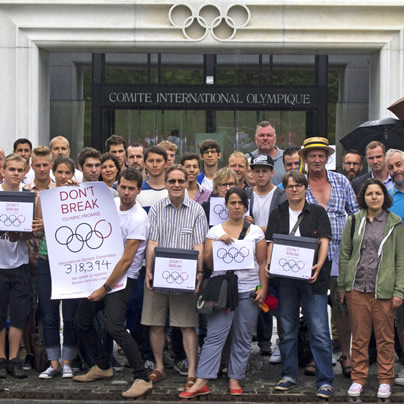
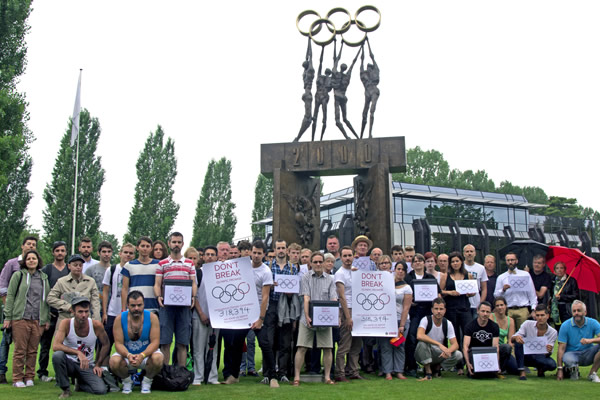
Members of All Out and Athlete Ally on August 7 presented a petition with more than 300,000 signatures to the International Olympic Committee that urges it to pressure Russia to end its gay crackdown. (Photo courtesy of All Out)
The International Olympic Committee on Thursday said it had received additional assurances from the Russian government that gay people would be welcome to attend the 2014 Winter Olympics in Sochi, Russia.
The IOC said in a statement Russian Deputy Prime Minister Dmitry Kozak wrote in a letter to the Olympic body that his country “has committed itself to comply strictly with the provisions of the Olympic Charter and its fundamental principles, according to item 6 of which ‘any form of discrimination with regard to a country or a person on grounds of race, religion, politics, gender or otherwise is incompatible with belonging to the Olympic movement.”
“The Russian Federation guarantees the fulfillment of its obligations before the International Olympic Committee in its entirety,” Kozak added, according to the IOC.
Kozak’s letter to the IOC comes eight days after the Olympic body reiterated to the Washington Blade its previous statements that said it has “received assurances” from the Kremlin the broadly-worded law that President Vladimir Putin signed in June that bans gay propaganda to minors will “not affect those attending or taking part” in the Sochi games.
The Russian Interior Ministry in an August 12 statement said it would enforce the statute during the Olympics. Russian Sports Minister Vitaly Mutko earlier this week again defended the law.
“We want to protect our children whose psyches have not formed from the propaganda of drug use, drunkenness and non-traditional sexual relations,” he told reporters during a Moscow press conference as the Associated Press reported.
Athletes speak out against anti-gay law
Russian chess champion Gary Kasparov and gay playwright Harvey Fierstein are among those who have called for a boycott of the Sochi games that will take place in February. Author Dan Savage, LGBT rights advocate Cleve Jones and others have called for a boycott of Russian vodka.
President Obama, retired tennis champion Martina Navratilova, gay Olympic diver Greg Louganis and several LGBT advocacy groups that include Athlete Ally are among those who feel the U.S. should compete in Sochi.
American runner Nick Symmonds criticized Russia’s gay propaganda ban last week in an interview with the Russian news agency RIA Novosti after he competed in the World Athletic Championships in Moscow. Figure skater Johnny Weir, whose husband is of Russian descent, told CBS News earlier this month he is “not afraid of being arrested” while at the Olympics.
High jumper Emma Green Tregaro and sprinter Mao Hjelmer, who are from Sweden, painted their fingernails in rainbow colors as they competed in the World Athletic Championships. The AP reported Green Tregaro wore red fingernail polish during an August 17 high jump competition at the same event because Swedish athletic officials reportedly asked her to change their color.
Yelena Isinbayeva, a Russian Olympic pole vault champion, defended the gay propaganda law as she criticized Green Tregaro and Hjelmer during an August 15 press conference after she won her third title at the World Athletic Championships. Russian sprinter Kseniya Ryzhova earlier this week dismissed suggestions she and teammate Tatyana Firova challenged the statute when they kissed on the medal podium after they won the women’s 4 x 400 meter rally at the event.
The IOC on August 14 reaffirmed to the Blade it will not allow athletes who compete in Sochi to publicly challenge Russia’s gay propaganda ban. The Olympic Charter states anyone who violates the rule could face potential disqualification or loss of their accreditation to the games, although the IOC it would “always treat cases individually and take a sensible approach depending on what was said or done.”
An IOC spokesperson declined to provide the Blade a copy of the letter it said Kozak wrote to the Olympic body.
The AP reported Kozak wrote in his letter he addressed to French IOC member Jean-Claude Killy the gay propaganda law is about the “restriction of information that promotes non-traditional sexual relationships among children.” The news agency said Kozak further defended the statute.
“These legislations apply equally to all persons, irrespective of their race, religion, gender or sexual orientation and cannot be regarded as discrimination based on sexual orientation,” he reportedly wrote.
Cyd Zeigler, Jr., co-founder of Outsports.com, again criticized the gay propaganda law in response to Kozak’s letter to the IOC.
“The problem with this law has always been interpretation,” Zeigler told the Blade. “It’s the same ‘love the sinner, hate the sin’ mantra we’ve heard so many times before. Russia can say they will welcome anyone, but they won’t allow any action. They won’t allow fans to wave rainbow flags in the streets or hold hands and kiss in public.”
Zeigler also described the IOC as “problematic.”
“Now they’re pressuring national Olympic committees to stop athletes from painting their fingernails in rainbow colors,” he said. “Russia is only part of the problem here, the IOC itself is the other piece.”



Switzerland
Swiss government backs nationwide conversion therapy ban
Several cantons have already prohibited widely discredited practice
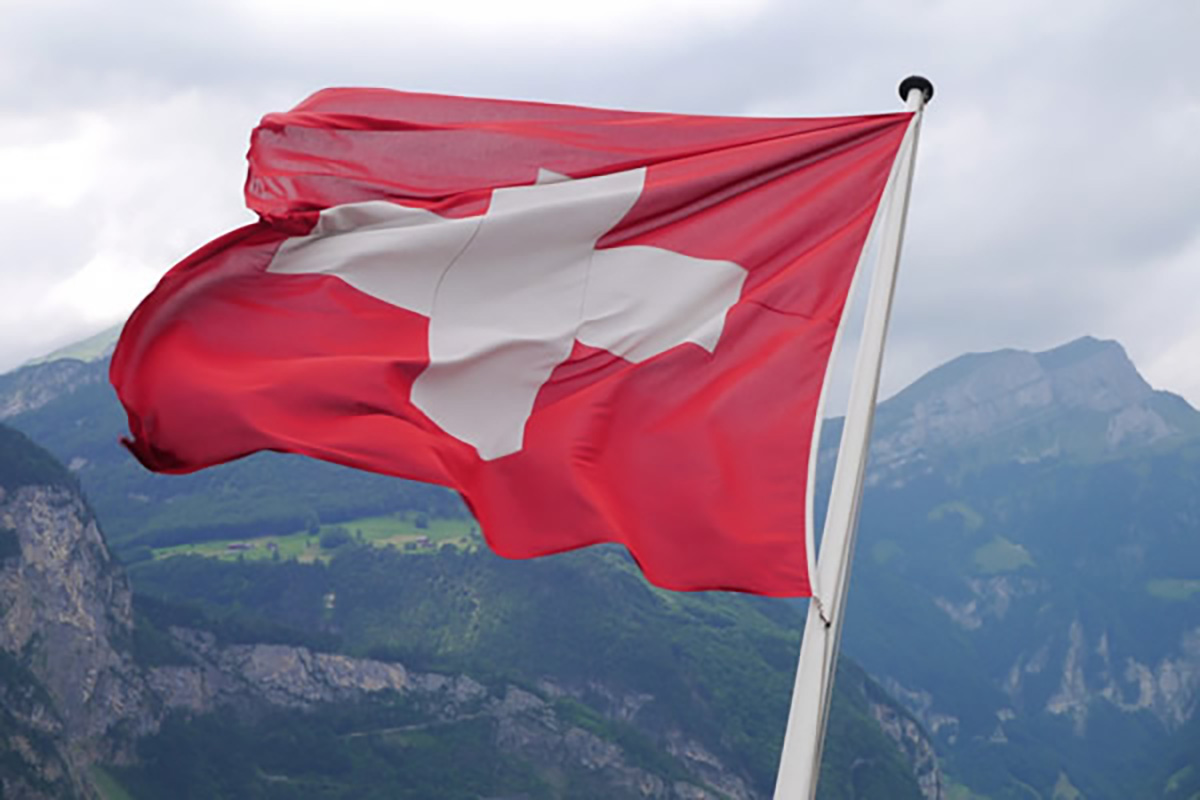
The Swiss government has said it supports a nationwide ban on so-called conversion therapy.
The Swiss Broadcasting Corporation on its website notes the government officially announced its position in a report it published on Wednesday.
Neuchâtel in 2023 became the first Swiss canton to ban conversion therapy.
Lawmakers in Valais and Vaud have also prohibited the widely discredited practice in their respective cantons. Bern and Geneva are among the other cantons in which lawmakers have considered similar prohibitions.
The European Commission earlier this year said all European Union countries should ban conversion therapy.
Switzerland is not a member of the EU, but lawmakers in neighboring Germany in 2020 passed a law that prohibits conversion therapy for minors and for adults who have not consented to undergoing the widely discredited practice.
Several EU countries — Belgium, Cyprus, France, Malta, Norway, Portugal, and Spain — have banned conversion therapy outright.
The Dutch Senate in June approved a bill that would ban conversion therapy in the Netherlands. The lower house of the country’s parliament approved the measure in September 2025.
Greece in 2022 banned conversion therapy for minors.
Bulgaria
Top Bulgarian court rules government must legally recognize trans people
Decision caps off decade-long legal fight
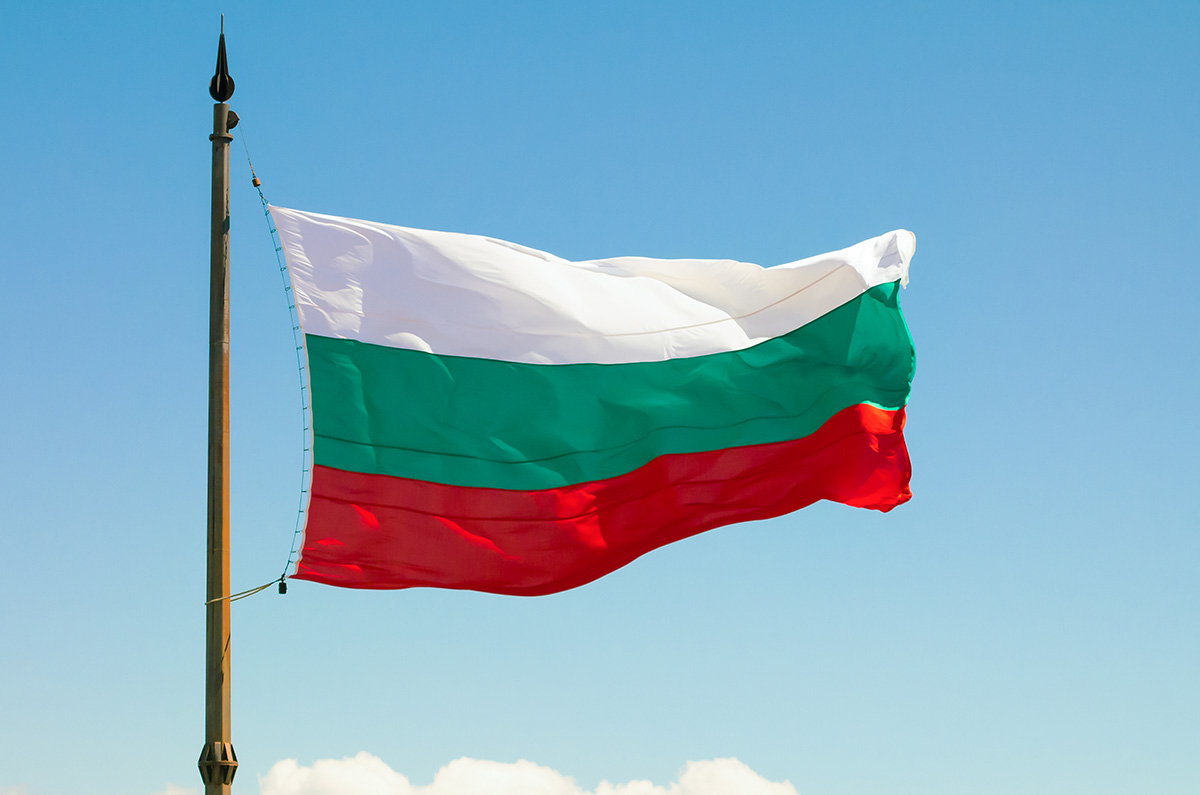
Bulgaria’s top court has ruled the country’s government must allow transgender people to legally change their name and gender on ID documents.
A trans woman from Bulgaria who moved to Italy, had tried to change her gender and name on her Bulgarian ID documents, but courts in the country denied her requests for nearly a decade.
The Bulgarian Supreme Court of Cassation in a 2023 ruling essentially banned trans people from legally changing their name and gender on ID documents.
The EU Court of Justice in Luxembourg, which is the European Union’s highest court, in March ruled in the “Shipova” case that member states must allow trans people to legally change their name and gender on ID documents. The lead plaintiff in the “Shipova” case is among the four litigants in the Bulgarian Supreme Court of Cassation case.
Two Bulgarian advocacy groups — Bilitis and Deystvie — along with TGEU – Trans Europe and Central Asia and ILGA-Europe in a joint statement they issued on Tuesday noted the Bulgarian Supreme Court of Cassation’s July 22 decision “aligns Bulgarian practice with the Court of Justice of the EU, enabling changes to gender markers, names, and personal identification numbers.”
“The judges also concluded that EU law requires Bulgaria to establish a legal procedure for legal gender recognition, which is necessary so that Bulgarian trans citizens can travel and reside freely inside the EU,” they added.
Bulgaria has been a member of the EU since 2007.
The country borders Romania, Serbia, North Macedonia, Greece, and Turkey.
“We are very glad to see that the judges of the Supreme Court clearly stated that it is actually a matter of rule of law for Bulgaria to respect the universal equality and the dignity of all human beings, including trans people for whom human rights-based legal gender recognition procedures are an indispensable element,” said Denitsa Lyubenova, co-chair of Deystvie who represented the four plaintiffs in the Bulgarian courts and the lead litigant in the “Shipova” case at the EU Court of Justice. “The government needs to act swiftly now to put in place an LGR procedure that is fully in line with European human rights case law, which means without any conditions requiring proof of medical, surgical or hormonal treatment.”
The groups also urged the Bulgarian government to codify the ruling into law.
“While lower courts are expected to follow this ruling directly, a court decision is not a substitute for law,” they said. “Bulgaria still needs a fast, transparent, and accessible legal gender recognition procedure written into legislation, not left to case-by-case court precedent. TGEU – Trans Europe and Central Asia, Bilitis, Deystvie, and ILGA-Europe call on the Bulgarian government to start that legislative process now, with meaningful involvement from civil society.”
France
Prominent French activist attacked outside Paris bar
Pierre Picavet hospitalized with internal bleeding, head injury

French prosecutors say a man shouted anti-gay slurs at a prominent activist before he attacked him in Paris on Saturday.
Media reports indicate Pierre Picavet, a police officer who is the president of FLAG!, a group within the French Justice and Interior Ministries that defends LGBTQ rights, was attacked as he left a bar in Paris’s Marais neighborhood.
The Marais since the 1980s has been center of the French capital’s LGBTQ community.
France 24 reported Picavet’s assailant struck him with a bottle. The attack left Picavet hospitalized with internal bleeding, a head wound, and other injuries.
“When I get better, when my wounds have healed, I will continue the fight,” Picavet told Radio France on Monday. “I am particularly shocked, but it tells me that there is still work to do.”
Paris Mayor Emmanuel Grégoire is among those who condemned the attack.
STOP Homophobia (STOP homophobie), a French group that fights against anti-LGBTQ violence, on its social media pages published a picture of Picavet in the hospital.
“As a long-standing partner of FLAG!, STOP Homophobia wishes to express its solidarity with Pierre Picavet, his loved ones, and the entire association,” said the group. “STOP Homophobia condemns this assault in the strongest possible terms and reiterates that anti-LGBT violence remains a reality — even in spaces where everyone should be able to move freely and live out their sexual orientation or gender identity without fear of attack.”
STOP Homophobia also praised a bystander who came to Picavet’s aid after the attack, and the first responders and law enforcement personnel who responded.
“STOP Homophobia extends its full support to Pierre, his family, his loved ones, and the entire FLAG! team, and wishes him a full recovery,” said the group.
Reports indicate the assailant, who was born in 2006, was scheduled to appear in a Paris court on Monday at 1:30 p.m. local time.

Pentagon expands testosterone screening as trans troops face hormone therapy restrictions

Calendar: September 4-10

Swiss government backs nationwide conversion therapy ban

Gloria Steinem dies at 92

The mastery of love

Shooting outside gay bar in Ariz. leaves three dead

PHOTOS: Miss Gay Old Bay

Gay men linked to 2006 Wone murder failing to make lawsuit settlement payment

Anne Arundel schools now need parent permission to call trans students by preferred names

‘People don’t see me. They see a trend’
-

 Arizona5 days ago
Shooting outside gay bar in Ariz. leaves three dead
-

 Photos5 days ago
PHOTOS: Miss Gay Old Bay
-
District of Columbia5 days ago
Gay men linked to 2006 Wone murder failing to make lawsuit settlement payment
-
Maryland5 days ago
Anne Arundel schools now need parent permission to call trans students by preferred names