Arts & Entertainment
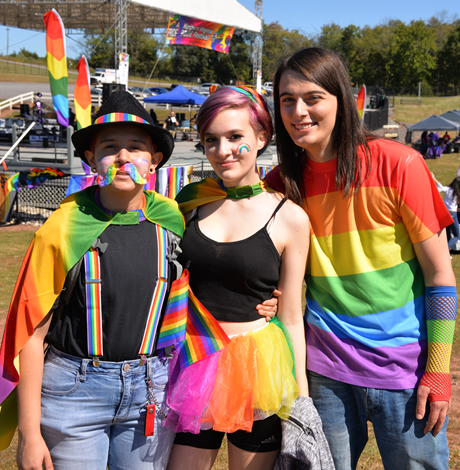
Smaller regional Prides plan virtual, postponed events
NOVA, Frederick, Annapolis et. al. thinking outside the box in pandemic’s wake
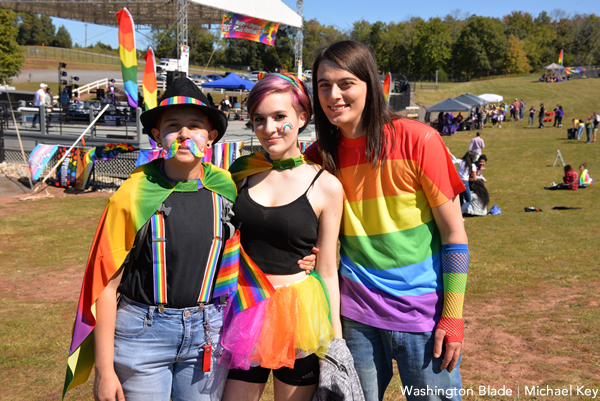
Washington
Capital Pride #StillWe launches a virtual series of streamed events June and beyond through a partnership with The D.C. Center.
Programs include monthly online town halls, expanded resources available through its website and a shared community calendar. Pride 2020 Reimagined includes new Pride month programming as well as ongoing virtual versions of the D.C. Center’s Reel Affirmations film series, Outwrite Literary Festival and more.
For more information and a listing of events, visit capitalpride.org and thedccenter.org.
This weekend would typically be D.C. Youth Pride weekend (although they had their 2017 in the fall). No virtual events are listed on either the Youth Pride Alliance website or Facebook page. Organizers did not immediately respond to Blade request for details.
D.C. Leather Pride has been postponed until further notice.
D.C. Trans Pride and Silver Pride (60 and older), usually held in May, may have fall events.
Maryland
Annapolis Pride has cancelled its second annual parade and festival due to COVID-19 concerns and gathering restrictions. But in its place will be an online event live-streamed via YouTube and Facebook on June 27 at 4 p.m. Participants are encouraged to turn their home into a “float” and show off Pride-themed outfits during the virtual event. Visit annapolispride.org to register and for more information.
Baltimore Pride 2020, originally scheduled for Saturday, June 20, has been postponed to either August or September, depending how the COVID-19 situation in Maryland and globally unfolds. The community is encouraged to monitor the Baltimore Pride website for further updates.
Frederick Pride events have been postponed due to pandemic concerns. On Sunday, Oct. 4 at 11 a.m. the rescheduled parade will travel along Carroll Creek Linear Park in historic downtown Frederick. Vendor registration is now open at frederickpride.org. News about Pride events and entertainers will be posted at a later date.
Howard County Pride has been postponed due to the spread of the coronavirus. However, they are planning virtual drag queen story times, poetry slams, a talent show and other virtual events throughout Pride month. For more information, email [email protected] or visit howardcountypride.org.
Hagerstown Pride plans a virtual Pride Festival on Saturday, July 18 at 11:30 a.m. Details at hagerstownhopesmd.org.
Virginia
Hampton Roads Pride announced on its Facebook page a decision to postpone its 32nd Annual PrideFest, ninth annual Pride Block Party and second annual Pride at the Beach all scheduled for June 19-21, 2020 due to pandemic-related health concerns. New dates have not been announced.
However, Pride Night at Harbor Park hosted by Hampton Roads Pride and the Norfolk Tides has been rescheduled to August 26 at 7 p.m. Tickets start at $13 on Ticketmaster. Continue to monitor this event’s Facebook page for any changes due to COVID-19.
Ghent Pride, presented by the Ghent Business Association and Hampton Pride, has not announced dates for this year’s event. The public is invited to monitor ghentpride.com and its Facebook page for updates as pandemic guidance evolves.
Winchester Pride is scheduled for Saturday, Oct. 24 at noon in the Downtown Walking Mall. Its third annual Pride celebration will include guest speakers, entertainment and more. For details and information about this event, the Miss Winchester Pride Pageant scheduled for Saturday, Aug. 29, or for possible postponements or adjustments, visit winchesterpridecelebration.com.
No word yet from NOVA Pride, usually held in August. Check later at novapride.org.
Reston Pride is cancelled.
Shenandoah Valley Pride hopes to have its event on Saturday, Sept. 19 from noon-6 p.m. Details at shenandoahvalleypride.org.
VA Pride (Richmond) is also looking to fall with a Sept. 26 event. Details at vapride.org.
West Virginia
Eastern Panhandle Pride in Shepherdstown, W.Va., is postponed indefinitely. Look for the organization on Facebook later in the year for updates. “Alternatives” are being considered, organizers said.
International
Global Pride is June 27 and is an international response to multiple Pride cancellations due to the ongoing global health crisis. This first-ever gathering of the worldwide LGBTQ community includes an impressive slate of speakers to include the President of Costa Rica, Prince Manvendra Singh Gohil of India and more. The show will be livestreamed on the Global Pride website and YouTube, and will be free to view. More information is available at globalpride2020.org.

Theater
Immersive ‘Nation-State’ imagines a society free of authoritarianism
Queer duo brings unique theater experience to Dupont Underground
‘Nation-State: A Live Experiment’
Sept. 2-13
La Pluma Theatre
Dupont Underground
19 Dupont Circle, N.W.
$25-40
Dupontunderground.org
Industry Night: September 7. Free for all theater makers
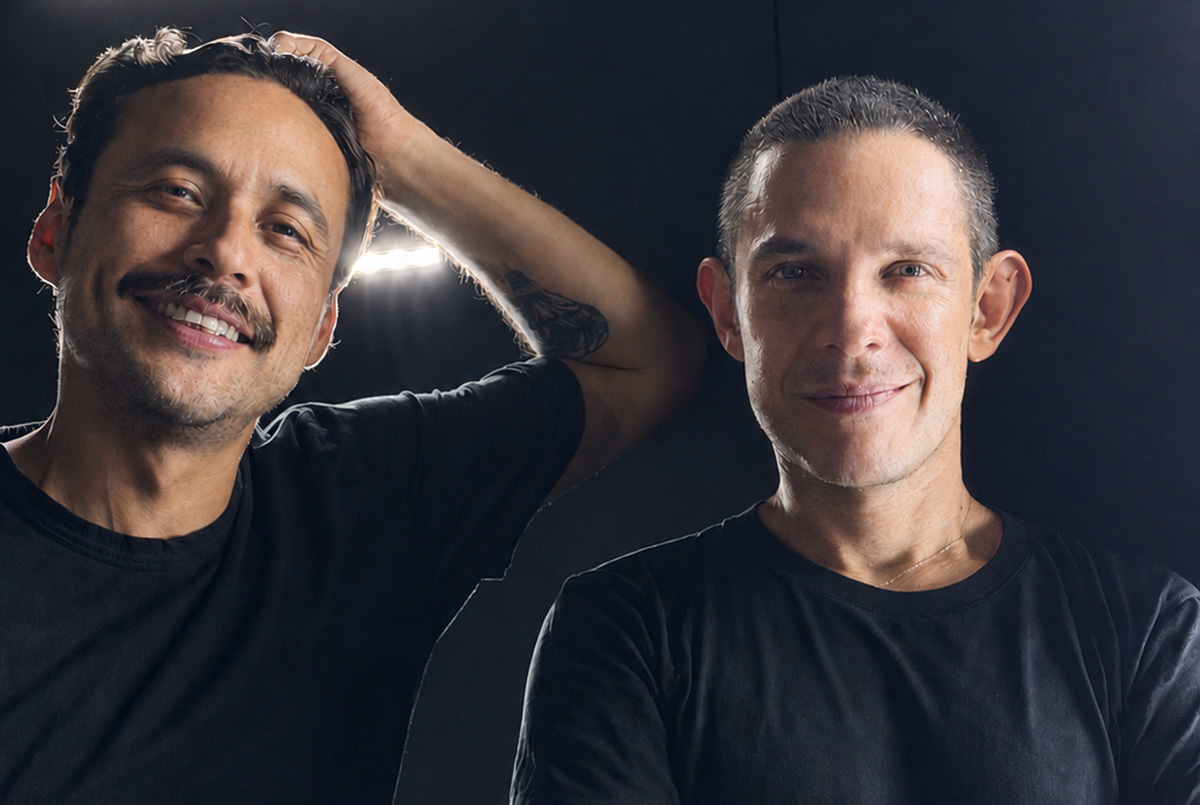
A relevant piece replete with borders and passports, La Pluma Theatre’s “Nation-State: A Live Experiment”is immersive, site-specific, and testimonial.
With the production, the company’s queer co-founders Victor Salinas and Gabriel de la Cruz pose unique situations and experiences. In lieu of tickets, audience members get passports. What follows are questions and tests, and whether they gain entrance into a nation built to protect its citizens from authoritarianism, resource theft, and colonization remains to be seen.
Originally from Mexico and Peru, respectively, Salinas and de la Cruz met at a birthday party in D.C. and instantly clicked as theater makers, sharing outlook and ambition. Reluctant to go it alone, both had been searching for artistic and producing collaboration. That all changed.
And while their enterprise is primarily Latino and queer, these professional partners refused to be confined to a box, choosing rather to amplify the voices of all of D.C.’s diverse communities. In line with their plans, “Nation-State” is open to serving many points of view.
As director of “Nation-State,” de la Cruz mostly guides the questioning. He’s the right man for the job. Since arriving in the U.S. six years ago, he has been consistently curious about certain things. Who belongs here? How do you make this your home? And who is creating the rules?
“But the writing process is shared,” de la Cruz corrects. “I come up with questions. I provide Victor the topic and he goes from there. We’re both writing what happens next.”
He adds, “the most exciting moment for people is when they share something unique. As a questioner, you need to find the confidence and the right moment to ask the question. If you provide the space for that, the actor or audience member will give you something singular.”
Since before La Pluma opened in November 2025, its creators have agreed that “the most beautiful thing is when you use theater to fashion something innovative. Theater is the place where you can create new frameworks and rehearse new ways to live.”
At just an hour, “Nation-State” is performed in English at Dupont Underground – the company’s historic residence, a once subterranean street car barn located beneath Dupont Circle. For the production, the tunnels serve as boundaries, and its different curved spaces make up a micro nation and welcome different guest actors who will come to share their stories.
At certain times, Salinas plays Officer Salinas, Director of N.I.C.E. (Non-Discriminatory, Inclusive Customs Enforcement), a humorous social critic of the system and border patrol. Other times, it’s Salinas as himself telling his real-life stories. He says, “it’s a level of vulnerability that I’ve never experienced. The script is my personal life with zero censorship. But I think, if not now in a play that we are pouring our souls into, then when?
“As a kid I dreamed of being TV show host and now I am. I will sing and tell my stories. I feel comfortable and ready to do it.”
In Spanish, “pluma” means both pen and feather. For the company, it’s the latter, and comes with lively associations. Salinas explains. In mysticism, feathers serve as a portal between the real and spiritual worlds, like that between fact and fiction. And in Spanish and Latin American slang “showing feathers” (in other words, showing queerness). La Pluma encourages a good display of authenticity.
And specifically for Salinas, there’s a personal story involving his beloved grandmother with whom he was extremely close. After she died, he has regularly found feathers as if she’s making contact. “A bit romantic, I know. But I think if you’re open you can see these things,” he says.
“Nation-State” is challenging but fun. It’s unmistakably La Pluma. In the end, the company wants to build a world where everyone feels safe to tell their own stories, as individuals and performers.
Books
New book examines Trump cuts to LGBTQ healthcare
‘Aftershocks’ details impact of policy shifts on HIV response, broader public health
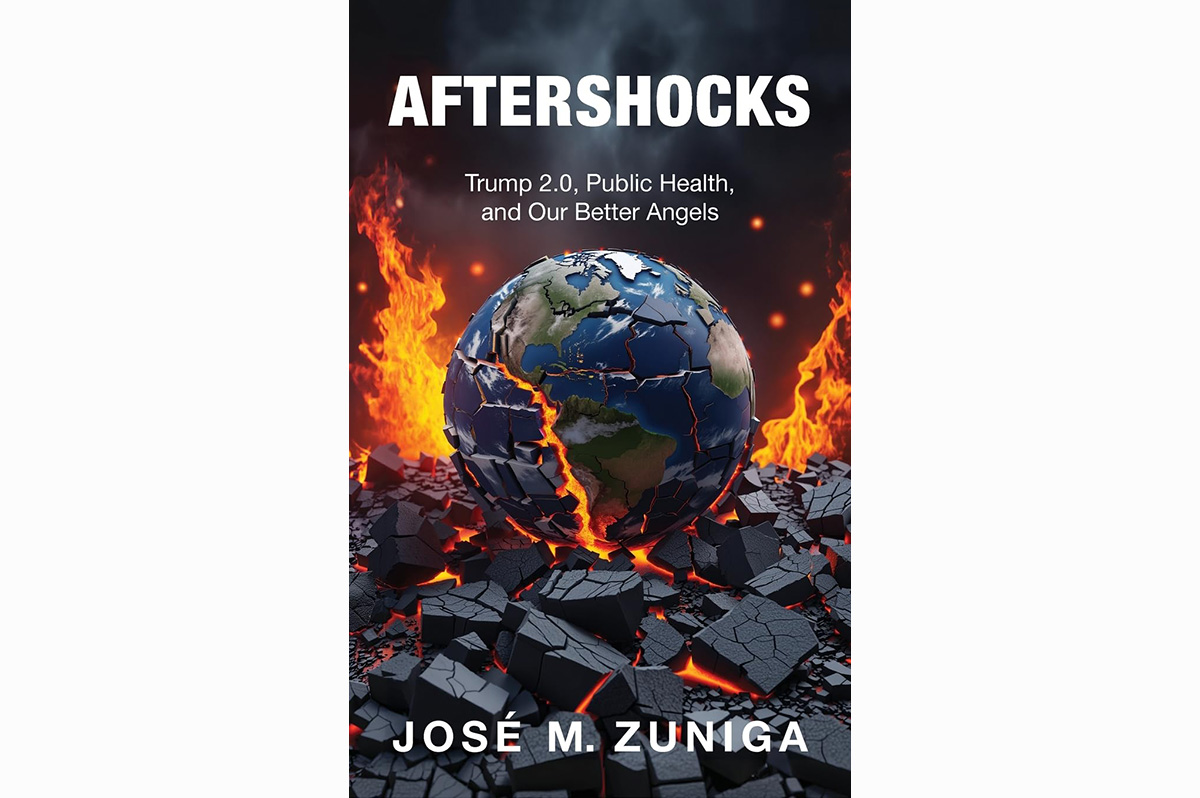
As LGBTQ and HIV advocates continue to grapple with the Trump administration’s attacks on healthcare, a new book offers a timely look at what happens when public health systems — and the democratic institutions that sustain them — are pushed to their limits.
The book, “Aftershocks: Trump 2.0, Public Health, and Our Better Angels,” was written by Dr. José M. Zuniga, president/CEO of Fast-Track Health. Zuniga is a globally recognized public health leader with more than three decades of experience advancing responses to HIV, communicable and non-communicable diseases, and the health impacts of climate change. He is also editor-in-chief of the Journal of Fast-Track Health.

The book covers the first year of the second Trump administration. It chronicles the impact of federal policy shifts and budget cuts on the HIV response and public health more broadly, including for LGBTQ communities. Drawing from policy analysis, frontline insight, and lived experience, the author reveal how decades of hard-won progress became vulnerable through Project 2025 and DOGE, but also a paralysis in the HIV and public health communities following the outcome of the 2024 elections.
“In other words, we were caught flat-footed when our opposition had a detailed plan to create chaos and disruption,” Zuniga says. “Thus, the book also offers Horizons 2028 as an antidote to Project 2025 as a starting point for a wide-ranging conversation about how we will build back better given the baseline pre-Trump 2.0 was already imperfect.”
Below is an excerpt from the book.
What Could Not Be Left Unsaid
Let me begin with a simple truth: I did not set out to write this book. Like many in the public health community, I set out daily to do the work of scaling prevention, expanding access to care, strengthening health systems, and ensuring that dignity, equity, and justice are operational realities. Writing, for me, has always been in service of action: policy briefs to shape decisions, editorials to provoke accountability, reports to document progress or failure, and books to synthesize experience into insight that can guide public health action. But Aftershocks is something different; it is not merely an analysis. Instead, it is a record of rupture, of response, and of what it means to continue when the ground beneath your work begins to shift.
This book was written because something changed, and that change came into sharp relief during the beginning days of the second Trump administration, including the erosion of norms, the weaponization of rhetoric, and the recalibration of governance itself. The change was not limited to policy reversals or budget cuts, though there were many. Moreover, it was not confined to rhetoric, though language played a central role. The change was structural and moral: a redefinition of how power understood its obligations to people, to evidence, and to truth itself. And for those of us working in public health, the effects were immediate and personal. We experienced a purposeful disruption of the public health ecosystem and a direct repudiation of the “health for all” principle that guides our work….
Writing this book was, unexpectedly, an act of catharsis. Not because it resolved anything, but because it created space to process what would otherwise have been overwhelming… Amid what many in the public health community experienced as both individual and collective trauma, documenting itself was stabilizing, allowing reflection without detachment and critique without disengagement. But catharsis alone is insufficient. This book is not an exercise in lament; it is also a response. If the period it chronicles is defined by disruption, then its purpose is to offer direction. Where Project 2025 represented a blueprint for ideological capture of institutions, language, and governance, this book offers a counterpoint: Horizons 2028…
Horizons 2028 is grounded in a simple premise: that the future of public health – and of democratic governance more broadly – depends on rebuilding systems that are resilient to political volatility. That means strengthening not only federal capacity, but subnational leadership. It means embedding community-led accountability into data systems. It means aligning health outcomes with social determinants and recognizing that equity is not an endpoint but a continuous process of adjustment and correction. It means treating global engagement not as optional, but as essential to national well-being. In other words, it is a roadmap not for returning to what was, but for building what is required…
I write as an Independent. Not in the sense of detachment, but in the sense of accountability to evidence, to outcomes, and to the people whose lives depend on both… Independence does not mean neutrality in the face of harm; it means refusing to filter reality through partisan allegiance. Importantly, it also means being guided by a consistent commitment to equity, dignity, and justice. These are not abstract values… They are tested in moments of crisis, when the gap between principle and practice becomes most apparent. They demand accountability not only for what is said, but for what is done – and for what is allowed to persist unchallenged. And they require the courage to name harm clearly, even when doing so is inconvenient or politically unwelcome.
That commitment shapes the analysis that follows, but it is also what makes the writing difficult. Because to document harm is to confront it. To trace its origins is to name decisions and their consequences. And to do so honestly is to risk being read as partisan in a landscape where truth itself has become politicized. But the alternative – silence, or false equivalence – is not acceptable. Not when the stakes are as high as they are. There is, however, a thread that runs through this book that resists cynicism, is not optimism, at least not in the conventional sense, but is something quieter and more durable: a belief that even in moments of rupture, there remains a capacity – within institutions, within communities, within individuals – to reorient toward something better.
The Blade may receive commissions from qualifying purchases made via this post.
Out & About
Archuleta to host book signing in Rehoboth Beach
Entertainer to meet with fans at Browseabout Books

David Archuleta will chat with fans and sign his book “Devout: Losing My Faith to Find Myself” on Sunday, Sept. 6 at 2 p.m. at Browseabout Books in Rehoboth Beach.
The book is an inspirational account of his transformation from a closeted Mormon teen singer to a pop star who is comfortable with his queer identity. For additional information on this event, go to browseaboutbooks.com.
Archuleta will also be in Rehoboth Beach to headline the “Night of Entertainment” on Saturday, Sept. 5 for CAMP Rehoboth’s SUNFESTIVAL weekend, which includes the Night of Dance Sept. 6.
Visit camprehoboth.org for more information.

SUNFESTIVAL takes center stage as Rehoboth Beach closes out summer

Anne Arundel schools now need parent permission to call trans students by preferred names
Shooting outside gay bar in Ariz. leaves three dead

‘People don’t see me. They see a trend’

Gay men linked to 2006 Wone murder failing to make lawsuit settlement payment

San Francisco, long a queer safe haven, remains competitive for homebuyers

Trans, nonbinary Americans find refuge in the Netherlands

Calendar: August 28-September 3

‘Teenage Sex and Death’ has never been more entertaining

Actor Tim Curry dies at 80
-

 California4 days ago
San Francisco, long a queer safe haven, remains competitive for homebuyers
-
Netherlands4 days ago
Trans, nonbinary Americans find refuge in the Netherlands
-
Calendar4 days ago
Calendar: August 28-September 3
-
Movies4 days ago
‘Teenage Sex and Death’ has never been more entertaining