The White House
Trans immigrant activist declines invitation to attend White House Pride reception
Jennicet Gutiérrez heckled Obama during 2015 event
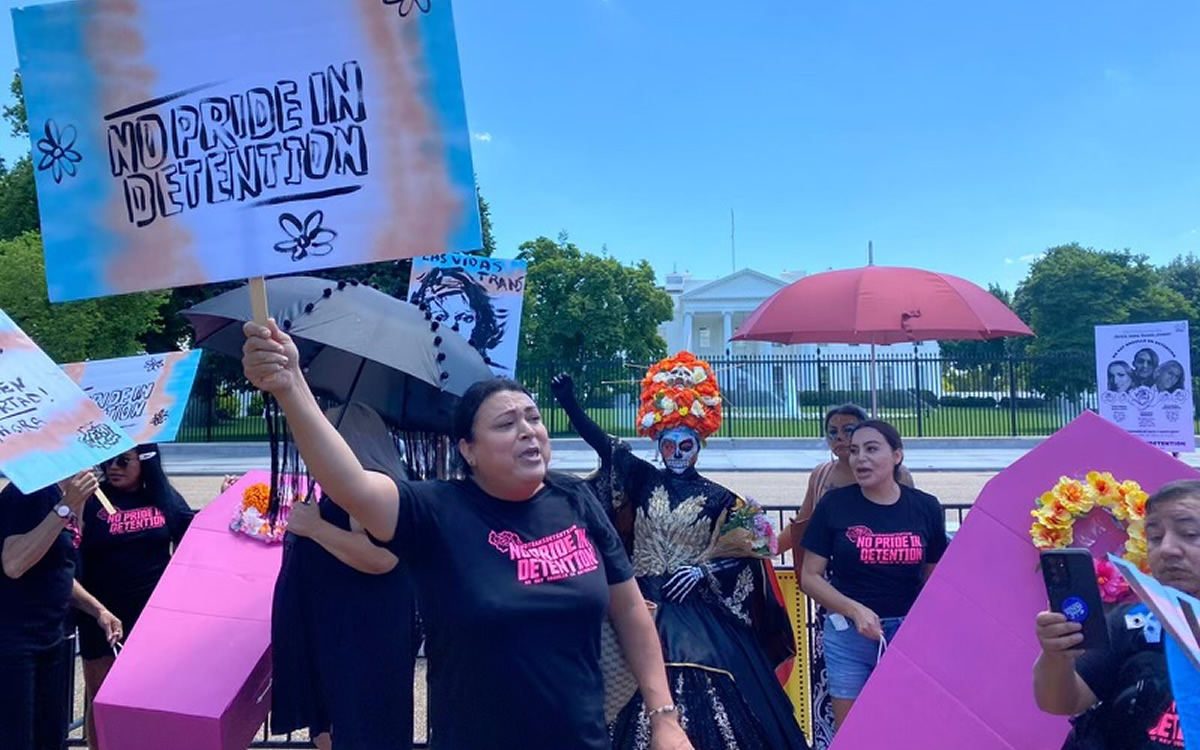
The co-executive director of an organization that advocates on behalf of transgender and gender non-conforming immigrants has declined an invitation to attend the White House’s Pride Month celebration on Wednesday.
Familia: Trans Queer Liberation Movement Co-Executive Director Jennicet Gutiérrez on Tuesday told the Washington Blade during a telephone interview that she “very consciously” decided “not to attend” the event “because the community is under attack.”
“There are people that are coming after us, both politicians and white supremacists, and it just doesn’t feel right to me coming and celebrating and listening to a speech when there are all these attacks happening,” said Gutiérrez. “I don’t see how that can be a solution to what we are dealing with in our daily lives.”
Gutiérrez is a trans woman who was born in Mexico’s Jalisco state.
Gutiérrez noted she and her Familia: Trans Queer Liberation Movement colleagues over the last eight years have organized around a variety of immigration-related issues that include ending the detention of trans people in immigrant detention centers and stopping the deportation of trans people who ask for asylum in the U.S.
“Those things are still happening,” said Gutiérrez. “So, that’s why I made the conscious decision to decline the invitation.”
Gutiérrez noted three trans women — Victoria Orellano, Roxsana Hernández and Johana “Joa” Medina León — who died in U.S. Immigration and Customs Enforcement custody or immediately after their release in 2007, 2018 and 2019 respectively. (Neither President Obama, nor President Biden were in the White House when Orellano, Hernández or Medina passed away.)
Title 42, a Centers for Disease Control and Prevention rule that closed the Southern border to most asylum seekers and migrants because of the pandemic, remains in place.
The White House in April announced it would terminate the rule the previous administration implemented in March 2020. Title 42 was to have ended on May 23, but a federal judge blocked the Biden administration’s plans.
“Title 42 is still in place and people are stuck, and that’s not ok,” said Gutiérrez. “Communities here are willing to welcome them, to support them, to get them back on track so they can find their way and fight for dreams overall.”
Gutiérrez in 2015 heckled Obama during a White House Pride Month reception.
She pointed out that Biden was standing next to him. Gutiérrez also noted many attendees booed her.
“I was really surprised by the reaction,” said Gutiérrez. “I thought I was surrounded by people that truly care about change, that were fighting for the most vulnerable among us and when they were just bullying and silencing.”
Gutiérrez further described the treatment she received at the reception as “very humiliating.”
“It was really heartbreaking and that’s also part of the problem,” she said. “If we can’t get behind people who are facing so many injustices, then how are we going to fight for all of us … it’s been shown that time after time trans folks and non-binary individuals are often left behind.”
The 2015 reception took place two days before the U.S. Supreme Court issued its landmark Obergefell ruling that extended marriage rights to same-sex couples throughout the country. Growing concerns over whether the U.S. Supreme Court will strike down Roe v. Wade will loom over this year’s event.
Gutiérrez described marriage equality to the Blade as an issue that is “very digestible, very pleasing to the mainstream.”
“Rarely did you see trans folks in campaigns and people of color in general being part of it,” she said, once again referring to the reaction she received when she challenged Obama in 2015. “So that to me was very disappointing to see that reaction and to live it and to feel the hypocrisy and how some people are seeking their own benefit and don’t really care about the rest of us.”
The White House has yet to respond to the Blade’s request for comment on Gutiérrez’s decision.
The letter in which Gutiérrez declined the invitation is here.


The White House
White House counterterrorism strategy targets ‘anti-American, radically pro-transgender’ groups
Administration released document last week

The White House released the “United States Counterterrorism Strategy” last week, introducing enforcement priorities that include references to people with “extreme transgender ideologies.”
The document is the first executive branch counterterrorism strategy released since former President Joe Biden’s 2021 “National Strategy for Countering Domestic Terrorism,” which largely focused on threats tied to domestic extremism and the Jan. 6 Capitol attack. The Trump-Vance administration’s new strategy instead centers heavily on cartels, Islamist organizations, and what it describes as “violent left-wing extremists.”
The report identifies three primary categories of terror threats facing the U.S.: “Narcoterrorists and Transnational Gangs,” “Legacy Islamist Terrorists,” and “Violent Left-Wing Extremists, including Anarchists and Anti-Fascists.” The strategy repeatedly frames those groups as existential threats to the U.S. and outlines a more aggressive, militarized counterterrorism posture.
The introduction to the report closes with a warning from President Donald Trump referencing counterterrorism operations carried out during his second administration: “We will find you and we will kill you.”
In the section outlining the administration’s counterterrorism priorities, the document argues that federal intelligence, and law enforcement agencies under prior administrations focused on the wrong threats while overlooking violence committed by left-wing extremists. The strategy specifically references transgender ideology while discussing political violence.
“As real threats were ignored or underplayed, Americans have witnessed the politically motivated killings of Christians and conservatives committed by violent left-wing extremists, including the assassination of Charlie Kirk by a radical who espoused extreme transgender ideologies.”
Claims tying a trans person to Kirk’s killing have been disputed, however, and multiple news outlets later retracted or corrected early reports that identified the shooter as trans.
The report later expands on that argument, saying the administration will prioritize targeting “violent secular political groups” it describes as anti-American and “radically pro-transgender.”
“In addition to cartels and Islamist terror groups, our national CT activities will also prioritize the rapid identification and neutralization of violent secular political groups whose ideology is anti-American, radically pro-transgender, and anarchist.”
The rhetoric mirrors claims frequently made by Trump allies and conservative commentators linking trans people and left-wing activism to political violence. However, data compiled by researchers and organizations tracking mass shootings does not support the idea that trans people are responsible for a significant share of such attacks.
Factcheck.org says rhetoric from Trump and several far-right political pundits contradicts available data, noting that the percentage of mass shootings committed by trans people is “exceedingly small.”
Despite the lack of evidence supporting generalized claims about trans people, the president’s son Donald Trump, Jr., told Fox News in September 2025 that he could not “name a mass shooting in the last year or two in America that wasn’t committed by, you know, a transgender lunatic.”
Factcheck.org also found that even if cases involving shooters with unclear gender identities were included in statistics about trans mass shooters, the number would still account for only a fraction of a percent.
Mark Bryant, founding executive director of the Gun Violence Archive, said the number of trans mass shooters could be as high as eight, but would still account for less than 0.1 percent of mass shootings over the last 12 years, according to GVA data. He added that the figure would remain below 0.2 percent even when examining incidents from 2018 to the present.
Beyond domestic extremism, the strategy frames the administration’s broader counterterrorism agenda through the lens of “America First” foreign policy and renewed U.S. dominance in the Western Hemisphere. The report repeatedly references the Monroe Doctrine, the nearly 200-year-old policy warning European powers against interference in the Americas.
“After years of neglect, the United States will reassert and enforce the Monroe Doctrine to restore American preeminence in the Western Hemisphere, and to protect our homeland” Trump said in the report.
The document also breaks down counterterrorism priorities by region, including the Middle East, where it argues the U.S. is “no longer as dependent” on the region because of increased domestic energy production.
“Our growing domestic energy production means the Middle East is no longer as central to America’s stability, yet threats from this region remain, and our counterterrorism goals continue to be specific and rooted in realistic threat analysis.”
The statement comes amid rising gas prices tied in part to instability surrounding the war involving Iran, with fuel costs reaching some of their highest levels since 2022. According to AAA, the national average price for gasoline climbed to $4.52 per gallon as the national average rose “$.25 for a second straight week.“
The White House
From red carpet to chaos: A first-person narrative of the WHCD shooting
The Blade’s WH correspondent Joe Reberkenny recounts his night at the WHCD after a shooter attempted to gain entry.

It started as any White House Correspondents’ Dinner is supposed to go—I assume. I’ve never been to one before this, but based on other events I’ve attended at the Hilton, including an HRC gala, it all seemed fairly normal.
There was a lot of traffic. Police had blocked off streets encompassing a large portion of Adams Morgan—particularly around the hotel. The president was making his first appearance after boycotting the event during his first term, so there was a sense of anticipation. It took me about 45 minutes to go just under a mile from my apartment to about three blocks from the hotel in my Uber. I waited until the last possible second before I felt like I was going to be late—6:30—to get out of the car, because it was raining and I was wearing my green tux.
I walked up to a group of people checking tickets at the base of the hotel. They seemed to just be glancing at the tiny, index-card-sized tickets rather than conducting any kind of full security screening outside. As I walked from that first checkpoint to the drive-around drop-off area, I joined what was essentially one long line for the red carpet. It eventually split into people who wanted photos and those who didn’t—but again, there was no real need to show anything beyond that small ticket upon entering, and even that wasn’t being checked closely.
A light went off in my head; I felt that, given the speed at which security was checking tickets, they couldn’t fully see the foil logo and tiny table numbers from that distance. I remember thinking that if I had a similarly sized piece of paper, I could have gotten through up to that point.
I also noticed there was no real security checkpoint or metal detectors upon initially entering the hotel grounds—unlike what I had seen at the HRC gala the year before.
I waited about 35 minutes in line in the car drop-off area—without cars, since it had been repurposed to corral press and their guests before entering the building and heading onto the red carpet. I took my photo, then went up the escalator to meet my date, Jacob Bernard from Democracy Forward. They wouldn’t let him onto the red carpet without his ticket, so I gave him his, which I had been holding. He was already inside the venue despite not having his ticket on him and had been at one of the pre-parties.
That also struck me as odd—that you could access a pre-dinner party without a ticket or going through any visible security.
After I found him, we took a photo together at a step-and-repeat past the main red carpet area around 7:45. Oddly enough, a group of my friends—gays who I regularly see on the dance floors of the gay bars of Washington, who work in various government and media-adjacent fields—found me, and we took pictures together. None were White House correspondents or held a “hard pass” to the White House (security credentials that allow entry into the White House complex).
Another light went off in my head that indicated party crashers probably shouldn’t be getting inside to an event that is supposed to be one of the most secure rooms in the country.
After the photos, I could see groups of people being moved from pre-party spaces in various meeting rooms on other floors and directed toward the main floor where the red carpet had been.
My guest and I went back up to the main floor and walked through a small security checkpoint that included only a handful of metal detectors. From there, I went down the stairs from the lobby into the International Ballroom, where we took our seats at Table 200. I talked to a few people I knew—very traditional pre-event chit-chat. The vibes felt good. It was my first time attending, and I was genuinely excited.
Around 8:15, the Marine Corps Band played and “Commandant’s Four” color guard presented the flags. We were then told to take our seats.
They introduced the head table—the president, first lady, vice president, and members of the White House Correspondents’ Association board. Weijia Jiang, senior White House correspondent for CBS News and president of the WHCA, gave a brief speech, essentially saying we would eat first and then move into the main program, which was supposed to feature mentalist Oz Pearlman.
At this point my table, 200 which included members of the Wall Street Journal, the Blade, and a European outlet all started eating. About 15 minutes later, Washington Hilton staff began clearing plates and preparing to bring out the next course.
As they cleared the plates, I heard four loud bangs.
I saw hotel employees immediately start ducking. They seemed to understand the gravity of the situation much faster than most attendees, including myself. At first, it sounded like a tray might have fallen over (but I later found out that wasn’t the case).
After about 30 seconds of watching some people duck, others look around in confusion, and some continue eating and drinking, I got down. I kneeled with my chair in front of me as a kind of barrier. Being at Table 200, I felt somewhat removed from where the actual incident occurred.
Then I saw the president being whisked away quickly by Secret Service, along with the first lady and others at the head table.
My reporter instincts kicked in. I grabbed my phone and started filming. I saw SWAT team members rush into the ballroom and onto the stage, clearing the area. I captured a video of people looking around, confused about what had just happened.
A few minutes later, the room was told by the WHCA president to hold on—that they would provide more information and guidance on what would happen next. There was some indication that they might try to continue the event despite what had occurred.
Everyone started frantically checking X to see if any major outlets were reporting. I was receiving texts from family, friends, and colleagues about the rapidly unfolding situation.
I walked to the bathroom—twice, technically. I couldn’t find it initially because it was hidden behind black curtains. (Later, those curtains were removed, and the men’s room was in clearer view.)
During the first walk to the bathroom, I called my editor to tell him what was happening. He instructed me to start sending copy to another editor, who would get it online. The ballroom had almost no service—it’s in the basement of a 12-story hotel—so it was a challenge. I utilized SMS fallback (since iMessage wasn’t working) to send updates.
I returned to the table, where people were still hovering—calling editors, scrolling, texting, sending photos and copy. I was already drafting my story and sending it in chunks, adding details as I gathered more information.
I walked my guest toward the bathroom again, which was on the opposite side of the ballroom from our table, so I had to cross what felt like a sea of journalists, PR officials, guests, and others on their phones, talking and scrolling. My guest pointed out that the press pool was being held in an alcove away from the ballroom doors and escalator exit—not in the ballroom with everyone else.
“Alive” by the Bee Gees was playing over the speakers in the bathroom, which felt a little too on the nose.
On my way out, I heard someone speaking over a microphone and rushed to the ballroom entrance. WHCA President Weijia Jiang was speaking. She announced that the event was over and the space was being evacuated.
She also said that President Trump would hold a press conference at the White House in about 25 minutes.
That’s when I knew it was a race against the clock.
I called my editor a second time to update him and asked if I should head to the briefing (knowing the answer would be yes). He confirmed.
Then the crowd began to move. People grabbed purses, bottles—some left belongings behind. Even though it was technically becoming a crime scene, no one was actively forcing us out. It felt more like a collective understanding: It was time to go.
I texted my guest: “OK, I have to go to the White House. I’m so sorry to leave you.”
I made my way with the sea of people toward the one exit we were allowed to use and zipped between women in fancy gowns and men looking like penguins.
I put on my hard press pass, opened the Capital Bikeshare app, reserved the closest e-bike, and headed out.
I walked up Columbia Road to 20th and Wyoming, grabbed the bike, and rode down Wyoming, then 18th, cut over to U Street, and went straight down 16th to the White House. That ride was exhilarating. I also filmed an Instagram Reel updating my followers on what was going on. I could see tourists and D.C. residents alike looking at me from their cars and the sidewalk, obviously confused as to why a man dressed in a tux had hopped on a bike.
I got off the bike where 16th Street meets Lafayette Square and darted toward the first White House security checkpoint, where they were verifying press credentials. Luckily, I had mine. After that, it turned into a mad dash. Everyone who made it through started moving quickly.
The sound of heels on what I think was cobblestone—or maybe brick—sticks with me. My own shoes were clacking as I ran toward the White House alongside other journalists in heels and dress shoes.
At the Secret Service checkpoint, there was a separate line for hard pass holders. Having my hard pass let me skip much of the impeccably dressed line of journalists who didn’t think to bring their hard pass with them.
It was probably the most exquisitely dressed press crowd I’ve ever seen—tuxedos, gowns, full makeup. It felt like something out of “The Hunger Games.”
I went through security, put my belongings through the metal detector, entered my code, grabbed my things, and ran to the briefing room.

The White House
Grindr to host first-ever White House Correspondents’ Dinner party
App’s head of global government affairs a long-time GOP-aligned lobbyist
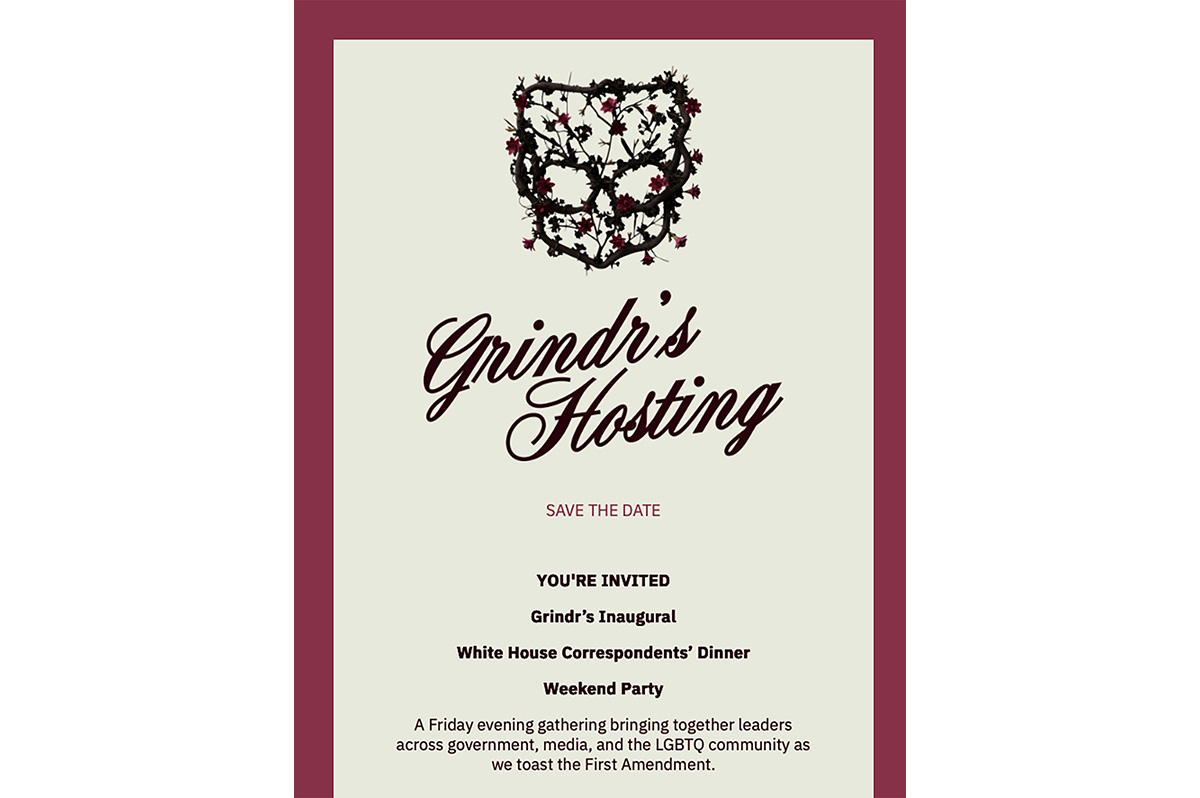
Gay dating and hookup app Grindr will host its first-ever White House Correspondents’ Weekend party on April 24.
The event is scheduled for the night before the White House Correspondents’ Dinner, an annual gathering meant to celebrate the First Amendment, honor journalism, and raise money for scholarships.
The White House Correspondents’ Dinner is organized by the White House Correspondents’ Association, a group of journalists who regularly cover the president and the administration.
An invitation obtained by the Washington Blade’s Joe Reberkenny and Michael K. Lavers reads:
“We’d be thrilled to have you join us at Grindr’s inaugural White House Correspondents’ Dinner Weekend Party, a Friday evening gathering to bring together policymakers, journalists, and LGBTQ community leaders as we toast the First Amendment.”
The Blade requested an interview with Joe Hack, Grindr’s head of global government affairs, but was unable to reach him via phone or Zoom. He did, however, provide a statement shared with other outlets, offering limited explanation for why the company decided 2026 was the year for the app to host this event.
“Grindr represents a global community with real stakes in Washington. The issues being debated here — HIV funding, digital privacy, LGBTQ+ human rights — are daily life for our community. Nobody does connections like Grindr, and WHCD weekend is the most iconic place in the country to make them. We figured it was time to host.”
Hack said the company has been “well received” by lawmakers in both parties and has found “common ground” on issues such as HIV funding and keeping minors off the app. He credited longstanding relationships in Washington and what he described as Grindr’s “respectful” approach to lobbying.
Hack, a longtime Republican-aligned lobbyist, previously worked for several GOP lawmakers, including U.S. Sens. Deb Fischer (R-Neb.), Jon Kyl (R-Ariz.), George Voinovich (R-Ohio), Bill Frist (R-Tenn.), and U.S. Rep. Randy Forbes (R-Va.).
According to congressional disclosure forms compiled by OpenSecrets, Grindr spent $1.3 million on lobbying in 2025— more than Tinder and Hinge’s parent company Match Group.
“This is going to be elevated Grindr,” Hack told TheWrap when describing the invite-only party that has already generated buzz on social media. “This isn’t going to be a bunch of shirtless men walking around. This is going to be very elevated, elegant, but still us.”
He also pointed to the company’s work on HIV-related initiatives, including efforts to maintain federal funding for healthcare partners that distribute HIV self-testing kits through the app.
The event comes at a particularly notable moment for an LGBTQ-focused connection platform to enter the Washington social circuit at a high-profile political weekend, as LGBTQ rights remain under constant attack from conservative lawmakers, particularly around transgender healthcare, sports participation, and public accommodations.

Campaign launched to elect more LGBTQ candidates to ANC seats

Gay librarian to discuss new novel at Green Lantern

Calendar: July 10-16

Gay Fla. Democrat Elijah Manley sees opportunity in Trump’s second term

Ron Singer, owner of popular Mount Vernon gay bar Leon’s, dies

In Trump’s divided America, Michael Weinstein’s AHF responds

Turkish authorities refuse to allow gay cruise to dock in country

When a church fears the rainbow

PHOTOS: Crush Dance Bar