District of Columbia
D.C. police hiring program welcomes LGBTQ recruits
Mayor, MPD chief announce $20K bonus in recruitment effort
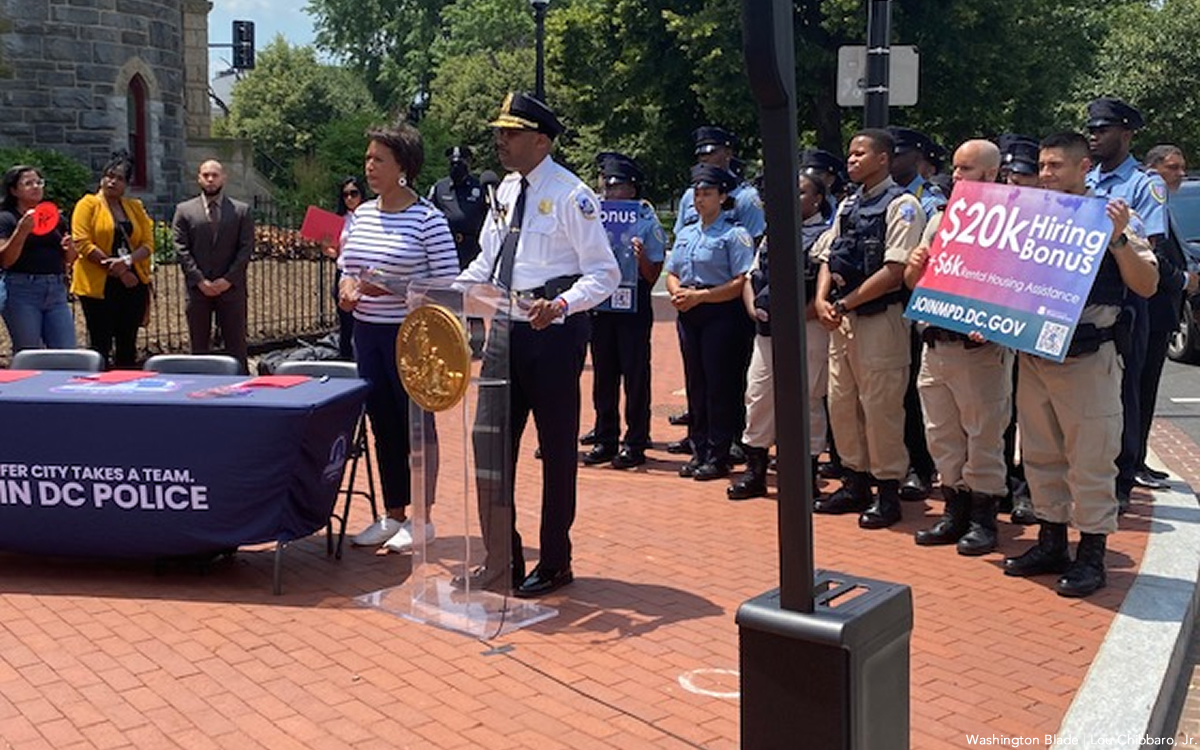
The D.C. Metropolitan Police Department’s LGBT Liaison Unit and the department’s other community liaison units are playing a “huge part” in a stepped-up officer recruitment program and members of the LGBTQ community are encouraged to consider applying to become a D.C. police officer, Police Chief Robert Contee told the Washington Blade.
“We welcome everybody. The LGBTQ community – we welcome everybody,” Contee told the Blade after he and Mayor Muriel Bowser announced a new $20,000 hiring bonus to make MPD more competitive in recruiting new officers during a press conference on Friday, June 17, held just outside Stanton Park on Capitol Hill.
“And this is just a great place to work,” the chief told the Blade. “You can follow us on our Instagram, and you can see how much we embrace the LGBTQ community,” he said. “So, join MPD if you’re interested in a career in law enforcement.”
Bowser said the new $20,000 hiring bonus is part of her Fiscal Year 2023 police budget, which funds an additional 347 new officers and takes effect at the start of the fiscal year on Oct. 1, 2022.
“We know how critical it is to have a fully staffed and resourced MPD, and that requires us to hire strong talent and to retain experienced officers,” Bowser said at the news conference. “These hiring bonuses will help MPD recruit and hire more officers to keep our city safe,” she said.
A statement released by the mayor’s office says the bonus would be paid in two installments, with $10,000 paid at the time a new officer is hired and the remaining $10,000 paid upon the officer’s successful completion of the police academy training program.
“The starting salary at MPD is currently $60,199, which means that with the new bonus, first-year officers will be eligible to earn more than $80,000,” the statement says. It says full details on how to apply to become a D.C. police officer can be accessed at joinmpd.dc.gov.



District of Columbia
Campaign launched to elect more LGBTQ candidates to ANC seats
Capital Stonewall Democrats behind Queering ANCs effort

The Capital Stonewall Democrats, D.C.’s largest local LGBTQ political group, announced on July 7 it has launched a campaign to help elect large numbers of LGBTQ candidates to the city’s Advisory Neighborhood Commissions.
The D.C. local government is believed to be unique among U.S. cities in currently having 46 Advisory Neighborhood Commissions consisting of 345 single-member districts in neighborhoods throughout the city in which unpaid Advisory Neighborhood Commissioners are elected for two-year terms.
The commissions are charged with considering a wide range of policies and programs impacting their neighborhoods, including traffic, parking, recreation, street improvements, liquor licenses, zoning, economic development, police protection, sanitation and trash collection, and D.C.’s annual budget, according to the ANC website.
Although the ANCs do not have authority to set or reject policies or proposals, such as applications for liquor licenses, city agencies are required to give “great weight” to ANC recommendations, according to the law creating the ANCs.
Kent Boese, a gay former ANC commissioner, currently serves as executive director of the D.C. Office of ANCs.
“We are launching the most ambitious hyperlocal LGBTQ+ candidate pipeline initiative in the country,” said Stevie McCarty, the Capital Stonewall Democrats president, in a July 7 statement that announced the Queering ANCs campaign.
“As an ANC member, I know firsthand how these seats shape our neighborhoods, from housing and public safety to sanitation,” McCarty says in the statement. “I’m proud to lead this effort to ensure more LGBTQ+ Washingtonians see themselves as leaders in their communities,” he said.
The ANC Rainbow Caucus, which was created by LGBTQ ANC members, shows on its website that there are currently 38 caucus members consisting of elected LGBTQ ANC commissioners serving in the current 2025-2026 two-year term.
The website shows there are LGBTQ commissioners who are caucus members in each of the city’s eight wards, with six in Ward 1, eight in Ward 2, one in Ward 3, six in Ward 4, five in Ward 5, three in Ward 6, eight in Ward 7, and one in Ward 8.
The Washington Blade couldn’t immediately determine how many of them will be running for re-election in D.C.’s general election in November. But McCarty said Capital Stonewall Democrats hopes to recruit many more LGBTQ candidates to run for ANC seats.
The D.C. Board of Elections website shows the deadline for filing 25 required petition signatures to be placed on the ballot is Aug. 5.
A Queering ANCs website launched this week by Capital Stonewall Democrats provides details on how to run for an ANC seat and offers help for those interested in running.
“Think of someone in your building, neighborhood, friend group, community organization, or professional network who cares deeply about D.C. and would make a strong leader,” McCarty says in his statement. “Send them QueeringANCs.org and personally ask them to consider running,” he said.
The website can be accessed at QueeringANCs.org.
District of Columbia
Mary’s House founder, CEO retires
Dr. Imani Woody played leading role in opening DC’s first home for LGBTQ seniors
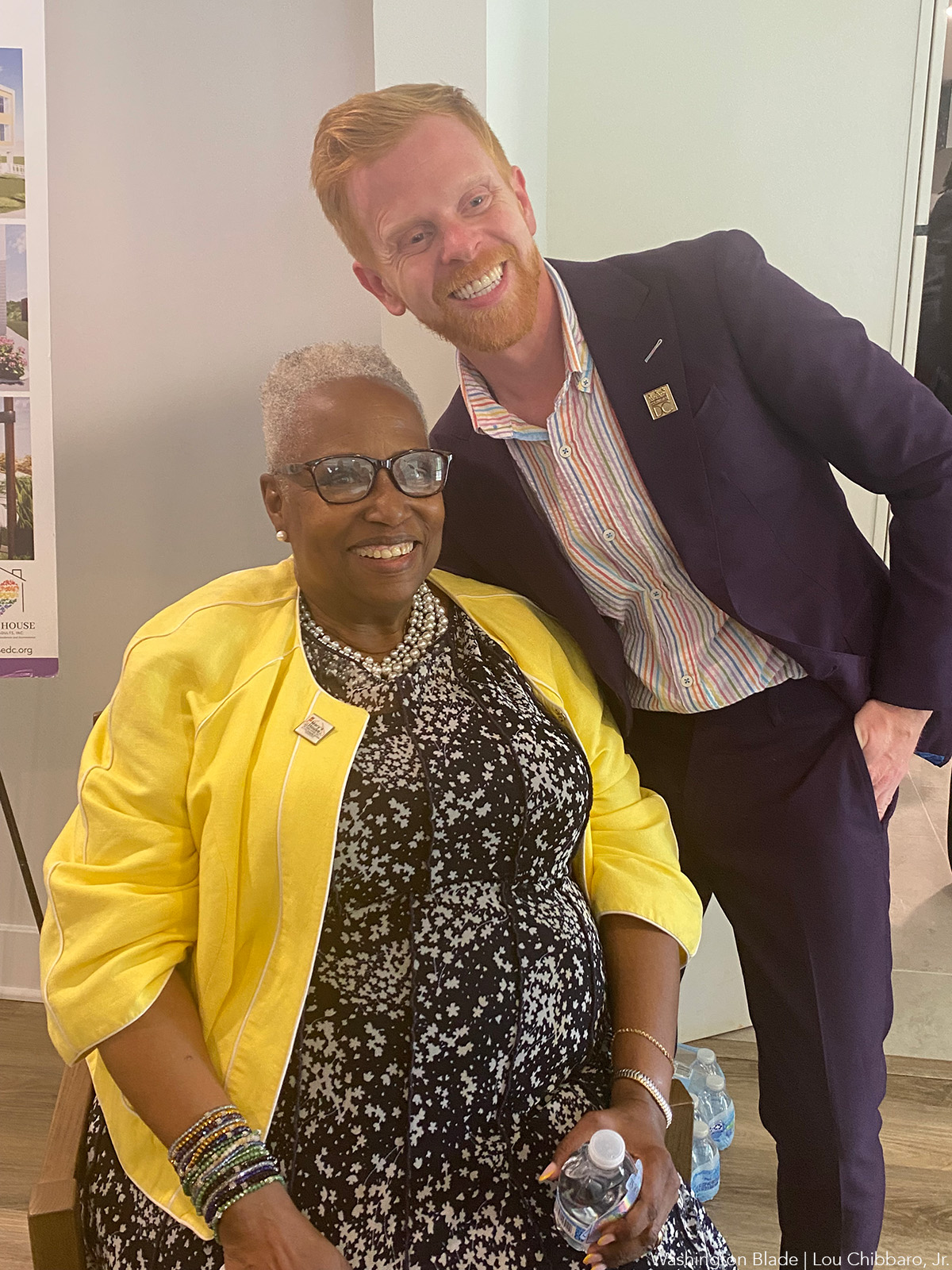
The board of directors for Mary’s House for Older Adults, DC’s first official home dedicated to providing affordable housing for LGBTQ seniors, announced on July 7 that its founding president and CEO, Dr. Imani Woody, has retired.
Woody, who holds a PhD in Human Services, is credited with playing a leading role over many years in arranging both city and private funding needed to construct and operate the Mary’s House three-story building located at 401 Anacostia Road, S.E., in the city’s Fort Dupont neighborhood.
The house, which opened in March 2025, with a grand opening ceremony held in May 2025, includes 15 single-occupancy residential units and more than 5,000 square feet of shared communal living space.
“It is with profound gratitude and hearts full of celebration that the board of directors of Mary’s House for Older Adults, DC (MHFOA) announces the retirement of our visionary founder, Dr. Imani Woody, from her role as president and CEO,” the Mary’s House board says in a statement.
“Dr. Woody’s journey with Mary’s House began with her vision and a kitchen table gathering of women with a bold, urgent, and loving vision: to create safe, affirming, affordable housing for LGBTQ/SGL older adults in Washington, DC,” the statement says.
It adds, “What started as a dream has grown into DC’s first affordable LGBTQ+/SGL affirming communal living space for adults 60 and over, a 15-room community residence at 401 Anacostia Road in Southeast Washington.”
The statement says Woody will continue to serve on Mary’s House board.
“The board will be sharing information about the leadership transition process in the coming weeks,” the statement continues. “We are committed to honoring Dr. Woody’s legacy by ensuring Mary’s House continues to thrive and grow in faithful service to LGBTQ/SGL elders experiencing housing insecurity and isolation.”
District of Columbia
SMYAL receives $25,000 award for ‘courageous acts’
D.C. group provides support services for LGBTQ youth
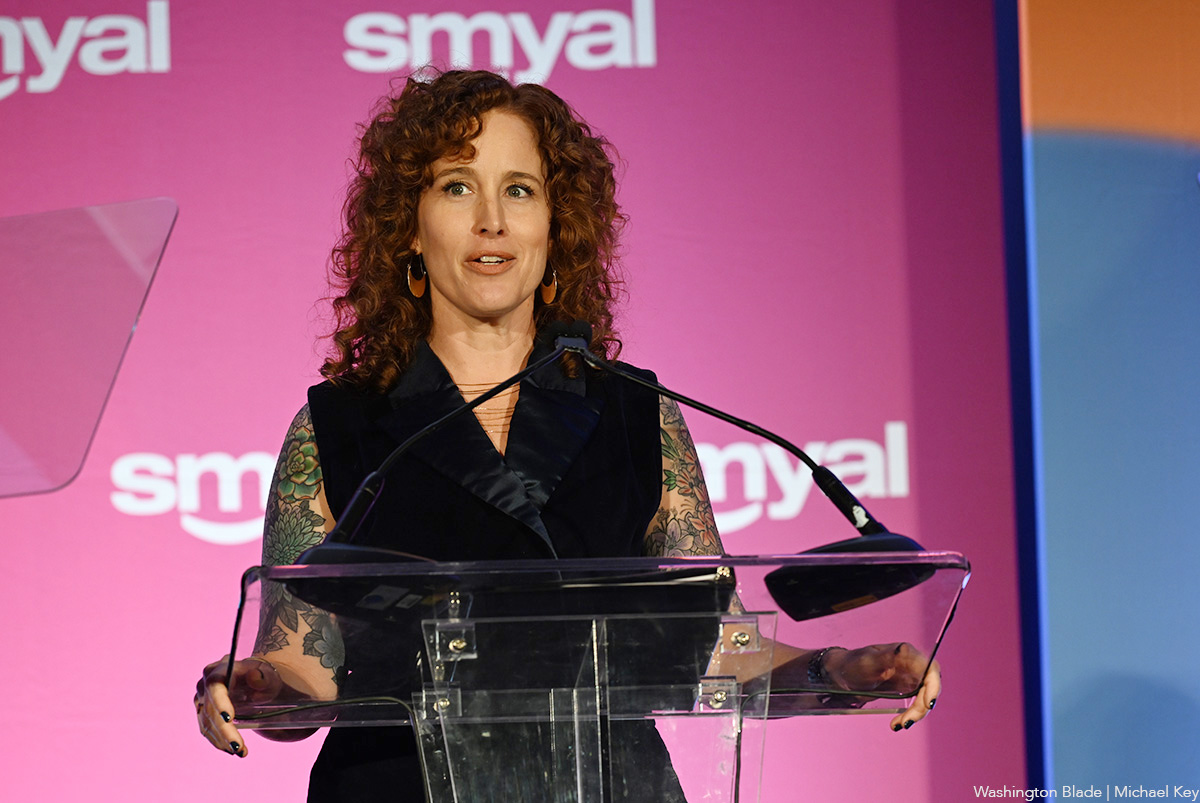
The D.C.-based organization SMYAL, which provides services for LGBTQ youth in the D.C. metro area, including housing for homeless LGBTQ youth, announced on June 30 that it received a $25,000 award for its “courageous acts” in support of the community it serves.
The award was a monetary grant from The Courage Project, which describes itself as a “national initiative investing in acts of courage and compassion that strengthens our communities and democracy.”
A statement on its website says it was launched in May 2025 and is funded and backed by leading national foundations in the U.S.
“At SMYAL, we are deeply grateful to receive support from The Courage Project and are inspired by their bold investment in LGBTQ+ youth at such a critical moment,” SMYAL CEO Erin Whelan said in a statement. “For queer and trans young people, simply showing up as themselves each day requires immense courage, and that courage is strengthened when organizations like The Courage Project stand behind them loudly, proudly, and without hesitation,” Whelan said.
In its statement announcing the award SMYAL says The Courage Project will recognize SMYAL and other awardees and their work on July 3 at the Washington National Cathedral as part of a special interfaith service marking the U.S. 250th anniversary.
“The Courage Project is a bold initiative honoring everyday acts of bravery – the quiet, often unseen acts of heroism that reflect the best of the American spirit and strengthen democracy at the community level,” the project states on its website.

Campaign launched to elect more LGBTQ candidates to ANC seats

Gay librarian to discuss new novel at Green Lantern

Calendar: July 10-16

Gay Fla. Democrat Elijah Manley sees opportunity in Trump’s second term

Ron Singer, owner of popular Mount Vernon gay bar Leon’s, dies

In Trump’s divided America, Michael Weinstein’s AHF responds

Turkish authorities refuse to allow gay cruise to dock in country

When a church fears the rainbow

PHOTOS: Crush Dance Bar