Virginia
Student protesters in Fairfax County call for inclusivity
FCPS youth activists rally, speak to urge implementation of coed Family Life Education classes
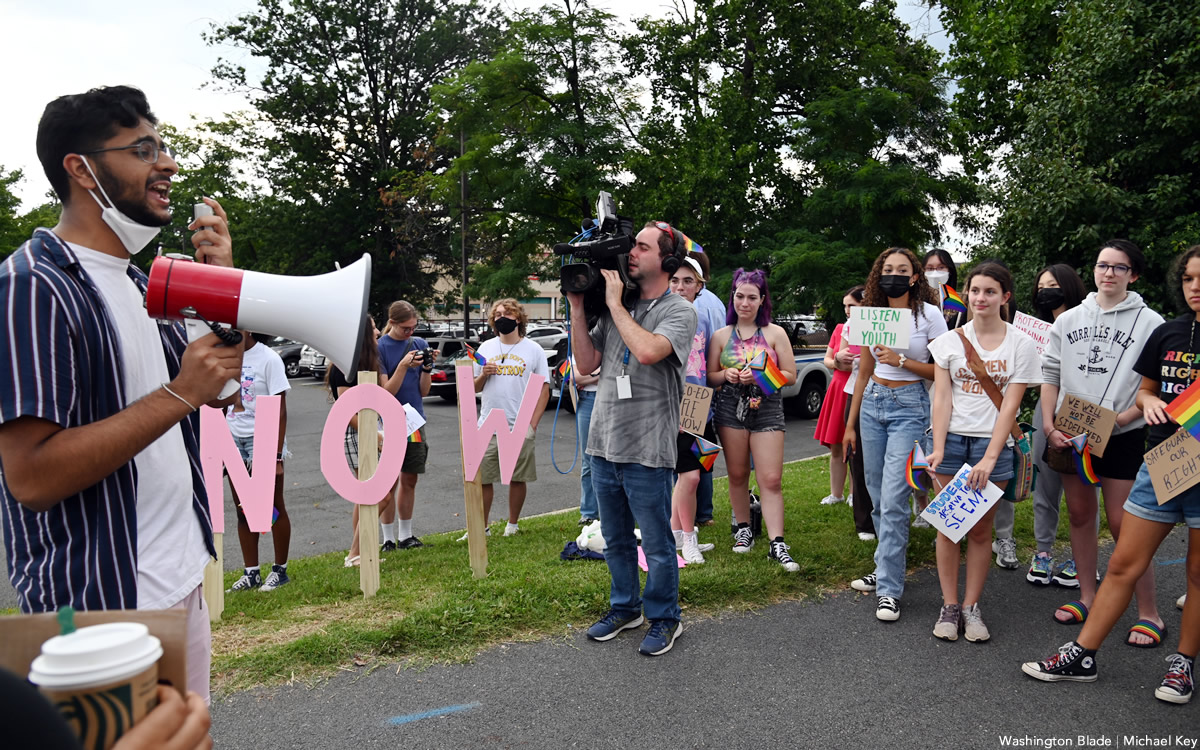
Student activists and community supporters of the Pride Liberation Project rallied outside of Luther Jackson Middle School in Falls Church, Va., on Thursday ahead of a Fairfax County School Board meeting.
A group of about 50 students, teachers, and supporters gathered on the sidewalk along Glebe Road holding signs and chanting to call for the Fairfax County Public Schools (FCPS) to adopt a gender neutral or “coed” Family Life Education (FLE) program for certain subjects in the curriculum. FLE is the sex education program in Fairfax County.
The activists assert that a coed FLE program would be beneficial to students, particularly for transgender and nonbinary students. Activists agreed with the recommendations of the FLE Curriculum Advisory Committee.
The Family Life Education Curriculum Advisory Committee (FLECAC) is comprised of members of the school board, representatives from the student body, representatives from the community and representatives from teachers and administrators in FCPS. FLECAC recommended that certain lessons be coed in its 2021-2022 Recommendations to the School Board report.
However, the Fairfax County School Board opted to postpone a vote on whether to introduce gender neutral FLE classes for certain subjects along with other changes to the curriculum proposed by the advisory committee at a work session in May.
“FLECAC recommended that we create gender neutral FLE unanimously,” Aarayn Rawal, a student activist with the Pride Liberation Project told the crowd. “But this school board will not choose to ratify that. What they chose to do instead is to kick the can down the road because they are too scared of queer children having rights in our school system.”
“We’re trying to ensure that all people are represented in the way they want to be seen in schools: one of the places they spend time the most,” said a student who identified herself as Natasha. “I think that we need coed FLE in order to promote equality and more importantly, equity among all students regardless of their gender, their sexual orientation, their race.”
“Today we’re fighting for the right for people to have bodily autonomy to make their own decisions about their own body,” the student organizer of the protest Rivka Vizcardo-Lichter told the Blade. “But specifically with the school board we’re fighting so that they adopt the FLE reforms that FLECAC has suggested, especially the one to adopt coed FLE into the curriculum. That is, that there is no gender separation within the classes. This is a step toward inclusivity for transgender and nonbinary students but moreover, if this was accepted, it would show that the board is willing to take a step further and — possibly in the future — broaden the FLE curriculum to include queer students. “
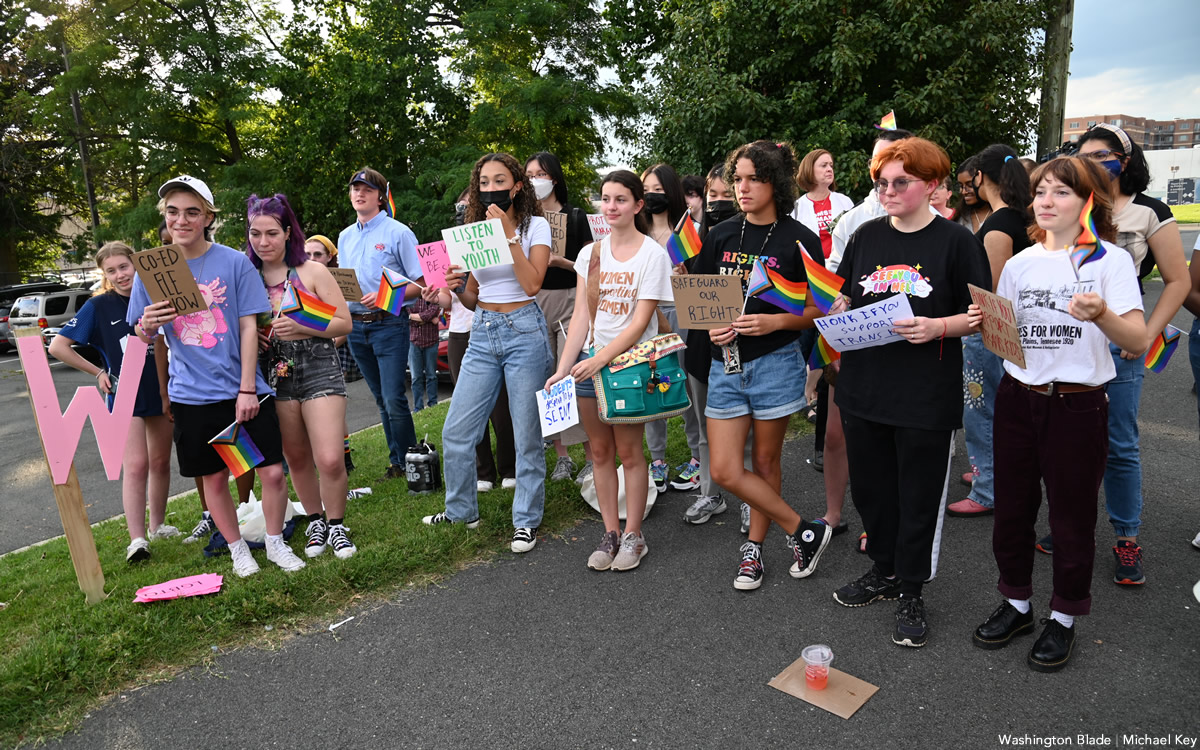
A smaller group of conservative adult demonstrators gathered on the sidewalk outside of the school board meeting. The group stood in front of a “Parents for Youngkin” yard sign and had a public address system with songs such as David Lee Roth’s “Just a Gigolo” blaring out to the assembled crowds: many in the opposing crowd down the sidewalk being underage students. The group held aloft signs calling for the resignation of members of the Fairfax County School Board including gay member Karl Frisch.
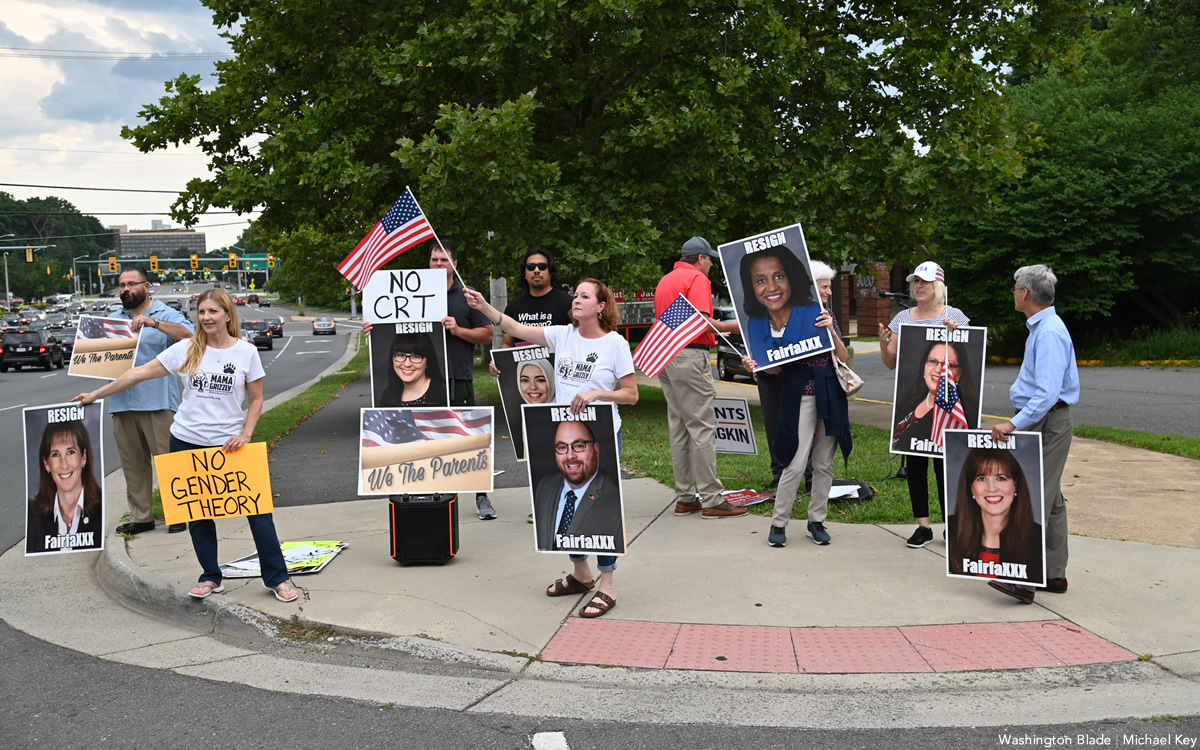
Following the protest outside, members of the Pride Liberation Project, Fairfax NAACP and FCPS Pride as well as adversaries from right-wing groups such as Mama Grizzly entered the auditorium of Luther Jackson Middle School to attend the Fairfax County School Board meeting.
Several speakers at the community participation segment of the meeting spoke in favor of gender neutral Family Life Education.
“The fact remains, queer students are struggling,” rising FCPS senior Inaayah Kahn addressed the board. “We have been struggling. We are fighting for our right to be heard, to be represented, to be able to feel safe. Almost constantly, I have friends who get called slurs regularly, I have friends who keep forgiving casual homophobia because the person just ‘didn’t know better.’ I shouldn’t have to say this, but this shouldn’t be happening.”
“I have sat through countless FLE classes throughout my years in FCPS,” Kahn continued. “We started out by being divided by gender: girls in one room, boys in the other, and there was a distinct lack of discussion of trans, nonbinary, and queer identities.”
“Queer students are not seeing themselves represented in our curriculums,” said Kahn. “Queer students are feeling dysphoric in these classrooms. And queer students need gender neutral FLE desperately.”
“Your FLECAC committee has recommended coed FLE classes, yet they still have not been established,” admonished Kahn. “Trans and non-binary students are living in a world that keeps growing more and more hostile toward their identities. And currently, the board is not helping them.”
FCPS student and organizer of the Pride Liberation Project Vizcardo-Lichter was recognized to speak at the podium. “If you’ve heard of the Pride Liberation Project, you’ve probably heard this statistic about a million times,” Vizcardo-Lichter said. “Fifty percent of students in FCPS are depressed. And, at this point, you are probably tired of hearing it but I’m here to tell you why it is essential that you don’t ignore this.”
Vixcardo-Lichter and other speakers referred to the Fairfax County government survey that found 50 percent of self-identified LGBTQ youth in Fairfax County Public Schools from the Fall semester of 2019 experienced depressive symptoms compared to 26 percent of their heterosexual classmates. Further, the survey found that 32 percent of self-reported LGBTQ students had contemplated suicide compared to 11 percent of their heterosexual peers.
“You have a choice: to continue to exclude queer students from their own FLE classes and further the statistic, or you can take a step toward inclusivity by adopting the reforms suggested by FLECAC,” concluded Vizcardo-Lichter.
“If you implemented the reforms suggested by FLECAC, you’ll be taking a small but meaningful step toward accepting queer students,” rising senior Cathy Le said, addressing the board. “If not, the status quo of hate and fear directed toward the queer community will never change. I hope that the decision to do what’s right is unanimous.”
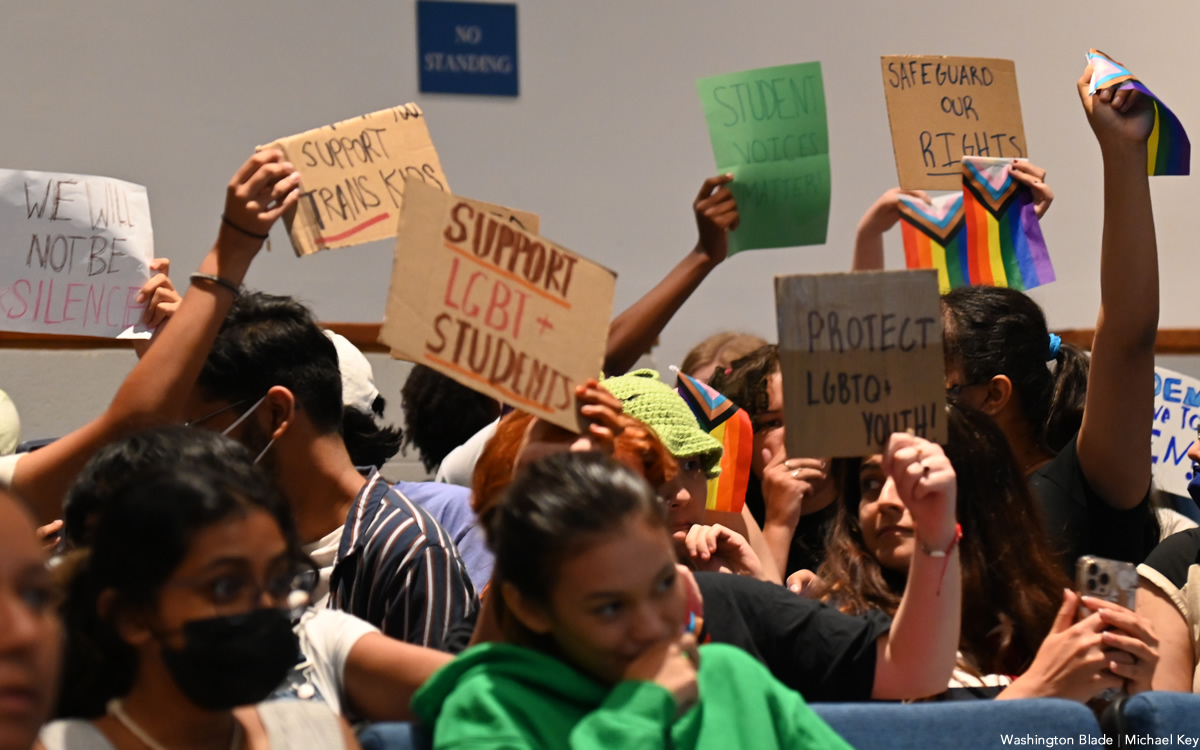
Not all speakers during the community participation segment of the school board meeting were in support of FLE, coed or otherwise.
Kathleen Mallard, wearing a ‘Mama Grizzly’ T-shirt, denounced the Family Life Education program for a number of unsubstantiated claims when she spoke before the school board.
“I was very concerned when my daughter in 12th grade, no 7th grade, was going to learn about beastiality,” Mallard said at the podium. “You know, I didn’t know. Fisting. Whatever. I didn’t know what that was. So anyway, I joined this group.”



Virginia
Campaign urges Virginia High School League to reverse stance on trans athletes
Equality Arlington and other advocacy groups behind ‘Right 2 Play’ VA’ initiative

Virginia advocacy groups have launched a campaign that urges the Virginia High School League to once again allow student athletes to compete on sports teams that correspond with their gender identity.
Equality Arlington on Sept. 16 published an article about the “Right 2 Play VA” campaign. Amy, a group representative, spoke about the initiative with the Washington Blade.
“The primary goal is to reverse the Virginia High School League’s discriminatory ban on allowing transgender girls to play on girls’ sports and replace it with a policy that is fair for all students.” they said.
The Virginia High School League in 2025 announced the policy, which reversed a previous position in support of transgender and nonbinary athletes. The 2025 policy coincided with President Donald Trump’s executive order — “Keeping Men Out of Women’s Sports” — that threatened to “rescind all funds from educational programs that deprive women and girls of fair athletic opportunities, which results in the endangerment, humiliation, and silencing of women and girls.”
The Arlington Gender Identity Alliance, Equality Virginia, and the American Civil Liberties Union of Virginia have also joined the “Right 2 Play VA” campaign.
“We had a policy in Virginia for 12 years that allowed transgender girls to play on girls’ sports teams, and we had not one instance — not one instance — that was brought forward demonstrating an unfair advantage or any type of safety concern,” said Amy.
Amy then discussed what they described are the benefits of trans youth playing sports.
“There are physical benefits. There are mental health benefits. There are community and social development benefits, and those are all well documented,” they said. “All kids should have the right to benefit from playing youth sports. We are talking about kids. We are talking about youth. We are not talking about Olympians. We are not talking about Division One college athletes. We are talking about kids in Virginia, and because the benefits of sports are so well documented, we think that every kid should have the ability to play sports.”
Virginia
Gay Va. couple hopeful voters will enshrine marriage equality in state constitution
Early voting has already begun in the state
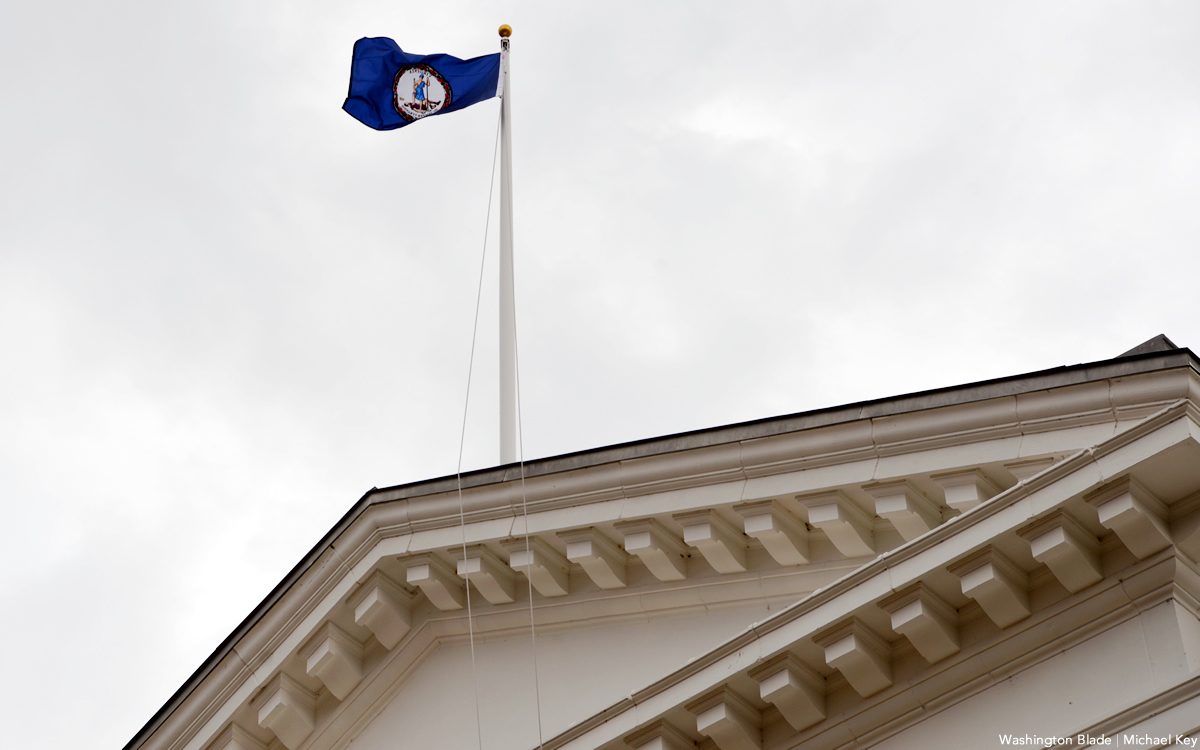
A referendum on whether to enshrine marriage equality in Virginia’s constitutional amendment is on the ballot this year.
If voters approve Question 2, it will codify the U.S. Supreme Court’s Obergefell ruling in 2015 that extended marriage rights to same-sex couples across the country — gays and lesbians have been able to legally marry in Virginia since Oct. 6, 2014.
Ron Bookbinder and James Fisher are a married couple who live in Arlington.
They have been together for 38 years — Bookbinder and Fisher married in 2014.
“We think this is a critical vote to remove this discriminatory language from the constitution and to ensure that going forward, no matter what happens, the state of Virginia will ensure marriage equality,” Fisher told the Washington Blade. “It is it is really difficult and upsetting to think that our current state constitution would prohibit same-sex marriage, even though the federal government overrides that now. There’s no saying what may happen in the future.”
Bookbinder said it was important for him and Fisher to get married “to gain social equality.”
“I was surprised how good it felt, how important it was to begin to say, ‘my husband rather than my partner,'” Bookbinder said.
Bookbinder then explained why it feels good to be married.
“Is it a legal partner, a business partner, a tennis partner, you know, or a romantic partner? But when you say my husband James, everyone knows exactly what you mean and confers an equal status with everyone else who’s married, and we were both surprised at how good it felt and how equal it felt to suddenly be married and be able to state that you were married and discuss your husband rather than your partner, and I would hate to lose that,” he said.
Bookbinder and Fisher said they are hopeful that voters will approve the amendment, noting Virginia has become more progressive over the years.
“I think people have, with the Supreme Court decision, people have seen that a same-sex marriage is just a marriage,” stated Fisher. “It’s just two people who love each other, and I think more and more people have attended a same-sex marriage, someone in their family or a friend, and the experience of what this is, firsthand experience, is so important in shaping people’s opinions, and I think the period of time that we’ve had since the Obergefell decision has given a lot of voters that experience, which I think is really important and powerful.”
The couple also said the push to enshrine marriage equality in Virginia’s constitution is in response to the Trump-Vance administration.
“And I think due to President Trump doing all the horrible things he’s done to so many groups, including LGBTQ, especially trans people, that Virginians are kind of pushed to be even more progressive to protect those who need protection, which would include the LGBTQ community in terms of marriage equality, so I’m confident it will pass,” said Bookbinder.
Narissa Rahaman, executive director of Equality Virginia, sent the Blade a statement about early voting on Question 2 that has already begun.
“With early voting now underway, our focus is making sure every Virginian knows Question 2 is on their ballot,” said Rahaman. “The outdated ban on same-sex marriage still in Virginia’s state constitution leaves a gap in protections for the thousands of same-sex couples that call this state home, but after 20 years we have the chance to fix it.”
Log onto www.mobilize.us/vaformarriage to find out more about the campaign in support of Question 2.
Virginia
Virginia Anti-Violence Project struggles to fill federal funding gaps
Group has lost 54 percent of funding since 2020
A loss of federal funding has threatened to adversely impact the Virginia Anti-Violence Project’s work in the state.
The group’s mission is to assist LGBTQ and BIPOC (Black, Indigenous and people of color) victims of domestic, sexual, interpersonal, and state violence with direct support, education, and advocacy. The VAVP seeks to build a future where LGBTQ and BIPOC individuals can live freely without a sense for worry about violence.
“Virginia Anti-Violence Project helps to close the distance between services existing and LGBTQIA+ survivors actually being able to reach safety, stable housing, and support that they can trust,” VAVP Executive Director Ebony Clark told the Washington Blade on Tuesday. “Our mission is to provide direct services and advocacy to LGBTQ+ survivors across Virginia.”
Clark said obtaining state and federal funds has become increasingly difficult.
“One of the reasons that we can talk about is politics and how you know queer diverse, queer communities are targets when it comes to politics, and so that may be a reason why the funding is decreasing in in very niche areas, but overall, state funding, federal funding has been lost or significantly reduced when it comes to culturally specific marginalized populations,” Clark said. “The bigger picture is that funding that was purposed for diversity, equity, inclusion, marginalized populations, or you know culturally competent programming, those funds have been strategically reduced or eliminated on state and federal levels overall.”
Even more so with the current Trump-Vance administration.
Data shows federal funding for one “major federal victim-services funding stream in” Virginia has dropped 54 percent over the last six years: from $25.1 million in fiscal year 2020 to $11.6 million in fiscal year 2026.
Clark noted some federal funding has been denied due to VAVP’s DEI policies — it has had to “water down” their language. These cuts have forced VAVP to limit housing and economic support, which has resulted in fewer resources for its clients.
The organization has set up a goal for receiving between $250,000-$300,000 a year that would allow it to operate — and focus on client housing.
“Housing is fundamental to safety,” Clark told the Blade. “If you know leaving violence puts someone on the street or forces them back to the person harming them, that means the crisis isn’t over. So there needs to be other prevention strategies and reactive strategies in place to be able to prevent further violence from folks.”
VAVP has set up a link for anyone who is interested in making a donation. It is here.
The VAVP website is also accepting donations.

Essential queer horror classics for Halloween

Solidarity beyond the parade: the actual cost of Pride

Physician: addiction doesn’t always look the way you think it does

Calendar: October 9-15

ICC unseals arrest warrants for Taliban officials accused of persecuting LGBTQ people, women

Alianza para la Inclusión fortalece la defensa de derechos LGBTQ en Centroamérica

The facts about Victory Fund’s investigation and the path forward

In Ga., 2 trans candidates believe voters are ready for them

Bessent says Trump chose him for his qualifications, not his sexuality

‘Some Like It Hot’ a wild ride at renovated Bernard Family Theatre
-

 Central America4 days ago
Alianza para la Inclusión fortalece la defensa de derechos LGBTQ en Centroamérica
-
Opinions4 days ago
The facts about Victory Fund’s investigation and the path forward
-
Georgia4 days ago
In Ga., 2 trans candidates believe voters are ready for them
-
Federal Government4 days ago
Bessent says Trump chose him for his qualifications, not his sexuality