Arts & Entertainment
Wide open spaces
Local gay actor plans ambitious Riverfront performance
‘The Nautical Yards’
April 26-29
The Yards Park, 10 Water Street SE
$30 premium seating; free general admission (lawn/standing)
Force-collision.org

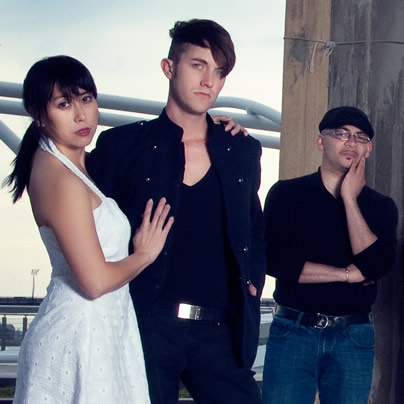
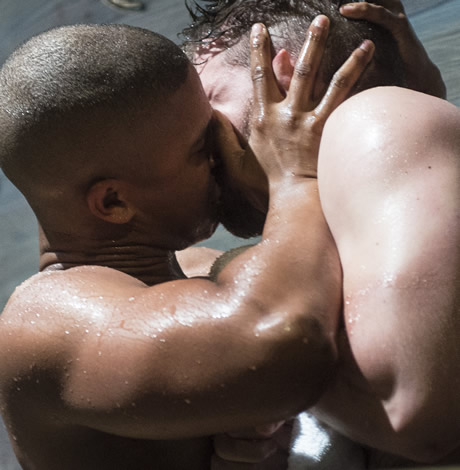
John Moletress, right, and company. (Photo courtesy force/collision)
For its upcoming production, force/collision has shunned details like securing rights to a play or leasing a theater. Instead, the new interdisciplinary company has opted to devise its own material — “The Nautical Yards” — and will premiere it outdoors at the Yards Park in the Capitol Riverfront neighborhood located just south of Capitol Hill.
Inspired by the history and architecture of the adjacent Navy Yard, the hour-long performance blends movement, music and text to tell the story of two lovers separated by war and sea. And because it’s truly site specific, the production calls on its 30-person ensemble cast to make wide use of the open space, including its shallow canal, fountains, ultra-modern bridge and boardwalk.
“While [the performance] does draw on documented accounts of the Navy Yard civilian work force, personal war correspondence and letters and the mythology of water, it’s not a true narrative,” says John Moletress, director and force/collision founder. “I wanted to take all findings and source material and use it to respond to the architecture and the history. It’s a collage and layering of different images, musings and texts.”
Moletress, who’s gay, lives just two blocks from the park. He says when he first moved to the neighborhood four years ago, he instantly saw potential for drama. “The area was much less developed then — a lot of the big old buildings that have since repurposed were standing empty and abandoned. I asked the Capitol Riverfront Business Improvement District about doing a performance in one of the buildings then, but was told it was too dangerous. The structures were in bad shape and there was still a lot of scrap metal lying around from the 1950s.”
More recently, when Moletress approached the District about the Yards Park project, they were much more receptive, expressing eagerness to bring in varying kinds of arts to supplement their summer concert and movies series. Also, the late April performance dates coincide with a new residential building opening in the area as well as more restaurants and retail.
“The Nautical Yards” is the result of ongoing collaboration among director Moletress, composer Daniel Paul Lawson, choreographer Erica Rebollar, dance captain/assistant choreographer Ilana Faye Silverstein, costume designer Collin Ranney and talented force/collision company performers Karin Rosnizeck; Dane Figueroa Edidi, who typically performs by the name Lady Dane; Sue Jin Song; and Ranney, and busy local actor Frank Britton. (About 20 or so additional actors have been cast for the performance.) Britton, who’s bi, is thoroughly enjoying the entire site-specific performance experience. He describes dipping into the fountains as fun but chilly, and hopes for warm evenings during the show’s short run.
This is Moletress’ first foray into directing al fresco. Fortunately he has a loud outside voice, so giving directions to 30 performers in a well-trafficked park hasn’t been a problem. “It’s a wonderful way to engage in the arts and with your community in the outdoors, but it’s not without challenges. Because the process is very open,” he says. “You have to throw your ego out the window. All of your direction is on display. From the start, you’re getting feedback from all the locals who pass by. It’s interesting to see who chooses to be curious and engage and who runs away.”
“We have no rain dates. We’re playing it by ear,” Moletress says. “But if a performance is interrupted by bad weather, we can all wait it out in a nearby lumber shed. There’s room for everyone.”
Theater
New GALA show about WWII spy full of conflict, intrigue
‘GARBO: The Actor Who Saved the World’ an inspired true story
‘Garbo: The Actor Who Saved the World’
Sept. 3-27
GALA Hispanic Theatre
3333 14th St., NW
$25-$50
galatheatre.org
Conflict, intrigue, and abundant imagination – all the elements for an extraordinary story. Add real-life Spanish spy Juan Pujol García who worked as a double agent loyal to the United Kingdom against Nazi Germany during World War II to the mix and it’s truly inspired.
Code-named “Garbo” by the British (a nod to his acting prowess), the anti-fascist’s mission took him from Madrid to Lisbon and later a London suburb where he created fictitious reports while unassumingly blending in with middle-class commuters.
By inventing a phony spy network of 27 agents with intricate backstories and tales of espionage worthy of Balzac’s pen, Garbo convinced Hitler’s generals that the D-Day invasion would hit Calais instead of Normandy, saving thousands of lives along the way.
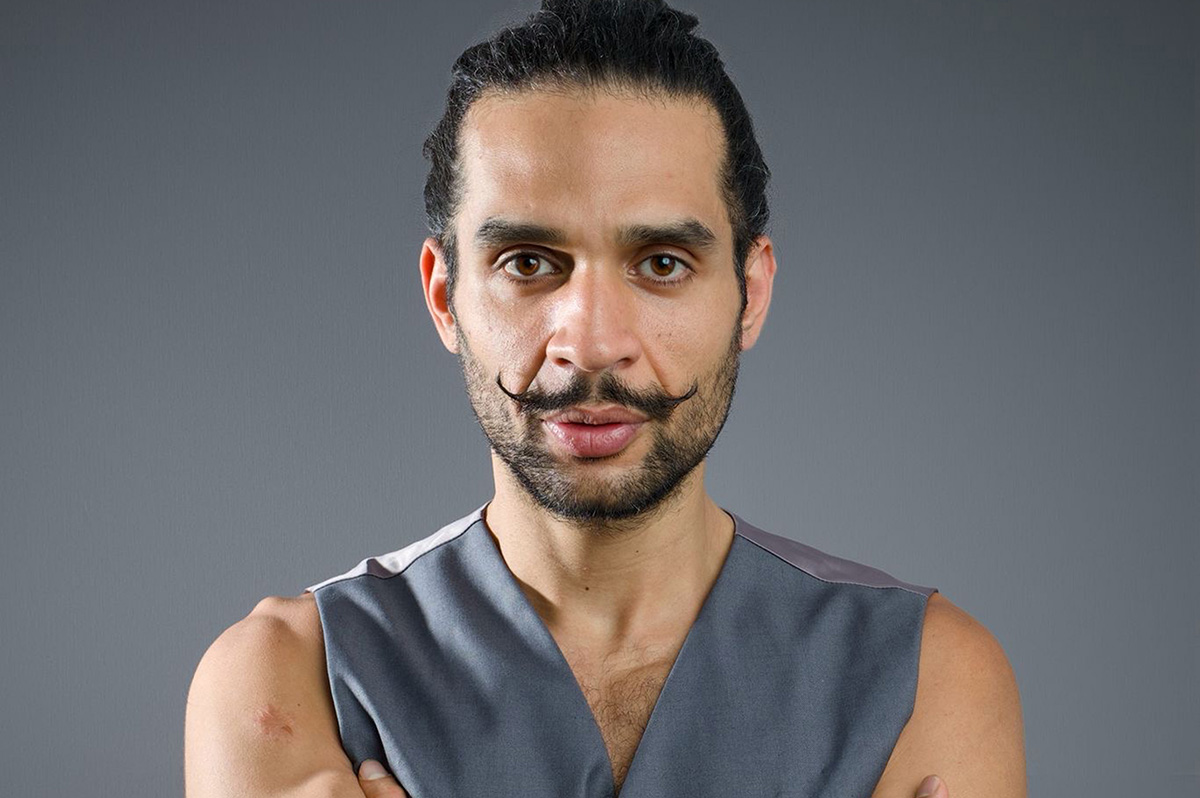
And now the tale unfolds on stage in “GARBO: The Actor Who Saved the World,” a premiere thriller at GALA Hispanic penned by GALA artistic director Gustavo Ott, staged by Cuban director Carlos Celdrán, and starring out actor Kevin Jorges in the title role.
When Jorges was tapped to play Garbo, he (like the rest of the cast) was utterly unfamiliar with the play’s cunning protagonist.
But that changed quickly. Jorges, 37, has immersed himself in the biography and become increasingly interested and somewhat enamored with the character.
Charismatic with an easy smile and rich, warm voice, Jorges says he had to put aside his sensibility as a gay man in order to portray Garbo, who was a straight, patriarchal figure. But he also embraced similarities with the spy, like their shared aversion to physical violence.
And Jorges cites what he finds a pivotal moment: Garbo says to his British MI5 case officer and handler Thomas Harris (played by gay GALA veteran Carlos Castillo) that after what they’ve been through, neither will be what they once wanted to be. They are changed. They’ll never be the same.
Performed at 90 minutes in Spanish with user friendly English surtitles, “Garbo” is about imagination as resistance. “It’s also about a theatrical vocation that went unfulfilled,” says Ott. “That is perhaps the greatest disappointment of modernity: the insurmountable obstacles a vocation faces.
“Through his imagination, Garbo attempts to reclaim his lost calling—that of being an artist—and in his new trade as a spy, he uses it as a lifeline.”
Ott adds, “Walt Whitman viewed imagination as a traveling companion. He could rely on it when he was alone, when he lost hope, and when life slammed every door shut.”
Jorges was was attracted to acting at an early age, but the murder of his father in Caracas in 1999, made it more than an interest, theater became a refuge that saved him from tragedy. Today, he believes that theater is a refuge for many Venezuelan artists, it’s a way for them to contribute to society despite difficult circumstances.
Despite enjoying a successful early career in Caracas with many roles and accolades, Jorges had no choice but to seek new horizons. Political turmoil and economic collapse prompted him to leave Caracas in 2019 for Spain where he worked outside of his profession for a few years.
The actor credits “migrant persistence” for his return to the stage. On New Year’s Eve in 2022, Jorges made a pilgrimage to the famous monument to Cervantes at Plaza de España in Madrid where he made a heartfelt wish to act again.
Soon after, Jorges was collaborating with playwright and director Elio Palencia on “Timón Of(f) Caracas,” a personal one-man adaptation of Shakespeare’s “Timon of Athens, reframing the universal themes of betrayal, excess, and misanthropy to mirror the sociopolitical realities of Venezuela. To much success and acclaim, the production toured important cities throughout Spain.
It was Palencia who suggested to GALA’s Ott that Jorges hop the pond to play Garbo in D.C.
While he once viewed each acting job as an opportunity, Jorges now sees them as gifts. And, he says, the part of Garbo is a gift filled with possibilities: “It’s wonderful performing in Spanish with English translation. I love the interaction of culture. I really enjoy seeing the way things are done at GALA. Maybe sometime I’ll be performing in English too.”
Books
Exploring Renée Richards’s life through lens of a trans author
Surprises await in new book about pioneering tennis star

‘Finding Renée Richards’
By Julie Kliegman
c.2026, HarperOne
$28.99/272 pages
Come on in, the water’s fine.
Wade into it up to your ankles, your calves, your waist, you’ll be OK. You’ll adjust to the waves that swirl around you so come on, dive in, it’s all good. As in the new book “Finding Renée Richards” by Julie Kliegman, that goes for swimming, and for controversy.

Assigned to do a story on books written by trans tennis great Renée Richards, Julie Kleigman read the books and became “transfixed by a woman who had fought so hard to simply live as who she had long known she was….”. Their editor had figured that, as a nonbinary and trans individual, Kleigman would have “something incisive to say…” in an article. Instead, once they met and began interviewing Richards, Kliegman was left frustrated.
Born in the late summer of 1934, Richard Henry Raskind seemed to have arrived with a tennis racket in his hand. His mother was a psychiatrist; his father was an orthopedic surgeon who hoped “Dick” would follow his footsteps but Raskind was drawn instead to ophthalmology and tennis. He was also irresistibly drawn to wearing women’s clothing.
His sister knew of this pull and Raskind eventually came out to both parents, but few others on the tennis circuit were aware. When Raskind visited his hometown of New York City, however, he enjoyed furtively going out in women’s clothing but he also tried to squash the desire; in the meantime, he fell in love, married, fathered a son, and eventually learned that it was possible to become the woman he knew he really was.
To continue playing tennis professionally was a bonus.
And right there were the disagreements Kleigman had with Richards.
Richards, “To this day… [makes] a point of describing herself as a woman, period,” says Kleigman, but she firmly acknowledged Richard, almost as a separate individual, insisting that Kleigman use “him/his” pronouns when describing her earlier life.
And as for tennis and trans women’s participation in the sport, Richards had something even more frustrating to say.
Take that as a fair warning: you might be equally surprised at what author Julie Kliegman uncovered in “Finding Renée Richards,” and you may be truly gobsmacked by reading opinions from other women about the topic of trans women in sports.
That’s the main, huge point of interest in this fascinating book; the other is Richards’s life as seen through the lens of a trans individual. Kleigman’s wrestling with the 90-year-old Richards’ firmly dug-in heels is, in itself, worth your time as a study of highly varying viewpoints. That Kleigman and Richards have both lived at least a part of trans history is somewhat of a key to understanding how this book unfolds, as Kleigman offers up Richards’s tale. Readers who are able to read between the lines will be riveted.
If you’re a sports fan and you have opinions, you must read this book – and that goes double if it’s tennis you love. Also check out “Finding Renée Richards” if you just want a raucously good and very fine read.
The Blade may receive commissions from qualifying purchases made via this post.
Movies
Queer team brings girl power to fully baked ‘The Wrong Girls’
Perfect film for anyone who loves stoner comedies
Generally speaking, the “Stoner Comedy” genre is aimed at an audience of “stoners,” and if you’re not one, you probably don’t get the appeal.
If you are, though, you’re likely to enjoy “The Wrong Girls,” the new indie from screenwriter Dylan Meyer in her directorial debut, which began a theatrical release on Aug. 14. The plot is ridiculous, the humor is lowbrow, and you won’t find any substance in it except for the ones that get consumed onscreen – but that’s exactly the reason why it’s pretty much perfect for anybody who loves stoner comedies, and the fact that everyone involved commits to it whole-heartedly might just makes it all the more so.
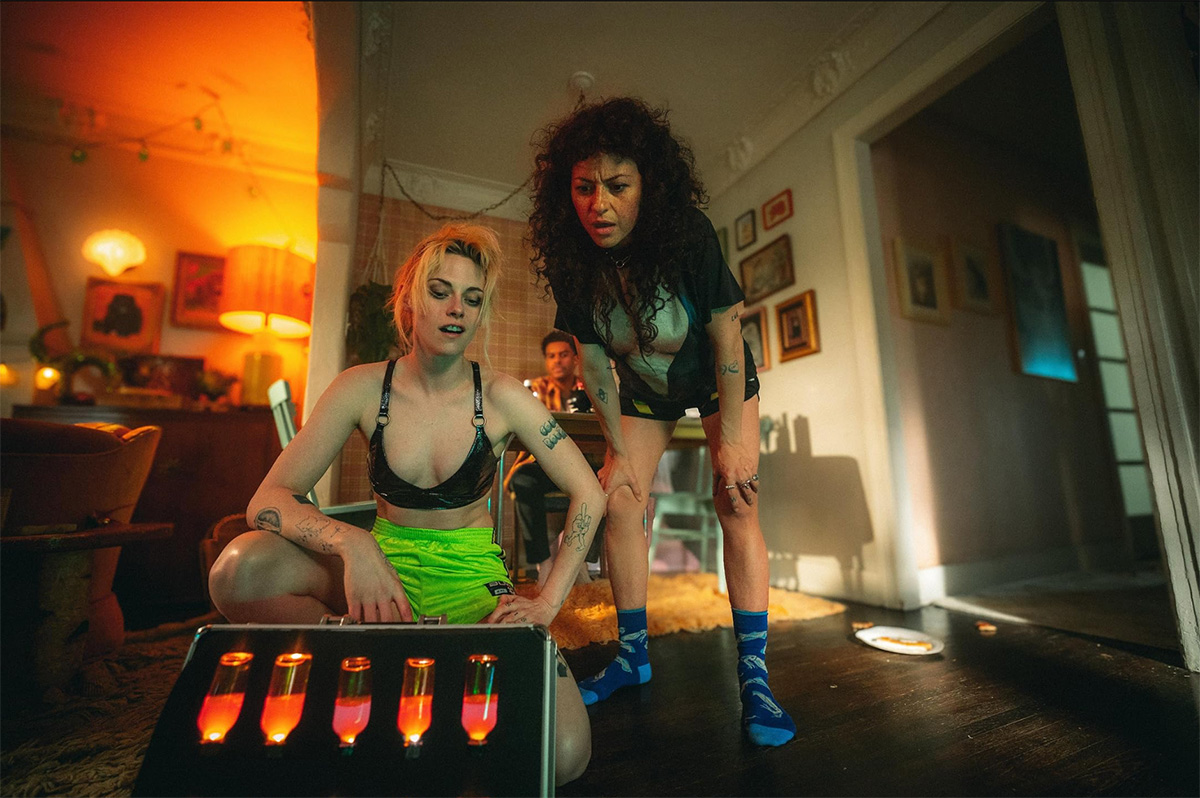
Starring Kristen Stewart (Meyer’s real-life spouse) opposite Alia Shawkat as a pair of broke, directionless best friends who share an L.A. apartment and spend an impressive amount of effort finding new and elaborate ways of consuming cannabis, it opens with them facing a financial crisis; Frankie (Stewart) is thousands of dollars in debt for a scholarship to Stanford – even though she failed out before graduating – and Molly (Shawkat), who dreams of being a professional chef, channels her creative cooking skills into creating off-the-wall recipes for cannabis-infused snacks. To make matters worse, rent is due, and – as usual – they are short.
Their situation gets a sudden surprise windfall when Frankie (through a freak case of mistaken identity) ends up in possession of a briefcase full of a mysterious liquid they assume is some kind of drug. Thinking they can sell it for rent money, they decide to try it for themselves, first, resulting in a pink-and-bubbly hallucinogenic experience in which they can hear each other’s thoughts (and their cats’ thoughts, too) – an effect that lingers even after the “trip” subsides.
Their plan to sell the substance hits a snag, however, when a cadre of gun-toting Euro-thugs in dark suits show up on the scene trying to get their hands on it. Forced to go on the run, they eventually learn that the substance they took is a top-secret experimental drug, developed by a scientist (Kate McKinnon) researching human consciousness – and that the Europeans work for a dangerous rival who wants the formula for his own nefarious purposes. Can two 20-something stoners successfully elude and overcome a team of international mercenaries on a mission? Probably not, but the superpowers they seem to be developing might improve their chances – if they can figure out how to use them, that is.
Cut from the same cloth as every weed-centric movie farce you’ve ever seen, “The Wrong Girls” leans into most of the genre’s usual formula points, first and foremost of which is that it doubles as a buddy comedy. From Cheech and Chong, through Jay and Silent Bob, to Harold and Kumar, these films have always relied on the goofy chemistry between two friends, and Mayer (who wrote as well as directed) makes a special point of following that blueprint – because it’s also where her film sets itself apart from most of the other examples within a traditionally male-dominated genre by making the buddies female instead.
It’s a simple switch, and it really doesn’t have any significant impact on the general “vibe” of the story; the dynamic is more or less the same familiar back-and-forth banter between two people who have spent years getting high together, and their antics are just as stupid. Even so, in another way, flipping the usual gender of its protagonists makes an essential difference, simply because we’re so accustomed to seeing it the other way around – but women also like to get high, so why shouldn’t we see them doing it in the movies? After all, the now-legendary Comedy Central series “Broad City” (to which “The Wrong Girls” also owes a debt of inspiration) brought a pair of stoner chicks to TV over a decade ago with the epic pairing of Ilana Glazer and Abbi Jacobson, so it’s high time (if you’ll pardon the pun) we see the same on our big screens, too.
There are other twists that spruce up the formula too – a boyfriend (Zack Fox) who sparks girl buddy jealousy by asking Molly to move in with him; the crashing of a party thrown by a corporate douchebag (Tony Hale) who provides a great target for the anti-establishment satire that’s almost obligatory for the genre; and a plot thread about giant squid biochemistry that adds an air of comedic mysticism while tapping into the “cephalopod awareness” trend that has wriggled its way into our cultural discourse around ethical seafood consumption. All of it is written and executed with a cleverness that makes it easy to laugh at all the “dumb” comedy without it feeling too much like a guilty pleasure.
Steward and Shawkat, needless to say, carry the film; they find just the right blend of authentic friendship and “train wreck” energy to make their relationship both wacky and relatable. LaKeith Stanfield brings an admirable seriousness to his role as the guy who delivers the briefcase to the wrong person before becoming a comic foil and ending up a reluctant ally; stoner movie veterans Seth Rogan and Kumail Nanjiani amusingly lend their voices to the girls’ two cats; but it’s McKinnon who raises the bar, entering the story late in the game to become the hands-down MVP in a comedy that is only improved by her proven gift for stealing every scene she’s in. It’s also worth noting that Geena Davis turns up for a memorable appearance that feels like a nod to that grandmother of all girl-buddy films, “Thelma and Louise.”
What gives “The Wrong Girls” an extra appeal for queer stoners (and we know there are a lot of you) is that it features two queer stars in a queer-written-and-directed comedy that also features several other prominent queer (or queer adjacent) cast members, despite not having any specifically queer story elements. Maybe it’s the camp sensibility, or the obvious lampooning of overtly toxic heterosexual “types,” or just a general feeling of irreverence and a sharply counter-cultural edge – but somehow, the whole thing comes across as an expression of queer perspective that manages to run circles around the banality that might otherwise easily have turned the movie into an unfunny slog through a territory we’ve all seen plenty of times before.
All that said, it’s important to return to the original point that stoner movies are not necessarily meant for everyone – and fresh as it might feel, “The Wrong Girls” is definitely a stoner movie. There’s a lot of humor (and we mean A LOT) that will fall flat for those who don’t “get it,” and a considerable amount of absurdity and excess which will probably only frustrate viewers without a natural taste for it. Like even the best of the genre, it’s not intended to be deep, or even coherent – it’s all just for the sake of mindless, feel-good fun for those with a taste for it. So be warned by that caveat if you think it applies to you – otherwise, we suggest you grab a pack of edibles and jump on board for the ride.

Gay-owned pizzeria in Dupont Circle burglarized

Advocates honored at Engendered Spirit Awards

Two awesome, affordable rides

Proposed Indian foreign funding law overhaul could further pressure LGBTQ groups

Why we need to protect ‘sacrilegious’ art

I respect AOC, even though I often disagree with her

Black Educated Lesbians: A movement rooted in community

Chicago’s LGBTQ+ youth: Why their zip code still matters

Hegseth uses transphobic slur while campaigning for Iowa congressman

NYC lawmakers seek to repeal bathhouse ban
-

 Opinions4 days ago
I respect AOC, even though I often disagree with her
-
Opinions4 days ago
Black Educated Lesbians: A movement rooted in community
-
Illinois4 days ago
Chicago’s LGBTQ+ youth: Why their zip code still matters
-
U.S. Military/Pentagon4 days ago
Hegseth uses transphobic slur while campaigning for Iowa congressman