Living
HOME & GARDEN SPRING 2018: Home makeovers
Think about expanding your living space with these projects

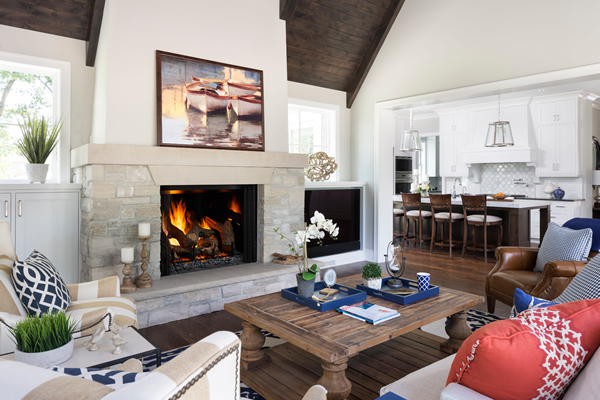
Major renovation projects can feel daunting at the outset but consider the longterm cost/benefit analysis before you decide. (Photo by Steve Herder; Herder Photography via StatePoint)
(StatePoint) — Building a new home? Overhauling an existing one? Here are three renovation ideas that will add beauty and value.
Expand your living space
Don’t let that basement sit unfinished and unused. Substantially expand your home’s livable areas by turning your attention to the bottom floor. Finishing a basement is an involved project, potentially requiring electrical and plumbing work, insulation, drywall and more, but the end result is worth the effort and expense. And some of the less technical aspects of this renovation could even be DIY-ed.
Before getting started, consider what type of space would most benefit your household long-term. You may even be able to recoup some cost of the investment. For example, turning your basement into an at-home fitness center means ditching the costly gym membership. Want to reduce time and money on your commute? Your basement may just make an ideal home office.
Add a focal point
Is your interior design in need of a little something? The right eye-catching elements can make a room pop while adding vitality to your living spaces. A fireplace, for example, adds ambiance and comfort while also creating a natural gathering space.
New models pair the charm of a traditional open-front fireplace with the design flexibility of gas models. The Phoenix TrueView from Heat & Glo offers the convenience of gas without the glass, giving homeowners an unobscured view of the flames against the traditional brick or fade-resistant reflective black glass liner. An optional Bluetooth speaker system allows one to hear the fire as well as see it, making it a focal point for the ears as well as the eyes.
Boost the backyard
If you find that your household spends very little time in the backyard, figure out why. Is there a lack of shade? Are there not enough places to sit? Take a poll so you can diagnose the problem and take steps to correct it. Consider also how to make this space usable for a larger portion of the year, such as adding a fire pit or an enclosed, heated patio. Also consider aesthetics. A bit of landscaping can make your backyard as visually appealing as your home’s interiors.
This season, consider the renovations that will go furthest to boost your home’s livability, beauty and value.


Real Estate
Under-the-radar Delaware beach towns smart buyers are targeting
There are other options if Rehoboth prices are scaring you off

Look, we love Rehoboth. We will always love Rehoboth. Queer folks have been flocking there since the 1940s, and with scores of LGBTQ-owned businesses and a Pride calendar packed tighter than the boardwalk in July, “Rehomo” earned its crown fair and square.
But let’s be honest with each other: trying to buy property there right now feels a lot like trying to get a reservation at the one good restaurant in town on a Saturday in August. Everyone wants in, inventory is tighter than your swim trunks after Labor Day brunch, and the prices have officially entered “are you kidding me” territory.
So here’s a thought: What if you didn’t fight the crowd? What if, instead, you let Rehoboth keep doing its glorious, chaotic, glitter-bomb thing and you quietly built your beach life 15 minutes away for considerably less drama and considerably more square footage? Here are four towns ready for their close-up.
Lewes: The Charming Overachiever
Lewes is what happens when a beach town actually has its life together. Historic charm, walkability, proximity to Cape Henlopen State Park, less crowding, and a strong year-round community. Unlike towns that turn into ghost towns after Labor Day, Lewes maintains a real community all year long, which is more than we can say for some situationships.
And right now, the market is practically begging you to make a move. It’s one of the most desirable and stable markets in the county — built for buyers thinking long-term, not flippers, and Sussex County overall has flipped into genuine buyer’s market territory for the first time in years. Translation: you finally get to be the one with leverage.
Bethany Beach: My Personal Pick
Full disclosure: I own in Bethany. So consider this section a little biased — and also the most honest thing I’ll tell you in this whole article.
When I drive down from D.C., I’m not looking for more of D.C. I love this city, but I also love leaving it — and yes, some of the people in it too (you know who you are, and so do I). Bethany gives me that full exhale. It’s quiet in the way that actually means something: fewer crowds, slower mornings, a soundtrack that’s mostly waves instead of nightlife. It leans hard into its “quiet resort” reputation, with low property taxes and a limited geographic footprint, and it is not the least bit sorry about it.
But quiet doesn’t mean isolated. I’ve got a genuinely excellent food scene nearby, real shopping, and a string of charming neighboring beach towns — and when I do want a taste of Rehoboth’s energy, it’s a short, easy drive away. I get to choose my dose of chaos instead of living inside it.
And here’s the part that matters most for this article: the price. If you’ve looked at Rehoboth listings and quietly closed the tab in despair, I need you to hear this — you can absolutely afford a beach house. It just doesn’t have to be in Rehoboth. Bethany’s average home value sits around $848,592, which is still real money, no question — but it buys you more house, more land, and more peace than the same budget gets you closer to the boardwalk. Bethany is welcoming too, just without Rehoboth’s decades of built-in queer institutional history — and for plenty of us, that trade-off is more than worth it.
Fenwick Island: Small Town, Big Flex
Fenwick rarely gets mentioned and, frankly, it should be insulted. It’s tiny, it’s quiet, and it has beach access without the carnival energy. The market data tends to lump it in with Bethany, where single-family oceanfront homes clear $1 million while entry-level condos start in the $600s — proof that “under-the-radar” doesn’t mean “bargain bin,” it means “fewer people fighting you for it.”
South Bethany: For the Boat Gays
Some of us want sand between our toes. Others want a private dock and a boat named something deeply unserious. South Bethany’s canal communities are built for the latter — water access on both sides, fewer crowds, and a lifestyle that says, “I have a captain’s hat and I am not afraid to wear it.”
The Math Works in Your Favor Now
Here’s the part that should really get your attention: Sussex County’s median sold price has dropped to $440,000, down 3.3% year-over-year, and buyers are routinely closing around 88 cents on the dollar compared to asking price. That’s a far cry from the unhinged bidding wars of 2021 and 2022, when overpaying was basically a competitive sport. Inventory across the county sits at nearly 2,500 active listings — the most of any county in Delaware, meaning you actually get to be picky for once. Revolutionary, we know.
And no, choosing one of these towns doesn’t mean leaving your people behind. Sussex Pride serves the entire county, not just Rehoboth proper, and CAMP Rehoboth’s resources extend well beyond town limits too. You’re not exiling yourself to the suburbs of queerness — you’re just getting a bigger kitchen, a quieter porch, and a much shorter line for the bathroom.
Add in the fact that Delaware has no estate tax and some of the lowest property taxes around, savings that genuinely add up over a retirement horizon, and the case writes itself. Rehoboth will always be the beating, sequined heart of queer beach culture in Delaware. But if you’ve been telling yourself a beach house isn’t in the cards — I’m here to tell you it absolutely is. It just might be 15 minutes south, with your own quiet porch, your own salt air, and considerably more room to breathe.
Have a real estate question or Rehoboth market tip? Reach out to [email protected] for LGBTQ-friendly real estate resources in the Rehoboth area.
Justin Noble is a Realtor licensed in D.C., Maryland, and Delaware with Monument Sotheby’s International Realty. Reach him at [email protected] or 302-897-7499.
Real Estate
‘Culture eats strategy for breakfast’
Real estate agents must adapt, learn how to manage from within

“Culture Eats Strategy for Breakfast” was a phrase often repeated in many of my management courses from the University of Illinois. The concept was discussed at length – how the best laid plans can sometimes be supported or derailed by the culture of the people involved in whichever project to be implemented. Whether it be a project to implement new software, roll out a new product or service, or just reaching a sales target, the way the team involved works together can indeed affect the outcome.
Perhaps this is just another way to say, “teamwork makes the dream work!” Most teams usually have someone who is designated as a leader. The leader can try to lead through authority and control or can alternatively try to lead through influence and encouraging a more collective framework for solving problems.
Why does this matter when picking the right real estate agent or team to work with? Besides having a job as a salesperson for the brokerage, the real estate agent is contractually bound to act on their client’s behalf. The buyer broker agreement is in place so that the agent and the client can work together as a team in communications regarding offer strategy, during negotiations, implementing marketing plans, as well as selecting which renovations or upgrades to choose before selling a property. After the property goes under contract, the job isn’t “done”. There is still work to do.
At this point, the agents then turn into a project manager of sorts – coordinating communications between the lending team, the title attorneys, the other client’s agents, any governmental agencies that could be involved in down payment assistance or helping to clear a property for a sale, and often times groups like a condo board, a home inspector, or contractors when arranging repairs and estimates before a final walk through.
In short, the agent takes on somewhat of a “leadership role” in the transaction and ensures that all the ducks stay in a row until the project is complete. That agent will hopefully be very fluid and forthcoming with their information, copying the required parties on all communications and creating a “paper trail” of who said what or didn’t offer to fix A, B, or C, so that all the minutiae of the contract can be addressed and fulfilled before the settlement date. The agent often must wear many hats and quickly learn the communication styles of an entire new set of people in a short period. One person may not return calls for a week after being contacted. Another person may go on vacation at the beginning of the process and not return emails for two weeks. Another person may wish to have daily updates of the progress of the process.
In this way – an agent quickly learns in each transaction that “culture can eat strategy for breakfast.” Because the agent must adapt to a wide variety of communication styles, learn how to “manage from within”, build support for closing the project by the due date, and somehow keep all the interested parties invested, engaged, and responsive.
Who you work with matters when picking the right person to represent you in your next transaction – so, just remember that “teamwork makes the dream work!”
Joseph Hudson is a referral agent with RLAH. Reach him at 703-587-0597 or [email protected].

Dear Michael,
I’ve been dating Mark for three years, living together for two, and I’m not sure he’s for me. We get along great but I’m questioning how attracted I am to him.
I was never crazy about him physically but he was such a sweet and smart guy that I wanted to date him.
Sex was never mind-blowing and the longer we’ve been together the more this is bothering me. I wonder if I could find someone who appeals to me more, physically.
On the plus side, I like him a lot. He has good values, shares my religious faith, which is hard to find in another gay guy, is responsible and has a good work ethic. Also, I just have fun with him and he’s always interested to hear what’s on my mind. He’s an all-around decent guy.
As I’m writing this, I’m thinking that he seems great and that I’m a fool for even questioning our relationship. But all my friends are always talking about the amazing sex they are having, and then I think I’m missing out on a key part of life because my sex life is comparatively lackluster.
I don’t want to settle. But how likely am I to find another guy who is as all-around a good catch as Mark, but with more sexual chemistry?
Michael replies:
I don’t think the right approach is to wonder about your chances for of finding someone better. Anyone you find will have things you aren’t crazy about.
For example, you might find someone whom you’re wildly attracted to sexually, but they’ll bore you or annoy you, or have values you don’t respect.
I understand that you aren’t wildly sexually attracted to Mark. The truth is that it’s extremely unlikely that you would remain wildly sexually attracted to anyone for that long. People tend to get used to each other over time. Sex can remain great, but more from closeness and love than heat and sizzle.
I work with people all the time who wonder if there is someone “better” out there. And I tell them, they’re never going to get through all the possibilities before they die. Instead, how about thinking if the guy you are with is someone you’d like to go with on this journey through life?
Mark’s attributes that you mention sound wonderful to me. After more than 30 years working with folks on relationships, and being in my own 30+ year relationship, I have learned a thing or two about what creates a relationship that is satisfying and good. A decent, kind guy with admirable values is an excellent start.
The question is, can you live with your sex life not being on an orgasmically hot mind-blowing level? I hope the answer is yes, because sex with anyone you pick is not likely to stay in that sort of realm for long.
Another point to consider: I don’t think you should get too caught up in what your friends are telling you. They may be having amazing sex, but are they all having it with the same long-term partner? As I mentioned, long-term sex can be great, but the excitement tends to be replaced by caring connection over time.
I’ll generalize here for a moment: Because so many gay men have many sexual partners, the kind of sex you have with someone new, whom you’re tremendously attracted to, tends to be glorified among gay men as the gold standard of sex. But it’s not realistic for sex with a long-term partner.
This glorification is a big problem: It leaves gay men who are not having torrid sex with lots of guys feeling like there is something wrong with the sex they are having, that they are missing out on something super fantastic. Just like you are feeling.
If you want a lifetime of ongoing hot sex, I don’t think you should be looking for a relationship. If you are willing to accept sex being a not-always fantastic, but perhaps consistently loving, often good, and occasionally great part of life with a kind decent guy, then Mark might just be the right partner for you after all.
(Michael Radkowsky, Psy.D. is a licensed psychologist who works with couples and individuals in D.C., Maryland, Virginia, New York, and all PSYPACT states. He can be found at michaelradkowsky.com. All identifying information has been changed for reasons of confidentiality. Have a question? Send it to [email protected].)

Ron Singer, owner of popular Mount Vernon gay bar Leon’s, dies

Egyptian authorities refuse to allow gay cruise to dock in country

‘She’s the He’ brings gender-bending twist to teen comedy genre

Supreme Court ruling on trans athletes is a public health story

Queer media dominates 2026 Emmy nominations

‘My Favorite Sociopath’ debuts at Shepherdstown’s CATF

Under-the-radar Delaware beach towns smart buyers are targeting

In Trump’s divided America, Michael Weinstein’s AHF responds

Turkish authorities refuse to allow gay cruise to dock in country

When a church fears the rainbow
-

 Theater4 days ago
‘My Favorite Sociopath’ debuts at Shepherdstown’s CATF
-
Real Estate4 days ago
Under-the-radar Delaware beach towns smart buyers are targeting
-
Politics4 days ago
In Trump’s divided America, Michael Weinstein’s AHF responds
-
Turkey3 days ago
Turkish authorities refuse to allow gay cruise to dock in country