Connect with us

World

Cuban president meets with LGBTQ activists

Havana gathering took place months after anti-government protests
Published

on

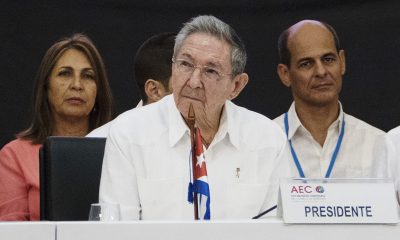
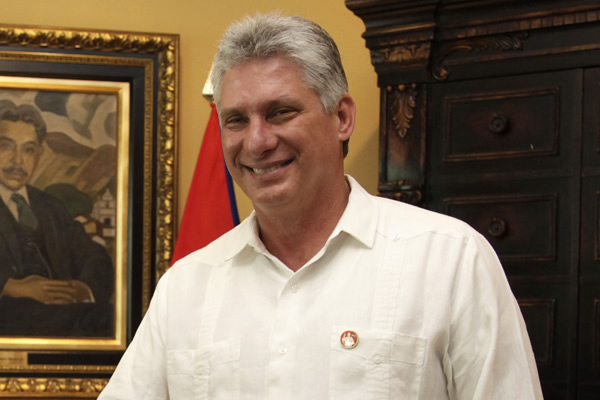
Cuban President Miguel Díaz-Canel (Photo public domain)

Cuban President Miguel Díaz-Canel on Friday met with more than a dozen LGBTQ activists.

Tremenda Nota, the Washington Blade’s media partner in Cuba, reported the meeting took place at Havana’s Palace of the Revolution. Francisco Rodríguez Cruz, a gay man living with HIV who writes under the pen name Paquito el de Cuba, and Malú Cano, coordinator of Transcuba, a transgender organization that is affiliated with the National Center for Sexual Education (CENESEX), are among those who participated.

“I see it as a political will to advance the recognition of the rights of LGBTIQ+ people, an outstanding debt that the revolution has always had with us,” Cano told Tremenda Nota.

The Cuban government tweeted pictures of of the meeting. Rodríguez in a blog post notes CENESEX Director Mariela Castro, the daughter of former President Raúl Castro, was sitting next to Díaz-Canel.

Former President Fidel Castro, who was Mariela Castro’s uncle, in the years after the 1959 revolution that brought him to power sent gay men and others to work camps known by the Spanish acronym UMAP. The Cuban government until 1993 forcibly quarantined people with AIDS in state-run sanitaria.

Mariela Castro and Díaz-Canel both publicly support marriage rights for same-sex couples. Friday’s meeting took place less than a month after Cuba’s Justice Ministry released a draft of a proposed new family code that would allow gays and lesbians to tie the knot.

Yoan de la Cruz, a gay man from San Antonio de los Baños in Artemisa province who live-streamed the first of a series of anti-government protests that took place across Cuba on July 11, and hundreds of others who participated in the demonstrations remain in custody.

14ymedio, an independent website founded by Yoani Sánchez, a prominent critic of the Cuban government, earlier this week reported the country’s attorney general is seeking an 8-year prison sentence for De La Cruz. 14ymedio also notes Cuban authorities continue to hold De La Cruz “somewhat incommunicado” in a prison east of Havana.
Advertisement
FUND LGBTQ JOURNALISM
SIGN UP FOR E-BLAST

Colombia

LGBTQ Venezuelans in Colombia uncertain about homeland’s future

US forces seized Nicolás Maduro and his wife on Jan. 3

Published

on

(Image by Tindo/Bigstock)

BOGOTÁ, Colombia — LGBTQ Venezuelans who live in Colombia remain uncertain about their homeland’s future in the wake of now former-President Nicolás Maduro’s ouster.

José Guillén is from Mérida, a city in the Venezuelan Andes that is roughly 150 miles from the country’s border with Colombia. He founded an LGBTQ organization that largely focused on health care before he left Venezuela in 2015.

Guillén, whose mother is Colombian, spoke with the Washington Blade on Jan. 9 at a coffee shop in Bogotá, the Colombian capital. His husband, who left Venezuela in 2016, was with him.

“I would like to think that (Venezuela) will be a country working towards reconstruction in a democracy,” said Guillén, responding to the Blade’s question about what Venezuela will look like in five years.

American forces on Jan. 3 seized Maduro and his wife, Cilia Flores, at their home in Caracas, the Venezuelan capital, during an overnight operation.

Maduro and Flores on Jan. 5 pleaded not guilty to federal drug charges in New York. The Venezuelan National Assembly the day before swore in Delcy Rodríguez, who was Maduro’s vice president, as the country’s acting president.

Hugo Chávez died in 2013, and Maduro succeeded him as Venezuela’s president. Subsequent economic and political crises prompted millions of Venezuelans to leave the country.

Ousted Venezuelan President Nicolás Maduro in 2024. (Photo courtesy of Maduro’s Instagram page)

The Blade in 2021 reported Venezuelan authorities raided HIV/AIDS service organizations, arrested their staffers, and confiscated donated medications for people with HIV/AIDS. Tamara Adrián, a member of the Venezuelan opposition who in 2015 became the first openly transgender person elected to the National Assembly, told the Blade she had to take security precautions during her campaign because government supporters targeted her.

The Blade on Jan. 8 spoke with a Venezuelan AIDS Healthcare Foundation client who said Maduro’s ouster “is truly something we’ve been waiting for for 26 or 27 years.” Another Venezuelan AHF client — a sex worker from Margarita Island in the Caribbean Sea who now lives in Bogotá — echoed this sentiment when she spoke with the Blade two days later.  

“I love the situation of what’s happening,” she said during a telephone interview.

Sources in Caracas and elsewhere in Venezuela with whom the Blade spoke after Jan. 3 said armed pro-government groups known as “colectivos” were patrolling the streets. Reports indicate they set up checkpoints, stopped motorists, and searched their cell phones for evidence that they supported Maduro’s ouster.

“In the last few days, it seems there are possibilities for change, but people are also very afraid of the government’s reactions and what might happen,” Guillén said.

“Looking at it from an LGBT perspective, there has never been any recognition of the LGBT community in Venezuela,” he noted. “At some point, when Chávez came to power, we thought that many things could happen because it was a progressive government, but no.”

The Venezuela-Colombia border near Paraguachón, Colombia, on March 7, 2018. (Washington Blade photo by Michael K. Lavers)

Luis Gómez is a lawyer from Valencia, a city in Venezuela’s Carabobo state. He and his family since he was a child have worked with autistic children through Fundación Yo Estoy Aquí, a foundation they created.

Gómez was in high school in 2013 when Maduro succeeded Chávez. He graduated from law school in 2018. Gómez in November 2020 fled to Colombia after he became increasingly afraid after his mother’s death that authorities would arrest him because of his criticism of the government.

The Colombian government in December 2025 recognized him as a refugee.

Gómez during a Jan. 9 interview in Bogotá discussed his initial reaction to Maduro’s ouster.

“I’m 28 years old, and 27 of those years have been in dictatorship,” Gómez told the Blade. “I had never experienced anything like this, which is why it had such a strong impact on me.”

Gómez said he initially thought the operation to seize Maduro and Flores was similar to an attempted coup that Chávez led in 1992. Gómez added he quickly realized Jan. 3 was different.

“The last thing we thought would happen was that Maduro would be wearing an orange jumpsuit in prison in New York,” he told the Blade. “It’s also important that those of us outside (of Venezuela) knew about it before those inside, because that’s the level of the lack of communication to which they have subjected all our families inside Venezuela.”

Gómez said Maduro’s ouster left him feeling “a great sense of justice” for his family and for the millions of Venezuelans who he maintains suffered under his government.

“Many Venezuelans, and with every reason, around the world started celebrating euphorically, but given our background and our understanding, we already knew at that moment what was coming,” added Gómez. “Now a new stage is beginning. What will this new stage be like? This has also generated uncertainty in us, which the entire citizenry is now experiencing.”

Trump ‘puts us in a very complex position’

U.S. chargé d’affaires Laura Dogu on Jan. 31 arrived in Caracas to reopen the American embassy that closed in February 2019.

Tens of thousands of people on Jan. 7 gathered in Bogotá and elsewhere in Colombia to protest against President Donald Trump after he threatened Colombian President Gustavo Petro, who was once a member of the now disbanded M-19 guerrilla movement. The two men met at the White House on Tuesday.

Colombian President Gustavo Petro, left, meets with President Donald Trump at the White House on Feb. 3, 2026. (Photo courtesy of the White House’s X account)

Both Gómez and Guillén pointed out Rodríguez remains in power. They also noted her brother, Jorge Rodríguez, is currently president of the National Assembly.

“Delcy has been a key figure in the regime for many years,” said Guillén. “In fact, she was one of the toughest people within the regime.”

Gómez and Guillén also spoke about Trump and his role in a post-Maduro Venezuela.

“Donald Trump, especially in this second term, has played a very particular role in the world, especially for those of us who, genuinely, not falsely or hypocritically, truly defend human rights,” said Gómez. “It puts us in a very complex position.”

Gómez told the Blade the operation to seize Maduro and Flores was “not an invasion for us.”

“It’s not a military intervention,” said Gómez. “It was the beginning, or I would even dare to say the end of the end.”

He acknowledged “there are interests at play, that the United States doesn’t do this for free.” Gómez added U.S. access to Venezuelan oil “for us, at this point, is not something that matters to us.”

“Venezuelans have received nothing, absolutely nothing from the resources generated by oil. We live without it,” he said. “The only ones getting rich from the oil are the top drug traffickers and criminals who remain in power.”

Guillén pointed out the U.S. “has always been one of the biggest buyers of oil from Venezuela, and perhaps we need that closeness to rebuild the country.”

“I also feel that there is a great opportunity with the millions of Venezuelans who left the country and who would like to be part of that reconstruction as well,” he said.

“Logically it’s sad to see the deterioration in the country, the institutions, even the universities in general,” added Guillén. “Those of us who are outside the country have continued to move forward and see other circumstances, and returning to the country with those ideas, with those new approaches, could provide an opportunity for change. That’s what I would like.”

Editor’s note: International News Editor Michael K. Lavers was on assignment in Colombia from Jan. 5-10.

Continue Reading

Italy

44 openly LGBTQ athletes to compete in Milan Cortina Winter Olympics

Games to begin on Friday

Published

on

(Public domain photo)

More than 40 openly LGBTQ athletes are expected to compete in the Milan Cortina Winter Olympics that open on Friday.

Outsports.com notes eight Americans — including speedskater Conor McDermott-Mostowy and figure skater Amber Glenn — are among the 44 openly LGBTQ athletes who will compete in the games. The LGBTQ sports website also reports Ellis Lundholm, a mogul skier from Sweden, is the first openly transgender athlete to compete in any Winter Olympics.

“I’ve always been physically capable. That was never a question,” Glenn told Outsports.com. “It was always a mental and competence problem. It was internal battles for so long: when to lean into my strengths and when to work on my weaknesses, when to finally let myself portray the way I am off the ice on the ice. That really started when I came out publicly.”

McDermott-Mostowy is among the six athletes who have benefitted from the Out Athlete Fund, a group that has paid for their Olympics-related training and travel. The other beneficiaries are freestyle skier Gus Kenworthy, speed skater Brittany Bowe, snowboarder Maddy Schaffrick, alpine skier Breezy Johnson, and Paralympic Nordic skier Jake Adicoff.

Out Athlete Fund and Pride House Los Angeles – West Hollywood on Friday will host a free watch party for the opening ceremony.

“When athletes feel seen and accepted, they’re free to focus on their performance, not on hiding who they are,” Haley Caruso, vice president of the Out Athlete Fund’s board of directors, told the Los Angeles Blade.

Four Italian LGBTQ advocacy groups — Arcigay, CIG Arcigay Milano, Milano Pride, and Pride Sport Milano — have organized the games’ Pride House that will be located at the MEET Digital Culture Center in Milan.

Pride House on its website notes it will “host a diverse calendar of events and activities curated by associations, activists, and cultural organizations that share the values of Pride” during the games. These include an opening ceremony party at which Checcoro, Milan’s first LGBTQ chorus, will perform.

ILGA World, which is partnering with Pride House, is the co-sponsor of a Feb. 21 event that will focus on LGBTQ-inclusion in sports. Valentina Petrillo, a trans Paralympian, is among those will participate in a discussion that Simone Alliva, a journalist who writes for the Italian newspaper Domani, will moderate.

“The event explores inclusivity in sport — including amateur levels — with a focus on transgender people, highlighting the role of civil society, lived experiences, and the voices of athletes,” says Milano Pride on its website.

The games will take place against the backdrop of the U.S. Olympic and Paralympic Committee’s decision to ban trans women from competing in women’s sporting events.

President Donald Trump last February issued an executive order that bans trans women and girls from female sports teams in the U.S. A group of Republican lawmakers in response to the directive demanded the International Olympics Committee ban trans athletes from women’s athletic competitions.

The IOC in 2021 adopted its “Framework on Fairness, Inclusion and Nondiscrimination on the Basis of Gender Identity and Sex Variations” that includes the following provisions:

• 3.1 Eligibility criteria should be established and implemented fairly and in a manner that does not systematically exclude athletes from competition based upon their gender identity, physical appearance and/or sex variations.

• 3.2 Provided they meet eligibility criteria that are consistent with principle 4 (“Fairness”, athletes should be allowed to compete in the category that best aligns with their self-determined gender identity.

• 3.3 Criteria to determine disproportionate competitive advantage may, at times, require testing of an athlete’s performance and physical capacity. However, no athlete should be subject to targeted testing because of, or aimed at determining, their sex, gender identity and/or sex variations.

The 2034 Winter Olympics are scheduled to take place in Salt Lake City. The 2028 Summer Olympics will occur in Los Angeles.

Continue Reading

China

Two Chinese men detained over AI-generated picture of pandas engaging in same-sex behavior

Arrests part of increased online surveillance, LGBTQ rights crackdown

Published

on

(Photo by Aylandy/Bigstock)

Chinese authorities have detained two men after they shared an artificially altered image that linked queer identity with a specific city.

The Washington Post on Jan. 21 reported the men — who are 29 and 33 — circulated an AI-generated picture depicting pandas engaging in same-sex behavior in Chengdu, a major city in southwestern China often referred to as the “panda capital” due to its association with giant panda conservation. Local officials described the sharing of the image as “malicious,” and police in Chengdu took the men into custody.

Authorities also suspended the two men’s social media accounts, accusing them of spreading misinformation presented as legitimate news. According to the Post, the artificially generated image was posted alongside a fabricated headline, giving the appearance of an authentic news report. The image depicted two male pandas mating.

According to an official police report, police said the fabricated image was presented in the format of a legitimate news article and accompanied by a false headline. The caption read, “Chengdu: Two male Sichuan giant pandas successfully mate for the first time without human intervention,” authorities said.

Chinese regulators have in recent years tightened oversight of AI and online content. 

Under the Interim Measures for the Administration of Generative Artificial Intelligence Services, issued in 2023, providers and users of generative AI systems are required to comply with existing laws, adhere to social and ethical standards, and refrain from producing or disseminating false or misleading information. Additional rules that took effect on Sept. 1, 2025, require online platforms to clearly label AI-generated content, a measure authorities have said is intended to curb misinformation and maintain order in digital spaces.

Police under Chinese law are permitted to impose administrative detention of up to 15 days for offenses deemed to disrupt public order, a category that includes the fabrication or dissemination of false information online. Such cases are handled outside the criminal court system and do not require formal prosecution.

According to a statement the Chengdu Public Security Bureau’s Chenghua branch released, police opened an investigation after receiving public reports that online accounts were spreading false information about the city. Authorities said officers collected evidence shortly afterward and placed the two individuals under administrative detention.

The detentions are not an isolated case. 

The Washington Blade in July 2025 reported a Chinese female writer was arrested and subjected to a strip search after publishing gay erotic fiction online. At least 30 other writers — most of them women in their 20s — in the months that followed publicly described similar encounters with law enforcement, including home raids and questioning related to their online writing.

ShanghaiPRIDE, a Chinese LGBTQ advocacy group that organized annual Pride events in the city, has remained indefinitely suspended since 2021. In the same period, dozens of LGBTQ-focused accounts have been removed from WeChat, China’s largest social media platform, as authorities intensified oversight of online content related to sexual orientation and gender identity.

Authorities in 2021 detained the founder of LGBT Rights Advocacy China. They later released them on the condition that he shut down the organization, which ceased operations shortly afterward.

China decriminalized homosexuality in 1997 when it removed consensual same-sex sexual relations from the country’s criminal code. The Chinese Society of Psychiatry in 2001 formally removed homosexuality from its list of mental disorders. Despite those changes, same-sex relationships remain unrecognized under Chinese law, and there are no legal protections against discrimination based on sexual orientation or gender identity. Public advocacy for LGBTQ rights remains tightly restricted, with authorities continuing to limit community organizing, public events and online expression related to sexual minority issues.

Within China’s LGBTQ community, transgender and gender non-conforming people remain among the most vulnerable. Under current regulations, access to gender-affirming surgery is subject to strict requirements, including being at least 18 years old, unmarried, obtaining parental consent and having no criminal record — procedures that are required in order to legally change one’s gender on official documents.

China’s system of online governance places responsibility on both users and platforms to prevent the spread of prohibited content. Social media companies are required to conduct real-name verification, monitor user activity and remove posts that violate regulations, while individuals can be punished for content authorities determine to have caused public misunderstanding or social disruption.

“Actually, at least three similar incidents have occurred in Chengdu recently, all involving netizens posting on social media linking Chengdu with homosexuality, resulting in legal repercussions. This isn’t just about giant pandas. I think the local police’s reaction was somewhat excessive,” said Renn Hao, a Chinese queer activist. “The content was actually praising Chengdu’s inclusivity, and there was no need to punish them with regulations like ‘maliciously spreading false information.’” 

“This situation reflects the strict censorship of LGBT related content in the area,” they added. “This censorship makes LGBT-related content increasingly invisible, and people are even more afraid to post or mention it. This not only impacts the LGBTQ+ community in China but also hinders public understanding and awareness of this group.”

Continue Reading

Popular