Local
Prop 8 lawyers honored at D.C. events
This week in Washington D.C., Whitman-Walker and the Cato Institute honored Ted Olson and David Boies, the lead attorneys in Perry v Schwarzenegger, the Federal case seeking to overturn California’s Proposition 8.
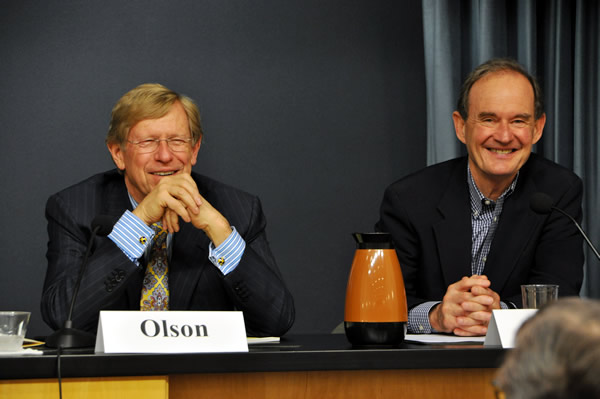
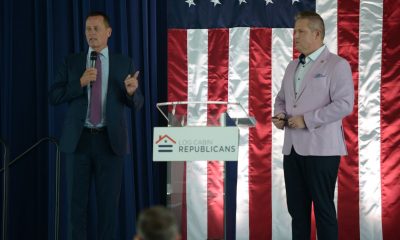
Ted Olson and David Boies at the Cato institute (Blade photo by Michael Key)
The two lead attorneys in the widely followed lawsuit seeking to overturn the California ballot measure that bans same-sex marriage in the state and the attorney who successfully argued the Supreme Court case that overturned anti-gay sodomy laws were honored this week in Washington.
The Cato Institute, an LGBT supportive libertarian think tank, held a forum on Wednesday that featured presentations by conservative Republican lawyer Theodore Olson and Democratic attorney David Boies, who have teamed up to fight Proposition 8.
D.C.’s Whitman-Walker Health, formerly known as Whitman-Walker Clinic, was scheduled to present Olson, Boies and Washington attorney Paul Smith with its Joel A. Toubin Memorial Award at a reception Thursday evening. The award recognizes their legal work in support of the rights of LGBT people.
Smith was the lead attorney challenging state sodomy laws in the 2003 case known as Lawrence v. Texas, in which the high court ruled that laws banning intimate sexual relations between people of the same sex in the privacy of their home were unconstitutional.
In interviews with the Blade, Olson and Smith each said they were hopeful that the Lawrence decision would provide an important legal foundation for the Supreme Court to overturn Proposition 8 when that case reaches the high court possibly within the next two years.
Olson worked as U.S. Solicitor General defending federal laws before the Supreme Court during the administration of President George W. Bush. Prior to becoming solicitor general, Olsen represented Bush in a highly controversial Supreme Court case credited with deciding the outcome of the 2000 presidential election in favor of Bush over then Vice President Al Gore in a dispute over challenged ballots in Florida.
Olson told the Blade he doesn’t see his role in seeking to overturn what he calls a “highly discriminatory” ballot measure as a contradiction to his status as a conservative.
“I think those of us in the political world who care about individual rights and individual liberty and individual freedom and treating our fellow citizens with respect and decency and fairness and understanding ought to be in favor of changing laws that discriminate against people on the basis of sexual orientation,” he said.
The California-based American Foundation for Equal Rights, which retained Olson and Boies to challenge Prop 8 in court, was initially questioned by some LGBT groups and progressive legal experts for taking on too great a risk in seeking to bring the case before the U.S. Supreme Court. Some argued that the conservative-leaning court could very likely uphold Prop 8’s constitutional standing, setting a potentially harmful legal precedent.
Olson said he and Boies considered those concerns when they decided to take on the case.
“We felt it was important to go forward because we’ve been approached by persons who felt their constitutional rights were being denied to them,” he said. “And we felt that as lawyers, we couldn’t say, well we’re not going to represent you or we’re not going to try to vindicate your constitutional rights.”
Smith said he’s hopeful that the Supreme Court will uphold a lower federal district court ruling in Massachusetts, which declared as unconstitutional a provision in DOMA that bars the federal government from recognizing same-sex marriages legalized by states.
He said he and other attorneys seeking to overturn the DOMA provision banning federal recognition of same-sex marriages received an important boost when the Justice Department decided earlier this year to no longer defend the law in court. President Barack Obama has said he favors the full repeal of DOMA by Congress.
The president said he also believes DOMA is unconstitutional and determined the Justice Department should end all efforts to defend the law in court. The Republican-controlled U.S. House of Representatives has since stepped in to arrange for legal counsel to defend DOMA as it makes its way to the Supreme Court.



Baltimore
The fight to save one of Baltimore’s last gay bars
Leon’s closed in July after its owner’s death
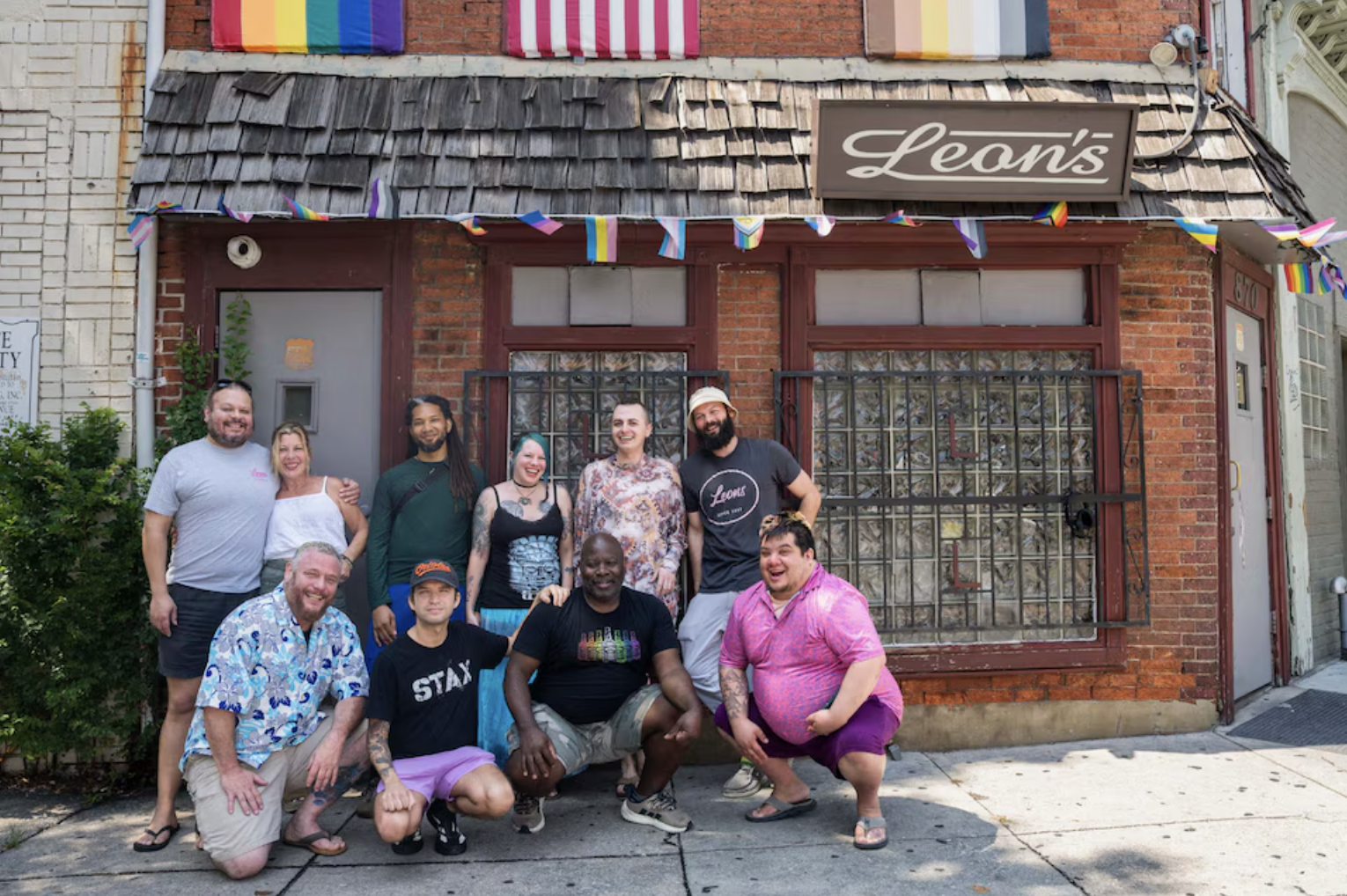
By JULIE SCHARPER and WESLEY CASE | Soon after Jim Becker came out as gay in 1967, he ducked into a Mount Vernon bar called Leon’s.
In the dark, smoky bar, men used pseudonyms for fear of being outed, as homosexual acts were illegal in Maryland. Bartenders, wary of vice squad raids, would blow a whistle if couples leaned in for a kiss.
But to Becker, arriving at Leon’s was a kind of homecoming. He could explore his identity, connect with other gay men and build community in the anxious years before the 1969 Stonewall uprising, a pivotal moment in the LGBTQ rights movement.
The rest of this article can be read on the Baltimore Banner’s website.
District of Columbia
Gay-owned pizzeria in Dupont Circle burglarized
Protest Pizza owners say community has expressed support
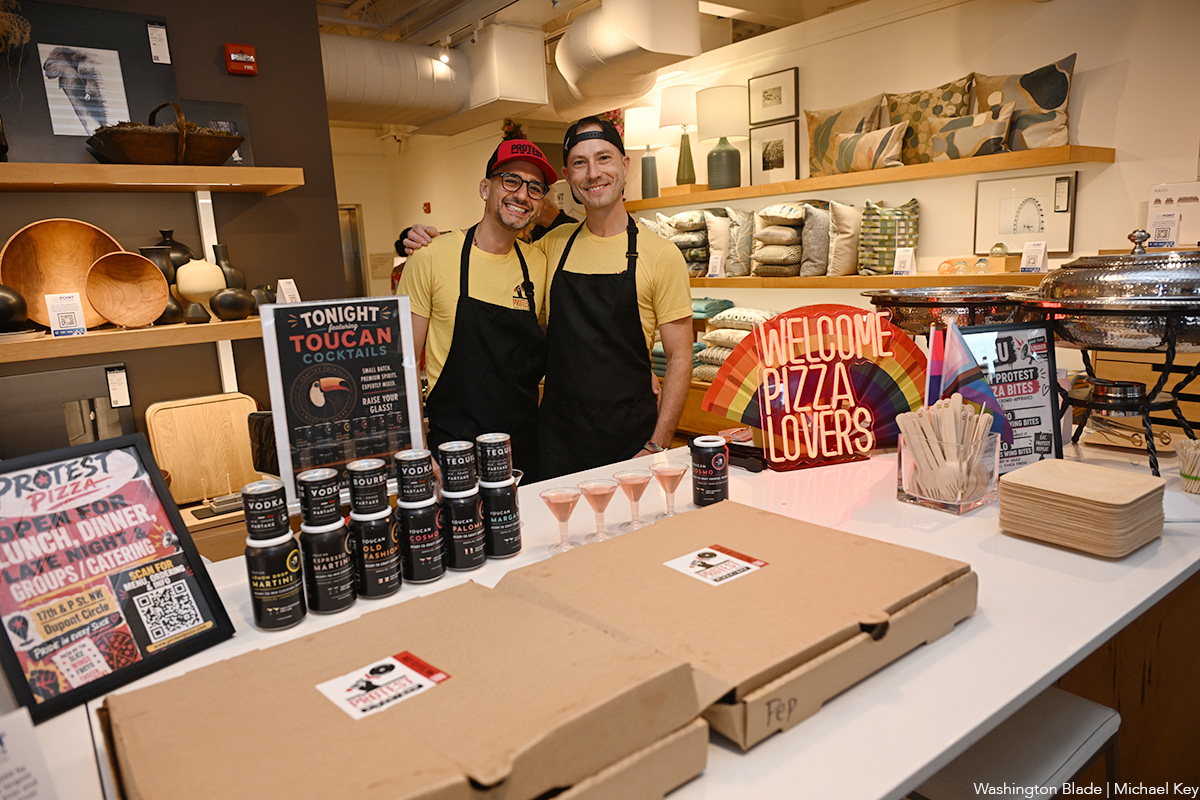
Gay activist Randy Downs said he and his business and life partner Ricky Bennett are grateful for the support they have received from the Dupont Circle community after they released a video showing a suspect breaking into their recently opened pizza shop and taking money from a cash register shortly before 3 a.m. on Friday, Aug. 21.
The surveillance video shows a man wearing black clothing with his face covered, smashing the glass front door of Protest Pizza, located at 1633 ½ P St., N.W. The video, which Downs and Bennett provided to D.C. police, also shows the suspect climbing over the bar to get to a cash register, which he opened to take out cash.
A D.C. police report obtained by the Washington Blade lists the incident as a Burglary in the Second Degree and says the owners reported “approximately $78 in cash” was taken from the cash register. The report says the incident is not listed as a suspected hate crime.
Downs told the Washington Blade that after he and Bennett reported the break-in and theft on social media, they received an overwhelming showing of support from neighbors and others, including business owners, from across the nation.
“The break-in was upsetting, but it is not what will define Protest Pizza,” Downs said. “What defines us is how quickly people showed up,” he told the Blade. “One person came looking for a cash register; our community saw a gathering place worth protecting. The response reminded us that Protest’s real value was never in the register.”
Downs said he and Bennett, who live around the corner on the section of 17th Street, N.W., near several other bars and restaurants, including the gay bar JRs are located, opened Protest Pizza in November 2025.
“Ricky and I built Protest Pizza as a positive, welcoming, queer owned neighborhood restaurant and bar — a space for protest and joy,” he said.
A D.C. police spokesperson said police offer a reward of up to $1,000 for information leading to an arrest and conviction of a suspect responsible for the type of burglary and theft that occurred at Protest Pizza. Police say anyone with information to help solve this type of crime should call the police tipline at 202-727-9099.
District of Columbia
Advocates honored at Engendered Spirit Awards
Annual ceremony held at conclusion of Trans Pride DC
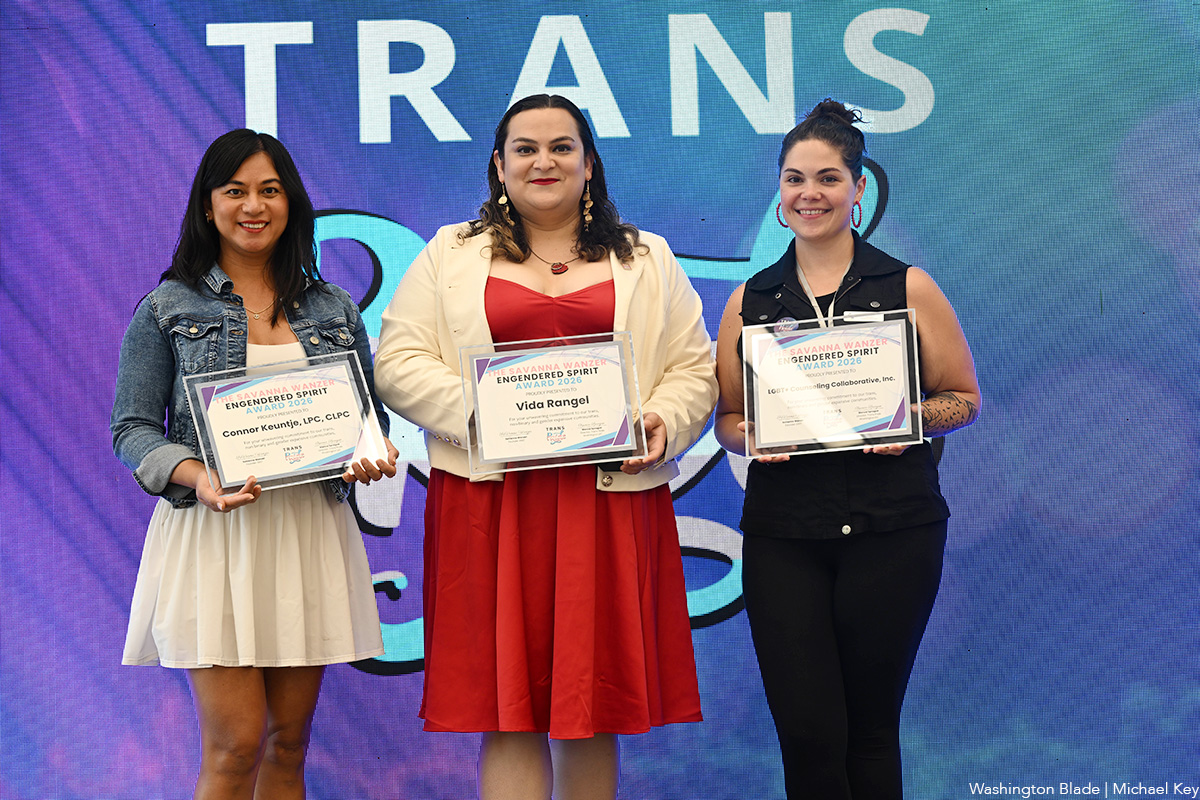
The 2026 SaVanna Wanzer Engendered Spirit Awards ceremony took place at the Martin Luther King, Jr. Memorial Library in D.C. on Saturday. The ceremony was held at the conclusion of the day-long Trans Pride DC: Encore.
Honorees included D.C. Mayor’s Office of Community Affairs Deputy Director Vida Rangel; the LGBT+ Counseling Collaborative, Inc.; and Connor Keuntje, CLP, CLPC.
Trans Pride DC: Encore was held throughout Saturday with several workshop sessions and a virtual conversation with actress and advocate Dominique Jackson.
The annual Engendered Spirit Awards were renamed the “SaVanna Wanzer Engendered Spirit Awards” in honor of SaVanna Wanzer, founder of D.C. Trans Pride. Wanzer died on April 24 of this year.
Speakers at the ceremony included Japer Bowles, director of the D.C. Mayor’s Office of LGBTQ Affairs and Bianca Sprague, executive director of D.C. Trans Pride.
“The intent behind this award and honoring members of our communities, organizations, and allies, is to really elevate all of the work that they’re doing to provide resources, tools, learning opportunities and connections: centering trans folks, gender non-conforming, and gender diverse individuals,” Sprague said.

Dolly Parton dies at 80

Monument to LGBTQ Canadians officially unveiled

The fight to save one of Baltimore’s last gay bars

When home becomes a journey: migration, memory, and the African diaspora

Gay-owned pizzeria in Dupont Circle burglarized

Trump-Vance administration’s LGBTQ brain drain: what you need to know

UPDATE: Impulse Group’s ‘PrEP Pool Party’ cancelled

Not all trans people are the same

Calendar: August 21-27