Movies
‘Barbie’ doesn’t care about your agenda
New film a ‘truth bomb’ delivered via candy-colored Trojan Horse
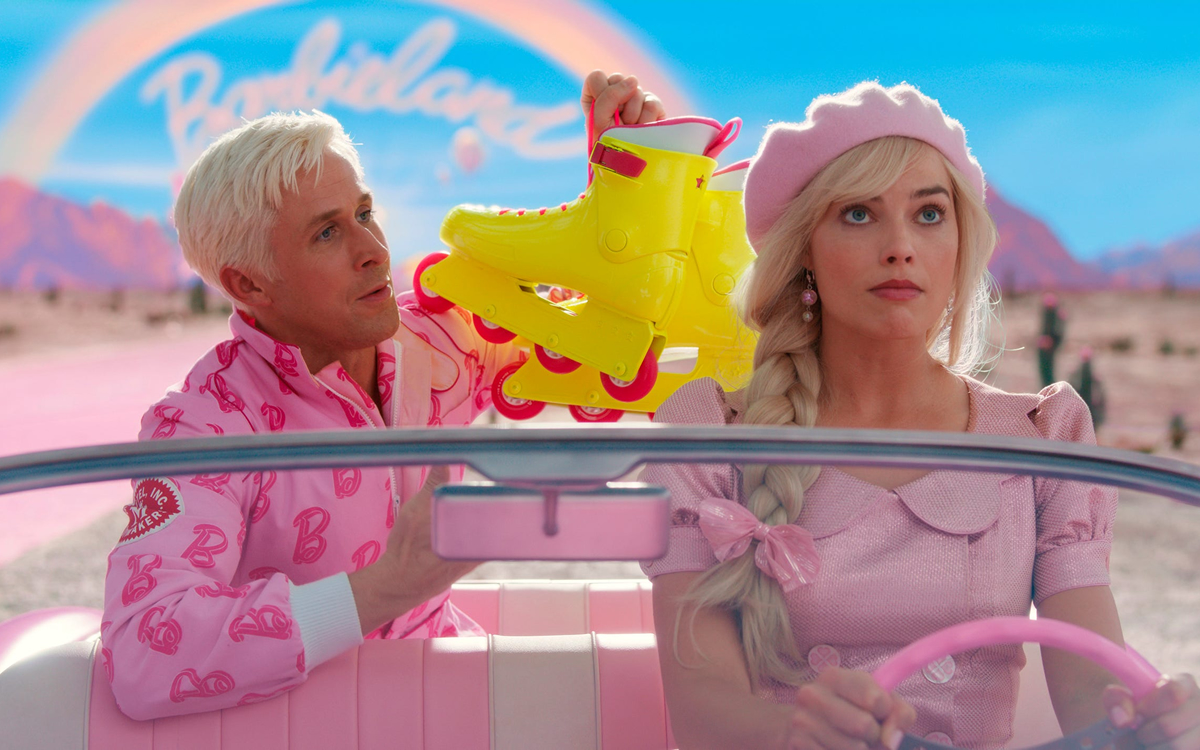
When you’re a Barbie, every day is perfect. You get to do whatever you want and be anything you want to be, whether it’s fashion model Barbie or President Barbie, and that’s just the way things naturally are.
When you’re not a Barbie, however, it might look more than a little bit like Barbie privilege.
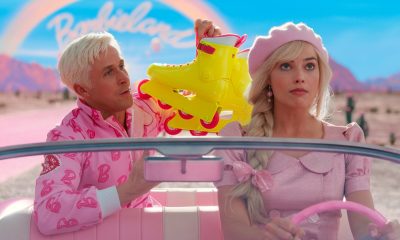
This is, of course, a perspective flip undertaken by filmmaker Greta Gerwig in her latest film, which brings the doll of its eponymous title into the “real world” to look for answers after she experiences an unexpected existential crisis, in an endeavor to turn it into something deeper than a flashy, over-hyped toy commercial masquerading as a big screen blockbuster. It’s not the only one, but it’s the most obvious, and it has most of the movie’s inexplicably vehement detractors feigning outrage over what they deem as “woke” propaganda.
It’s certainly true that “Barbie” is loaded with the kind of messaging that conservatives deplore. In the screenplay co-authored by Gerwig with partner Noah Baumbach, Barbieland exists through the imagination of all the children who play with her; every Barbie (and Ken) lives there, but the plot focuses on their “stereotypical” iterations (Margot Robbie and Ryan Gosling), who are forced to confront the differences between the idealized utopia in which they live and the still-far-from-perfect reality inhabited by their human counterparts. Barbie, crestfallen, just wants to go home – but Ken, after seeing a world where the men seem to be in charge, is inspired with a different notion.
That premise, needless to say, gives Gerwig’s movie plenty of fodder for cultural commentary, and it holds nothing back as it goes after all the usual targets with palpable glee, so it’s no surprise a segment of the population would get their feathers ruffled over it.
What’s less predictable, perhaps, is the level of animosity aimed at the film from quarters one might expect to embrace it. This might be a function of Barbie’s “problematic” image, which has been tarnished by decades of criticism from those who (not wrongly) have called out the iconic doll – and the company that sells it – for promoting an idealized, male-defined image of femininity and undermining its purported message of female empowerment by simultaneously creating an unrealistic body image for women; let’s face it, there are people who just don’t like Barbie, for these reasons and more, and never will.
Since the film clearly addresses these controversies, however, and attempts to move past them toward a more evolved manifestation of the character, one might be tempted to suspect there’s more behind the aversion for the very idea of this movie that compels so many people to belittle it, unprompted, on their social media feeds; and since – despite dismissive declarations of shallowness that have been levied against it, sight unseen, from the moment it was announced – “Barbie” goes much deeper than the predictably divisive political constructs of the so-called “culture wars” in its ambitious effort to be more than we expect it to be, we might be able to look further into those depths for more insightful reasons.
For starters, the path the movie takes to resolve its plot leads through many ideas that, for the more jaded among us, can easily seem like lip service. The idea that empathy, that seeing what it’s like to walk in someone else’s shoes, can fix all the problems of the world is so familiar that it can be reduced to a platitude; it’s a nice sentiment, but only the most romantic of optimists can be convinced of its believability, and perhaps of its sincerity, too. With that in mind, it’s easy to appreciate why so many people might be predisposed to resist its warm-and-cozy appeal.
Then there’s the well-publicized barrage of cinematic references – influences to which Gerwig has given a dizzyingly exhaustive array of shameless nods in her treatment of “Barbie” – that pop up as “Easter Eggs” from the movie’s very first sequence and continue without pause for pretty much its entire runtime. From “2001: A Space Odyssey” to “Blade Runner,” from “The Wizard of Oz” to “The Umbrellas of Cherbourg,” she lovingly crafts her visuals to evoke connections to myriad classics that have shaped her self-evidently masterful understanding of cinema – but while those might be fun for movie buffs with a penchant for trivia, they don’t do much for the average viewer who has likely never seen anything directed by Jacques Demy, let alone have knowledge about his use of color in crafting the “look” of a film. In fact, knowing that such elements are there could even feel like exclusionary intellectual snobbery.
Still, after experiencing the film firsthand, such reasons feel like excuses to us, rationalizations to justify a dislike that stems from something more personal – and perhaps, more uncomfortable – than the rhetorical stances that often dominate the analysis and judgment of film or any other art form. Though it makes no apologies for its espousal of feminist ideals or any of the other core “liberal” principles it embraces, it nevertheless dares to suggest that the problems of the world can’t be solved by merely upending the status quo. There may be quite a few amusing jokes about “The Patriarchy” involved, but by the time it’s over, “Barbie” posits that tearing it down isn’t really the solution so many of us imagine it to be – and that’s a frightening concept for anyone who is invested in the idea that it is.
There are many standout moments in “Barbie” – and yes, you can take that as an unequivocal recommendation of the film, which to us feels like a disruptive “truth bomb” delivered via a candy-colored Trojan Horse into the heart of contemporary culture and features superb and layered performances, not only from its two oft-maligned leading players but from a host of supporting cast members like Kate McKinnon and America Ferrera (who deserves to be a front-runner in next year’s Oscar race on the strength of one show-stopping monologue alone) as well – but two of these capture its essence. The first is a “Forrest Gump”-ish exchange between Barbie and an elderly woman on a park bench, which consists of only six words; the studio, reportedly, wanted it cut, but Gerwig – who insisted on complete creative control before accepting the job – declined to concede. It’s a transcendent touch, and its power lies beyond words, so we’ll just leave it at that.
The second comes later, when Barbie confides to a mysterious woman (Rhea Perlman) she encounters by seeming chance that “The real world isn’t what I thought it was” – to which she receives the reply, “It never is.”
If “Barbie” can be said to have a moral, that’s probably it – and it’s one that has shaken humanity to its core for centuries.
Is it any wonder that so many human beings, believing themselves to be secure in their unquestioned and pre-programmed personal illusions, don’t want to hear that message?
But what do we know? Taste, like life itself, is a subjective experience, and the only opinion that ever matters – at least for you – is your own.


Movies
‘Maddie’s Secret’ defies campy expectations
An over-the-top, old-school melodrama combined with modern satire
Sometimes, when you think you know what to expect from a movie, it doesn’t match those expectations. What do you do then?
I’m not talking about the unmet expectations of fans, like those who complain that Kubrick’s “The Shining” made sweeping changes from Stephen King’s novel, or start a social media campaign trashing the latest “Star Wars” or “Marvel” film because of a plot twist they don’t like. Those are complaints about content, about a story not going the way it is “supposed” to go.
I’m referring to the expectations we have when we walk into a movie thinking that it’s going to have a particular tone, a specific style, a familiar formula – essentially that it is going to easily fit into a comfortable box, and stay there. What happens when it doesn’t?
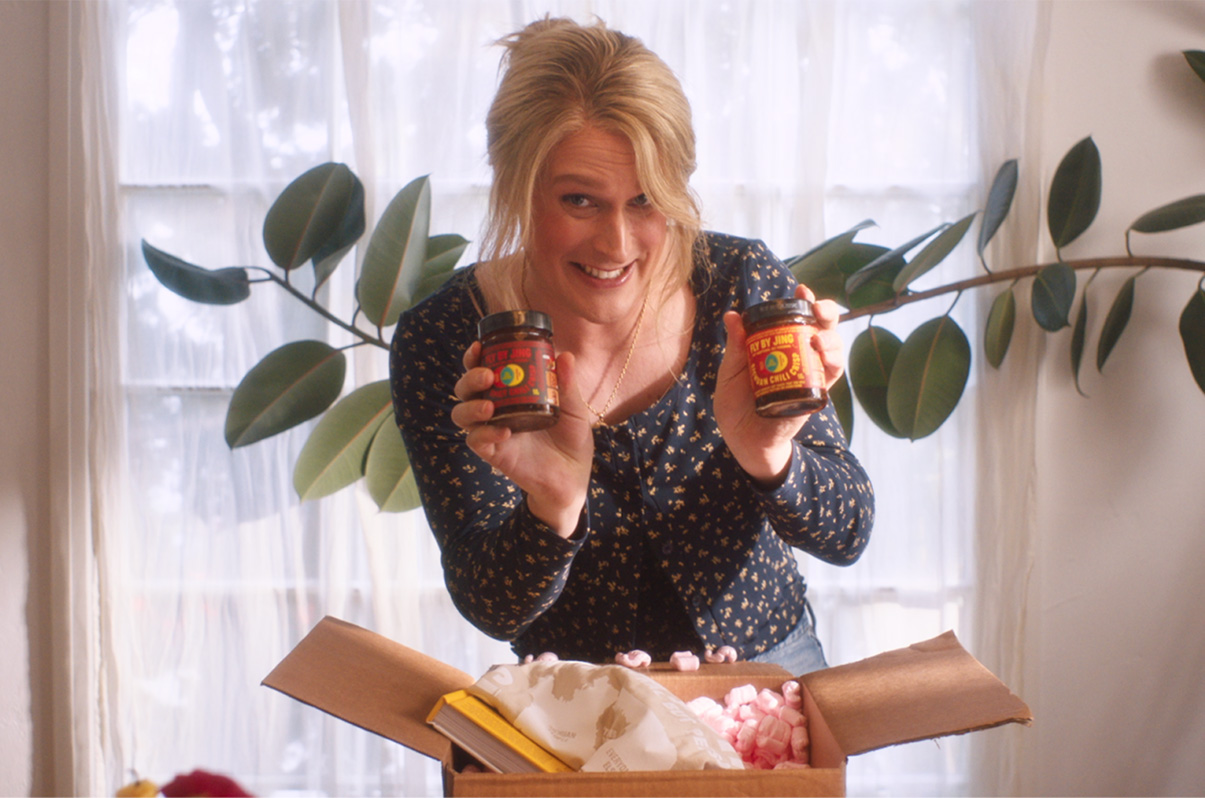
That’s the question I found myself asking as I watched “Maddie’s Secret,” the directorial debut from gay actor/comedian John Early, which is now screening in a limited theatrical release. It’s the story of a humble housewife whose doting husband persuades her to turn her love of cooking into a career as a virally popular “food influencer,” only to find that her sudden success triggers traumatic feelings from her childhood; clearly a contemporized hybrid of the melodramatic “woman’s pictures” of Old Hollywood and the “Afterschool Special” style cautionary dramas of ‘70s/’80s TV, it has all the earmarks of being an exercise in “camp” – especially since Early himself stars as Maddie.
To put it plainly, it’s an over-the-top old-school melodrama combined with modern-day satire of online social media fame, with a gay man in a dress playing the lead. What could be campier than that?
And it is campy, make no mistake. Yet at the same time, somehow, it isn’t. From its opening scene (which shows us Maddie as she jogs to her dishwashing job at the headquarters of an LA test kitchen/content studio named “Gourmaybe”), we expect things to get wacky. The ingredients are definitely present for it, like her aggressively butch co-worker/BFF Deena (Kate Berlant), who is clearly nursing a serious “girl crush”; bitchy TikTok star Emily (Claudia O’Doherty), who demeans her and ridicules her ambitions of being a chef; and boss Zach (Connor O’Malley), a womanizing corporate “bro” who enthusiastically embraces all the toxic traits we associate with that description.
As the story opens up beyond her workplace, there are more elements that feel ripe for the kind of histrionic humor we might expect from a film by John Waters, or the stylish old-school parody of Charles Busch, or even the radicalized sexual transgression of Bruce La Bruce: Maddie’s adorably bearish husband Jake (Eric Rahill) could be made into a goofy caricature with a food fetish, and her estranged, abusive mother Beverlee (Kristen Johnston in a deliciously grotesque performance) is easily monstrous enough to be at the campy center of any “hag horror” from the ‘60s.
And when we finally discover her “secret” (spoiler alert: it’s an eating disorder that returns when the pressures of being a popular social media chef bring up old feelings about her relationship with food), it’s easy to imagine a different filmmaker taking the whole thing in a thoroughly savage direction; the potential for tasteless, excessive, and deliberately juvenile comedy might be limitless, in the hands of a director unafraid of being branded “offensive.”
It’s hard not to see all these possibilities on hand as we watch Early’s film – which he also wrote – and (for myself, anyway) hard not to hope they all play out to maximum outrageous effect.
They don’t. Instead, “Maggie’s Secret” does something so unexpected that it feels, at first, like a mistake: it decides to play things straight.
It’s still a comedy, make no mistake, but it’s not the kind of comedy we think it’s going to be. It doesn’t go for over-the-top anarchy; it doesn’t go for the bitch-slapping catfight between rival divas, or for the running parade of filthy double-entendres, or for the absurd “gross-out” humor that might have emerged from its scenes of binge-and-purge overeating. Well, okay, maybe it does go for that last one, a little bit.
What all this comes down to, perhaps, is that the film gets its laughs – and there are quite a lot of them – without making fun of itself or, more importantly, its characters. The comedy here is built into the story; it comes from its send-up of social media influencers, corporate content creation, media tie-ins, and all the other interlocked microcosms of our “new, now, next” digital culture; it comes from the foibles and fumbles of its characters as they pursue their objectives in the story, from the qualities and quirks of their personalities, from their simply being funny because they feel like being funny; and yes, it sometimes comes from the obvious cliches of form that we recognize, the plot formulas and sudden revelations and shocking twists that have emerged time and time again in these kinds of domestic melodramas, but it does so good-naturedly, in a way that feels like laughing “with” the movie than laughing “at” it.
It also never diminishes or ridicules the seriousness of Maddie’s eating disorder, nor the experiences that come for her when she (spoiler alert, again) ends up going into an inpatient facility to be treated for it; though these later scenes come populated with their own set of stereotypical characters, ready to be exploited, the movie may poke gentle fun, but it humanizes them, too, helping build the film toward an emotional climax that leaves us with the kind of satisfying uncertainty we don’t quite expect from a movie like this one.
Most significantly, perhaps, it never gets its laughs out of the fact that Maddie is being played by a man – and it’s this that makes Early’s film feel more profound than we expect it to be. It’s not a “drag” movie, or a cross-dressing comedy, or anything to do with Maddie’s gender at all. She is a woman, presented without exaggeration or irony, and she just happens to be portrayed by a male actor instead of a female one. There’s no joke involved, just an excellent performance.
This is an apt approach, considering that Early cites Waters’ 1974 “Female Trouble” as his inspiration for “Maddie’s Secret.” Though he sets aside the extremes of that classic in favor of nuance and kindness, he takes his cue from its star – the incomparable Divine, who never called himself a drag queen but considered himself an actor playing a part. Early does the same, and it makes his film into a kind of full-circle moment in queer “underground” cinema (if a premiere at the 2025 Toronto International Film Festival, where “Maddie’s Secret” screened to enthusiastic response, can be called “underground”) which pays homage to the legacy of a past icon while picking up the mantle and carrying it in a new – and unexpected – direction.
That’s the thing about expectations: sometimes they are left unfulfilled – and in answer to my own question, as I watched this uniquely winning queer indie gem, what happens just might be something wonderful.
Movies
Greg Araki still wants your sex
Shrewd, sexy film may be the most fun you’ll have this summer

Greg Araki may not have been solely responsible for the “New Queer Cinema” movement of the 1990s, but he certainly gave it an edge.
From early low-budget groundbreakers like “The Living End” (1992) through his “Teen Apocalypse Trilogy” (1993-97) and beyond, his films have subverted cinematic tropes with queer characters and themes and co-opted them into his own unique brand of filmic storytelling — extreme, campy, and transgressive – in which his queer characters were usually framed as sexual outlaws, flawed and anti-heroic outsiders who disregard not only sexual conventions, but often the law and the social order itself.
In subsequent decades, he’s continued to bring that same fiercely counter-cultural swagger to a surprisingly diverse array of projects, from the melancholy and critically acclaimed “Mysterious Skin” (2004) to the first-ever Cannes Queer Palm winner “Kaboom” (2010). And though it’s been 12 years since his last feature film release (“White Bird in a Blizzard”), he’s brought his twisted talents under the radar to helm episodes of popular TV shows like “13 Reasons Why,” “Riverdale,” and “Monster: The Jeffrey Dahmer Story.”
Now, he’s back to the big screen with “I Want Your Sex,” a new erotic comedy-thriller that proves he hasn’t lost that edge. In fact, he may have honed it to a sharpness that cuts deeper than ever — and he’s aimed it not only at the moralistic posturing of mainstream attitudes around carnality, but at the thinly veiled high end consumerism that drives the world of avant-garde art.
Structured with a nod to “Sunset Boulevard” – it begins with a shocking “face down in a swimming pool” moment that is then explained in flashback – and flavored with the kind of sexual anarchy that rarely manages to penetrate the cultural mainstream, it’s the quintessentially “L.A.” story of Elliot (Cooper Hoffman), a perennially down on his luck 23-year-old would-be podcaster who manages to land a job as an assistant to multi-media artist Erika Tracy (Olivia Wilde), known as much for her domineering personality as for her highly sexualized (and deliberately provocative) work. At first, he is just one of a small army of fellow assistants tasked with helping prepare for an exhibition of new work at her gallery, which ranges from writing emails and scheduling interviews to chewing gum for a conceptual artwork depicting her vagina; but something about him catches her eye, and he soon finds himself taking on the additional duty of being her sexual plaything.
It’s strictly a business arrangement, of course, and all under cover of an NDA he signed before ever being hired; she needs the sexual outlet to keep her focused on her work, and he – thanks to his unsatisfying relationship with disinterested girlfriend Minerva (Charlie XCX) and his desire to finally pay his share of rent for the apartment he shares with BFF Apple (Chase Sui Wonders) – is happy to be of service. At first, it all feels like a dream come true, as he crosses his own boundaries to become enmeshed in a Dom/sub dynamic with an older woman on whom he’s long had a crush; she’s the Dom, of course, and he soon discovers he has more than just a mild taste for being submissive. But as things progress, he begins to “catch” the feelings he was never allowed to have, while Erika’s manipulation and humiliation of him starts to cross lines that threaten to undermine his tenuous sexual liberation, simultaneously eroding the comfortable relationships that have kept him feeling grounded, if perennially dIsappointed, up until now. Needless to say, things get progressively twisted, and Elliott finds himself ever more haplessly exploited as the story winds back to that “swimming pool moment” with all the inevitability of a train wreck experienced in irresistibly delicious slow motion.
Yes, it’s all deliberately “shocking” in the sense that it takes us places – both sexually and psychosexually – that a lot of audiences might never have thought they’d be expected to go. There’s plenty of nudity, the kinky sex is “explicit” in the sense that we have no doubt about the physical logistics of what’s happening even if we don’t see it, and the overall sense of “ethics” is pretty much “who cares?” In today’s world of “purity politics,” that might actually be the most transgressive thing of all about Araki’s film.
It’s not all just thumb to the nose at 21st century morality, however; nor is it merely a chance to undermine our faith in concepts like “consent” or suggest that inappropriate sexual dynamics in the workplace are anything other than toxic. Erika is most definitely a kind of beautiful monster – all the more because her angle, from the beginning, is all about increasing the value of her “brand” – but to frame her as a villain is missing a crucial point in what is essentially, despite its coy pretense at being a thriller, a coming-of-age story wrapped in a dark and de-romanticized rom-com.
Central to Araki’s story is the oft-cited observation that Gen Z people, having come of age in a time of social isolation in which private indiscretion can frequently lead to public shame, are afraid of sex. Elliot himself discusses this generational trope, yet he exposes himself to betrayal and humiliation anyway – and while that choice may take him down a rocky road, it also takes him on the journey of sexual self-discovery that he’s always wanted to have. Erika facilitates this, however unethically she may go about it, and even makes some discoveries about herself along the way; and despite the fact the journey ends up with police interrogations, tabloid scandal, and reversals of fortune not even she can see coming, the sex itself is never really to blame. After all, it’s only sex.
Maybe that’s the main point of “I Want Your Sex,” if there is one: all the stigma, all the prudish judgments and standards of moral “decency” become absurd in the face of the act itself, which – for most humans, at least – only comes naturally and, when stripped of unnecessary shame, can be a joyful experience, no matter how “kinky” it gets.
In fact, it’s not so much the sexual “deviance” or betrayals that Araki positions as the driving force in his movie, but the pretensions of a commercialized art world in which notoriety, controversy, and even tragedy can boost fame and fortune overnight – something that savvy artists, like Erika (and perhaps Araki himself) understand and exploit without qualm. One can make judgments about that, too, but in the end, isn’t that just part of how capitalism works?
In any case, “I Want Your Sex” doesn’t make judgments about any of it, just observations – with wit, slyness, and a refreshingly sex-positive attitude. Wilde and Hoffman deliver superb performances, as does the entire cast – which, apart from others previously mentioned, includes Mason Gooding as Elliot’s super-gay co-worker, Daveed Diggs as Erika’s haughty business manager, and Margaret Cho and Johnny Knoxville in admirably deadpan roles as a pair of police detectives. Shrewd, sexy, and all in good fun, it might well be the most fun you’ll have at the movies this summer.
Movies
‘Heartstopper Forever’ delivers satisfying conclusion
Beloved queer phenomenon shows us hope can belong to everyone

When I wrote my review of the first season of “Heartstopper,” I said that if the series could only be summed up in one word, it would be “adorable.”
After an additional two seasons and a movie length series finale (which began streaming on Netflix July 17), I’m going to make up a new rule and say that I can choose a second word to close things out. By the time I reach the end of my review of “Heartstopper Forever,” in which our adorable Nick and Charlie must face the possibility that their tender young romance may not be able to survive their graduation to college, I hope I’ll have figured which word it would be.
Directed by Wash Westmoreland and written (as always) by Alice Oseman, artist and creator behind the YA webcomic/graphic novel that launched the whole “Heartstopper” phenomenon, this final installment finds a very different Nick and Charlie than we met in those early episodes – yet in many ways they’re still very much the same. Far from the timid and bullied queer lad of the first season, Charlie (Joe Locke) is now boldly out and confident enough to win the election for “head boy” in his final year at school, and Nick (Kit Connor) no longer struggles with being open about his bisexuality; yet as the stress of their impending separation – each to a different college in a different city – begins to become more urgent, both of them fall back on old patterns.
To those of us who have been around long enough to re-examine such a crisis with 20/20 hindsight, that’s bound to strike chords of recognition. To the younger “Heartstopper” fans, however, it’s likely to feel like high drama – exactly as it did for us when we were going through it ourselves. It’s not just Nick and Charlie, either; other characters, like transgender prodigy Elle (Yasmin Finney) and her cis-het boyfriend Tao (William Gao), must also come to terms with the changing dynamics of their relationships. The result is multiple mirrors through which queer teens can see their own experience reflected, which has always been the appeal of “Heartstopper” in the first place. And as it has from the beginning, Oseman’s intent to provide her teen audience with positive perspectives shines through, ensuring that the story’s final chapter lands in a place where hope can belong to everyone.
That doesn’t mean it doesn’t have its share of dark moments – it wouldn’t be “Heartstopper” if it didn’t, would it? Part of the show’s value for its fans, young and old alike, has always come through its various characters’ growing pains; their missteps and misjudgments, their confused emotions, their fumbling efforts at “first times,” their struggles toward self-esteem. All these and more have provided the necessary “weight” to counter the show’s bubbly optimism and keep it from becoming as insubstantial as spun sugar. More importantly, these issues have always been the real core of the story: We love the sweetness of the romance, but the deeper satisfaction comes from watching these young people navigate all their challenges, sometimes alone but more often together, and build a community through the shared experience of working through them.
The final installment, having brought Charlie, Nick, and all the rest to the cusp of young adulthood, brings a suitably more mature level of problems into the mix. Sure, Charlie has grown into the hero he once needed himself, but the uncertainty that emerges between himself and Nick as they ponder their impending separation is enough to spark a relapse of his eating disorder; likewise, Nick may be confident and unguarded about his sexuality and openly proud of being Charlie’s boyfriend, but that doesn’t stop him from slipping back into self-doubt (and bad behavior) when he contemplates the possibility that their love story might be coming to an end. We know they have the “tools” to get back on track, but with everything so up in the air, will they be able to remember how to use them?
So, too, throughout the series, we have seen these kids come to terms with their individual queerness, navigating those personal journeys and learning how to embrace who they are in an environment where, for the most part, they get a lot of support. At the same time, there have been shadows around the edges, encounters and circumstances that remind them (and us) that, outside the protective circle provided by their school and each other, bigotry still exists. In “Heartstopper Forever,” those reminders are still there, and they feel all the more ominous – not just because of the worldwide rise in anti-LGBTQ+ sentiment, though that’s tied to it, but because these bright young things will soon be moving into a larger world where safety and shelter from the hate is not quite so certain.
Still, it’s Nick and Charlie’s story above all else, and naturally the main focus of this finale is on them. There has always been a too-good-to-be-true perfection to their romance, but Locke and Connor are so good at bringing it to life we believe it; here, fittingly for a final chapter, these boys finally face the crossroad that comes with adulthood – the recognition that, one way or another, there will be an ending to their relationship. How they handle that, we won’t spoil; once again, though, this is “Heartstopper,” one can feel sure that Oseman’s characters will work their way through it in the most imperfectly perfect – and emotionally satisfying – way possible.
Deserving of mention: characters like Isaac (Tobie Donovan), Imogen (Rhea Norwood), and Charlie’s sister Tori (Jenny Walser) return to get their fair share of the spotlight, and gay teachers Mr. Ajayi (Fisayo Akinade) and Mr. Farouk (Nima Taleghani) get the chance for a new beginning of their own; and out UK acting legend Derek Jacobi (“I, Claudius”) appears alongside real-life partner Richard Clifford as an elderly couple in a quiet but important scene at the cafe where Charlie works.
With any “franchise” as popular as “Heartstopper,” the task of bringing closure to a story that has emotionally involved so many fans is almost always a thankless one (just ask George Lucas), so there are sure to be some who have objections to the way Oseman brings her beloved story to an end; but it’s her story to end, and in choosing to uphold its sensational (yet sentimental) imagining of the world as it could be, “Heartstopper Forever” doubles down on the idea that we can make it the way that it should be.
That’s why my choice for the second word we can use to sum up “Heartstopper” is “aspirational.” In the relative innocence and un-ironic preciousness of Nick and Charlie’s enduring love story, we can find no excuses; not all of us can keep our first love alive for an entire lifetime (nor, often, should we), but maybe we can learn to follow our hearts as surely and openly as they do.
That’s about as aspirational as any of us can hope to be – but don’t worry: it’s still adorable, too.

Chicago’s LGBTQ+ youth: Why their zip code still matters

Anne Arundel schools updates gender identity regulation following Trump administration threats

Thailand’s first openly gay senator attends World Pride in Amsterdam

Philadelphia gayborhood preservation battle raises questions about displacement

Man charged with anti-gay assault in D.C. accepts plea offer

Bros + romance + fantasy = ‘Bromantasy.’

National tour of ‘The Notebook’ retains its tearjerking power

‘Maddie’s Secret’ defies campy expectations

PHOTOS: Nellie’s Drag Brunch