LGBTQ Non-Profit Organizations
HRC warns LGBTQ progress faltering as Trump enters second year
New polling from HRC shows increasing struggles under the Trump-Vance administration.
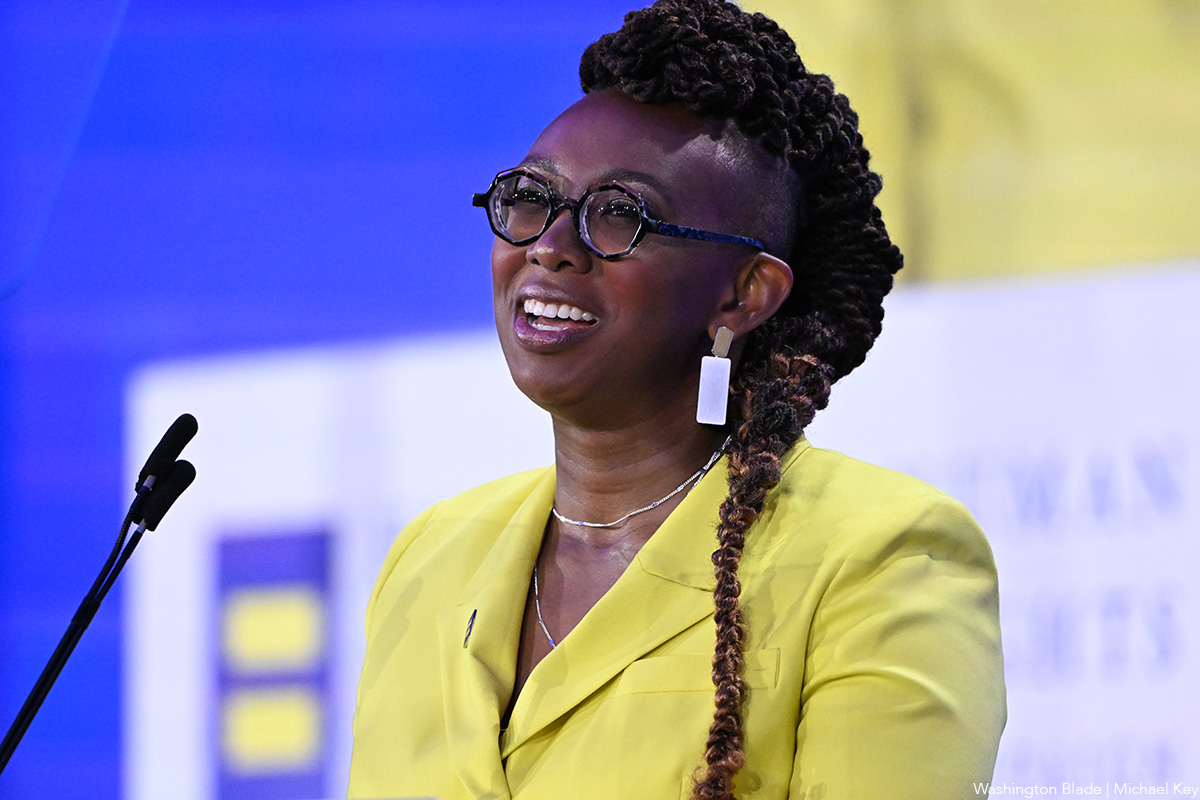
As President Donald Trump begins the second year of his second term, LGBTQ advocacy organizations say they are shifting into a more aggressive posture — armed with new data that shows how quickly hard-won progress is eroding under the Trump-Vance administration.
The Human Rights Campaign hosted its 2026 Election Strategy Kick-Off meeting last week at the National Press Club in Washington, where leaders shared fresh polling data detailing how Trump’s first year back in office has affected LGBTQ Americans — and how pro-equality candidates can respond heading into the midterms.
HRC President Kelley Robinson hosted the event, joined by MSNBC’s Jonathan Capehart, Reproductive Freedom For All President Mini Timmaraju, and Joey Teitelbaum of Global Strategy Group. Together, they laid out what they described as a dire political and cultural moment for LGBTQ people — and the concrete steps campaigns must take to counter a surge of anti-LGBTQ rhetoric and policy coming from the GOP.
“The emergency that we warned about is no longer a warning — it is the reality that we are living inside,” Robinson said. “Donald Trump may not have started this fire, but he surely poured gasoline on it.”
New data collected by HRC and Democratic pollsters at Global Strategy Group (GSG) paints a grim picture of life for LGBTQ Americans in Trump-era America — particularly when it comes to visibility, safety, and economic security.
Acceptance and visibility declining
One of the clearest trends from the survey is a decline in perceived acceptance. The data found that 21.6% of all U.S. adults say acceptance of LGBTQ+ people has declined in the past year. Among LGBTQ+ adults themselves, that number jumps to 29.7%.
That erosion of acceptance is translating into tangible changes in behavior. Nearly half of LGBTQ+ adults surveyed — 47.5% — reported being less out in at least one area of their lives over the past 12 months, at least in part due to cultural shifts or executive actions taken by the Trump-Vance administration.
The survey found that 26.5% of LGBTQ+ people are less out at work than they used to be, 25.4% are less out in healthcare settings, and 28.3% feel less out in public spaces. While the choice to be out varies by person and circumstance, researchers note that higher levels of being openly LGBTQ — particularly when safety is assured — have historically been linked to greater societal acceptance.
Visibility is slipping even more broadly. More than half of LGBTQ+ adults — 51.1% — say they are less visible than they were a year ago. Among LGBTQ+ parents with school-aged children, 40.1% reported being less visible at their children’s schools — the highest rate of retreat in any measured environment.
“Nearly half of LGBTQ+ people say they are less out than they were just a year ago,” Robinson said. “Visibility — something we fought generations to build — is slipping before our very eyes.”
Capehart emphasized that these numbers have real-world consequences beyond personal identity.
“Half the community retreating back into the closet is distressing, but understandable in these times,” Capehart said. “The danger is when people disappear from public life, because it becomes easier to ignore their suffering.”
Decades of research from organizations such as Gallup and PRRI have consistently shown that increased visibility correlates with greater public support for LGBTQ+ rights. When people personally know someone who is LGBTQ+, they are significantly more likely to support equality — creating what advocates describe as a positive feedback loop. The new data suggests that loop is now reversing.
Voters are ahead of politicians
Despite the cultural retrenchment reflected in the data, GSG’s findings also offer a clear political opening for candidates who run unapologetically on equality — particularly in competitive districts.
According to the polling, voters in battleground and purple districts “overwhelmingly support” nondiscrimination protections and LGBTQ equality. These voters, the data show, are deeply wary of politicians inserting themselves into people’s personal lives while failing to address urgent issues like the cost of living, healthcare, and public safety — especially when those intrusions target transgender people.
Teitelbaum, GSG’s senior vice president for research, said the polling makes clear that Republican messaging on transgender issues is far out of step with the electorate.
“In no state have we ever seen more than 18% of voters say being transgender should be illegal,” Teitelbaum said. “That means more than 80% of Americans are not where Republicans are — and that gives us room to go on offense.”
HRC leaders pointed to the recent Virginia gubernatorial race as a case study in how candidates can successfully navigate anti-trans attacks. Democratic Gov.-elect Abigail Spanberger faced a barrage of anti-trans messaging from her opponent, yet refused to cede ground on equality — instead redirecting her campaign toward economic concerns and quality-of-life issues.
“Look at Virginia and the good governor that’s about to be inaugurated, Abigail Spanberger,” Robinson said. “She faced a flood of anti-trans attacks. More than half of her opponent’s ad budget was spent trying to divide and mislead voters, but she didn’t flinch. She stood her ground, and voters rewarded her by a win of over 15 points in Virginia.”
Economic, healthcare impacts deepen
Beyond cultural shifts, the survey shows that the administration’s policies are having measurable economic and health impacts on LGBTQ Americans.
LGBTQ+ adults are twice as likely as non-LGBTQ+ adults to say their financial situation has worsened over the past year. Advocates pointed specifically to the administration’s hardline rollback of diversity, equity, and inclusion initiatives as a key driver of workplace hostility. Among LGBTQ+ workers whose employers ended or scaled back DEI programs, 57.4% reported experiencing stigma or bias at work.
Healthcare access is also deteriorating — not only due to Trump’s aggressive push against gender-affirming care, but across other critical areas as well. Access to HIV prevention and treatment has become significantly more difficult. LGBTQ+ adults on Medicare or Medicaid are more than twice as likely to report barriers to HIV care compared to those with other forms of insurance. Among LGBTQ+ adults earning less than $75,000 per year, 41.5% reported difficulty accessing HIV prevention or treatment.
“Since Donald Trump returned to office, LGBTQ+ Americans are worse off in every area this survey measures than we were one year ago,” Robinson said. “We are less visible, less safe, and less economically secure.”
A playbook for going on offense
In response, HRC is urging more pro-equality candidates to run — and to do so strategically. The organization outlined a campaign playbook designed to help candidates define themselves early, counter anti-trans attacks, and proactively promote their values rather than playing defense.
The framework centers on five core pillars:
- Share your story before attacks come
- Lead with your values
- Address concerns directly
- Turn the tables and gain voters
- Go big
U.S. Rep. Julie Johnson of Texas joined the meeting virtually, echoing the call for more openly pro-LGBTQ leadership in Congress.
“They’re banking that the politics of hate and division can distract voters from their failure to address soaring health care costs, high grocery bills, and the scourge of gun violence — and we cannot let them win,” Johnson said. “The answer is not to hide or stay silent. The answer is to be prepared.”
Johnson, the first out LGBTQ member of Congress from the South, said real change in Washington begins with elections.
“We need to flip the House to a pro-equality majority that will focus on the needs of all Americans, without exception,” she said. “With HRC’s help, candidates like me can go on offense and lean into our values, because the American people want real leadership, full equality, and a commitment to freedom.”
Robinson closed the event with a blunt assessment of the moment ahead.
“This is a different United States of America than it was just months ago,” she said. “Preserving democracy and protecting LGBTQ lives both require the same thing: winning power and refusing to back down.”



LGBTQ Non-Profit Organizations
Anti-LGBTQ commentator Tyler O’Neil to testify in Southern Poverty Law Center probe
House Judiciary Committee will hold hearing on group on Wednesday

The man behind some of the strongest push against the Southern Poverty Law Center, who has an extensive anti-LGBTQ history, is being asked to speak before the House Judiciary Committee as part of its ongoing investigations into the nonprofit legal organization.
Last month, the Justice Department indicted the SPLC on 11 counts of wire fraud, false statements made to a federally insured bank, and conspiracy to commit money laundering related to payments to informants.
The DOJ alleges the civil rights group defrauded donors by using their money to fund the extremist groups it claims to be fighting. It also alleges the SPLC used more than $3 million paid to informants through a now-defunct program designed to infiltrate white supremacist and other extremist organizations.
Since then, the House Judiciary Committee, which says its main goals are to “protect constitutional freedoms and civil liberties, provide oversight of the U.S. Departments of Justice and Homeland Security, and manage legal and regulatory matters” has launched its own investigation into the ongoing litigation against the civil rights organization and tapped far-right journalist Tyler O’Neil to speak on the matter on Wednesday.
O’Neil has worked for several outlets that advance far-right perspectives, including the Washington Free Beacon and Fox News, and is currently the senior editor at the Daily Signal.
The Daily Signal began as a newsletter for the conservative Heritage Foundation, which authored Project 2025, a policy blueprint for a second Trump administration that outlines expanded executive power, increased conservative control of federal agencies, reduced civil and human rights protections, and a vision of the U.S. as a Christian nationalist nation.
O’Neil has written extensively about progressive organizations — most notably the SPLC. He authored the book “Making Hate Pay: The Corruption of the Southern Poverty Law Center,” in which he argues that the organization’s “hate map,” which identifies extremist groups — including neo-Nazis, Ku Klux Klan groups, and openly antisemitic organizations — is “an organ of disinformation” for also including mainstream conservative groups. He also did an interview with the Heritage foundation in 2022 about his work on the civil rights group, where it was called a “left-wing smear factory.”
In addition to his work on the SPLC, O’Neil has a long history of anti-LGBTQ — and specifically anti-transgender — commentary. At one point, he spotlighted the Reintegrative Therapy Association, a practice likened to conversion therapy by the Global Project Against Hate and Extremism. The American Medical Association has condemned the practice, stating: “Professional consensus rejects pathologizing homosexuality and gender nonconformity and evidence does not support the efficacy of changing sexual orientation.”
He has also attacked Christian groups that actively support LGBTQ people, particularly the Episcopal Church. He called the church “one of the most flaccid and spineless of the dying mainline Protestant denominations” and criticized its theology as a “watered-down bastardization of Christianity.”
O’Neil has also defended the anti-LGBTQ “pro-family” policies of former Hungarian Prime Minister Viktor Orbán, who had been in office from 2010 until earlier this month. Orbán and his government faced widespread criticism for policies including banning Pride celebrations and restricting legal gender recognition for trans and intersex people.
The European Commission in 2022 sued Hungary, a member of the EU, over the country’s 2021 anti-LGBTQ propaganda law.
Vice President JD Vance spoke at an April rally for Orbán, supporting the hardline anti-transgender approach the former prime minister has taken in Hungary.
Overall, O’Neil’s work reflects a clear pattern of endorsing anti-LGBTQ rhetoric, defending groups organizations have labeled as hate groups, and consistently writing through a Christian conservative nationalist lens.
Kyle Herrig of the Congressional Integrity Project, an organization “committed to exposing the reality behind Republicans’ politically motivated oversight and investigations,” gave a statement about the Judiciary Committee’s decision to have O’Neil testify, saying it further endangers those most vulnerable.
“House Republicans can’t find credible witnesses for their anti-civil rights crusade next week because they have no credible case. They’re giving a microphone to one of the far-right’s most discredited, anti-LGBTQ+ extremists and dressing it up as congressional oversight. It’s all in service of the Trump administration’s backwards prosecution of the Southern Poverty Law Center, the premiere organization tracking the very extremism people like Tyler O’Neill support. Attacking the SPLC doesn’t do anything to make Americans safer. It just makes it easier for racist, anti-LGBTQ+ organizations to operate in the dark.”
A Judiciary Democrats spokesperson provided a statement to the Washington Blade on O’Neil’s relationship and anti-LGBTQ rhetoric:
“Mr. O’Neil is no stranger to the committee — he has already testified twice in this Congress and has become something of a default witness for people who want to support and platform far-right extremist rhetoric. Judiciary Republicans’ decision to rely on him again here suggests a shortage of both new evidence and credible claims against the Southern Poverty Law Center.
Committee Democrats remain focused on protecting civil rights and resisting political efforts to discredit organizations that track and combat extremism, hate, and discrimination. As in prior hearings, Democrats are prepared to carefully scrutinize Mr. O’Neil’s hateful and out-of-touch ideas and debunk his false allegations about organizations dedicated to defending all of our civil rights.”
A Judiciary spokesperson [Republican] also provided the Blade with a comment, ultimately agreeing with O’Neil that the characterisation of some conservative groups by the Southern Poverty Law Center is unfair.
“We always knew the Southern Poverty Law Center was wrongfully targeting conservative groups as hate groups. Now we know the SPLC funneled money to extremists, raising questions whether the SPLC has been artificially elevating the domestic extremist threat and misleading its donors.”
The Blade reached out to O’Neil and the Daily Signal about O’Neil’s slated testimony for the committee.
LGBTQ Non-Profit Organizations
Lambda Legal names new deputy policy director
Group continues to fight against anti-LGBTQ federal actions.
Lambda Legal announced Wednesday that it has a new Deputy Legal Director of Policy.
Cathryn “Kate” Oakley, a former staff member at the Human Rights Campaign, is now Deputy Legal Director of Policy at Lambda Legal.
Oakley has covered extensive ground in the fight for LGBTQ rights in the courtroom and beyond. Since joining HRC in 2012, she has held several advocacy roles, including Senior Director of Legal Policy, Senior Counsel, and State Legislative Director. Throughout her career, Oakley has worked to advance LGBTQ equality in federal and state legislative offices across the country.
Working on landmark legislation like the Respect for Marriage Act and the Virginia Values Act, while fighting discriminatory efforts such as North Carolina House Bill 2, Oakley also served as a founding author of HRC’s Municipal Equality Index and co-author of the State Equality Index, two of the organization’s most widely accessed resources. She has also provided on-the-spot legal analysis of landmark U.S. Supreme Court decisions, including U.S. v. Skrmetti, Obergefell v. Hodges, and U.S. v. Windsor.
Now, Oakley is looking toward changing federal policy to “stand up for the LGBTQ+ community and everyone living with HIV.”
“Freedom and equality are hanging in the balance in America, and LGBTQ+ people are on the frontlines,” Oakley said. “Lambda Legal has been at the forefront of fighting for LGBTQ+ civil rights for decades, and the nation needs that leadership now more than ever. I am honored to join this powerful team and look forward to fiercely and passionately defending the communities we serve together.”
In addition to her extensive work creating protections LGBTQ people across the country have used to stay safe against anti-LGBTQ politicians and policies, Oakley is also a member of the Virginia Bar. Prior to joining the Human Rights Campaign, Oakley practiced domestic relations law at the Law Offices of Jay B. Myerson in Fairfax County.
In addition to practicing law, Oakley has also worked to educate the next generation of lawyers while serving as an adjunct professor at George Washington University since 2014. There, she has co-taught the Sexual Orientation, Gender Identity, and the Law course in the Women’s, Gender, and Sexuality Studies Program.
“Kate Oakley is exactly the kind of leader Lambda Legal needs at this moment,” said Kevin Jennings, chief executive officer at Lambda Legal. “Her command of nondiscrimination law and her years on the front lines fighting anti-transgender legislation make her an outstanding addition to our team. We are thrilled to welcome her.”
Douglas Curtis, chief legal officer at Lambda Legal highlighted Oakley’s experience within the LGBTQ rights arena as a major draw for the nonprofit”s newest policy head.
“Kate’s experience is a tremendous asset to Lambda Legal,” Curtis said. “She has spent her career turning legal expertise into real wins for LGBTQ+ people at every level of government, and I could not be more excited to have her alongside us in this fight.”
Lambda Legal currently has multiple ongoing cases against the Trump-Vance administration challenging a range of anti-LGBTQ policies pushed by the White House. The organization is involved in seven open cases against the administration, centered on trans rights and related federal policy shifts, with five preliminary injunctions granted in current cases.
LGBTQ Non-Profit Organizations
Victory Fund brunch draws top LGBTQ officials, 2028 hopeful Andy Beshear
Ky. governor honored with Allyship Award

Despite the dreary, chilly weather on Sunday, the energy inside the Salamander Hotel in downtown Washington was warm and welcoming. With the U.S. Capitol, National Mall, and the Washington Monument as a fitting backdrop, political leaders in the LGBTQ movement gathered to celebrate the strides made over the past year and to reframe their path forward at the LGBTQ+ Victory Fund National Champagne Brunch. Just over a mile and a half away, an increasingly hostile Trump administration loomed, sharpening the urgency of their fight.
Given the current political climate—one that has many LGBTQ advocates wary about the future of LGBTQ rights, especially for transgender members of the community—LGBTQ people showed up in full force (and full ‘fits) to support the next wave of LGBTQ elected officials. Colorful print shirts and bright jackets filled the ballroom, while cherry blossom centerpieces echoed the hotel’s location, just feet from the Tidal Basin. Even as guests moved through long lines for seafood paella and waffles after speeches from LGBTQ elected officials and allies, the general feeling remained upbeat.
This year’s brunch — the 25th annual — was complete with drinks, discussions of what’s on the agenda, and, of course, a slew of high-ranking LGBTQ elected officials and allies, from local offices all the way to Capitol Hill, representing states both red and blue.
Of the guests at this year’s LGBTQ Victory Brunch, none was more anticipated than 2028 presidential hopeful and Kentucky Gov. Andy Beshear. The 63rd governor of Kentucky and the state’s 50th attorney general, Beshear was honored with the Allyship Award and delivered the keynote address to more than 150 attendees at the national brunch.
The governor, who has made multiple allusions to his 2028 bid for the Democratic seat in the presidential election over the past year, covered a wide range of topics when speaking with journalists before the brunch, as well as during his highly anticipated keynote address. He came out strongly condemning the use of discrimination as a political tool — something he said the Republican Party has increasingly embraced, particularly against the transgender community. The ACLU’s anti-LGBTQ tracker currently shows 17 statewide bills across the country that have passed into law.
“It’s sad that some people are passing legislation that discriminates solely for political reasons. They are willing to tear away somebody’s rights just to fire up a base and get more votes,” Beshear said. “ And it’s sad that we’ve got a federal administration right now engaging in discrimination in just about every form, every day. That harms people who love this country and want to contribute to it. As a country, we are slipping backwards.”
He continued, arguing that while the Democratic Party often touts itself as a party of inclusion, it must still reckon with the gap between rhetoric and policy.
“Discrimination is never okay. It’s not a bargaining chip so that you can win elections. I’m against discrimination because it’s wrong, and it’s always going to be wrong. We shouldn’t be allowing a little bit of discrimination in order to do better in the polls or on Election Day. We should stand up for who we are and be the true party of inclusion.”
He also highlighted his record on protecting the most vulnerable in his home state of Kentucky, where his father also served as governor from 2007-2015. Beshear has remained a vocal advocate for LGBTQ rights, frequently opposing legislation in the Bluegrass State — including Senate Bill 150, which would have required parental notification when students come out at school, restricted pronoun use to biological sex, and limited instruction on human sexuality in school curricula.
“I vetoed every anti-LGBTQ bill that came to my desk, and I still won reelection by five points in a state Donald Trump would win by 30 the next year. So don’t tell me we should throw anybody under the bus. We can stand for all of our convictions and still win. We can govern in a way that tells people they are welcome and accepted. It makes a difference when your governor is willing to say that he sees you and that he’s with you.”
He also turned to the U.S. Supreme Court, which he said has played an increasingly harmful role in LGBTQ rights.
“That Supreme Court decision allowing conversion therapy is wrong. It’s horrifying, and torture is torture. It should never be done in the name of religion or free speech,” he said while giving his keynote. “I vehemently disagree with the idea that this barbaric practice can continue. Torture is not a First Amendment right.”
Prior to the keynote, while speaking with journalists, Beshear was asked how Democrats should approach LGBTQ rights when the issue has become so divisive nationally. He responded with a clear message centered on principle over politics.
“Never throw anyone under the bus. Stand up for your convictions, and don’t let polling decide what you believe. If you’re not willing to stand up for your convictions because of polling, they’re not real convictions. We should be the party where people feel they can come and be exactly who they are. That’s how we win and who we’re supposed to be.”
One unique element of Beshear’s approach to LGBTQ rights is his consistent use of faith alongside inclusion. He often frames scripture as a call to love rather than exclusion, arguing against those who, as he put it in his speech, try to “love, vote, or look like you” differently. This framing is part of why he maintains a 64 percent approval rating in a solidly red state that voted for Trump by 30 points.
“Faith is meant to lift people up and never kick anyone while they’re down. When we’re told to love our neighbor as ourselves, there’s no asterisk and no exception. There’s no ‘unless’ people look different, pray different, or love different than you. We are simply called to accept and love one another. When people try to add that comma, they’re changing the message.”
He also briefly addressed the possibility of a presidential run in 2028, again emphasizing inclusion over ambition.
“This doesn’t have anything to do with 2028 — it has to do with right and wrong. Nobody should be thrown under the bus for political gain. We shouldn’t allow discrimination just to do better in the polls. That’s what people expect from us.”
Eugene Daniels, former Politico reporter and current MSNBC journalist, attended the event and spoke to the Washington Blade about Beshear’s ability to bridge divides on issues that often polarize voters.
“What’s striking about Andy Beshear is his ability to take what many Democrats call cultural issues and make them kitchen-table issues,” Daniels said. “He talks about protecting trans kids not just as policy, but as a parent and as a person of faith. That’s a connection a lot of Democrats struggle to make. He frames it in a way that resonates beyond politics. And that’s why he stands out.”
Victory Fund President Evan Low also spoke at the event, emphasizing that the organization’s mission is not solely focused on higher office, but on electing LGBTQ leaders at the local and state level where many key decisions are made.
“We are laser focused on state and local races because that’s where so many of these decisions are made,” Low said. “Even if Washington is taking chances away from people, we can still protect them at the state level. We want LGBTQ people not just at the table, but setting the agenda. This is about governing power, not just representation. And we are not taking our foot off the gas.”
Tristan Schukraft, founder and CEO of MISTR, a telemedicine platform specializing in HIV prevention, and owner of one of the most famous LGBTQ clubs in the world, the Abbey in West Hollywood, Calif., was also in attendance and was awarded the National Impact Award for his efforts to curb HIV through his telemedicine service, MISTR.
“Ending HIV is within reach — we have the tools right now,” Schukraft told the crowd, commending past administrations on their work to stopping the virus from continuing to ravage the LGBTQ community. “As ADAP, the AIDS drug assistance program is now under threat in 20 states, we’re stepping up offering insurance and premium assistance. It doesn’t matter what office you hold, HIV is an issue that can be resolved, and if we don’t end HIV, it’s not because we did not have the tools, but it’s because we did not act.”
He continued, touching on how his highly publicized “Housewives of the Hill” program, which the Blade covered from the scene, showed how HIV prevention is something everyone — including the notoriously catty Housewives — could all get behind.
“We got voices from all parties together, and it was really a remarkable event. And I’d like to get my six Latino boyfriends to agree on something, and seven Real Housewives, I got high hopes for Congress.”
Greta Neubauer, member of the Wisconsin State Assembly, also spoke to the Blade after addressing the crowd on what is being done in her state to push a pro-democracy and pro-human rights agenda forward.
“We have, as Democrats, been in the minority in Wisconsin for quite a while due to gerrymandered legislative maps and Republican consolidation of power. So we’re hoping to win a trifecta this year so that we can take Wisconsin in a new direction. We know that our rights are under attack at the federal level. In Wisconsin, people lost access to abortion, and thankfully, that was restored by a court case, but we still have that law on the books. And then, of course, we know that access to health care and just our fundamental rights is essential, so we want to make sure that we have a legislature that is going to protect folks from discrimination and support all of us to feel safe and welcome in the state.”
Brooke Pinto, a current member of the D.C. Council who is running for Washington’s congressional seat, also spoke to the Blade.
She emphasized the need for leaders who understand and fight for LGBTQ rights at all levels of office amid the Trump administration’s takeover of the city.
“We’ve seen an administration that continues trying to undermine people’s rights and dignity, and that makes it even more important to stand together,” Pinto told the Blade. “In D.C., we are proud to be a place that not only protects LGBTQ residents but celebrates them. We are pushing back to make sure we secure real rights and autonomy for our communities. This is about safety, dignity, and equality. And that work is ongoing.”
Amanda Gonzalez, the Victory Fund–endorsed candidate for Colorado Secretary of State, also gave a rousing speech.
“They want us divided, and they want us exhausted. But here’s what they don’t know—democracy is how we protect what we love: our families, our freedom, and our future,” Gonzalez said. “Love is stronger than corruption. It is stronger than bullies, and it is stronger than hate. We have done this before, and we are going to do it again.”

Pentagon expands testosterone screening as trans troops face hormone therapy restrictions

Calendar: September 4-10

Swiss government backs nationwide conversion therapy ban

Gloria Steinem dies at 92

The mastery of love

HRC president campaigns for Chris Pappas in NH

We’re getting married but our parents object

Prominent French activist attacked outside Paris bar

Whitman-Walker’s 40th Walk & 5k Run to End HIV set for Sept. 19