Politics
Berry to exit this week as OPM director
Move comes after four years as highest-ranking out gay official in the administration
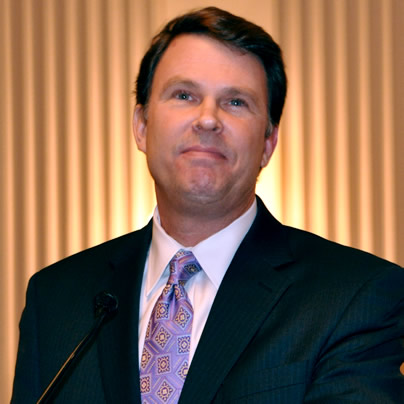

John Berry is departing as OPM director at the end of this week. (Blade file photo by Michael Key)
The official who’s considered the highest-ranking openly gay member of the Obama administration is set to leave his post as director of the Office of Personnel Management at the end of this week.
In an email to workers within the agency, Berry talks of his plans to leave his position at the end of his term after four years of service. The email was first reported by Federal News Radio.
“From my first day on the job through to today, I’ve known that I could count on this team to accomplish great things,” Berry wrote. “Together we undertook big challenges. We aimed to simplify and speed hiring, to boost hiring among Veterans and Americans with disabilities, to catch up and keep up with both retirement and background investigations, and to expand access to health insurance. We’ve done all that and more — much more.”
In the message, Berry says OPM General Counsel Elaine Kaplan, who’s also gay, will take over as acting director. Last month, President Obama nominated her for a seat on the U.S. Court of Federal Claims.
Berry took on the job on April 13, 2009, so his departure will be nearly four years to the day that he started the role. According to Federal News Radio, Berry informed the Chief Human Capital Officers Council earlier this month of his intention to leave. The news outlet also states the position of OPM director is limited to a four-year term, and although Obama can extend the term through re-nomination, there is no indication he will do so.
In a statement on Friday, President Obama praised Berry for his work at OPM, saying he’s “served the American people well” as head of the agency.
“He’s streamlined the way federal employees are hired, modernized the workplace, made the federal workforce more diverse, and increased the number of returning servicemembers hired by the government,” Obama said. “John has been a champion for federal workers – men and women who devote their lives to vital tasks like securing our borders, curing disease, and keeping the American people safe. This country is better off because of John’s talent and dedication, and I’m grateful to him for his service.”
Under Berry’s tenure at OPM, Obama issued a memorandum extending limited benefits to federal workers with same-sex partners. Additionally, OPM proposed a rule that would enable gay federal workers to cover the children of their same-sex partners under federal health insurance.
Berry has been active as an adviser on LGBT issues for the administration. The OPM director was present at the meeting in which White House officials informed LGBT advocates it won’t issue at this time an executive order barring LGBT workplace discrimination among federal contractors, and Berry also took part in a White House meeting with transgender advocates on the Transgender Day of Remembrance.
The Washington Post reported last month that Berry is in the running for the nomination as U.S. ambassador to Australia. His name has often been floated for other positions within the administration — such as secretary of the interior, which ultimately went to Washington State-based businessperson Sally Jewell. Had Berry been chosen, he would have been the first openly gay Cabinet member in the nation’s history.
It’s unclear who’ll be the highest-ranking openly LGBT person within the Obama administration upon Berry’s departure. That distinction may go to Fred Hochberg, who serves as head of the U.S. Export-Import Bank.
Berry’s complete farewell email to employees follows:
As many of you know, my term as Director of OPM will shortly come to a close. Starting April 15th, Elaine Kaplan will serve as Acting Director – and I know that each of you will be just as helpful to her as you’ve been for me.
From my first day on the job through to today, I’ve known that I could count on this team to accomplish great things.
Together we undertook big challenges. We aimed to simplify and speed hiring, to boost hiring among Veterans and Americans with disabilities, to catch up and keep up with both retirement and background investigations, and to expand access to health insurance
We’ve done all that and more – much more.
Today we handle over 2 million background investigations a year so smoothly that we’ve taken the issue off the GAO list.
We’ve eliminated KSA’s and moved to the world of the resume. We’ve given our applicants the respect of timely responses and concise job announcements. More than three-quarters of our job announcements were longer than 5 pages in 2009 –now 69% are shorter than 5 pages. We relaunched –and repaired – USAJOBS, and have now processed over 29 million applications since the update, with feedback that’s better than ever.
We’ve raised the bar in big ways on hiring Veterans – from 24% of new hires in 2009 to 28.3% in 2011, and even higher preliminary numbers in 2012, reaching all-time highs. Likewise, we’ve lifted hiring of Americans with disabilities to all-time highs, at 7.96% of all new hires. Including Veterans who are 30% or more disabled, people with disabilities now represent 14.7% of all new hires – also an all-time high.
We’ve revitalized our appeal for students and recent graduates, with three clear and streamlined pathways that will keep the best talent coming into public service. We’ve taken the lead in boosting diversity and inclusion, with comprehensive plans from every agency, and partnerships both in and out of government. We’ve expanded benefits for same-sex partners of Federal employees to the full extent allowed by law.
We’ve set the Senior Executive Service on a new path to fulfill old principles, with a strengthened merit system, new and better training programs, and an increasingly inclusive culture across agencies – bringing more women and minorities into the SES than ever in its history.
We’ve made Federal health insurance possible for firefighters and emergency response workers, and for over 10,000 tribal employees. On an overhead of less than 0.1% of premiums, we’ve kept premium increases for our 8 million FEHBP members well below the industry average – just 3.4% in each of the past two years. We stood up the Pre-existing Condition Insurance Program, and we’re on our way to certifying quality health insurance plans for the multi-state programs that open this fall.
We’ve systematically worked our way through the backlog in retirement applications, with partners and process changes that met even the challenge of extra retirements from Postal Service buyouts. We gained a new phased retirement authority that’s sure to help smooth transitions and transfer institutional memory through part-time work for aging employees and mentorships for those who take over the reins.
We launched the Feds Feeds Families drive, gathering almost 16 million pounds of food and non-perishables for needy families across the nation.
We brought labor and management together to agree on the GEAR framework for performance management.
We undertook the largest-ever employee viewpoint survey – and at the same time saw our agency climb up the standings to become one of the Federal Government’s best places to work. We’ve used employee wellness programs to quit smoking and lose weight.
We’ve brought our agency website forward at least a decade in both appearance and utility, and we’ve learned the ways of social media to help spread our messages far and wide. Through the CHCO Council and HRU, we’ve saved over $55 million on training, and we’ve proved to agencies that we’re here to help.
We’ve started the ball rolling on changes that will help the Combined Federal Campaign continue its success as the world’s biggest workplace charity drive by making sure that every last dime of employees’ donations go into the charities they’ve chosen.
We’ve weathered a storm or two – even an earthquake – and we’ve expanded telework to keep agencies achieving their missions, no matter what the weather.
We’ve brought great ideas in from the private sector in the form of our Innovation Lab, a place and an approach that is already generating new approaches and new savings.
Through it all, it’s been a tremendous honor to serve as your leader.
Your achievements are many and magnificent – and I deeply appreciate the work you’ve done to make it all possible.
Your grateful Director,
John Berry
UPDATE: This article has been updated to include a statement from President Obama.





Congress
Chris Van Hollen says the Democratic Party needs change. Is he the one to lead it?
Senator is backing anti-establishment Democrats across the country
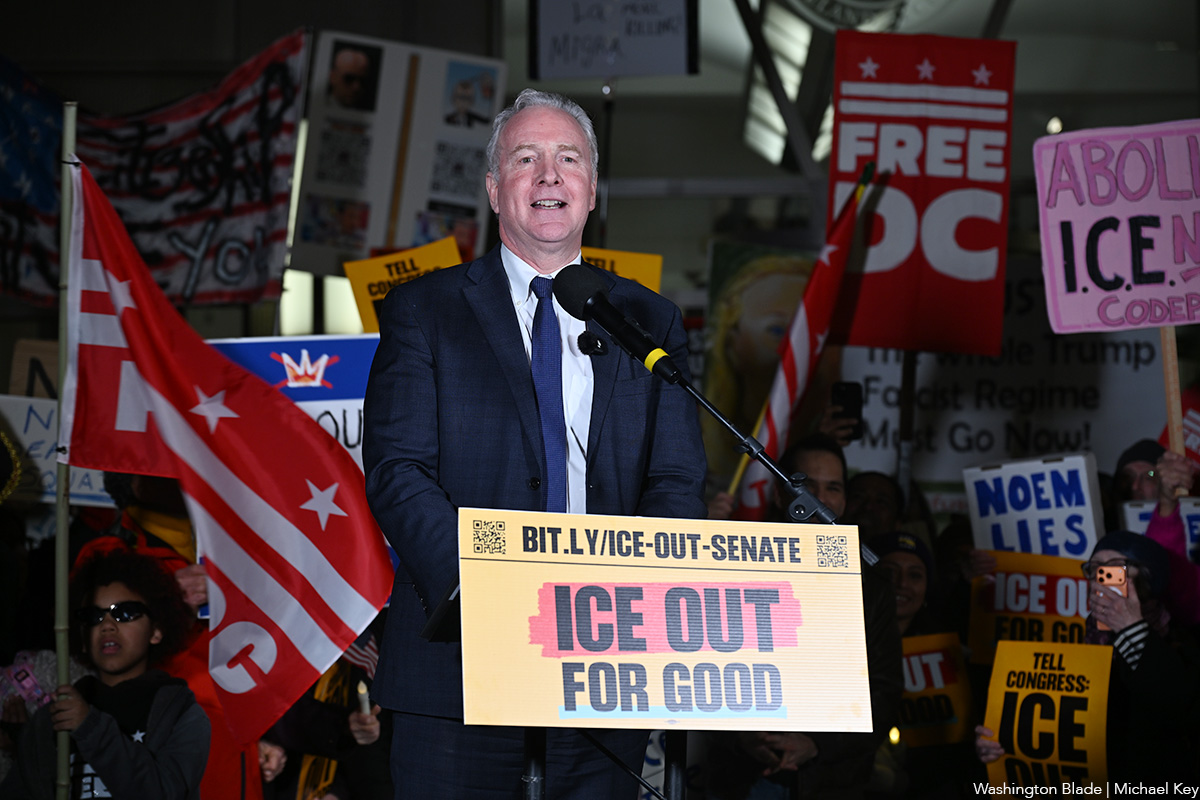
By LEE O. SANDERLIN | The Democratic Party is having something of an identity crisis — losing to President Donald Trump twice in three elections will do that.
Should the party embrace anti-establishment figures who espouse progressive policy ideas like Medicare for all and rhetoric about unrigging the economy for the 1 percent? Or should Democrats try to appeal to moderates who want to return to semi-normalcy in a time of political upheaval?
Although he’s been in Congress since 2002, with key leadership roles throughout his tenure, Maryland Sen. Chris Van Hollen, 67, counts himself firmly in the anti-establishment camp.
The rest of this article can be found on the Baltimore Banner’s website.
Politics
Log Cabin Republicans remove transgender rights from mission
Decision made after ‘significant discussion’ with members, board

Log Cabin Republicans, an organization that formerly represented LGBTQ conservatives, has removed advocating for transgender and queer rights from its “renewed” national advocacy focus.
In an opinion piece written by Log Cabin Republicans President Ross Hemminger for the conservative media outlet Town Hall, he announced that trans rights would no longer be part of what the organization advocates for through conservative leadership and candidates.
In his piece, Hemminger wrote that after “significant discussion” with members and Log Cabin Republicans’ board of directors, the organization’s leadership voted to “refine Log Cabin Republicans’ national advocacy focus to concentrate specifically on issues of sexual orientation and conservative values,” a focus that does not include trans people.
“We have fought for the right to legally marry who we love, serve our country and our communities openly and proudly, and to enjoy the same inalienable rights afforded to all law-abiding Americans — and we succeeded,” Hemminger wrote. “However, the new era of gender identity politics is not the movement we supported and fought for. Gay men and women are losing public support across the country, and support for gay marriage and other once-widely accepted rights is eroding. Why? Because many voters today weren’t alive or cognizant of the politics of gay marriage winding its way through the courts and gaining ground in public opinion. Their view of the gay community is based on today’s radical transgender activists with their unnecessary and discomfiting focus on America’s youth.”
Hemminger then went on to argue that trans advocacy has shifted to focusing primarily on minors — a characterization that does not reflect the breadth of issues trans advocates address.
“They push schools to teach radical gender ideology; they want biological men in women’s sports regardless of the consequences; perhaps most offensively, they support gender reassignment treatments for minors, often without the knowledge or consent of the parents, knowing full well these treatments are mostly irreversible,” he wrote.
Hemminger and many right-wing political leaders have continued to assert this false reality as fact.
A Harvard-affiliated study found approximately 2.1 gender-affirming surgeries occur per 100,000 trans and gender-diverse minors diagnosed with gender dysphoria, underscoring how uncommon these procedures are among minors. In addition to the option of surgery for those who think it’s right for them, there is an array of other medically sound options to treat gender dysphoria, which according to KFF, an independent source for health policy research and polling, includes “medical, surgical, mental health, and non-medical services for transgender and nonbinary people.”
Additionally trans advocacy is not as narrow as Hemminger makes it seem in his opinion piece.
There are a slew of issues the trans community faces — and fights for — on a daily basis that have nothing to do with healthcare. Those include obtaining government documents that accurately reflect one’s gender identity, multiple elements of family law that include the right to marry and adopt children as straight couples can, protections from violence, hate crime protections, the right to serve in the military, access to bathrooms corresponding with their gender, and the right to education.
Despite the overwhelming number of issues trans people — regardless of political affiliation — have to struggle with as a result of systemic gaps in protections that are supposed to be afforded to everyone under the law, they remain vulnerable to unequal treatment.
Despite this shift, Log Cabin Republicans has committed to standing with the Republican Party rather than LGBTQ people as a whole. The organization was initially founded as a loosely connected network of local California social clubs made up of LGBTQ conservatives in the late 1970s before eventually emerging as a national political organization in the early 1990s under its founding executive director, Rich Tafel.
As the organization continued to gain momentum, it endorsed a handful of Republicans who voted against the Respect for Marriage Act, the 2022 law that federally recognized marriage equality for same-sex couples.
The Washington Blade reached out to Log Cabin Republicans for comment but did not hear back by the time of publication.
White House
Trump-Vance administration’s LGBTQ brain drain: what you need to know
Several high profile figures have left government since January 2025
Uncloseted Media published this article on Aug. 21.
By SPENCER MACNAUGHTON and HOPE PISONI | Since President Donald Trump regained office in January 2025, he and his administration have waged an all-out war against the LGBTQ community.
This has led queer Americans to move to other countries at unprecedented rates — Rainbow Railroad, a Canadian nonprofit that supports LGBTQ asylum seekers, reported receiving a huge increase in inquiries from the U.S. last year.
The same pattern is playing out within the government. And it’s leading to a brain drain of competent queer employees and allies who are either resigning or being fired, often because of their LGBTQ identity or their belief that queer people deserve basic human rights.
Here are six examples of federal workers who had a messy exit from Trump 2.0:
Demetre Daskalakis
- WHAT HE DID: Dr. Daskalakis is one of the foremost LGBTQ health professionals in the U.S. Under Trump’s first term, he was appointed director of the Division of HIV/AIDS Prevention at the Centers for Disease Control and Prevention. Under Biden, he also served as the deputy response coordinator for mpox at the White House.
- WHAT HAPPENED: While he continued a lot of this work under Trump 2.0, he didn’t last long. In August 2025, he resigned from the CDC, writing in his resignation letter that he was “unable to serve in an environment that treats CDC as a tool to generate policies and materials that do not reflect scientific reality and are designed to hurt rather than to improve the public’s health.”
- BOTTOM LINE: I recently interviewed Daskalakis, where he told me that leadership from RFK Jr.’s Health and Human Services Department justified HIV cuts by saying the virus is “just too woke.”
Julia Curlee
- WHAT SHE DID: Julia Curlee worked in intelligence for nearly two decades between the CIA and the National Security Council. Earlier this week, she wrote an article in The Atlantic explaining how she had served as Mike Pence’s daily briefer and the NSC’s director for intelligence programs. During Trump 1.0, she briefed the president on Air Force One.
- WHAT HAPPENED: Curlee told CNN this week that in Trump’s second term, her treatment by the federal government transformed. She was no longer allowed to use the women’s bathroom on federal property and had to leave her workplace to relieve herself. Her passport was also reissued to read “male,” which led to complications when traveling abroad. In March 2025, less than 70 days into Trump’s second term, Curlee says she received a call while at a rib joint in Virginia with her family informing her that her White House tour was over and that they couldn’t tell her why. She continued to work for the CIA for some months, but she later resigned.
- BOTTOM LINE: Curlee wrote that moments after she learned she was fired from the White House, she saw a post from right-wing political activist Laura Loomer that read “A transgender, Biden holdover who hates President Trump is still working in the NSC intel office. I’m told there are several NSC staffers who have complained that this trans Biden holdover hasn’t been fired yet, but nothing is being done about it.”
Marc Seawright
- WHAT HE DID: Marc Seawright worked for more than eight years at the U.S. Equal Employment Opportunity Commission. Most recently, he served as the EEOC’s director of information governance and strategy, where he oversaw tech policy to help combat workplace harassment and discrimination.
- WHAT HAPPENED: During Trump 2.0, Seawright was ordered to develop technology that would erase any mention of LGBTQ identities from EEOC outreach materials. “[My expertise] was being leveraged to perpetuate discrimination against people like me,” he told the Associated Press. In that article, Seawright and other transgender and gender nonconforming federal employees described their “fear, grief, frustration, and distress working for the federal government at a time when it rejects them — often with no clear path for recourse or support.”
- BOTTOM LINE: Seawright quit in June, citing a hostile work environment. “It became overwhelming. It felt insurmountable,” he told the AP. He has now hired lawyers at Katz Banks Kumin and has filed a discrimination complaint.
David Maltinsky
- WHAT HE DID: Until 2025, Maltinsky worked for more than 16 years at the FBI as an intelligence specialist. In 2025, he was training to become a special agent, but three weeks ahead of graduation, he was fired.
- WHAT HAPPENED: On Oct. 1, he was delivered a letter from FBI Director Kash Patel informing him that he was being fired for an “inappropriate display of political signage.” The signage in question, according to Maltinsky, was a Pride flag displayed in his work station at a previous post in Los Angeles. The flag had been given to him by the FBI’s LA Field Office, and Maltinsky says he had been told by multiple supervisors that displaying it would not be a violation.
- BOTTOM LINE: Maltinsky is currently suing the FBI and the Department of Justice, arguing that his firing constituted unlawful discrimination.
Mary Brinkmeyer
- WHAT SHE DID: Brinkmeyer had been working as a psychologist for the Department of Veterans Affairs since 2008. She held multiple leadership roles, including the LGBTQ veteran care coordinator at the Hampton VA Medical Center. She established the first military support group for trans servicemembers and was awarded Navy Psychology Civilian Psychologist of the Year in 2016.
- WHAT HAPPENED: Following an early Trump executive order directing the federal government to purge any practices promoting “gender ideology,” Brinkmeyer says staff at her workplace were told to remove all LGBTQ-affirming materials from both public and private areas, as well as to identify “anything in medical records, training materials, or patient resources that could be considered ‘gender ideology.’” When she refused to comply and confronted her supervisor, she says her concerns were dismissed.
- BOTTOM LINE: Brinkmeyer resigned in February 2025, stating that she “didn’t want to be complicit in something that I knew was wrong.”
Amy Paris
- WHAT SHE DID: Paris was the second-highest ranking trans woman in the federal government, serving as a deputy digital services lead in the HHS Department, where she oversaw the safety of organ donations. Prior to that, she worked in a number of tech-related roles across the federal government since the Bush administration. She helped create cross-agency spending trackers, streamlined unemployment insurance during the pandemic and implemented trans-inclusive policies like gender-neutral passports.
- WHAT HAPPENED: Paris was fired as part of a string of mass layoffs across the federal government in February 2025. While the HHS did not publicly comment on why she was fired, Paris says she was told it was because of her performance, despite the fact that she got a 4.75 out of five on her last performance review and was praised for her work by multiple Biden administration officials.
- BOTTOM LINE: Paris told the 19th she suspected her firing was politically motivated, saying the Trump administration is “trying to sow discord and disrupt confidence in the workings of the federal government.”

Immersive ‘Nation-State’ imagines a society free of authoritarianism

New book examines Trump cuts to LGBTQ healthcare

E-INFOSOL leaders encourage youth to pursue tech careers

Milo Yiannopoulos deported to UK

San Francisco, long a queer safe haven, remains competitive for homebuyers

Music icon and dear LGBTQ friend Dolly Parton remembered

Push to elect more LGBTQ ANC members yields results

Please join me in supporting the Washington Blade Foundation

American democracy on the brink