Local
Judge strikes down Virginia gay marriage ban
Two couples filed lawsuit against gay nuptials ban
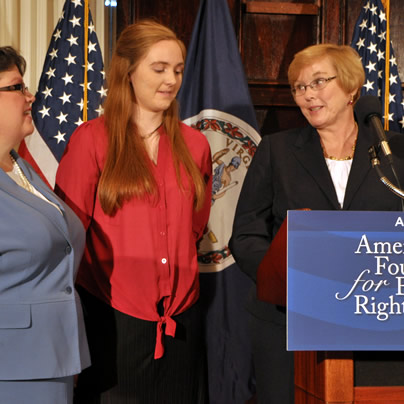
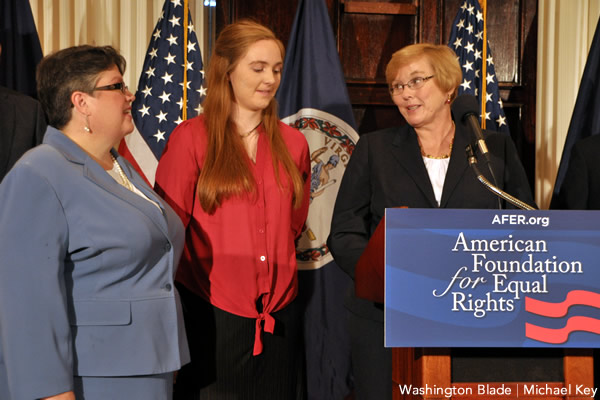
Carol Schall (left) with Mary Townley and their daughter Emily. (Washington Blade photo by Michael Key)
A federal judge Thursday struck down Virginia’s constitutional amendment that defines marriage as between a man and a woman as unconstitutional.
“The court is compelled to conclude that Virginia’s marriage laws unconstitutionally deny Virginia’s gay and lesbian citizens the fundamental freedom to choose to marry,” said Judge Arenda L. Wright Allen of the U.S. District Court for the Eastern District of Virginia. “Government interests in perpetuating traditions, shielding state matters from federal interference, and favoring one model of parenting over others must yield to this country’s cherished protections that ensure the exercise of the private choices of the individual citizen regarding love and family.”
Allen, who President Obama nominated to the federal bench in 2010, repeatedly referenced the U.S. Supreme Court’s landmark 1967 ruling that struck down Virginia’s interracial marriage ban in her 41-page decision. She also opened her decision with a quote from Mildred Loving, who publicly backed marriage rights for same-sex couples before her death in 2008.
“Tradition is revered in the commonwealth, and often rightly so,” said Allen. “However, tradition alone cannot justify denying same-sex couples the right to marry any more than it could justify Virginia’s ban on interracial marriage.”
Allen also dismissed arguments made by those who defend Virginia’s same-sex marriage ban that marriage rights for gays and lesbians harms children.
“Of course the welfare of our children is a legitimate state interest,” she said. “Limiting marriage to opposite-sex couples fails to further this interest. Instead, needlessly stigmatizing and humiliating children who are being raised by the loving couples targeted by Virginia’s Marriage Laws betrays that interest.”
Allen’s ruling comes less than two weeks after she heard oral arguments in a lawsuit that Timothy Bostic and Tony London of Norfolk and Carol Schall and Mary Townley of Chesterfield filed last year.
“We want to be married for the happy times, but we need to be married for the sad times,” Schall told the Washington Blade earlier this month before Wright heard oral arguments in their case. “When one of us is sick or when one of us needs surgery or when health care is an issue, we need to be there for each other. And Virginia should not be in the business of standing in the way of people wanting to care for each other and take responsibility for each other.”
Virginia voters in 2006 approved the marriage amendment by a 57-43 percent margin.
Attorney General Mark Herring last month announced he would not defend the amendment.
The Republican-controlled Virginia House of Delegates earlier this month overwhelmingly approved a bill that would allow any state lawmaker to defend a law if the governor and attorney general decline to do so. Gov. Terry McAuliffe a few days earlier denied a request from 30 state lawmakers to appoint a special counsel to defend the marriage amendment.
A federal judge in Harrisonburg on Jan. 31 certified a second lawsuit the American Civil Liberties Union, Lambda Legal and the ACLU of Virginia filed on behalf of two lesbian couples from the Shenandoah Valley who are seeking marriage rights in the commonwealth as a class action.
“This decision is a victory for the Constitution and for treating everyone equally under the law,” said Herring in a statement after Allen issued her ruling in the Bostic case.
McAuliffe also applauded the decision.
“In order to grow our economy and attract the best businesses, entrepreneurs, and families to Virginia, we must be open and welcoming to all who call our commonwealth home,” he said in a statement. “As this case continues through the judicial process, I will enforce the laws currently on the books, but this decision is a significant step forward in achieving greater equality for all of our citizens.”
Former U.S. Solicitor General Ted Olson, who successfully argued against California’s Proposition 8 before the U.S. Supreme Court with David Boies, joined the lawsuit last September with the American Foundation for Equal Rights. Olson said in an AFER press release that Allen’s decision has “upheld the principles of equality upon which this nation was founded.”
“Virginia’s prohibition on marriage for same-sex couples relegates gay and lesbian Virginians to second-class status,” he said. “Laws excluding gay men and lesbians from marriage violate personal freedom, are an unnecessary government intrusion, and cause serious harm. That type of law cannot stand.”
Equality Virginia Executive Director James Parrish said Wright’s ruling “finally puts Virginia on the path toward allowing lesbian and gay couples to marry the person they love here in the place they call home.”
“This is an historic day in Virginia,” added Parrish.
National Organization for Marriage President Brian Brown blasted Allen.
“This is another example of an Obama-appointed judge twisting the constitution and the rule of law to impose her own views of marriage in defiance of the people of Virginia,” said Brown in a statement.
Brown also again sharply criticized Herring for not defending the commonwealth’s marriage amendment.
“This case also leaves a particular stench because of the unconscionable decision of Attorney General Mark Herring to not only abandon his sworn duty to defend the laws of the state, but to actually join the case against the very people he is duty-bound to represent,” said Brown.
Victoria Cobb, president of the Family Foundation of Virginia, also criticized Herring.
“Regardless of one’s stance on marriage, the people of Virginia were disenfranchised by this ruling as our voice and our vote that amended our Constitution have been rendered meaningless by a single federal judge with the assistance of our own attorney general,” she said.
Neighboring Maryland is among the 18 states and D.C. that have extended marriage rights to same-sex couples.
The Southern Poverty Law Center earlier on Thursday filed a federal lawsuit against Alabama’s same-sex marriage ban on behalf of a gay widower who married his late-husband in Massachusetts in 2011.
A federal judge on Wednesday ruled Kentucky must recognize same-sex marriages legally performed in other states.
Gays and lesbians in West Virginia, Utah, Pennsylvania, Florida, Missouri, Louisiana and other states have filed lawsuits seeking marriage rights in the wake of the U.S. Supreme Court’s landmark decision last June that found a portion of the Defense of Marriage Act unconstitutional. Nevada Attorney General Catherine Cortez Masto earlier this week announced she will no longer defend her state’s same-sex marriage ban in court.
Attorney General Eric Holder on Feb. 10 announced the Justice Department will now recognize same-sex marriages in civil and criminal cases and extend full benefits to gay spouses of police officers and other public safety personnel. This directive applies to Virginia and the 31 other states that have yet to allow nuptials for gays and lesbians.
U.S. Sen. Ted Cruz (R-Texas) earlier on Thursday introduced a bill that would ban the federal government from recognizing same-sex marriages in states that ban gay nuptials.
Allen has stayed her ruling, pending the outcome of an appeal.



Rehoboth Beach
BLUF leather social set for April 10 in Rehoboth
Attendees encouraged to wear appropriate gear

Diego’s in Rehoboth Beach hosts a monthly leather happy hour. April’s edition is scheduled for Friday, April 10, 5-7 p.m. Attendees are encouraged to wear appropriate gear. The event is billed as an official event of BLUF, the free community group for men interested in leather. After happy hour, the attendees are encouraged to reconvene at Local Bootlegging Company for dinner, which allows cigar smoking. There’s no cover charge for either event.
District of Columbia
Celebrations of life planned for Sean Bartel
Two memorial events scheduled in D.C.
Two celebrations of life are planned for Sean Christopher Bartel, 48, who was found deceased on a hiking trail in Argentina on or around March 15. Bartel began his career as a television news reporter and news anchor at stations in Louisville, Ky., and Evansville, Ind., before serving as Senior Video Producer for the D.C.-based International Brotherhood of Electrical Workers union from 2013 to 2024.
A memorial gathering is planned for Friday, April 10, 11:30 a.m.-1:30 p.m. at the IBEW International Office (900 7th St., N.W.), according to a statement by the DC Gay Flag Football League, where Bartel was a longtime member. A celebration of life is planned that same evening, 6-8 p.m. at Trade (1410 14th St., N.W.).
District of Columbia
D.C. Council member honored by LGBTQ homeless youth group
Doni Crawford receives inaugural Wanda Alston Legacy Award

About 100 people turned out Tuesday evening, April 7, for a presentation by D.C.’s Wanda Alston Foundation of its inaugural Wanda Alston Legacy Award to D.C. Council member Doni Crawford (I-At-Large) for her support for the foundation’s mission to support homeless LGBTQ youth.
Among those who attended the event was Japer Bowles, director of D.C. Mayor Muriel Bowser’s Office of LGBTQ Affairs, who delivered an official proclamation issued by Bowser declaring April 7, 2026 “A Day of Remembrance for Wanda Alston.”
Alston, a beloved women’s and LGBTQ rights activist, served as the city’s first director of the then newly created Office of LGBTQ Affairs under then-Mayor Anthony Williams from 2004 until her death by murder on March 16, 2005.
To the shock and dismay of fellow LGBTQ rights advocates, police and court records reported Alston, 45, was stabbed to death inside her Northeast D.C. house by a man high on crack cocaine who lived nearby and who stole her credit cards and car. The perpetrator, William Martin Parrott, 38, was arrested by D.C. police the next day and later pleaded guilty to second-degree murder. He was sentenced in July 2005 to 24 years in prison.
Crawford was among those attending the award event who reflected on Alston’s legacy and outspoken advocacy for LGBTQ and feminist causes.
“I am deeply humbled and honored to receive this inaugural award,” Crawford told the Washington Blade at the conclusion of the event. “I think the world of Wanda Alston. She has set such a great foundation for me and other Council members to build on,” she said.
“Her focus on inclusivity and intersectionality is really important as we approach this work,” Crawford added. “And it’s going to guide my work at the Council every day.”
Crawford was appointed to the D.C. Council in January of this year to replace then Council member Kenyan McDuffie (I-At-Large), who resigned to run for D.C. mayor as a Democrat. She is being challenged by four other independent candidates in a June 16 special election for the Council seat.
Under the city’s Home Rule Charter written and approved by Congress, the seat is one of two D.C. Council at-large seats that cannot be held by a “majority party” candidate, meaning a Democrat.
A statement released by the Alston Foundation last month announcing Crawford’s selection for the Wanda Alston Legacy Award praised Crawford’s record of support for its work on behalf of LGBTQ youth.
“From behind the scenes to now serving as an At-Large Council member, she has fought fearlessly for affordable housing, LGBTQ+ funding priorities, and racial justice,” the statement says. “Council member Crawford’s leadership reflects the same courage and conviction that defined Wanda’s legacy.”
Organizers of the event noted that it was held on what would have been Wanda Alston’s 67th birthday.
“Today’s legacy reception was a smashing success,” said Cesar Toledo, the Alston Foundation’s executive director. “Not only did we come together to celebrate Wanda Alston on her birthday, but we also were able to raise over $10,000 for our homeless LGBTQ youth here in D.C.,” Toledo told the Blade.
“In addition to that, we celebrated and we acknowledged a rising star in our community,” he said. “And that is At-Large Council member Doni Crawford, who we named the inaugural Wanda Alston Legacy Award recipient.”
At the request of D.C. Council Chair Phil Mendelson (D-At-Large) the Council voted unanimously on Jan. 20, 2026, to appoint Crawford to the Council seat being vacated by McDuffie.
Council records show she joined McDuffie’s Council staff in 2022 as a policy adviser and later became his legislative director before McDuffie appointed her as staff director for the Council’s Committee on Business and Economic Development for which McDuffie served as chair.

Calendar: April 10-16

BLUF leather social set for April 10 in Rehoboth

Celebrations of life planned for Sean Bartel

The ‘X’ returns to court

LGBTQ community explores arming up during heated political times

Risking it all for love during World War II

D.C. is the place for the Democratic Socialists of America

PHOTOS: The Bonnet Ball

Key lifestyle changes can help patients cope with diabetes