Asia
US funding freeze leaves South Asian LGBTQ groups reeling
USAID projects supported transgender, gender-diverse communities
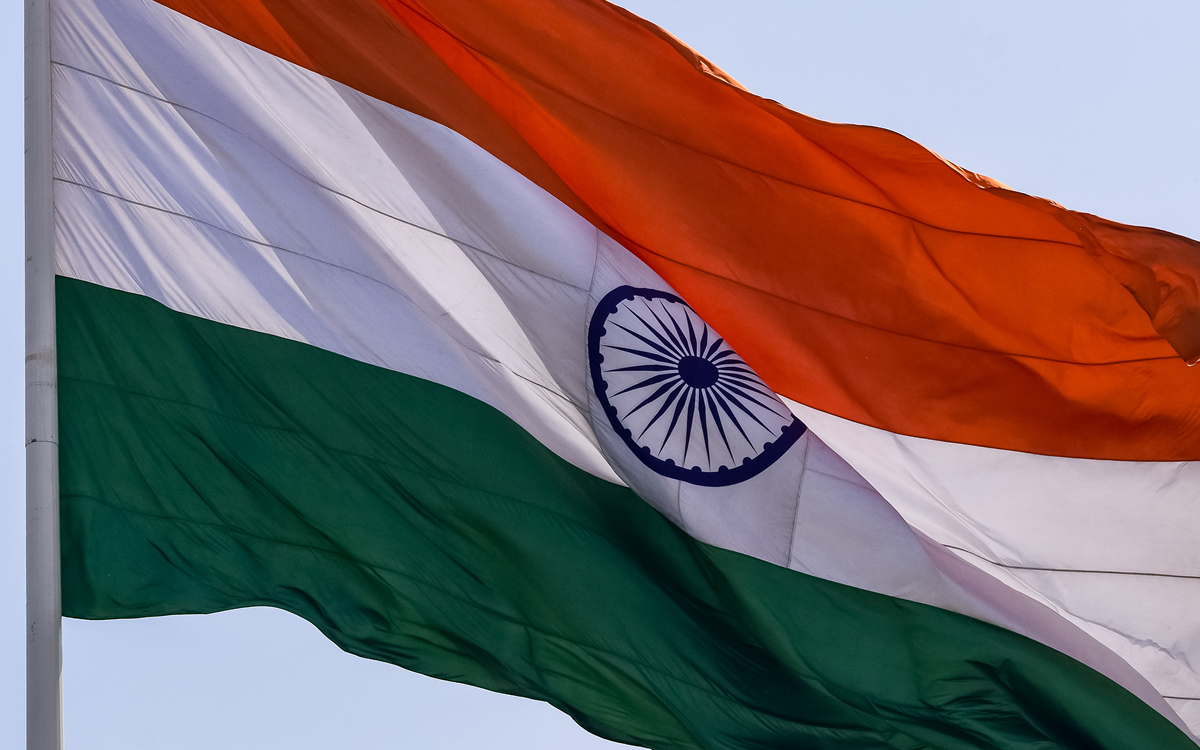
The Trump-Vance administration’s decision to freeze nearly all U.S. foreign aid has had a devastating impact on LGBTQ communities in India, Nepal, Bangladesh, and Pakistan
The suspension of aid has slashed critical USAID-funded projects; jeopardizing healthcare, jobs, and services for LGBTQ communities that often rely on such funds to bridge gaps their own governments overlook.
USAID for years championed LGBTQ communities around the world through initiatives like the LGBTI Global Development Partnership, which has awarded more than 100 grants to civil society organizations and trained more than 1,700 LGBTQ entrepreneurs and business owners.
USAID in 2022 launched the Alliance for Global Equality, a 5-year collaboration that Outright International and the LGBTQ+ Victory Institute led. This initiative by March 2024 had awarded 39 grants in 16 countries, totaling nearly $800,000, to advance LGBTQ human rights and inclusion.
In Nepal, USAID has supported efforts that include the Rights for Gender Diverse Populations program, partnering with local groups to raise awareness of LGBTQ rights and improve access to healthcare and legal services for marginalized communities.
India’s MIST LGBTQ Foundation, based in Pune in Maharashtra state, is reeling from the funding freeze and is scrambling for alternative resources to sustain its mission.
MIST has been a lifeline for the LGBTQ community, driving HIV prevention, distributing PrEP, and spearheading empowerment programs, while partnering with doctors and mental health experts. Reports show the group delivered over 200 PrEP kits and conducted 300 HIV tests each month, a vital effort now at risk as the funding drought threatens to stall its work.
MIST has been a vital bridge for India’s LGBTQ community, reaching those who might otherwise go unserved because they are often wary of approaching NGOs or government-run testing centers due to stigma or distrust.
“Along with USAID, we have managed to ensure test kits reach the homes of those who want to test at home,” said Shyam Konnur, MIST’s founder and CEO, during an interview with Indian Express, a prominent English newspaper in India. “Distribution of PrEP and condoms were also part of the initiative, MIST bore the cost of parcelling and shipping the kits.”
The Indian Express reported MIST is now approaching corporate leaders and individual donors to help fill the funding gap.
The U.S. Embassy in India last June in New Delhi launched an open competition for Empowering LGBTQI+ Community Leadership, a program designed to promote equal access and hone leadership skills for India’s LGBTQ community. Aimed at training at least 200 leaders—prioritizing transgender and intersex people—the 12-month effort offered a grant between $120,000 and $150,000.
The program’s future is now in doubt.
The U.S. President’s Emergency Plan for AIDS Relief (PEPFAR) and USAID in January 2021 supported Program ACCELERATE, led by the Johns Hopkins University School of Medicine, to establish Mitr Clinic, India’s first comprehensive health center for the trans community in Hyderabad in Telangana state.
U.S. Sen. John Kennedy (R-La.) on Feb. 9 criticized PEPFAR using American tax dollars to fund such trans clinics. The Louisiana Republican’s X post specifically noted Mitr.
Mitr did not respond to the Washington Blade’s repeated requests for comment.
South First, an Indian news outlet, later reported the clinic closed because of the USAID funding disruptions. Telangana’s state-run Maithri Clinic, which has served similar populations since 2018, will reportedly not receive state funding.
Span, a magazine that the U.S. Embassy in New Delhi has published since 1960 in order to foster ties between the U.S. and India, one highlighted the Mitr clinic. The U.S. Consulate General in Mumbai last August celebrated the clinic’s achievements with an Instagram post. The Span report on the clinic has been removed from its website.
The Blade reached out to the Humsafar Trust, a Mumbai-based advocacy group, for comment, but it declined.
Known for its work in HIV prevention and care, the Humsafar Trust has collaborated with USAID on efforts targeting men who have sex with men and trans people. It has also spearheaded more than 25 national and international research studies—some backed by USAID—to shape policies and programs for India’s LGBTQ community.
The Democratic Processes Project, which USAID launched in Nepal on May 27, 2024, sought to bolster inclusiveness and responsiveness of the country’s democratic systems and make them more resilient. With a sharp focus on empowering marginalized groups—including the LGBTQ community—the initiative aimed to amplify their role in governance and decision-making, while strengthening civic engagement and institutional capacity to serve all citizens equitably.
A report in the Diplomat warns that President Donald Trump’s Jan. 20 executive order that says the U.S. federal government will only recognize two genders—male and female— has left Nepal’s LGBTQ community on edge. The directive, which also halts federal funding for trans-related programs, threatens the more than a dozen LGBTQ groups that work in Nepal and could cost more than 300 community members their jobs.
“While this will impact U.S.-funded organizations, projects and jobs, said Sunil Babu Pant, LGBTQ rights activist and Asia’s first openly gay parliamentarian, in an interview with the Diplomat. “It will not impact the entire LGBTQI community as condoms are affordable, antiretroviral therapy for HIV and sexual health programs are already included in the government budget.”
The Blade contacted the Blue Diamond Society, a leading LGBTQ rights group in Nepal that Babu founded and a longtime USAID beneficiary, for comment on the funding freeze. The organization did not immediately respond.
Meanwhile, the Nepali Times reports that nearly $700 million in USAID grants, slated to support Nepal through 2027, are now in doubt.
In Bangladesh, USAID has been a key force in advancing LGBTQ initiatives.
The country’s parliament recognized “hijras” as a third gender in 2014, and USAID in 2021 worked with local organizations to ensure their inclusion in the national Census.
Through its Rights for Gender Diverse Populations program, USAID sought to strengthen civil society, training human rights activists to document and address violations while helping LGBTQ people navigate their rights. USAID also joined forces with 15 local radio stations to broadcast gender diversity awareness nationwide.
USAID in May 2023 partnered with the Bandhu Social Welfare Society and Sompriti Samaj, a Bangladeshi NGO focused on community empowerment, to launch the SHOMOTA (Equality) Project—a 5-year effort to uplift Bangladesh’s gender-diverse populations.
The initiative sought to boost the socio-economic and cultural standing of trans and hijra communities in eight cities: Dhaka, Chattogram, Sylhet, Khulna, Mymensingh, Rajshahi, Rangpur, and Barishal. It planned to directly support 8,700 people and provide vital resources and outreach to 4,750 more, including organizations, through 2028.
More than 100 development projects launched in Bangladesh with USAID backing ground to a halt after Trump issued his executive order, putting the jobs of roughly 50,000 NGO employees at risk.
In Pakistan, the USAID funding freeze dealt a sharp blow to HIV/AIDS prevention and treatment programs, hitting trans people and men who have sex with men especially hard. Once sustained by USAID support, these initiatives provided critical medications and care, but their sudden suspension has left many without access to life-saving antiretrovirals and support services. Local organizations championing LGBTQ rights and inclusion, reliant on those funds, have been forced to scale back or close down.





India
Proposed Indian foreign funding law overhaul could further pressure LGBTQ groups
Measure introduced in Parliament earlier this year
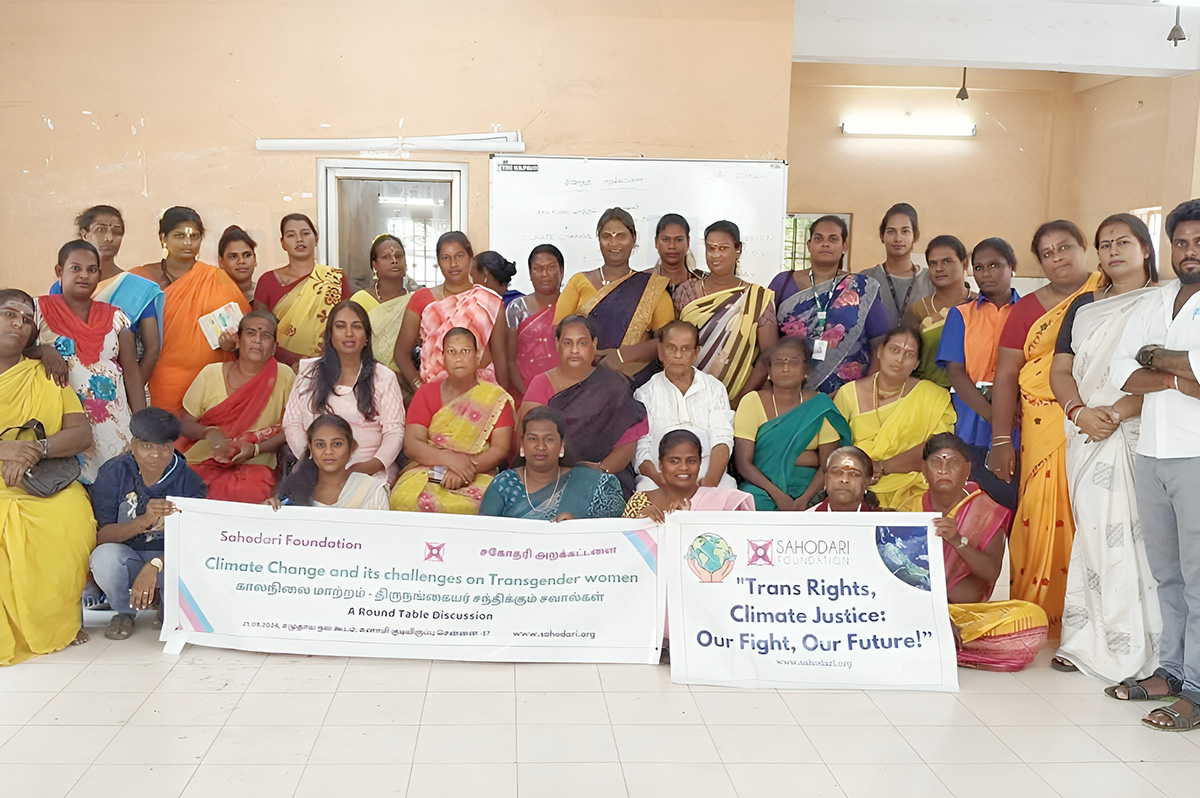
India’s proposed overhaul of its foreign funding law could put LGBTQ organizations that depend on overseas donations under new pressure.
Introduced in the Lok Sabha, the lower house of Parliament, on March 25, the Foreign Contribution (Regulation) Amendment Bill, 2026, or FCRA, would give a government-designated authority control over foreign funds, and assets when an organization loses or surrenders its registration.
The Foreign Contribution (Regulation) Amendment Bill returned to the spotlight this month as the Indian government prepared to seek its passage during Parliament’s Monsoon Session; drawing fierce opposition from political parties, civil society groups and religious organizations.
The government says the bill is intended to address gaps in the management of foreign funds and assets when an organization’s FCRA registration is cancelled, surrendered, or expires. The Foreign Contribution (Regulation) Amendment Bill, 2026, would create a Designated Authority to oversee the vesting, supervision, management, and disposal of foreign contributions and assets when an organization’s FCRA registration is cancelled, surrendered , or ceases. If a vested asset is a place of worship, the authority would be required to preserve its religious character. The FCRA would also reduce the maximum prison term for violating the law from five years to one year.
The changes could also make it difficult for organizations to leave the FCRA regime without surrendering assets created with foreign funds. Under the bill, an organization would have to keep renewing its FCRA certificate to retain those assets. FCRA rules also impose spending requirements on organizations seeking to maintain their certificates.
The bill may also create a distinction between assets created by organizations with FCRA registration and those created through the separate prior-permission route.
More significantly, neither the existing law nor the bill provides an appeal mechanism when the central government refuses to renew an FCRA certificate. They also do not expressly require the organization to be given an opportunity to be heard before renewal is denied. Under the proposed framework, such a denial could trigger the vesting of the organization’s foreign-funded assets in the Designated Authority.
The bill would also widen the circle of people who could face consequences for an organization’s FCRA violations.
Its definition of “key functionary” extends beyond directors and office bearers to trustees, governing-body members, managing-committee members and others responsible for an organization’s affairs. Those functionaries could be held liable for offenses committed by the organization, unless they can show that they were unaware of the violation or had exercised due diligence to prevent it. The FCRA bill would also impose restrictions on dealing with foreign-funded assets during a suspension and leave several important operational details — including timelines and procedures for managing and returning assets — to rules that have yet to be prescribed.
Parliament on Aug 12 moved to refer the FCRA bill to a parliamentary committee for further scrutiny and wider consultations.
Minister of State for Home Nityanand Rai moved the motion in the Lok Sabha, to refer the bill to a committee comprising 21 members of the lower house and 10 members of the Rajya Sabha, Parliament’s upper house.
The Rajya Sabha subsequently approved the nomination of its 10 members to the committee. The panel is expected to submit its report by the last day of the first week of Parliament’s Winter Session.
The proposed changes could have significant implications for LGBTQ organizations that rely on the FCRA framework to receive foreign contributions. (The global LGBTQ and intersex rights movement since the Trump-Vance administration took office in 2025 has lost nearly $50 million in U.S. funding because of foreign aid cuts. One source with whom the Washington Blade spoke described the funding loss as a “catastrophe” for the global movement.)
While the government does not appear to have published an easily accessible, consolidated list of LGBTQ organizations receiving such funding, FCRA registration records and organizations’ financial disclosures indicate that foreign contributions have supported LGBTQ rights, healthcare, and community services in India.
K.C. Venugopal, general secretary of the opposition Indian National Congress, told reporters his party and other opposition parties would strongly protest the legislation if it were introduced in Parliament. He said the bill was aimed at targeting minorities and NGOs and vowed that the opposition would oppose its passage.
Venugopal called the proposed legislation “unconstitutional and anti-people.”
“If the Central Government thinks they can cook up and introduce the Foreign Contribution (Regulation) Amendment Bill within these two or three days, they should keep that wish to themselves,” he told reporters in Alappuzha, Kerala, on Aug. 9.
“Three provisions worry LGBTQ+ organizations like ours most directly,” said Souvik Saha, founder of People for Change and Jamshedpur Queer Circle. “First, the 2026 bill would let a government-appointed ‘Designated Authority’ take control of an organization’s foreign-funded assets— bank balances, equipments, sometimes even property— the moment its FCRA registration is cancelled, surrendered, or simply not renewed, and this happens through an administrative process, without prior judicial adjudication. For a small community organization, that means losing everything we have built — case files, shelter infrastructure, helpline equipment — almost overnight, with no court hearing first.”
Saha told the Blade the revised FCRA Rules announced in June introduced a minimum spending threshold: organizations must spend at least $10,449 in foreign contributions over two financial years or risk cancellation and non-renewal of their registration.
“This specifically penalizes small and grassroots groups that deliberately keep their foreign funding modest — which describes most LGBTQ organizations in India, including ours,” said Saha. “We are not running core-scale budgets; we are running helplines, safe spaces, and district-level outreach on modest grants.”
Saha told the Blade that the ban on sub-granting, carried over from the 2020 amendment, means larger, well-established rights organizations cannot pass foreign funds to smaller, unregistered LGBTQ collectives that could not obtain FCRA registration themselves. He said rights groups have long described the restriction as a near “death knell” for hundreds of small nongovernmental organizations that work collaboratively with larger organizations, adding that LGBTQ groups outside major metropolitan areas depend heavily on such funding arrangements.
“Domestic funding for LGBTQ work in India is still thin, CSR (Corporate Social Responsibility) money avoids us because we are seen as ‘controversial,’ and most Indian foundations would not touch gender-identity programming,” Saha said. “So foreign funding is not a convenience for organizations working with the transgender and LGBTQ community, it is often always funding.”
Netherlands
Thailand’s first openly gay senator attends World Pride in Amsterdam
Blade sat down with Pornchai Witayalerdpan on Aug. 7
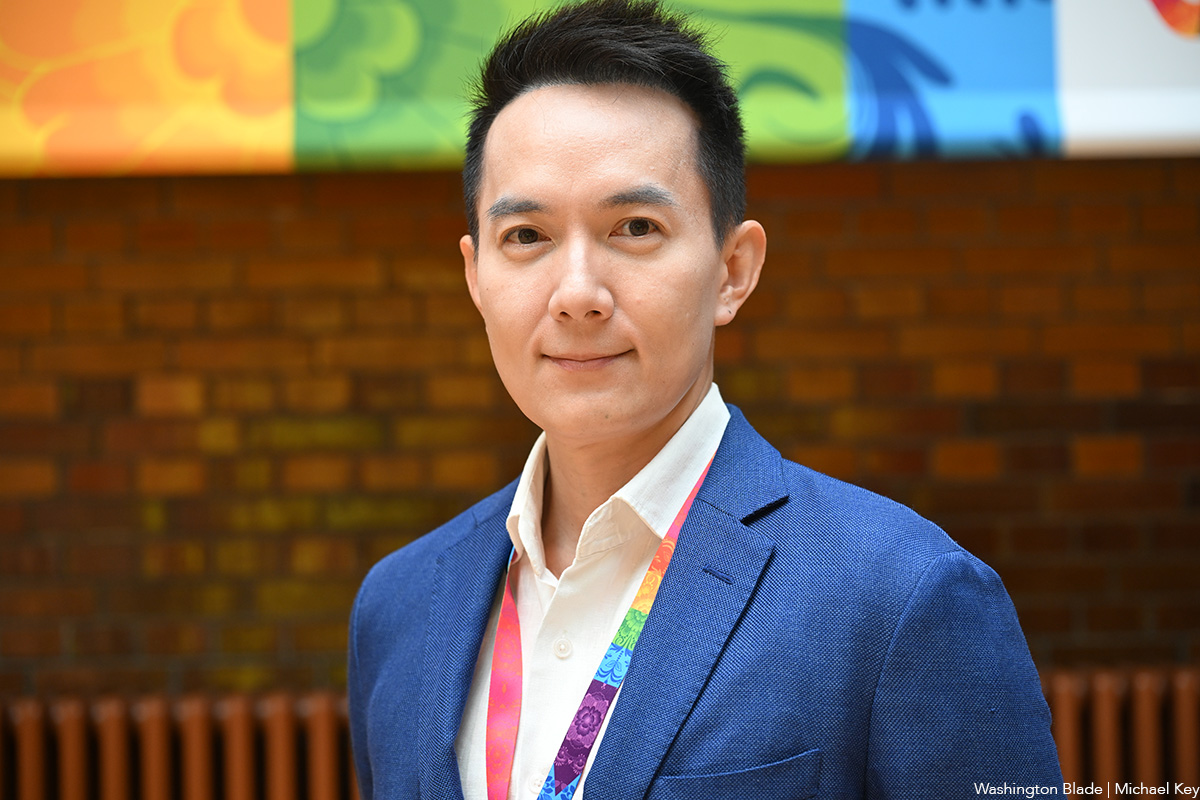
Editor’s note: International News Editor Michael K. Lavers and Photo Editor Michael Key were on assignment in the Netherlands from July 28-Aug. 10.
AMSTERDAM — The first openly gay man elected to the Thai Senate says the law that extended marriage rights to same-sex couples in Thailand has positively impacted his country’s global image.
“It totally changed how the world perceived Thailand,” Sen. Pornchai Witayalerdpan told the Washington Blade on Aug. 7 during an interview at the World Pride Human Rights Conference in Amsterdam.
Thailand on Jan. 23, 2025, became the first country in Southeast Asia to allow same-sex couples to legally marry.
The marriage equality bill received final legislative approval in June 2024 when the Senate approved it by a 152-130 vote margin. King Maha Vajiralongkorn signed it a few months later. Then-Prime Minister Prime Minister Paetongtarn Shinawatra is among those who supported the law.
Witayalerdpan was a freelance interpreter before he took office in July 2024.
The independent senator noted Thailand’s marriage equality movement began to gain traction with a lawsuit that the Foundation for Sexual Orientation and Gender Identity Rights and Justice, a Thai advocacy group, filed.
The Constitutional Court in 2021 upheld a law that defined marriage as between a man and a woman. MP Tunyawaj Kamolwongwat of the Move Forward Party later introduced the marriage equality bill that became law.
“It was a coalition of efforts between the civil society organizations, the LGBTQ organizations, and also the Pride movement in Thailand,” Witayalerdpan told the Blade.
Taiwan in 2019 became the first country in Asia to extend marriage rights to same-sex couples.
The Nepalese Supreme Court in June issued a landmark ruling that ordered the country’s government to guarantee full marriage rights to same-sex couples.
The Japanese Supreme Court in March said it will consider six marriage equality lawsuits that have been filed in the country. The Indian Supreme Court in 2023 ruled against marriage rights for same-sex couples. South Korea is among the other Asian countries in which marriage equality efforts are gaining momentum.
Witayalerdpan said Thailand’s marriage equality law could have a direct impact in Japan, which is the only G7 country that does not legally recognize same-sex couples.
“It’s been nothing but a positive effect (in Thailand) after the same-sex marriage law (took effect),” he said.
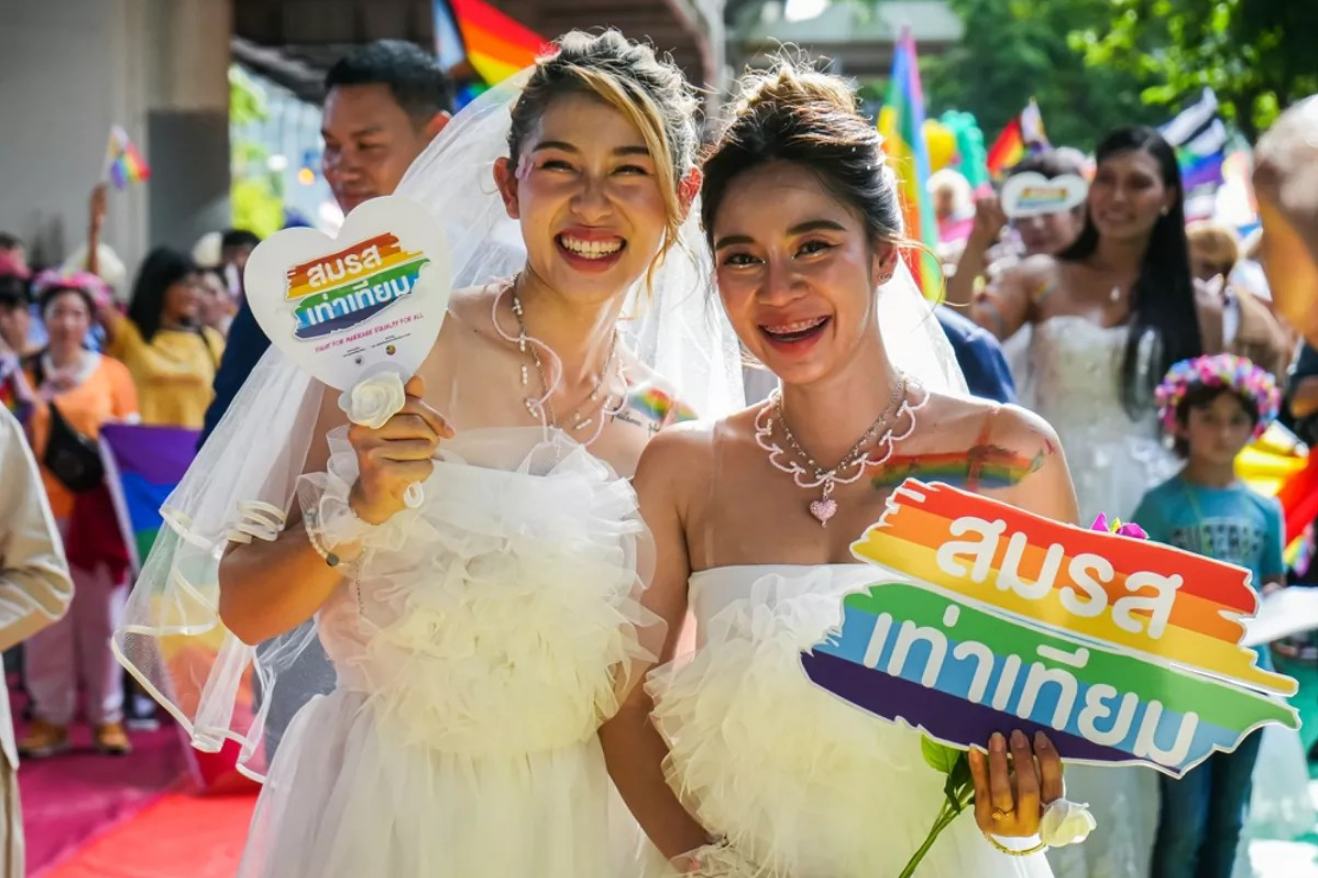
InterPride, the organization that coordinates World Pride events, has announced Bangkok and Barcelona, Spain, are the two finalists to host the biennial event in 2030. (World Pride took place in D.C. in 2025.)
Witayalerdpan told the Blade that World Pride in Bangkok would further improve Thailand’s global image. He also said his fellow lawmakers, in turn, should pass LGBTQ rights bills — including proposals that would allow transgender people to legally change their name and gender and enable same-sex couples to have children via surrogates from in vitro fertilization. Witayalerdpan noted the most important bill to him is one that would strengthen Thailand’s LGBTQ-inclusive nondiscrimination law that took effect in 2015.
Impact of US funding cuts has ‘been very hard’
Witayalerdpan also offered advice to activists in the U.S. and elsewhere around the world.
“Keep on pushing forward,” he told the Blade. “I know that it’s hard for activists in Thailand as well.”
Witayalerdpan acknowledged the loss of U.S. government funding since the Trump-Vance administration took office — which has forced advocacy groups in Asia and elsewhere around the world to close — has “been very hard.” Witayalerdpan noted the global LGBTQ and intersex rights movement in response to these cuts has turned to the European Union, the U.K., Canada, and the Netherlands to help fill the gap.
“It’s very good that these countries are providing more funds to the activists in Asia than before because of the Trump situation,” he told the Blade. “It can increase their soft power as well.”
Witayalerdpan said American activists should “wish for a positive result in the mid-term elections.”
“Then there is some resistance,” he added.
Witayalerdpan specifically highlighted efforts to fight against the Trump-Vance administration’s efforts to restrict gender-affirming healthcare.
A federal court in Massachusetts on Aug. 15 struck down a key provision of a U.S. Department of Health and Human Service rule that would have limited access to gender-affirming care under the Affordable Care Act. Maryland and California are two of the 21 states that sued the Trump-Vance administration over the issue.
“You have to show more resistance … to show that we are still here and we will push back when we can,” said Witayalerdpan.
India’s Income Tax Department has opposed a same-sex couple’s petition that challenges Section 56(2)(x) of the Income Tax Act.
The provision exempts gifts between spouses from tax. The couple seeks the same benefit for their relationship.
At the center of the challenge is the explanation to the fifth provision of Section 56(2)(x). According to the petition, the provision excludes same-sex partners from the definition of “spouse.” The petition describes that exclusion as unconstitutional.
The provision defines “relative” to include an individual’s spouse, siblings, the spouse’s siblings, parents’ siblings, and other blood relatives.
Paiyo Ashiho and another petitioner, Vivek Divan, asked the Bombay High Court to recognize same-sex couples presumed to be in a marriage as “spouses” under the fifth provision to Section 56(2)(x).
A similar challenge is pending before the Karnataka High Court.
Bengaluru-based engineers Anurag Kalia and Akhilesh Godi have sought similar relief. Kalia said he wanted to give Godi a gold bracelet worth more than ₹115,500 ($1213.44.). The case remains pending.
The Prime Minister Narendra Modi-led government rejected the petition in an affidavit filed last year. It argued the plea was not legally tenable because it challenged no action or order of the Income Tax Department. Calling the petition an “abuse of process of law,” the government said the relief sought fell outside the scope of the Income Tax Act, 1961.
The government also argued the petitioners sought the benefits available to a “spouse” without legal recognition of their relationship. According to the affidavit, they had not placed on record any law recognizing their relationship as a marriage. It urged the court to dismiss the petition with costs.
The case returned to the spotlight on July 6, when the Bombay High Court heard the petition.
Justices B.P. Colabawalla and Firdosh P. Pooniwalla adjourned the matter after Solicitor General Tushar Mehta said he would appear on behalf of Modi’s government.
The petition comes nearly two years after the Indian Supreme Court’s marriage equality ruling.
In 2023, a five-judge Constitution Bench, in a 3-2 verdict, declined to recognize the constitutional validity of same-sex marriage in India. The country’s top court said MPs must decide whether to extend marriage rights to same-sex couples.
During the 2023 marriage equality hearings, lawyer Abhishek Manu Singhvi told the Supreme Court that marriage is a source of social validation, dignity, self-respect, fulfillment, and security. He argued that it also carries legal and civil benefits, including those related to taxation, inheritance, and adoption. Lawyer Anand Grover, who also appeared for the petitioners, told the court that marriage remains fundamental to the functioning of society and is necessary to access several state benefits, including joint tax benefits and surrogacy rights.
Chief Justice Dhananjaya Y. Chandrachud, in his minority opinion, said the Income Tax Act provides numerous tax benefits for payments made on behalf of a spouse, including deductions for life and health insurance premiums. He also noted that marriage confers several financial benefits on a spouse, including eligibility for gratuity, funeral expenses, medical benefits, and provident fund claims as the dependent of a deceased spouse.
In the marriage equality ruling, the Supreme Court recognized queer people cannot be discriminated against. The court said denying queer couples the material benefits and services available to heterosexual couples violates their fundamental rights.
While issuing directions to the federal, state, and territory governments; Chandrachud said the government should ensure there was no discrimination in access to goods and services. He also directed governments to sensitize the public about queer rights, establish a hotline for the queer community, create safe houses for queer couples, and ensure intersex children were not forced to undergo medical operations.
The petition is awaiting its next hearing before the Bombay High Court.
India’s tax system relies on both direct and indirect taxes, although its direct tax base remains relatively narrow. Individuals pay income tax at progressive rates of up to 30 percent, while consumers pay taxes on most goods and services through the Goods and Services Tax. The Income Tax Act also provides exemptions, deductions, and other tax benefits for eligible taxpayers, including those linked to family relationships and legal marital status.
India’s LGBTQ community is estimated to comprise between 135 million and 140 million people, or nearly 10 percent of the country’s population. Collectively, it is estimated to have a purchasing power exceeding $168 billion. The World Bank estimated that exclusion based on sexual orientation and gender identity cost India between $1.9 billion and $30.8 billion in lost economic output annually, or up to 1.7 percent of its gross domestic product.
India imposed a separate Gift Tax Act in 1958 to tax certain transfers of property made without consideration. Parliament repealed the law in 1998 to simplify the tax system and encourage genuine gifting. However, concerns over tax avoidance later prompted the government to bring gifts back within the Income Tax Act. Today, specified gifts exceeding prescribed limits may be taxed under Section 56(2)(x), subject to exemptions that include gifts received from relatives.
Under the Income Tax Act, gifts received from non-relatives exceeding ₹50,000 ($525.30) in a financial year are generally treated as taxable income, unless they qualify for a statutory exemption. Gifts received from specified relatives, including a spouse, are exempt from tax regardless of their value.
Tarun Khaitan — a research director and professor of public law at the London School of Economics Law School, honorary professorial fellow at Melbourne Law School, and associate fellow of the Bonavero Institute of Human Rights at the University of Oxford — told the Washington Blade the guarantee of equality and non-discrimination under India’s constitution was deliberately framed in broad terms because its framers envisaged that the understanding of those principles would evolve over time. They did not intend to freeze their meaning in 1950, he said. Instead, older and newer statutes alike must be interpreted in light of the constitution’s contemporary understanding.
“Constitutional values must inform the interpretation of all laws in India. It is well established in Indian jurisprudence that if a term can carry two meanings, the court will give it the meaning that complies with constitutional demands,” Khaitan said. “The term ‘spouse’ is not defined in the Income Tax Act, and unlike ‘husband’ or ‘wife’ is not a legal term of art in Indian family law. Its use by the Income Tax Act therefore is apt for judicial interpretation, which must be guided by the constitutional guarantees of equality and liberty.”
Asked how courts should balance respect for legislative choices with their constitutional responsibility to safeguard equality and dignity, Khaitan said he was not convinced that the legislature had made a clear choice in this case. He noted that the Income Tax Act uses the term “spouse” without defining it, adding that no other Indian law, to his knowledge, defines the term either. Its meaning has evolved over time, he said, pointing to the Oxford English Dictionary, which now defines a spouse as “a husband or wife, or a person joined to another in a comparable legally recognized union.”
Khaitan said the decision to restrict the meaning of “spouse” to different-sex married couples appeared to be the government’s interpretation rather than one expressly adopted by MPs. Even so, he said, courts have a duty to safeguard constitutional rights, although those rights are not absolute. The state, he said, must justify any restriction by demonstrating that it serves a sufficiently important public interest and that the limitation is proportionate to that objective.
“The extension of marriage would be a symbolic expression of equal acceptance of same-sex relations by law as well as a the extension of the bundle of material incidents that typically attach to it. Whether or not such extension happens, concerns such as inheritance, hospital visitation rights, decisions regarding end of life care, pensions etc affect the lives of same-sex couples as well as unmarried different-sex couples in a real, material sense,” Khaitan said. “There is no conceptual reason why the expressive salience of ‘marriage’ and the material incidents of a domestic partnership cannot be unbundled.”
Khaitan has had his scholarship cited by the Supreme Court in several constitutional cases, including Navtej Singh Johar v. Union of India, which decriminalized consensual same-sex relations, and Lt. Col. Nitisha v. Union of India, a landmark judgment on indirect discrimination.

New book examines Trump cuts to LGBTQ healthcare

E-INFOSOL leaders encourage youth to pursue tech careers

Milo Yiannopoulos deported to UK

San Francisco, long a queer safe haven, remains competitive for homebuyers

For LGBTQ youth starting with nothing, Pride House in Florida offers help

Dolly Parton dies at 80

Music icon and dear LGBTQ friend Dolly Parton remembered

New data shows record-high LGBTQ population amid Trump attacks

Push to elect more LGBTQ ANC members yields results